This guide contains affiliate links. If you buy through them, we may earn a small commission at no extra cost to you.
The best perimenopause supplements for women depend on which stage of the transition you are in and which symptoms bother you most. Perimenopause is the transition period before menopause, and for many women it’s the most turbulent hormonal phase they’ve experienced since puberty. Cycles go irregular. Moods shift without warning. Sleep becomes unreliable. Breast tenderness and bloating that were manageable in your 30s become intense. And unlike menopause itself, perimenopause can stretch across several years — sometimes beginning as early as the early 40s.
The frustrating part is that the standard blood tests often come back ‘normal’ during perimenopause, even when something is clearly wrong. That’s because hormone levels fluctuate dramatically from day to day during this transition. You can be in full-blown perimenopause with entirely normal FSH levels on the day of your test.
This guide focuses specifically on the perimenopause window — not post-menopausal symptom management, but the transitional phase where estrogen is high and erratic rather than simply low. The supplement approach is different, and so are the right choices.
Table of Contents
What Perimenopause Actually Is — and How It Differs From Menopause
Menopause is a single moment in time: twelve consecutive months without a period. Everything before that is perimenopause, and everything after is post-menopause. The perimenopausal phase typically lasts four to eight years, though some women experience it more briefly or over a decade.
During early perimenopause, the problem isn’t estrogen deficiency — it’s estrogen excess and volatility. Ovulation becomes irregular, progesterone production drops (since progesterone is mainly made after ovulation), and estrogen levels can swing wildly. This estrogen-dominant phase produces specific symptoms: breast tenderness, heavier periods, bloating, mood swings, anxiety, and increased PMS severity.
As perimenopause progresses, the estrogen swings become more extreme and then the overall trend moves toward lower levels. Hot flashes begin. Sleep disruption worsens. The symptom picture starts to look more like what people associate with menopause. Understanding which phase you’re in matters because the best supplement choices differ significantly between them.
DIM and calcium d-glucarate are most relevant in the estrogen-dominant early phase. Black cohosh and pollen extracts become more useful as estrogen trends downward. Magnesium and adaptogenic herbs work throughout the transition. This is why a single ‘menopause supplement’ often doesn’t cover the whole perimenopausal journey effectively.
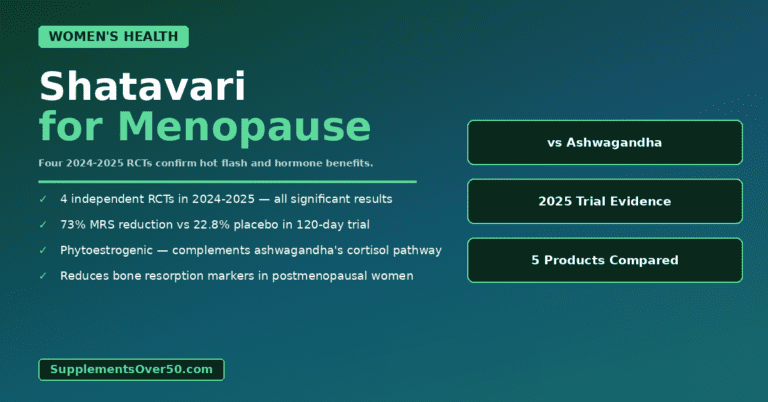
If vitex is on your shortlist, the National Center for Complementary and Integrative Health has a plain-language chasteberry overview covering what is known about its safety and side effects. For related reading on this site, see shatavari for menopause and our best menopause supplement for women over 50 guide for the stage that comes after perimenopause.
What to Look For in Perimenopause Supplements
For early perimenopause with estrogen dominance, DIM (diindolylmethane) is the most researched ingredient. It’s derived from cruciferous vegetables and influences how the liver breaks down estrogen, shifting the balance toward less potent, safer estrogen metabolites. Calcium d-glucarate supports the same process through glucuronidation — a different metabolic pathway that also reduces estrogen recirculation.
Vitex agnus-castus (chasteberry) works on the pituitary gland’s signaling to influence LH and FSH production, which can help smooth out the hormonal volatility of perimenopause. It has the most traditional use for cycle irregularities and PMS, and while the clinical evidence is moderate, it’s one of the better-studied herbal options for cycle support.
Magnesium is genuinely underrated in this context. Most women are below optimal magnesium intake, and magnesium deficiency directly affects both mood stability and sleep quality — two areas where perimenopause already creates problems. The glycinate form is the most bioavailable and has the least laxative effect, making it practical for daily use.
A complete multivitamin designed for women over 40 provides the B vitamins essential for neurotransmitter support (B6 for serotonin and dopamine), energy production (B12), and bone maintenance (D3 and K2). This foundation layer supports everything else you’re doing.
Quick Comparison
Product
Best for
Key ingredients
Thorne Hormone Advantage
Best overall for perimenopause
Calcium d-glucarate, DIM, flaxseed lignans
NOW Foods DIM 200mg
Best DIM supplement
200mg DIM from broccoli
Garden of Life mykind Organics Women’s Multi 40+
Best whole food multi
Certified organic, iron-free, B6 and B12
Pure Encapsulations Magnesium Glycinate
Best magnesium for perimenopause anxiety
Hypoallergenic magnesium glycinate
Vitex Chasteberry by Nature’s Way
Best vitex for hormonal balance
400mg vitex agnus-castus per capsule
Top Picks for the Best Perimenopause Supplement for Women
Thorne Hormone Advantage
Thorne Hormone Advantage is a well-designed option for women whose perimenopause symptoms point toward estrogen metabolism. It combines DIM with sulforaphane glucosinolate (SGS) and pomegranate extract to support the body’s normal processing of estrogen. Thorne runs four rounds of testing on its products, from raw materials to finished formulas.
The formula targets estrogen metabolism rather than individual symptoms, which makes it a longer-term choice rather than quick relief. Thorne also markets it for men, so check with your doctor that it fits your situation, especially if you take hormone therapy.
🏆 Best Perimenopause Supplement Overall
Thorne Hormone Advantage
DIM, sulforaphane glucosinolate (SGS) and pomegranate extract to support healthy estrogen metabolism
NOW Foods DIM is the most cost-effective way to get a clinically relevant DIM dose (200mg per capsule) without the additional ingredients in full perimenopause complexes. NOW uses a standardized broccoli-derived DIM with enhanced bioavailability — plain DIM from food doesn’t absorb well, so the formulation method matters here.
This is the right choice for women who want to address the estrogen dominance piece specifically without paying for additional ingredients they may not need, or who want to add DIM to an existing supplement stack without doubling up on ingredients. The 12,000+ reviews indicate widespread use and consistent satisfaction. Start at one capsule and assess how your body responds before adding more.
⚡ Best DIM Supplement for Perimenopause
NOW Foods DIM 200mg
200mg DIM (diindolylmethane) from broccoli, supports healthy estrogen metabolism, reduces estrogen dominance symptoms
Garden of Life mykind Women’s Multi 40+ covers the nutritional baseline that perimenopause demands. The iron-free formulation is appropriate for women whose periods are becoming irregular — iron excess is more of a concern than deficiency at this stage for many women. The whole food certification and organic sourcing mean bioavailability is generally higher than synthetic equivalent doses.
The B6 content is particularly relevant for perimenopause — it supports production of serotonin and dopamine, the neurotransmitters most disrupted by hormonal fluctuation. Think of this as the non-negotiable baseline that makes other supplements work more effectively. Almost every practitioner working with perimenopausal women would put a quality multivitamin at the top of the list regardless of what else is prescribed.
🔬 Best Whole Food Multi for Perimenopause
Garden of Life mykind Organics Women’s Multi 40+
Certified organic, iron-free after 40, B6 for mood, B12 for energy, D3 for bone, complete perimenopause nutrient base
Pure Encapsulations Magnesium Glycinate is the reference standard in magnesium supplementation for clinically sensitive applications. The hypoallergenic formulation (no fillers, binders, or artificial ingredients) means it works even for women with multiple sensitivities. The glycinate form is gentle on digestion, absorbs well, and has direct effects on GABA receptors — which is why it helps with both anxiety and sleep.
Taking 300-400mg of magnesium glycinate in the evening addresses two of perimenopause’s most disruptive symptoms simultaneously: the low-grade anxiety that shows up during hormonal fluctuation and the sleep disruption that compounds every other symptom. This isn’t a dramatic intervention — it’s the kind of targeted nutritional support that removes an obstacle to your body managing its own transition.
🌿 Best Magnesium for Perimenopause Anxiety
Pure Encapsulations Magnesium Glycinate
Hypoallergenic magnesium glycinate for perimenopause anxiety, poor sleep, and muscle tension without laxative effects
Nature’s Way Vitex has been the go-to chasteberry supplement for decades, and the 400mg dose per capsule aligns with what traditional herbal medicine and more modern research both support. Vitex takes time — expect three to six months before assessing its effects on cycle regularity and PMS severity. It works upstream on the pituitary rather than directly on hormones.
The price point makes it accessible as a long-term trial. Women who respond well to vitex often notice it during the second month of use, with the most pronounced effects on PMS-type symptoms (breast tenderness, irritability, bloating) rather than on hot flashes specifically. It’s not the right tool for late perimenopause with declining estrogen, but in early perimenopause with estrogen dominance, it’s one of the most rational herbal choices.
💰 Best Vitex for Hormonal Balance
Vitex Chasteberry by Nature’s Way
400mg vitex agnus-castus per capsule, supports LH/FSH hormonal balance, traditionally used for irregular cycles in perimenopause
How to Choose the Best Perimenopause Supplement for Women
If your primary symptoms are estrogen-dominance related (heavy periods, breast tenderness, bloating, mood swings), start with Thorne Hormone Advantage or standalone DIM. If anxiety and sleep disruption are your main complaints, magnesium glycinate is the highest-value addition you can make. Cycle support concerns lean toward vitex. Everyone in perimenopause benefits from a solid multivitamin foundation.
Don’t try to address everything at once. Start with the most disruptive symptom, introduce one supplement at a time over four to six weeks, and track what changes. Perimenopause can last years — building a sustainable, evidence-based regimen now is more valuable than experimenting with everything simultaneously.
Frequently Asked Questions
How do I know if I’m in perimenopause?
The defining feature of perimenopause is irregular periods — cycles that were previously like clockwork start varying in length, skipping, or becoming heavier or lighter. Other common signs include new or worsening PMS, sleep disruption, mood changes, and the first occasional hot flash. Perimenopause typically begins in the mid-40s but can start earlier. A blood test measuring FSH (follicle-stimulating hormone) can indicate where you are in the transition, but hormone levels fluctuate so much during perimenopause that a single test isn’t always diagnostic.
Can supplements help with irregular periods during perimenopause?
Vitex (chasteberry) has the most traditional use for cycle irregularities and some clinical support for its effects on LH/FSH balance. DIM supports estrogen metabolism but doesn’t directly regulate cycle timing. No supplement will produce the same effect as hormonal contraception for cycle regulation, and if your irregular periods are severe or accompanied by heavy bleeding, that warrants medical evaluation rather than supplement management.
What’s the difference between DIM and black cohosh?
DIM (diindolylmethane) is a cruciferous vegetable compound that influences how your liver metabolizes estrogen — it helps push estrogen toward less potent, safer metabolites and can reduce estrogen dominance symptoms. Black cohosh acts on serotonin receptors in the brain to reduce hot flash frequency and intensity. They work through entirely different mechanisms and are sometimes used together in comprehensive perimenopause formulas. DIM is generally considered appropriate for earlier perimenopause when estrogen is high and fluctuating; black cohosh becomes more relevant as estrogen declines.
Is it safe to take perimenopause supplements long-term?
For most well-formulated supplements in this category, moderate long-term use appears safe. Magnesium glycinate, multivitamins, and DIM at standard doses are generally well-tolerated for years. Vitex is typically recommended in cycles of three to six months rather than indefinitely. Black cohosh has a good safety record up to six months in most research, though some women use it longer. Always review your supplement regimen annually with your doctor as your hormonal status evolves. Whether a label says perimenopause or you see them sold as peri menopause supplements, the same rule applies: judge each perimenopause supplement by its ingredients and doses, not its name.
What symptoms respond best to supplements during perimenopause?
Mood instability, sleep disruption, and anxiety often respond well to magnesium glycinate and adaptogenic herbs. Estrogen dominance symptoms — bloating, breast tenderness, heavy periods — may improve with DIM and calcium d-glucarate. Hot flashes that begin in perimenopause can respond to black cohosh or pollen extract. Cycle irregularities are the hardest to influence with supplements, though vitex may help some women. If your symptoms are significantly impacting quality of life, hormonal contraception or low-dose HRT is often the more effective solution — supplements work best for mild-to-moderate symptom management.
Perimenopause is a genuine physiological transition, and the symptoms are not in your head. The supplements above represent the most rational approaches available without a prescription, targeted to what’s actually happening hormonally during this phase. Work with your doctor, track your symptoms honestly, and don’t underestimate how much lifestyle factors — sleep hygiene, stress management, protein intake — amplify or dampen what any supplement can do.
Looking for the best magnesium for women over 50? Compare 5 top picks for sleep, cramps, mood and bone support, plus the dose limit to know after menopause.
Urolithin A activates mitophagy to clear damaged mitochondria — but only Mitopure has clinical trial data. We break down the science, dosing, and whether it’s worth $80/month for seniors over 60.