Skincare for Menopausal Skin: What Changes and the Best Products to Use
This guide contains affiliate links. If you buy through them, we may earn a small commission at no extra cost to you.
If your skin suddenly feels tight after every shower, stings when you try a product you have used for years, or looks looser around the jaw, menopause is a likely part of the story. Good skincare for menopausal skin is less about buying a cabinet of new jars and more about a short, gentle routine that answers what has actually changed: drier skin, thinner skin, faster collagen loss and a barrier that is easier to upset.
Below we explain those changes using guidance from the American Academy of Dermatology (AAD) and MedlinePlus, then walk through a five-step routine and the products we would use for each step. Every product is sold on Amazon by the brand or by Amazon itself, every product detail comes from its listing, and any study numbers are the brands’ own. Results are cosmetic: skin that feels more comfortable and looks smoother, plumper and more even.
Table of Contents
Skincare for Menopausal Skin: Quick Comparison
| Routine step | Product | Best for | Key details (per listing) |
|---|---|---|---|
| 2. Hydrating serum | The INKEY List Hyaluronic Acid Serum | Best hydrating serum | 2% multi-molecular hyaluronic acid; fragrance-free; AM and PM |
| 3. Moisturizer | Kiehl’s Ultra Facial Cream | Best daily moisturizer (top pick) | 4.5% squalane, pro-ceramides; fragrance-free; morning and night |
| 4. Sunscreen (AM) | EltaMD UV Daily Broad-Spectrum SPF 40 | Best daily sunscreen | Transparent zinc oxide plus hyaluronic acid; fragrance-free |
| 5. Night and dry patches | First Aid Beauty Ultra Repair Cream | Best for very dry, sensitive skin | Colloidal oatmeal and ceramides; face and body; fragrance-free |
| 3. Moisturizer upgrade | Lancôme Rénergie H.P.N. 300-Peptide Cream | Best firming upgrade | 300 peptides, hyaluronic acid, niacinamide; morning cream |
Step 1 is a mild cleanser. You probably already own one that works, so we cover what to look for in the routine section rather than adding another product.
What Changes in Menopausal Skin After 50
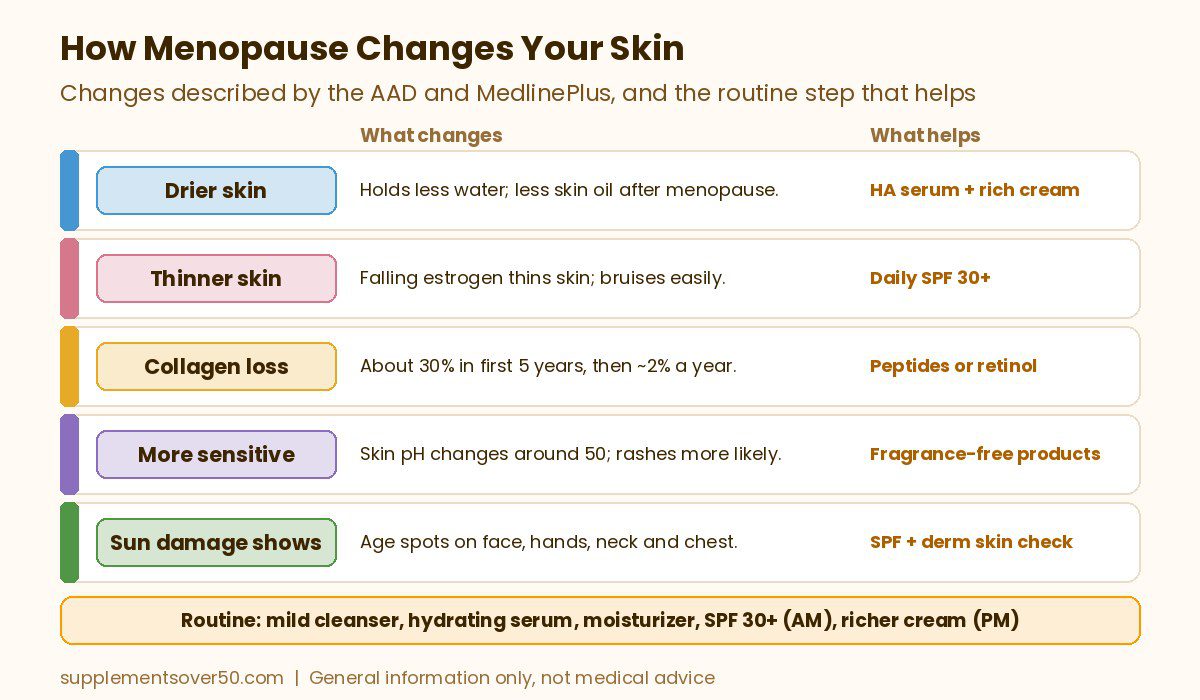
The American Academy of Dermatology explains that menopause officially begins one year after your last period, and that as hormone levels plummet, skin can become dry, slack and thin. Here is what that looks like day to day, and why each change matters for the products you choose.
Popular Supplement Guides:
Drier skin. In menopause, skin loses some of its ability to hold water, so it can get quite dry, especially when the air is dry. MedlinePlus adds that women gradually produce less skin oil after menopause, which makes it harder to keep skin moist and can leave it dry and itchy. This is the change most women feel first, and it is the easiest one to help with a good serum and cream.
Thinner skin that bruises more easily. As estrogen levels fall, skin becomes thinner, and the AAD notes thin skin bruises more easily. MedlinePlus also says the outer layer of skin thins with age and the blood vessels in the deeper layer become more fragile. Daily sunscreen cannot thicken skin, but the AAD says it can help prevent further thinning.
Faster collagen loss. This one surprises a lot of women. The AAD says studies show women’s skin loses about 30% of its collagen during the first five years of menopause, then about 2% a year for the next 20 years. As collagen drops, skin loses firmness and begins to sag, jowls appear, lines from the nose to the mouth deepen, and wrinkles that once showed only when you smiled stay visible. The AAD suggests sun protection plus a skin care product with retinol or peptides, which it says can increase collagen in your skin.
More sensitive, easily irritated skin. Around 50, the pH of skin changes, according to the AAD, and skin becomes more sensitive and more prone to rashes. Existing conditions such as eczema or rosacea can flare. The AAD’s simple fix is a fragrance-free moisturizer, which is why every pick on our list is fragrance-free.
Sun damage that finally shows. If you spent years in the sun without protection, the AAD says age spots and larger dark patches can now appear on the face, hands, neck, arms and chest, and skin cancer and precancerous growths also become more common. MedlinePlus calls sun exposure the greatest single factor in skin aging.
Adult acne and slower healing. Some women develop breakouts as hormones drop, and the AAD warns that harsh teenage acne treatments are often too drying for thinner, drier skin. Skin also takes longer to heal as hormone levels fall, so scratches and irritated patches can linger.
Hair changes too: the AAD mentions more hair on the chin and upper lip and thinning on the scalp. That is outside a skincare routine, but our guide to hair thinning after 50 covers the scalp side.
Can Skincare Really Help Menopausal Skin?
Yes, within limits. The AAD’s tips for anti-aging products say moisturizer traps water in your skin, which can reduce the look of fine lines and brighten your complexion, and that a moisturizer can plump up fine lines in a few days. That is the quick win for dry menopausal skin. For firmness and wrinkles, the AAD says most products take at least six weeks to work and sometimes up to three months, and it is clear that creams, gels and lotions cannot reduce all signs of aging skin.
So set your expectations around comfort and appearance. A steady routine can make skin feel less tight and itchy, look smoother and more even, and stay better protected from the sun that drives so much visible aging. It will not replace collagen already lost or reverse deep sagging. If those are your main concerns, or if dryness does not improve, a board-certified dermatologist can talk through options the AAD mentions, such as retinoid creams, lasers or exfoliation treatments, which it advises against trying at home on thinner skin.
A Simple Skincare Routine for Menopausal Skin
You do not need ten steps. The AAD actually warns that using several anti-aging products at once can irritate skin, and irritated skin looks older. This five-step routine covers what menopausal skin needs most:
- Step 1: Cleanse gently. The AAD recommends a mild cleanser instead of soap, since soap can be too drying for mature skin, and says to skip deodorant bars. MedlinePlus also advises against strongly detergent or heavily perfumed soaps. A creamy, fragrance-free facial cleanser is ideal. If you are breaking out, the AAD suggests a cleanser with salicylic acid.
- Step 2: Hydrating serum. The AAD says a moisturizer with hyaluronic acid or glycerin can be especially helpful for menopausal dryness. A hyaluronic acid serum on damp skin is an easy way to add that.
- Step 3: Moisturizer. Apply it after bathing and whenever skin feels dry during the day, as the AAD suggests. Fragrance-free is the safest choice for skin that is newly sensitive.
- Step 4: Sunscreen every morning. Broad-spectrum SPF 30 or higher on all skin clothing will not cover, every day, even in winter. This is the AAD’s number one tip for age spots, thinning and wrinkles.
- Step 5: Night care. At night, skip sunscreen and use a richer layer of moisturizer on dry areas. If firmness is your goal, this is where a peptide or retinol product can come in later, one new product at a time.
What to Look for in Skincare for Menopausal Skin
- Humectants. Hyaluronic acid and glycerin pull water into the skin, which the AAD singles out for menopausal dryness.
- Barrier helpers. Ceramides, squalane and colloidal oatmeal help skin hold on to moisture and feel calmer.
- Fragrance-free formulas. Skin is more reactive around 50, and the AAD recommends a fragrance-free moisturizer to reduce irritation.
- Broad-spectrum SPF 30 or higher. Non-negotiable in the morning, on your face, neck and hands.
- Peptides or retinol for firmness. The AAD names both as ingredients that can increase collagen. Add one only after your basic routine feels comfortable.
- Gentle, not harsh. Skip gritty scrubs and drying acne products. Thinner skin is easier to irritate and slower to heal.
Top Picks for Skincare for Menopausal Skin
1. Kiehl’s Ultra Facial Cream (Best Daily Moisturizer)
Kiehl’s Ultra Facial Cream is our top pick because it handles the biggest menopause complaint, dryness, without heaviness or fragrance. The listing describes a lightweight daily face cream for dry, dull, tired-looking skin that hydrates and helps strengthen the moisture barrier. It pairs 4.5% squalane, a plant-derived lipid that keeps skin soft, with Glacial Glycoprotein to help maintain moisture balance and Pro-Ceramides to reinforce the barrier.
Kiehl’s says it gives 72-hour hydration in an instrumental study, and in a study of 21 people, 85% showed improvement in visible redness 24 hours after use. It is made for dry, very dry, normal and sensitive skin, is fragrance-free and paraben-free, and carries the National Eczema Association Seal of Acceptance. Most usefully for a simple routine, Kiehl’s says one cream works morning and night, and suggests a thin second layer on extra-dry areas in winter. It has a 4.6 rating from more than 8,400 reviewers, and it is sold by Kiehl’s and shipped by Amazon.
2. The INKEY List Hyaluronic Acid Serum (Best Hydrating Serum)
If your skin feels tight within an hour of washing, a hyaluronic acid serum is the simplest step to add, and The INKEY List version is a well-reviewed, low-fuss choice. The listing calls it the brand’s number one bestseller and says its 2% multi-molecular hyaluronic acid acts like a sponge, attracting water and holding on to it, so skin feels plump, smooth and hydrated. It is fragrance-free, cruelty-free and described as non-sticky.
INKEY suggests it as the first step after cleansing, morning and night: apply a pea-sized amount to face and neck, follow with moisturizer, and finish with SPF in the morning. The brand also notes that applying it to damp skin helps lock in moisture, which lines up nicely with the AAD’s advice to moisturize after bathing. It has a 4.4 rating from more than 8,800 reviewers, 2,000+ bought in the past month, and it is shipped and sold by Amazon.
3. EltaMD UV Daily Broad-Spectrum SPF 40 (Best Daily Sunscreen)
Sunscreen is the step the AAD comes back to again and again for menopausal skin, so it gets a dedicated pick. EltaMD UV Daily is a moisturizing face sunscreen rather than a dry, chalky one, which suits skin that is already short on moisture. The listing says it uses transparent zinc oxide for broad-spectrum SPF 40 protection without leaving a white cast, and it adds hyaluronic acid to help skin keep moisture and look more supple.
It is fragrance-free, paraben-free and non-comedogenic, can be worn alone or under makeup, and comes in tinted and untinted versions (the listing describes this one as ideal for lighter skin tones). Use it as the last step of your morning routine after moisturizer. The listing does not claim water resistance, so for swimming or a long, sweaty day outside, reach for a water-resistant formula and reapply. It has a 4.7 rating from more than 19,000 reviewers, and it is shipped and sold by Amazon.
4. First Aid Beauty Ultra Repair Cream (Best for Very Dry, Sensitive Skin)
First Aid Beauty Ultra Repair Cream is the one to reach for when your skin is rough, flaky or reactive. The listing describes a fast-absorbing, whipped cream for sensitive and dry skin, with colloidal oatmeal and ceramides to strengthen the skin barrier and support dry, irritated and eczema-prone skin. It is free of fragrance, parabens, sulfates and mineral oil, and it is labeled for both face and body.
FAB says clinical testing showed it boosts hydration by 169% and restores the skin’s moisture barrier. Because it works on the body too, it doubles as the cream for dry shins, hands and elbows, which MedlinePlus notes can get itchy as skin oil drops. We like it as a richer night layer over your serum, or for nights when your face feels irritated and you want to keep things very simple. It has a 4.6 rating from more than 19,000 reviewers, and it is shipped and sold by Amazon.
5. Lancôme Rénergie H.P.N. 300-Peptide Cream (Best Firming Upgrade)
Once your skin feels comfortable, firmness is usually the next concern, and the AAD names peptides as one of the ingredients that can increase collagen. Lancôme Rénergie H.P.N. 300-Peptide Cream is a luxury morning moisturizer built around that idea. The listing says it combines more than 300 peptides to help elasticity, hyaluronic acid to smooth and replump rough skin, and niacinamide to soothe and even out tone. It is tested for tolerance and described as safe for all skin types.
Lancôme quotes an 8-week clinical study in which women saw a 27% reduction in lower-face sagging, 38% improved firmness and 22% less visible dark spots, and the brand says visible results can show in as little as two weeks. Those are the brand’s own figures, so treat them as a guide. Lancôme recommends it as part of your morning routine after cleansing, so it can replace Kiehl’s in the morning if you want one cream that does more. It has a 4.6 rating from more than 1,100 reviewers, and it is sold by Lancôme and shipped by Amazon.
How to Choose Skincare for Menopausal Skin
- If you want one product to start with, pick Kiehl’s Ultra Facial Cream and use it morning and night.
- If your skin feels tight even after moisturizer, add The INKEY List Hyaluronic Acid Serum on damp skin underneath.
- If you are not wearing sunscreen every day, start there with EltaMD UV Daily. It is the step the AAD says helps age spots, thinning and wrinkles.
- If your skin is flaky, itchy or newly reactive, pick First Aid Beauty Ultra Repair Cream, and use it on your body too.
- If firmness and sagging bother you most, try Lancôme Rénergie H.P.N. 300-Peptide as your morning cream.
- If you are building from scratch, add one product every couple of weeks, so you know what is working and what is not.
Menopause changes more than skin. Our best menopause supplement for women over 50 guide covers hot flashes, sleep and mood, and if you are earlier in the transition, see the best perimenopause supplement for women. For skin from the inside, read our picks for the best collagen supplement for skin over 50.
Before You Buy: Patch Test and When to See a Dermatologist
These tips come from the AAD’s tips for anti-aging products, the AAD’s menopause skin care guide and the product listings:
- Patch test every new product. Even hypoallergenic products can cause a reaction. Apply a little to your inner forearm twice a day for four to five days. If there is no redness or itching, use it on your face.
- Add one product at a time. Several new products at once can irritate skin and make it hard to tell which one is the problem.
- Stop anything that stings, burns or tingles. With over-the-counter skincare, that means it is irritating your skin.
- Give it six weeks. Moisture shows up in days, but most anti-aging results take at least six weeks and sometimes three months.
- Get a skin cancer screening. The AAD says skin cancer risk rises with age and recommends a dermatologist exam and regular self-checks.
- Do not self-treat dark spots. The AAD warns that skin cancer can look like an age spot, so see a dermatologist before buying any spot treatment.
See a dermatologist if your skin stays dry despite a good routine, if a rash lasts or eczema or rosacea gets worse, if acne will not settle, or if you notice a new or changing spot or a sore that will not heal. The AAD notes that wounds heal more slowly in menopause and that infections become more of a risk.
- Best Moisturizers for Dry Mature Skin
- Best Anti-Aging Serums for Women Over 50
- Collagen Supplements vs Topical Collagen: What Works Better After 50?
Frequently Asked Questions
What is the best skincare for menopausal skin?
A short, gentle routine works best: a mild cleanser, a hyaluronic acid serum, a fragrance-free moisturizer such as Kiehl’s Ultra Facial Cream, and broad-spectrum SPF 30 or higher every morning. Add peptides or retinol for firmness once your skin feels comfortable.
Why is my skin so dry during menopause?
The American Academy of Dermatology says skin loses some of its ability to hold water in menopause, and MedlinePlus notes women make less skin oil after menopause. A moisturizer with hyaluronic acid or glycerin, applied after bathing, can help.
Does menopause make your skin sag?
It can. The AAD says women’s skin loses about 30% of its collagen in the first five years of menopause, then about 2% a year. Daily sunscreen and products with retinol or peptides may help skin look firmer, but creams cannot reverse deep sagging.
Why has my skin become so sensitive after 50?
The AAD says the pH of skin changes around 50, making it more sensitive and prone to rashes, and eczema or rosacea can flare. Switch to fragrance-free products, add one new product at a time and patch test first.
Should I change my skincare routine during menopause?
Usually, yes. Swap soap for a mild cleanser, choose richer fragrance-free moisturizers, add a hydrating serum, and make daily sunscreen non-negotiable. Skip harsh scrubs and drying acne products, which thinner skin tolerates poorly.
How long before I see results from a new routine?
Moisturizer can plump fine lines in a few days, according to the AAD, but most anti-aging products take at least six weeks to work, and sometimes up to three months. Stick with one change long enough to judge it.
Our Take
The best skincare for menopausal skin is a routine you will actually keep: cleanse gently, hydrate, moisturize, and wear sunscreen every single morning. If you buy only one thing, make it Kiehl’s Ultra Facial Cream, a fragrance-free cream that covers morning and night. Add The INKEY List Hyaluronic Acid Serum for extra hydration, EltaMD UV Daily for sun protection, First Aid Beauty Ultra Repair Cream for rough or reactive patches, and Lancôme Rénergie when you are ready to focus on firmness. Patch test, go one product at a time, and give each change six weeks.
This article is for general information only and is not medical advice. Skincare results vary. See a doctor or dermatologist about persistent dryness, rashes, acne, or any new or changing spot on your skin.