Calcium and Vitamin D After the New BMJ Review: What Women Over 50 Should Do Now
This guide contains affiliate links. If you buy through them, we may earn a small commission at no extra cost to you.
If you have been taking calcium and vitamin d for women over 50 because you were told it protects your bones, a new study may have caught your attention. A major review in The BMJ concluded that these supplements, on their own, do very little to prevent broken bones or falls in most adults. Headlines ran with it, and plenty of women are now wondering whether to throw out the bottle.
The real answer is more useful than the headline. Calcium and vitamin D still matter after menopause. What the research questions is the habit of taking a pill “just in case” when your diet already covers you. Below we break down what the review found, who was studied, who may still need a supplement, and a simple plan you can follow this week.
Table of Contents
Why Calcium and Vitamin D Needs Change After 50
Bone is living tissue that is constantly broken down and rebuilt. Estrogen helps keep that process in balance, so when it falls at menopause, bone loss speeds up. Over time that can lead to osteoporosis and a higher chance of fractures, especially of the hip, spine and wrist.
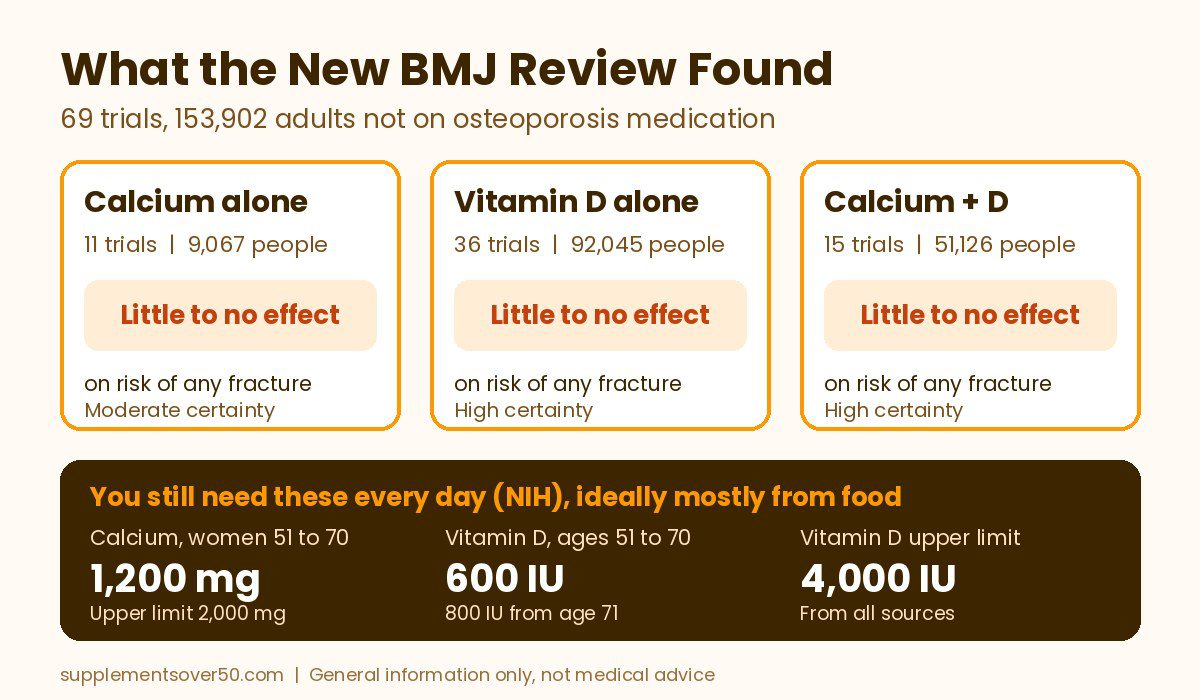
That is why recommended intakes rise for women in this age group. According to the NIH Office of Dietary Supplements calcium fact sheet, women aged 51 to 70 need 1,200 mg of calcium a day, compared with 1,000 mg for men of the same age. The upper limit for adults 51 and older is 2,000 mg a day from all sources combined, food and supplements included. The same fact sheet lists postmenopausal women among the groups most likely to fall short.
Popular Supplement Guides:

Vitamin D matters because it helps your body absorb calcium. The NIH vitamin D fact sheet sets the recommended amount at 15 mcg (600 IU) a day up to age 70 and 20 mcg (800 IU) from age 71, with an upper limit of 100 mcg (4,000 IU) for adults. It also notes that the skin makes less vitamin D from sunlight as we age, which is one reason older adults are more likely to run low.
What the New BMJ Review Found
The systematic review and meta-analysis published in The BMJ on May 20, 2026 pooled 69 randomized controlled trials with 153,902 participants. Researchers compared calcium, vitamin D, or the two combined against a placebo or no treatment in adults who were not receiving drug treatment for osteoporosis. The main question was simple: did supplements lower the risk of any fracture? They also looked at hip, spine and other fractures, the chance of falling, and the total number of falls.
Here is the headline result for any fracture, by type of supplement:
| Supplement type | Trials | Participants | Effect on any fracture | Certainty of evidence |
|---|---|---|---|---|
| Calcium alone | 11 | 9,067 | Little to no effect | Moderate |
| Vitamin D alone | 36 | 92,045 | Little to no effect | High |
| Calcium plus vitamin D | 15 | 51,126 | Little to no effect | High |
The other outcomes, including hip fractures and falls, told a similar story, mostly based on moderate to high certainty evidence. The authors also say their findings held up across many subgroup analyses. Their overall conclusion was that, judged by absolute risk reductions and thresholds considered clinically meaningful, the supplements offered little to no benefit for preventing fractures and falls.
One nuance is worth knowing. The combined calcium and vitamin D result showed a small reduction on paper, but the authors judged the real-world size of that effect too small to count as meaningful. In plain terms, any benefit for an average person was tiny.
Who Was Studied, and Who Was Not
This is the part most news stories skipped. In most of the trials (87%), participants lived in the community rather than in care homes, and in 73% of trials they were not at high risk of fractures or falls. The authors note that evidence was limited for high risk patients and for people in residential care, particularly for calcium alone and for the combination. People already being treated with osteoporosis medication were excluded.
So the review is strongest for one group: generally healthy, independent adults taking supplements for prevention. It says much less about frail older adults, people living in nursing homes, women with diagnosed osteoporosis, or anyone with a confirmed deficiency.
Who May Still Need Calcium and Vitamin D After 50
A supplement still makes sense for some women. The key is having a reason, not a reflex. You may still benefit if any of these apply to you:
- Your diet is low in calcium. If you avoid dairy, eat little fortified food, or follow a restrictive diet, you may be well short of 1,200 mg a day. The NIH lists people who avoid dairy as a group at risk of inadequacy.
- You have a diagnosed vitamin D deficiency. A blood test showing low levels is a clear reason to supplement, at the dose your clinician recommends.
- You are on an osteoporosis treatment plan. Doctors often pair bone medications with calcium and vitamin D to make sure the body has the raw materials it needs. Those women were not part of this review, so do not change that plan on your own.
- You get little sun. If you rarely go outside or keep your skin covered, your body makes less vitamin D.
- You live in care or are at high fall risk. The review had limited evidence for these groups, so a doctor’s judgment matters more than any headline.
If none of those describe you and you already eat calcium-rich foods most days, the review suggests an extra pill is unlikely to add much protection.
Food First: How to Get Enough Without a Pill
The NIH notes that milk, yogurt and cheese are rich sources of calcium, and that kale, broccoli, Chinese cabbage, and canned sardines and salmon with the bones also contribute. Many juices, plant milks, tofu and cereals are fortified. Very few foods are naturally high in vitamin D, so fortified foods supply most of it in the US diet. Check the Nutrition Facts label, which lists calcium and vitamin D.
A quick way to check yourself: write down a normal day of eating, then add up the calcium from labels. Many women find they are closer to 1,200 mg than they thought. Others find a real gap, and that is where a modest supplement can help. Food also brings protein and other nutrients that bones need, which is part of why many experts prefer the food-first approach.
Remember that bones respond to more than nutrients. Weight-bearing exercise, strength training, balance work, not smoking and limiting alcohol all support bone health and lower fall risk.
What to Look for in Calcium and Vitamin D for Women Over 50
If you decide to fill a gap with a supplement, these points matter more than the brand name:
- A dose that fits your gap. Supplement only the difference between your food intake and 1,200 mg. More is not better, and you should stay under the 2,000 mg daily upper limit from all sources.
- Split doses. The NIH says calcium is absorbed best in amounts of 500 mg or less at one time, so two smaller doses beat one large one.
- The right form. Calcium carbonate absorbs best with food. Calcium citrate absorbs well with or without food and is easier to absorb for people with low stomach acid, which is more common with age. Our guide to Calcium Citrate vs Calcium Carbonate for Women Over 60 goes deeper.
- Sensible vitamin D. A combined product should keep you comfortably below the 4,000 IU upper limit, counting any separate vitamin D or multivitamin you take.
- Independent quality checks. A USP Verified mark means an outside group has checked ingredients and potency.
- Your other medications. The NIH notes calcium can interact with several drugs, including levothyroxine. Ask your pharmacist about timing.
Calcium and Vitamin D for Women Over 50: Quick Comparison
| Product | Best for | Key details | Daily dose |
|---|---|---|---|
| Nature Made Calcium 600 mg with Vitamin D3 | A simple, USP Verified top-up | Calcium carbonate plus D3, gluten free, no added color or artificial flavors | 1 tablet, 1 to 2 times daily with a meal |
| Caltrate 600 Plus D3 | Flexible one or two tablet dosing | 600 mg calcium and 20 mcg (800 IU) D3 per tablet | 1 to 2 tablets daily |
Top Picks If You Still Need a Calcium Supplement for Women Over 50
We kept this list short on purpose. For most women the first step is food, not a product. These two options suit women whose diets genuinely fall short, and both are well established, widely reviewed choices on Amazon.
1. Nature Made Calcium 600 mg with Vitamin D3 (Best Simple Top-Up)
Nature Made’s formula pairs calcium carbonate with vitamin D3, and the brand positions it for adults whose diet is low in calcium, which is exactly the situation where a supplement still makes sense. It carries the USP Verified mark, meaning USP has checked the ingredients, potency and manufacturing process. It is gluten free with no added color or artificial flavors.
Because it is calcium carbonate, take it with water and a meal for best absorption. The label suggests one tablet once or twice daily, so if you only need a few hundred extra milligrams, one tablet a day may be enough. Check the label for the exact vitamin D amount before adding any other vitamin D product.
2. Caltrate 600 Plus D3 (Best for Flexible Dosing)
Caltrate 600 Plus D3 gives you 600 mg of calcium and 20 mcg of vitamin D3 per tablet, which is 800 IU. The brand says it has the highest level of vitamin D3 per tablet among leading calcium brands, and it is designed to support bone health along with everyday functions like muscle contraction and nerve signaling.
The directions allow one or two tablets daily, so you can match the dose to your food gap. Two tablets would provide 1,600 IU of vitamin D, so count that against any separate vitamin D you take. If you split doses, take one with breakfast and one with dinner.
How to Choose: Calcium and Vitamin D for Women Over 50 After the New Review
- Healthy, eating dairy or fortified foods daily, no deficiency? You may not need a supplement at all. Focus on food and exercise.
- Diet falls short of 1,200 mg? Take a modest dose to fill the gap only, such as one 600 mg tablet with a meal.
- On acid reducers or have low stomach acid? Consider a calcium citrate product instead, and ask your pharmacist.
- Diagnosed vitamin D deficiency? Follow your clinician’s dose and retest as advised.
- Prescribed calcium and vitamin D with osteoporosis medication? Keep taking them as directed until you talk to your doctor.
For more detail on specific products and forms, see our guides to the Best Calcium Supplement for Women Over 60, Best Vitamin D3 + K2 for Women Over 60, and Signs of Vitamin D Deficiency in Seniors.
When to See a Doctor
Do not stop calcium, vitamin D or any bone medication your doctor prescribed because of a news story. Book a conversation instead, and bring your supplement bottles. It is worth asking about a bone density scan if you are postmenopausal and have never had one, and about a vitamin D blood test if you rarely get sun or have symptoms of deficiency.
See your doctor promptly if you have had a fracture from a minor fall, notice you are losing height or developing a stooped posture, have kidney stones or kidney disease, or take medications such as thyroid hormone that can interact with calcium. Very high supplement doses can cause problems, so tell your doctor about everything you take.
Frequently Asked Questions
Should I stop taking calcium and vitamin D after the new study?
Not without talking to your doctor, especially if they prescribed it. The review found little benefit for fracture prevention in mostly healthy adults who were not on osteoporosis treatment. If your diet is low in calcium, you have a diagnosed deficiency, or you are on a bone treatment plan, a supplement may still be appropriate.
How much calcium does a woman over 50 need?
The NIH recommends 1,200 mg a day for women aged 51 to 70 and for all adults 71 and older. The upper limit is 2,000 mg a day from food and supplements combined. Try to get most of it from food.
How much vitamin D should I take after 50?
The NIH recommended amount is 600 IU (15 mcg) a day up to age 70 and 800 IU (20 mcg) from age 71. The upper limit for adults is 4,000 IU a day. If you have a diagnosed deficiency, your clinician may recommend a different dose for a period of time.
Does the BMJ review apply to women with osteoporosis?
Not directly. The review excluded people receiving drug treatment for osteoporosis, and the authors said evidence was limited for high risk patients and people in residential care. If you have osteoporosis, follow your doctor’s plan.
Is it better to get calcium from food or supplements?
Food is the preferred first source. Dairy, fortified plant milks and juices, tofu, leafy greens like kale, and canned fish with bones all contribute. A supplement is a reasonable way to fill a gap if your diet falls short.
Can taking too much calcium be harmful?
Yes. Going over the upper limit, mostly from supplements, may raise the risk of kidney stones and can cause constipation or bloating. Calcium can also interact with some medications. Supplement only what you need to reach your daily target.
Our Take
The new BMJ review is a useful reality check, not a reason to panic. For most healthy women, taking calcium and vitamin D purely as fracture insurance is unlikely to help much on its own. The better plan is to count your food calcium, close any real gap with a modest dose, keep vitamin D within the recommended range, and put real effort into strength and balance training. If your doctor prescribed calcium and vitamin D, especially alongside osteoporosis treatment, keep taking them until you have talked it through. That is the practical approach to calcium and vitamin d for women over 50 today.
This article is for informational purposes only and is not medical advice. Talk to your doctor before starting or stopping any supplement, especially if you take prescription medications or have been diagnosed with osteoporosis.