Best NAD+ Supplement for Seniors: NMN vs NR Compared
NAD+ (nicotinamide adenine dinucleotide) declines by roughly 50% between your 40s and your 60s. It is not a minor biochemical footnote. NAD+ sits at the center of cellular energy production, DNA repair, and the sirtuin longevity pathways. When levels fall, mitochondria produce less ATP, cells repair DNA more slowly, and the molecular signaling that governs healthy aging loses its signal strength.
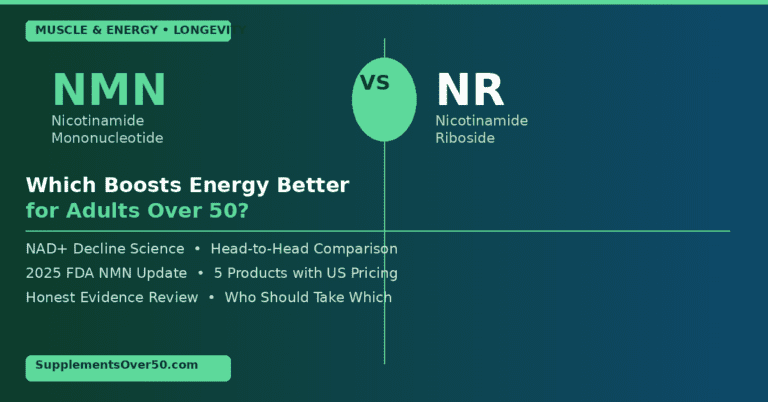
The question for seniors is not whether to support NAD+ levels — the research is compelling — but which precursor to use and at what dose. NMN (nicotinamide mononucleotide) and NR (nicotinamide riboside) are both converted to NAD+ in the body through different pathways. They are not interchangeable, and the marketing around both is aggressive enough to obscure the actual evidence.
This guide covers what the human clinical data actually shows, which products meet quality standards, the Best NAD+ Supplement for Seniors and how they should think about dosing and stacking.
Why NAD+ Declines Faster After 60
Three mechanisms drive the age-related NAD+ decline that accelerates in your 60s. First, the enzyme CD38 — which degrades NAD+ — becomes more active with age and chronic low-grade inflammation. Second, NAMPT, the rate-limiting enzyme in the NAD+ salvage pathway, decreases in expression. Third, DNA damage accumulates with age, and each repair event consumes NAD+ through PARP activation.
The result: muscle cells produce less ATP, neurons repair damage more slowly, and the SIRT1/SIRT3 deacetylases that regulate metabolic flexibility lose their NAD+ substrate. This is the molecular underpinning for the muscle fatigue, cognitive slowing, and metabolic shifts that feel like “just getting older” — but are partly addressable at the cellular level.
Popular Supplement Guides:


A 2023 study in Nature Aging confirmed that skeletal muscle NAD+ levels in adults over 65 were 57% lower than in adults under 40, and that this deficit correlated with grip strength, VO2 max, and insulin sensitivity — independent of lifestyle factors.
NMN vs NR: What the Evidence Actually Shows

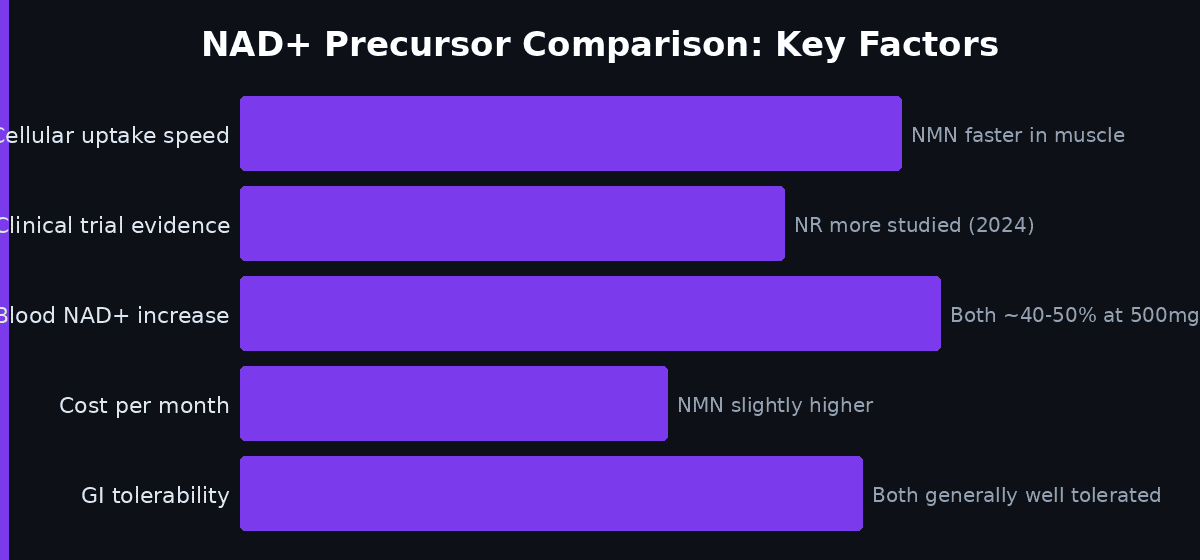
Both NMN and NR raise blood NAD+ levels. The question is where in the cell and tissue, and by how much, and what that translates to clinically.
NR (Nicotinamide Riboside)
NR has the longer human trial record. ChromaDex’s Tru Niagen (the branded NR used in most published trials) has been studied in at least 12 completed human RCTs. Key findings relevant to seniors: 300mg daily raised whole-blood NAD+ by 40-60% in adults over 60 in the CNAF trial. The CONIFER trial showed NR did not significantly improve skeletal muscle mitochondrial function in healthy older adults at 1g/day over 21 days — an important caveat that tempers some of the hype. However, a recent trial in adults with mild cognitive impairment (published in Aging Cell) showed NR at 500mg twice daily improved cerebral NAD+ and scored statistically significant improvements on two of four cognitive measures after 12 weeks.
NMN (Nicotinamide Mononucleotide)
NMN enters cells via a dedicated transporter (Slc12a8) expressed highly in the small intestine and muscle, which gives it a faster uptake profile in those tissues. The landmark 2022 trial by Imai et al. at Washington University showed that 250mg NMN daily over 10 weeks increased muscle NAD+ and improved walking speed and grip strength in postmenopausal women. A 2023 Japanese trial in adults over 65 found 500mg NMN daily improved self-reported energy and reduced fatigue scores at 12 weeks. The evidence base is still thinner than NR’s, but NMN has been catching up quickly since the FDA’s 2022 enforcement action (which removed some products from the market but solidified GMP compliance among remaining brands).
The Practical Difference for Seniors
For most seniors, the honest answer is that the clinical difference between a quality NR and a quality NMN product at equivalent NAD+-equivalent doses is probably small. The more important variables are dose, timing, and stacking. NR at 300-500mg/day is the more established choice for cognitive support and general NAD+ maintenance. NMN at 500mg/day is the better-supported choice if muscle function and physical energy are the primary goals.
Best NAD+ Supplements for Seniors: Top Picks Reviewed
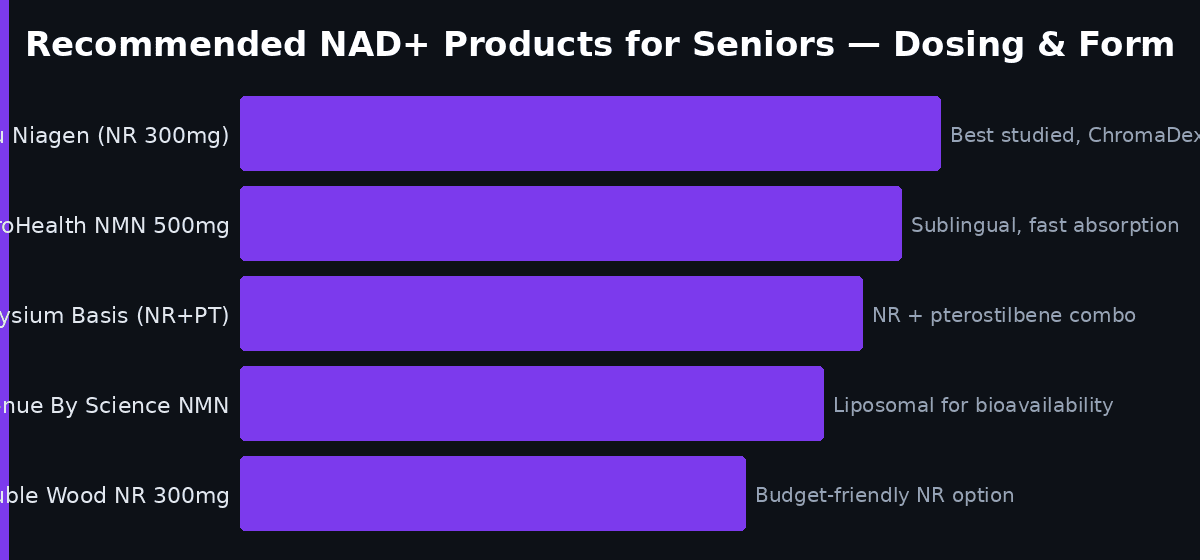
1. Tru Niagen (NR 300mg) — Best Overall for Proven Safety Record
Tru Niagen is ChromaDex’s branded nicotinamide riboside and the product used in the majority of published human NR trials. Every batch is tested by a third party, and the company publishes its clinical data openly. For seniors who want the most rigorously validated NAD+ precursor, this is the benchmark. The 300mg capsule raises blood NAD+ by approximately 40-60% in most adults — enough to see measurable metabolic and mitochondrial effects.
2. ProHealth Longevity NMN 500mg — Best NMN for Muscle Energy
ProHealth uses a sublingual delivery form for their 500mg NMN, bypassing first-pass intestinal metabolism for faster tissue uptake. They publish third-party COAs and have been operating in the longevity supplement space for over 30 years. The 500mg dose aligns with the Imai et al. trial dosing that showed muscle function improvements in older adults. If physical energy and muscle performance are the primary goals, this is the NMN to start with.
3. Elysium Basis — Best NR + Pterostilbene Stack
Elysium Basis combines NR (250mg) with pterostilbene (50mg) — a more bioavailable analog of resveratrol that activates SIRT1 alongside the NAD+ it requires. The rationale: sirtuins need both NAD+ as substrate and a SIRT activator to function optimally. Elysium’s founders include several prominent MIT longevity researchers, and the product has been through a published human trial showing sustained blood NAD+ increases. The 250mg NR dose is on the lower end; some users double up.
4. Renue By Science Lipo NMN — Best for Absorption Concerns
Renue By Science uses a liposomal encapsulation for their NMN, which protects the molecule from degradation in the gut and may improve cellular uptake. Their formulation has not been through a standalone RCT, but liposomal delivery is a validated approach for other poorly absorbed compounds and is likely to provide an advantage over standard NMN capsules for seniors with GI absorption changes. The 250mg sublingual powder form is particularly well-suited for seniors who have difficulty swallowing capsules.
5. Double Wood NR 300mg — Best Budget Option
Double Wood Supplements offers a clean NR 300mg product at roughly half the price of Tru Niagen. They publish third-party test results and have a strong track record of quality across their supplement line. For seniors on a fixed income or those wanting to test NAD+ supplementation before committing to a premium product, this is a reasonable starting point.
What to Expect: Realistic Timelines and Outcomes
NAD+ precursors are not stimulants. You will not feel a difference in week one. The clinical data shows meaningful changes at 6-12 weeks of consistent supplementation. The outcomes with the best evidence in seniors specifically are: improved mitochondrial function markers in muscle (measurable via bioenergetics, but not felt directly), modest improvements in physical performance in those starting with significant deficits, and in the MCI trial data, cognitive improvements that were real but modest.
What seniors commonly report after 8-12 weeks: less muscle fatigue during sustained activity, better recovery between exercise sessions, and improved energy consistency through the day (less afternoon crashes). These are subjective, but they align with the mechanistic picture — mitochondria producing ATP more efficiently, less cellular energy debt accumulating during the day.
Do not expect NAD+ supplementation to override a poor diet, sedentary lifestyle, or chronic sleep debt. It works at the margin of a sound foundation, not in place of one.
Dosing Guidelines for Seniors Over 60
| Precursor | Starting Dose | Target Dose | Timing |
|---|---|---|---|
| NR (nicotinamide riboside) | 300mg/day | 300-500mg/day | Morning with food |
| NMN (nicotinamide mononucleotide) | 250mg/day | 500mg/day | Morning, sublingual if available |
| Stacked (NR + pterostilbene) | Elysium Basis 1 cap/day | 2 caps/day | Morning with food |
One important note: niacin (vitamin B3) can interfere with NAD+ precursor supplementation when taken in high doses. If you take niacin for cholesterol management, discuss timing with your doctor — they should be separated by at least 4 hours. Standard multivitamin levels of niacin (18-20mg) are not a concern.
Drug Interactions and Safety Considerations
NAD+ precursors are generally well-tolerated in seniors. The most common side effects are mild GI discomfort and flushing with higher doses — both more likely with high-dose niacin than with NR or NMN at standard doses. Known interactions to discuss with your doctor:
- Chemotherapy drugs: Some DNA-damaging chemotherapy agents work partly by depleting cancer cell NAD+. Consult your oncologist before supplementing during or within 6 months of treatment.
- High-dose niacin: Competing B3 pathway; separate by 4 hours or avoid combining.
- Warfarin: Case reports of altered INR with high-dose B3 compounds; monitor INR if you supplement.
- Metformin: Some evidence that metformin affects the NAD+ salvage pathway; may theoretically reduce NMN/NR efficacy, though no clinical interaction data yet.
The Longevity Stack: How NAD+ Fits with Other Supplements
NAD+ precursors fit naturally into a broader mitochondrial and longevity stack. The compounds that work through non-overlapping mechanisms with the strongest combined evidence basis for seniors:
- NAD+ precursor (NR or NMN): Replenish the substrate sirtuins and PARP need
- Urolithin A (Mitopure): Clears damaged mitochondria through mitophagy — a different and complementary mechanism
- CoQ10 / Ubiquinol: Supports electron transport chain function in existing mitochondria
- Creatine monohydrate: Buffers ATP during energy demand spikes; works synergistically with improved mitochondrial output
- Alpha-GPC or CDP-Choline: Acetylcholine support for the cognitive piece that NAD+ precursors touch indirectly
This is not a stack to start all at once. Add NAD+ supplementation first, run it for 8 weeks, then layer in additional compounds one at a time so you can attribute any changes or side effects accurately.
Frequently Asked Questions
Is NMN better than NR for seniors over 60?
For muscle energy and physical performance, NMN at 500mg/day has slightly better-targeted evidence in seniors (the Imai et al. 2022 trial). For cognitive support and general NAD+ maintenance, NR at 300-500mg has the larger trial base. Both raise blood NAD+ effectively. The difference is meaningful but not dramatic — consistency over months matters more than which precursor you choose.
How long until I feel the effects of NAD+ supplementation?
Most clinical trials see measurable changes at 6-12 weeks. Subjective energy improvements are often reported at 4-8 weeks. If you have not noticed any change at 12 weeks on a quality product at appropriate dose, consider adding a SIRT activator (pterostilbene or resveratrol) or checking for the niacin interaction.
Can I take NAD+ supplements with my blood pressure medication?
There are no known significant interactions between standard NAD+ precursors (NR, NMN) and most antihypertensive medications. As always, mention it to your doctor at your next visit — particularly if you take warfarin, metformin, or are on a chemotherapy protocol.
Does NAD+ supplementation actually slow aging?
It supports the molecular mechanisms that govern healthy aging, but “slows aging” overstates the evidence. Human trial data shows improvements in measurable aging biomarkers — NAD+ levels, mitochondrial function, some physical and cognitive performance measures — but no longevity study has been completed in humans. The animal evidence (particularly in mice) is compelling, and the mechanistic rationale is strong. Think of it as supporting the machinery, not rewinding the clock.
What is the right dose of NMN for a 65-year-old?
The Imai et al. 2022 trial used 250mg/day. Most practitioners now recommend 500mg/day as the sweet spot for seniors over 60 — enough to see meaningful NAD+ elevation without the cost of higher doses. Start at 250mg for the first 2 weeks if you are sensitive to B-vitamin compounds, then move to 500mg.
Is it safe to take NAD+ supplements long-term?
NR at 300mg/day has the longest human safety record — multiple trials up to 8 weeks, with open-label extensions up to 8 months showing no serious adverse events. NMN has shorter long-term data but no signals of concern in the completed trials. The 2022 Chromax long-term NR safety study found no adverse effects at doses up to 2g/day over 8 weeks in healthy adults. Long-term (years) data in seniors does not yet exist for either compound.
This article is for informational purposes only and does not constitute medical advice. Always consult your healthcare provider before starting any new supplement, particularly if you take prescription medications or have a chronic health condition.
Related Articles
- 5 Best CoQ10 Supplements for Seniors — Ubiquinol vs CoQ10 Ranked
- 5 Best Heart Health Supplements for Seniors — Ranked by Evidence (2026)
- Ubiquinol vs CoQ10 — Is the More Expensive Form Worth It After 60?
- NMN vs NR: Which NAD+ Supplement Is Better for Energy After 50?
- Best CoQ10 Supplement for Seniors