Best NAC Supplement for Seniors : N-Acetyl Cysteine Reviewed
N-Acetyl Cysteine (NAC) is one of the few supplements that has been in clinical use for over 50 years — first as a mucolytic for respiratory conditions and as the antidote for acetaminophen (Tylenol) overdose, then increasingly recognized as a powerful glutathione precursor with broad antioxidant and anti-inflammatory effects.
For seniors, the case for NAC is grounded in a specific biological reality: glutathione — the body’s master antioxidant — declines by 20-40% between ages 20 and 70. Cysteine, which NAC delivers, is the rate-limiting amino acid in glutathione synthesis. You cannot meaningfully raise intracellular glutathione by taking glutathione directly (it doesn’t survive digestion well), but NAC does reliably raise it.
This guide covers the evidence base for NAC in seniors, the best products available, dosing, and the drug interactions that matter — including the one FDA warning that rattled the supplement market in 2020 but has since been clarified.
Why Glutathione Decline Matters After 60
Glutathione (GSH) is produced in every cell in the body and serves as the primary intracellular antioxidant. It neutralizes reactive oxygen species (ROS), recycles vitamins C and E, supports immune cell function (particularly T-cell proliferation), detoxifies environmental pollutants and medications in the liver, and directly influences mitochondrial function.
When glutathione levels fall in aging tissues, oxidative stress accumulates faster than the body can neutralize it. This drives the chronic low-grade inflammation (“inflammaging”) that underlies most age-related disease processes — cardiovascular disease, neurodegeneration, sarcopenia, and immune dysfunction. A 2021 Baylor College of Medicine study found that supplementing with NAC and glycine (the other glutathione precursor) in adults over 70 for 16 weeks significantly improved mitochondrial function, insulin sensitivity, and oxidative stress markers — and that these benefits reversed when supplementation stopped.
Popular Supplement Guides:

NAC is not a magic antioxidant. It is a targeted intervention for a specific and measurable deficiency that worsens with age.
Evidence-Based Benefits for Seniors
Respiratory Health and COPD
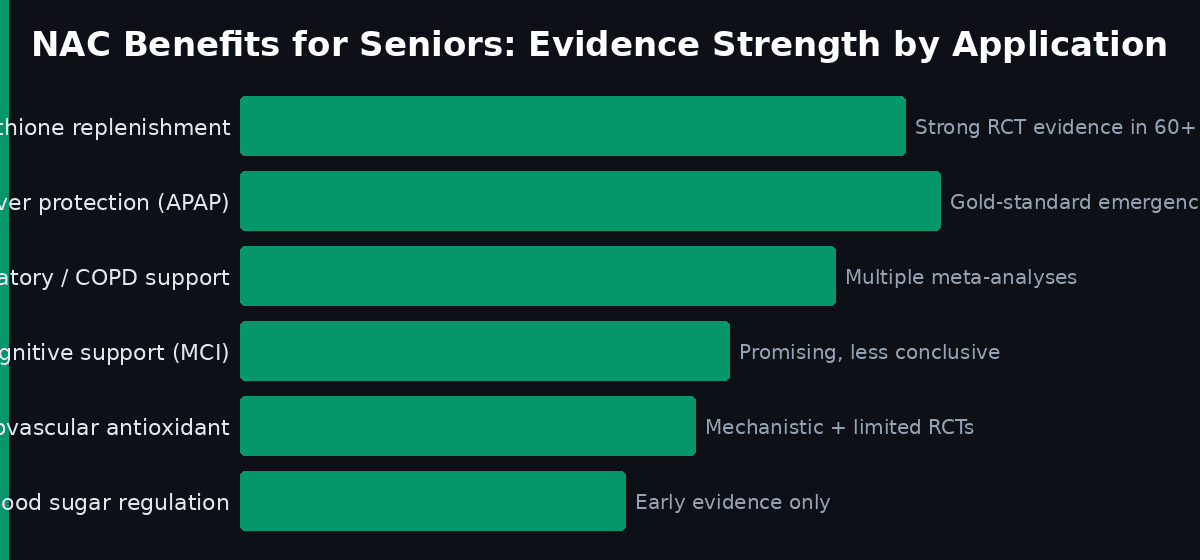
NAC has the most consistent trial evidence for respiratory applications. It was originally developed as a mucolytic — it breaks disulfide bonds in mucus glycoproteins, reducing viscosity and making mucus easier to clear. For seniors with COPD, chronic bronchitis, or recurrent respiratory infections, this mechanism is clinically meaningful. A Cochrane review of 13 RCTs found NAC at 600mg/day reduced acute exacerbations of chronic bronchitis significantly compared to placebo. The effect size was modest but consistent across studies, and the safety profile was excellent.
Liver Protection
NAC is the FDA-approved antidote for acetaminophen (Tylenol) overdose — delivered intravenously in emergency settings, it rescues glutathione stores in liver cells before irreversible damage sets in. This clinical application has been standard of care since the 1970s. For seniors taking acetaminophen regularly for pain management (a common pattern), NAC’s liver-protective properties are a genuine bonus, though not a substitute for staying within safe acetaminophen limits.
Beyond acetaminophen toxicity, a 2019 meta-analysis found NAC significantly reduced liver enzyme elevations in patients with non-alcoholic fatty liver disease (NAFLD) — a condition that increases in prevalence after 60, particularly in those with metabolic syndrome.
Cognitive Support
The cognitive evidence for NAC is less conclusive but promising. Oxidative stress in the brain is a driver of neurodegeneration, and NAC’s ability to raise cerebral glutathione levels is measurable via MRI spectroscopy. A 2019 trial in adults with mild cognitive impairment found NAC at 600mg twice daily for 24 weeks improved scores on one of three cognitive assessments and reduced biomarkers of neuroinflammation. It did not significantly improve all measures. The 2021 Baylor NAC+glycine trial showed improvements on a composite cognitive index, with working memory and processing speed most affected.
For seniors primarily concerned about cognitive health, NAC makes more sense as part of a broader stack — paired with choline (Alpha-GPC) for acetylcholine support and Urolithin A for mitochondrial health — than as a standalone cognitive intervention.
Cardiovascular Antioxidant Protection
Oxidative modification of LDL cholesterol is a key step in atherosclerosis development. NAC reduces markers of LDL oxidation in several small trials, and a 2000 RCT found NAC reduced cardiovascular events after myocardial infarction. The evidence base here is smaller than for its respiratory applications, but the mechanism is sound and the safety profile makes it a reasonable add-on for seniors already taking standard cardiovascular supplements.
Best NAC Supplement for Seniors
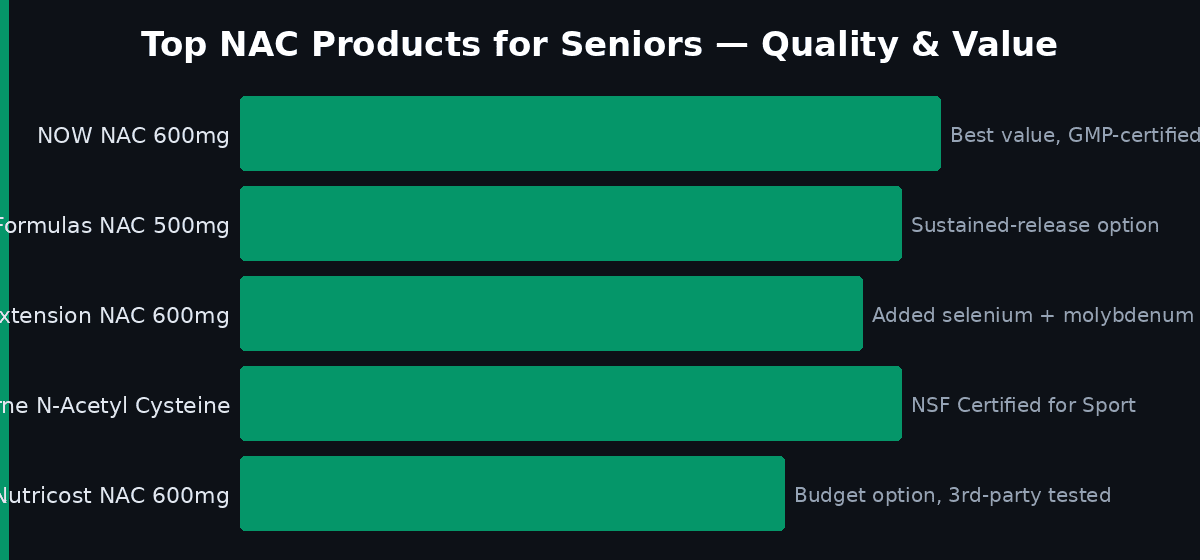
1. NOW NAC 600mg — Best Overall Value
NOW Foods has been producing pharmaceutical-grade supplements since 1968 and manufactures in its own GMP-certified facility with in-house quality testing. Their NAC 600mg is the benchmark value product — clean ingredient list, third-party verified, and consistent with the 600mg dose used in the majority of positive human trials. For seniors not needing a sustained-release formulation, this is the straightforward choice.
2. Jarrow Formulas NAC 500mg Sustain — Best Sustained Release
Jarrow’s sustained-release NAC spreads absorption over 6-8 hours, which may reduce the GI side effects (nausea, bloating) that some seniors experience with immediate-release NAC on an empty stomach. The 500mg dose is slightly below the most-studied 600mg threshold but is generally adequate for maintenance use. Jarrow publishes certificate of analysis data for each production batch.
3. Life Extension NAC 600mg with Selenium — Best for Comprehensive Antioxidant Stack
Life Extension’s NAC 600mg adds selenium (200mcg as Se-methylselenocysteine) and molybdenum, both co-factors in the glutathione peroxidase enzyme system. Selenium is required for glutathione peroxidase activity — so raising NAC without adequate selenium is like building more pipes without the pump. For seniors with limited seafood intake (a common selenium gap), this combination product addresses a real deficiency in one capsule.
4. Thorne N-Acetyl Cysteine 500mg — Best for Medication Users
Thorne holds NSF Certified for Sport certification, which requires testing for over 270 substances banned in sports — but more relevantly for seniors, it means every production batch is verified for label accuracy and absence of contaminants. For seniors taking multiple medications and wanting the highest possible quality assurance on their supplements, Thorne’s manufacturing standards are among the best in the industry. Their 500mg dose is suitable for maintenance use.
5. Nutricost NAC 600mg — Best Budget Option
Nutricost offers third-party tested NAC 600mg at a price point roughly 40% below the premium brands. Their testing is through Eurofins (an accredited laboratory) and certificates are available on request. Quality is consistent with their other well-reviewed products. For seniors managing supplement costs, this is a reliable entry-level option.
The 2020 FDA Action: What Actually Happened
In 2020, the FDA sent warning letters to several companies selling NAC as a dietary supplement, citing a rule that drugs approved before a supplement ingredient can be marketed (NAC was approved as a drug in 1963). This rattled the market and caused some Amazon and retail listings to disappear temporarily.
The FDA has since clarified that it will exercise enforcement discretion — meaning it will not actively pursue action against NAC supplement sellers while it evaluates the regulatory question. As of now, NAC remains widely available as a dietary supplement and the major quality brands have continued selling it without interruption. This is not a safety concern; it is a regulatory classification question that has not been resolved but is not actively affecting product availability.
Dosing for Seniors
| Goal | Dose | Timing | Notes |
|---|---|---|---|
| Glutathione maintenance / antioxidant support | 600mg/day | Morning with food | Standard maintenance dose |
| Respiratory support (COPD, bronchitis) | 600mg twice daily | Morning and evening | Cochrane review dose |
| Cognitive support stack | 600mg/day | Morning with food | Pair with glycine 1-2g |
| Liver support (regular Tylenol users) | 600mg/day | Separate from Tylenol by 2+ hours | Minimum 4 hours before a dose |
A note on the NAC + glycine combination: the Baylor studies used both precursors together (NAC + glycine, branded as GlyNAC). Glycine is the other amino acid required for glutathione synthesis, and cysteine availability is often the rate-limiting factor — but if glycine intake is also low, adding glycine at 1-2g/day may amplify the effect. Glycine is inexpensive and has its own sleep-supporting properties at 3g before bed.
Drug Interactions Seniors Should Know
- Nitroglycerin and isosorbide (nitrates for angina): NAC can potentiate nitrate effects, causing significant hypotension and severe headaches. This is a real interaction — do not combine without medical supervision.
- Activated charcoal: Used in some emergency GI situations; binds NAC and reduces absorption. Always separate by several hours.
- Immunosuppressants: NAC modulates immune cell activity. Transplant patients or those on immunosuppressants should discuss with their specialist before supplementing.
- Blood thinners (warfarin): NAC has mild antiplatelet activity at higher doses. Monitor INR if you supplement while on warfarin.
- Chemotherapy: As with NAD+ precursors, NAC’s antioxidant activity could theoretically interfere with oxidative-mechanism chemotherapy. Discuss with your oncologist.
NAC and the GlyNAC Protocol: The Baylor Research
Dr. Rajagopal Sekhar at Baylor College of Medicine has published three human trials on the NAC + glycine combination (GlyNAC) specifically in older adults. The 2021 pilot trial (20 participants, age 70+, 16 weeks) showed improvements in mitochondrial function, oxidative stress, inflammation, insulin resistance, endothelial function, body composition, and cognitive performance — a remarkably broad list for a two-ingredient protocol.
The 2022 replication trial confirmed the core findings. A third trial is underway. This is some of the most compelling targeted nutrition research in aging published in recent years, and it is why GlyNAC has become a serious topic in longevity medicine circles well beyond the supplement industry.
The practical implication: if you are going to take NAC, consider taking it alongside glycine (1-2g, available cheaply as a powder). This combination costs very little and the combined evidence base is stronger than either compound alone.
Frequently Asked Questions
Is NAC safe for seniors to take daily?
Yes, at 600mg/day, NAC has an excellent long-term safety profile backed by 50+ years of clinical use. The most common side effects are mild GI discomfort (nausea, bloating) which is reduced by taking it with food or using a sustained-release formulation. The main contraindication is concurrent nitrate use (nitroglycerin, isosorbide) — that combination is a real risk. Otherwise, NAC is among the better-tolerated antioxidant supplements in older adults.
Should I take NAC with food?
Yes, particularly for seniors. Taking NAC on an empty stomach increases the risk of nausea. Taking it with a small meal improves tolerability without significantly affecting absorption. If you experience GI upset with standard NAC, switch to a sustained-release formulation like Jarrow’s NAC Sustain.
Can I take NAC and glutathione together?
Yes, but it is redundant for most purposes. NAC raises intracellular glutathione, which is where you need it — oral glutathione supplements have limited absorption and most of the glutathione is broken down in the gut before reaching cells. Liposomal glutathione has better bioavailability, but for the majority of seniors, NAC alone raises tissue glutathione effectively. If cost is not a concern, combining NAC with liposomal glutathione is not harmful, but the marginal benefit over NAC alone is modest.
Does NAC help with lung health after COVID?
There is early data suggesting NAC may support recovery from respiratory damage, based on its established mucolytic and antioxidant mechanisms and several small post-COVID trials. It is not an established treatment, but the safety profile and broader benefits make it a reasonable addition to a recovery protocol under medical supervision. Discuss with your doctor, particularly for persistent respiratory symptoms.
How long does it take for NAC to raise glutathione levels?
Measurable increases in red blood cell glutathione are typically seen within 2-4 weeks of consistent 600mg/day supplementation. The full functional benefit — reduced oxidative stress markers, improved immune parameters — tends to develop over 8-12 weeks. The Baylor GlyNAC trials ran 16 weeks and showed continued improvement across the full duration.
This article is for informational purposes only and does not constitute medical advice. Always consult your healthcare provider before starting any new supplement, particularly if you take prescription medications or have a chronic health condition.
Related Articles
- Best Vitamin D3 + K2 for Women Over 60: Bone Health, Heart Protection & Top USA Picks
- Signs of Vitamin D Deficiency in Seniors — 11 Symptoms Most Adults Miss After 60
- Ashwagandha for Men Over 50 — Testosterone, Stress and Sleep Evidence Reviewed
- Vitamin D3 for Men Over 60: Testosterone, Bone, Immune and Prostate Health
- 5 Best Vitamin D Supplements for Seniors — Ranked by Form and Value