Medical Reviewer: Content reviewed for accuracy against current NIH and Endocrine Society guidelines. Last updated: 2026.
Affiliate Disclosure: SupplementsOver50.com may earn a commission on qualifying purchases at no extra cost to you. We only recommend products we’ve independently evaluated.
Best Vitamin D3 + K2 for Women Over 60 – Why it Matters
If you’re a woman over 60 living in the United States, there’s a better-than-even chance your vitamin D levels are suboptimal. According to the CDC’s National Health and Nutrition Examination Survey (NHANES), approximately 35% of U.S. adults have vitamin D deficiency (serum 25-hydroxyvitamin D below 20 ng/mL), with post-menopausal women representing one of the most vulnerable groups. If you’ve noticed symptoms, our guide to signs of vitamin D deficiency after 60 covers what to watch for.
But here’s the critical nuance most generic “vitamin D” articles miss: vitamin D3 without K2 can actually accelerate arterial calcification. D3 dramatically increases calcium absorption from your gut — but without K2 to direct that calcium into bones and teeth rather than arterial walls, you may be trading one risk for another. For women over 60, who already face elevated cardiovascular risk post-menopause, this distinction is not trivial.
This guide covers the science behind the D3+K2 combination, how to choose the right product for your needs, and the top picks available in U.S. pharmacies and online retailers in 2026. For a broader view of bone health supplementation, see our guide to supplements for bone strength after 50.
Vitamin D deficiency in American women over 60 is driven by several converging factors:
Reduced sun exposure: The NIH Office of Dietary Supplements notes that skin’s ability to synthesize vitamin D from sunlight declines significantly with age — a 70-year-old produces roughly 75% less vitamin D per sun exposure than a 20-year-old.
Geographic latitude: Roughly half of the U.S. population lives above 37°N latitude (north of San Francisco–Richmond–Norfolk line), where UVB radiation is insufficient for vitamin D synthesis from November through March.
Dietary gaps: USDA dietary data shows fewer than 10% of Americans consistently meet vitamin D intake recommendations through food alone.
Obesity prevalence:CDC data indicates 44% of U.S. women aged 60–74 are obese. Vitamin D is fat-soluble and sequesters in adipose tissue, reducing bioavailability in the bloodstream.
Kidney function decline: Conversion of vitamin D to its active form (1,25-dihydroxyvitamin D) requires healthy kidneys — function that diminishes naturally after 60.
⚡ Best Liquid D3+K2 for Women
Thorne Vitamin D/K2 Liquid
1000 IU D3 + 200mcg K2 per drop, easy-dose liquid for seniors who avoid swallowing pills
For women over 60, MK-7 is the preferred form. Its 72-hour half-life means a once-daily supplement maintains stable blood levels. The Rotterdam Study — one of the largest population studies examining K2 and cardiovascular health — found that participants in the highest tertile of MK-7 intake had 57% lower risk of dying from cardiovascular disease and significantly less aortic calcification.
Heart disease remains the #1 cause of death for American women, responsible for 1 in 5 female deaths annually (CDC, 2024). For women already managing cardiovascular risk, combining D3+K2 with a broader heart health supplement stack may be worth discussing with your cardiologist. See also our related guide on vitamin K2 and D3 for bone density during menopause.
How D3 and K2 Work Together: The Synergy Explained
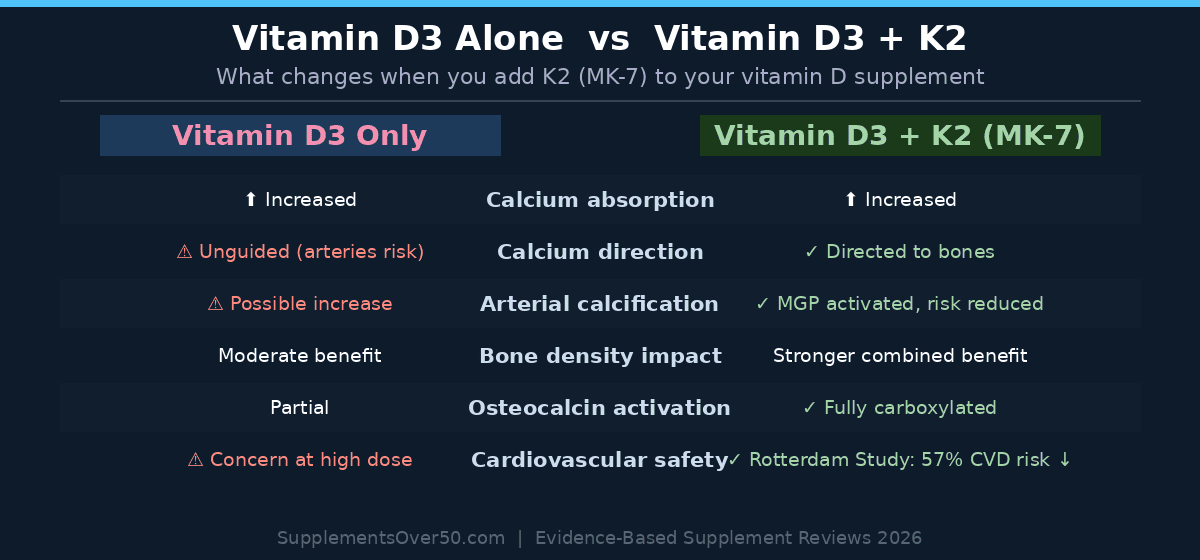
D3 alone increases calcium absorption but leaves direction unguided. Adding K2 (MK-7) activates Matrix Gla Protein to redirect calcium into bones and away from arteries.
Vitamin D3 acts as the calcium “recruiter” — it dramatically increases intestinal calcium absorption (by up to 30–40%) and activates osteocalcin, a protein that embeds calcium into bone matrix.
Vitamin K2 (MK-7) acts as the calcium “traffic director” — it activates Matrix Gla Protein (MGP), which prevents calcium from depositing in soft tissues like arteries, and carboxylates osteocalcin to ensure calcium is correctly integrated into bone.
🌿 Best Budget D3+K2 for Women
NOW Foods Vitamin D3 + K2
1000 IU D3 + 45mcg MK-7 K2, GMP certified, affordable daily combo for bone health
A 2019 meta-analysis in the Journal of the American Heart Association found that calcium supplementation without K2 was associated with a 15% increased risk of cardiovascular events. D3+K2 together neutralize this concern while amplifying bone benefits.
What to Look for in a D3+K2 Supplement (2026 Buying Guide)
1. Vitamin D3 Dose
For women over 60, most integrative physicians and the Endocrine Society recommend 1,000–2,000 IU daily for maintenance, with higher doses (4,000–5,000 IU) reserved for those with confirmed deficiency under physician supervision. The safe tolerable upper intake level (UL) is 4,000 IU/day per the National Academy of Medicine.
2. K2 Form and Dose
Look for MK-7 (not MK-4) at 90–200 mcg per serving. MK-7 derived from natto (Bacillus subtilis fermentation) is the gold standard. A 2014 study in Osteoporosis International showed 180 mcg/day MK-7 significantly reduced age-related bone mineral density loss in healthy post-menopausal women.
3. Fat-Soluble Delivery
Both D3 and K2 are fat-soluble vitamins. Better formulations use MCT oil or olive oil as a carrier within the capsule itself — improving absorption even when taken on a lower-fat meal. Avoid dry-powder tablets for D3+K2 combinations unless they include an emulsifier.
4. Third-Party Testing
The FDA does not pre-approve dietary supplements. For women over 60 managing multiple medications, choosing a product with USP, NSF International, or ConsumerLab verification ensures label accuracy and absence of contaminants.
Vitamin D Blood Level Guide: What Your Test Results Mean
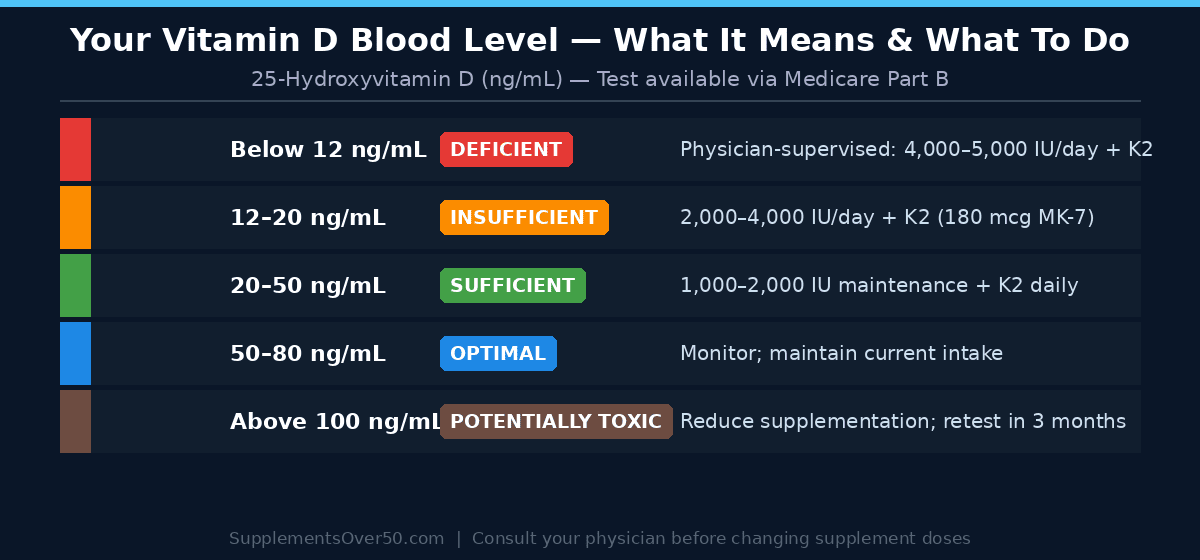
A 25-hydroxyvitamin D blood test is covered by Medicare Part B for at-risk women. Your result determines the right starting dose — do not guess.
Top D3+K2 Picks for Women Over 60 in the USA (2026)
1. Thorne Vitamin D/K2 Drops — Best Overall
Key specs: 1,000 IU D3 + 200 mcg MK-4 per drop | Liquid format | NSF Certified for Sport
Thorne is one of the few U.S. supplement brands that manufactures in an NSF-registered facility and is routinely recommended by integrative medicine physicians. The liquid drop format allows precise dosing — particularly useful for women who need to titrate their D3 based on periodic blood tests. Note: This product uses MK-4 rather than MK-7, so twice-daily dosing is recommended for optimal cardiovascular protection.
Best for: Women whose physician is actively monitoring 25(OH)D levels and who want precise dose control. Price range: $30–$38 (available on Amazon, Thorne.com, and Fullscript)
2. Life Extension Vitamin D3 + K2 — Best Value with MK-7
Key specs: 2,000 IU D3 + 100 mcg MK-7 | Softgel with olive oil | USP-verified ingredients
Life Extension (Fort Lauderdale, FL) has 45 years in the industry and one of the most rigorous in-house quality programs in the American supplement market. This formulation delivers both D3 and MK-7 in an olive oil softgel for reliable fat-soluble absorption. The 2,000 IU D3 dose sits at the Endocrine Society’s recommended range for maintenance.
Best for: Women wanting a comprehensive, once-daily D3+K2 at a strong price point. Price range: $18–$24 (available at Life Extension website, Amazon, Vitacost)
3. Pure Encapsulations D3 + K (MK7) — Best for Sensitive Formulators
Key specs: 5,000 IU D3 + 180 mcg MK-7 | Hypoallergenic capsule | No fillers, binders, or artificial ingredients
Pure Encapsulations (Sudbury, MA) is one of the most widely recommended U.S. brands among registered dietitians and functional medicine practitioners. The 180 mcg MK-7 dose mirrors the landmark MK-7 bone density study. The hypoallergenic formula is ideal for women with multiple food sensitivities — common in the 60+ population managing GI conditions. If magnesium and bone health are also concerns, see our guide to best magnesium supplements for seniors.
Best for: Women with confirmed deficiency being supervised by a physician, or those with significant food sensitivities. Price range: $42–$52 (available via Fullscript, Amazon, and select health food stores)
4. NOW Foods D-3 & K-2 — Best Budget Pick
Key specs: 1,000 IU D3 + 45 mcg MK-7 | Softgel | GMP-certified, non-GMO
NOW Foods (Bloomingdale, IL) is a family-owned company and one of America’s most trusted affordable supplement brands. GMP-certified and frequently verified by ConsumerLab, NOW’s D3+K2 offers solid nutrition at a price point accessible to women on fixed incomes. The 45 mcg MK-7 is on the lower end of the therapeutic range — best as a maintenance option for women without confirmed deficiency.
Best for: Budget-conscious women seeking basic D3+K2 maintenance coverage. Price range: $12–$16 (available at Walmart, Amazon, iHerb, and health food stores nationwide)
5. Garden of Life mykind Organics D3 + K2 Spray — Best for Absorption Issues
Key specs: 1,000 IU D3 + 50 mcg MK-7 per 4 sprays | Sublingual spray | USDA Organic, Non-GMO Verified, NSF Certified
Women over 60 with malabsorption issues — common in those with Crohn’s disease, celiac disease, or post-bariatric surgery — may struggle to absorb fat-soluble vitamins from capsules. Garden of Life’s sublingual spray delivers D3 and K2 through the oral mucosa, partially bypassing the digestive tract.
Best for: Women with GI malabsorption conditions or difficulty swallowing capsules. Price range: $22–$28 (available at Whole Foods, Target, Amazon, and Sprouts nationwide)
Critical Safety Note: Warfarin Interaction
Vitamin K2 directly antagonizes warfarin (Coumadin) — it can significantly reduce the drug’s anticoagulant effect and destabilize INR control. If you take warfarin, you must consult your prescribing physician before adding any vitamin K supplement. This is a clinically significant drug-nutrient interaction recognized by the FDA. Women on newer anticoagulants (apixaban/Eliquis, rivaroxaban/Xarelto) do not face the same interaction.
Bone Health Context: What Post-Menopausal Women Over 60 Need to Know
The National Osteoporosis Foundation estimates that 10 million Americans have osteoporosis, with 80% being women. Women can lose up to 20% of their bone density in the 5–7 years following menopause. D3+K2 provides the nutritional foundation that makes all bone-building interventions more effective. For a complete picture of bone and joint health, see our roundup of best joint supplements for seniors and our overview of best supplements for women over 60.
Frequently Asked Questions
How long does it take for D3+K2 supplementation to raise vitamin D levels?
Serum 25-OH vitamin D levels typically rise measurably within 4–8 weeks of consistent daily supplementation. Replenishing tissue stores (particularly in adipose tissue) takes 3–6 months. Most physicians recommend a follow-up blood test 3 months after starting supplementation to assess response.
Should I take D3+K2 in the morning or at night?
With a fat-containing meal is more important than the time of day. Some women report that high-dose vitamin D taken at night can disrupt sleep by affecting melatonin synthesis — if you notice this, shift to morning or lunchtime dosing. K2 has no known effect on sleep.
Can I get enough vitamin D from food without supplementing?
It’s very difficult. The richest dietary sources are fatty fish (salmon: ~570 IU per 3 oz), fortified dairy and plant milks (~100–130 IU per cup), and egg yolks (~40 IU each). For virtually all U.S. women over 60, supplementation is the realistic path to adequate vitamin D.
Vitamin D3+K2 and Fall Prevention: The Overlooked Benefit
Falls are the leading cause of injury death in Americans over 65 — the CDC reports 36 million falls per year in older adults, resulting in more than 32,000 deaths annually. Vitamin D’s role in preventing falls is one of the most evidence-backed benefits in geriatric medicine, yet it’s rarely discussed alongside the bone density conversation.
Vitamin D3 has receptors in skeletal muscle — it directly supports muscle fiber composition, contraction speed, and proprioception (your body’s sense of balance and spatial awareness). A 2018 meta-analysis of 81 randomized controlled trials found that vitamin D supplementation significantly reduced fall risk in community-dwelling older adults. The mechanism isn’t just bone strength — it’s muscle function and neuromuscular coordination.
For women over 60, this means D3+K2 supplementation isn’t purely about long-term fracture prevention. It’s an active intervention for reducing fall risk right now. Women with confirmed D deficiency often report meaningful improvements in leg strength and stability within 8–12 weeks of correcting their levels.
Getting Your Vitamin D Tested: What Medicare Covers
Medicare Part B covers a 25-hydroxyvitamin D blood test (CPT code 82306) for beneficiaries with a documented indication — which includes osteoporosis, malabsorption conditions, or documented deficiency risk. The test typically costs $40–$80 without insurance, and results come back in 2–5 days from most labs.
Understanding your result:
Below 12 ng/mL: Deficiency — typically requires therapeutic dosing (4,000–5,000 IU/day) under physician supervision
12–19 ng/mL: Insufficiency — most physicians recommend 2,000–4,000 IU/day to correct
20–29 ng/mL: Low-normal — 1,500–2,000 IU/day maintenance with retest in 3–6 months
Never supplement blindly at high doses. If you’re targeting levels above 40 ng/mL, periodic testing is the only safe way to manage your protocol.
D3+K2 and Immune Function After 60
Vitamin D’s role in immune regulation is one of the most studied areas in nutritional immunology. Vitamin D receptors are found on nearly every immune cell — T cells, B cells, macrophages, and dendritic cells all require adequate D3 to function optimally. After 60, immune senescence (age-related immune decline) makes this particularly relevant.
Research published in the British Medical Journal found that vitamin D supplementation reduced the risk of acute respiratory tract infections by 12% overall — and by 70% in those who were severely deficient at baseline. For women over 60 managing multiple health concerns, immune resilience is a compelling secondary reason to maintain optimal D3 levels beyond bone health alone.
K2’s role in immunity is less studied but emerging. Osteocalcin, activated by K2, has been shown to influence insulin sensitivity and energy metabolism — relevant to the chronic low-grade inflammation (“inflammaging”) that accelerates disease progression in older adults.
Vitamin D3+K2 vs. Standalone Vitamin D: Is the Combination Worth It?
The honest answer is: yes, especially at doses above 1,000 IU D3 per day. At lower doses (under 1,000 IU), the calcium flux is modest enough that K2 matters less. But most women over 60 targeting therapeutic outcomes need 1,500–2,000+ IU, at which point K2 becomes important for managing where the extra absorbed calcium goes.
The price premium for D3+K2 over standalone D3 is typically $5–$15 per month. Given the cardiovascular protective evidence for MK-7 and the bone synergy, this is among the most cost-effective upgrades available in the supplement market for women in this age group.
If you’re already taking a high-quality multivitamin, check whether it includes K2 (MK-7 specifically) and at what dose. Many senior multivitamins include K1 — which has minimal vascular protective effect — rather than K2 MK-7. Our guide to the best multivitamin for seniors flags this distinction for each product reviewed.
How D3+K2 Fits Into a Complete Bone Health Stack
D3+K2 is the foundation, not the complete structure. A comprehensive bone health protocol for women over 60 typically includes:
Calcium: 500–600 mg supplemental calcium daily if dietary intake is below 1,000–1,200 mg/day (National Osteoporosis Foundation recommendation). Split doses of 500 mg or less absorb better than single large doses.
Magnesium: Required for vitamin D activation and bone matrix formation. Most Americans are deficient. See our guide to best magnesium supplements for seniors.
Collagen peptides: Type I collagen forms the structural scaffold of bone. Several RCTs show supplementation improves bone mineral density markers in post-menopausal women.
Resistance exercise: No supplement stack replaces load-bearing mechanical stress as a bone-building signal. Even 2x/week strength training significantly reduces fracture risk independent of supplementation.
Complete the picture:Choline for Seniors addresses the cognitive and liver health gaps D3+K2 doesn’t cover — and like vitamin D, over 90% of seniors fall short. And Urolithin A rounds out the muscle and mitochondrial piece for women over 60 concerned about strength and physical independence alongside bone health.
This article is for informational purposes only and does not constitute medical advice. Always consult your healthcare provider before starting any new supplement regimen, particularly if you take prescription medications.
Struggling with recurrent UTIs after menopause? Learn how declining estrogen impacts bladder health and explore proven natural supplements like D-mannose, cranberry, and lifestyle fixes.
The best energy supplements for women over 50 fix real gaps like low B12 or iron. Check these fatigue causes first, then compare 5 non-stimulant picks.
Looking for a hair dryer for thinning hair? Compare 5 gentle picks with real heat control, from the Dyson Supersonic Nural to a budget Revlon, for fine hair over 50.