Best Bone Density Supplements for Women Over 50: 5 Picks Beyond Basic Calcium
This guide contains affiliate links. If you buy through them, we may earn a small commission at no extra cost to you.
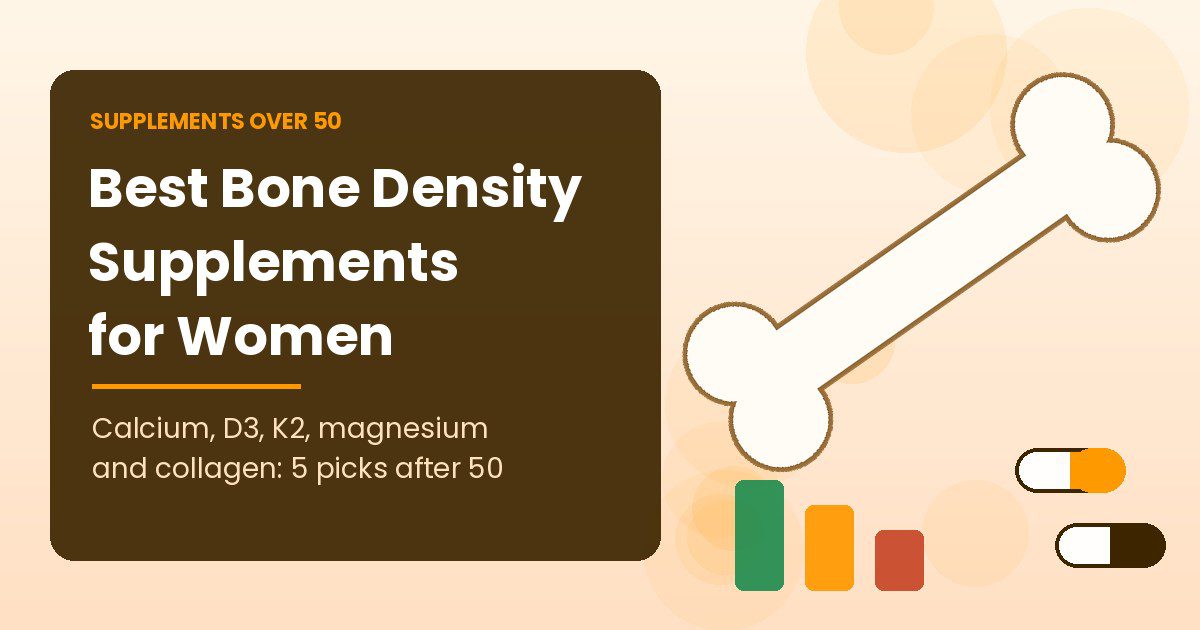
Choosing the best bone density supplements for women over 50 is not just about grabbing the biggest bottle of calcium. After menopause, bone loss speeds up, and the nutrients that help keep bone strong work as a team: calcium is the raw material, vitamin D helps you absorb it, vitamin K2 helps put it to work in bone, and magnesium and protein matter too. Some newer products also add specific collagen peptides that have been studied in postmenopausal women.
This guide goes beyond basic calcium. It covers what the research actually shows, why more calcium is not always better, the heart and kidney stone debate, the vitamin K2 and warfarin interaction, why we left strontium off the list, and when you need a DEXA scan instead of a new supplement. Then it compares five formulas, each picked for a different reason.
Table of Contents
Why Bone Density Drops After Menopause
Bone is living tissue. Your body breaks down old bone and builds new bone all the time, and estrogen helps keep that process in balance. When estrogen falls at menopause, breakdown gets ahead of rebuilding, and many women lose bone fastest in the first several years after their last period. Over time that can lead to osteopenia (lower than normal bone density) and then osteoporosis, where bones become fragile enough to break from a minor fall.
Women over 50 also tend to absorb calcium less efficiently, spend less time in the sun making vitamin D, and eat less protein, especially if appetite drops. Certain medicines, such as long-term steroids, some breast cancer treatments and acid-reducing drugs, can add to bone loss. That is why the right mix of nutrients matters more after 50, and why a simple calcium tablet is often not the whole answer.
Popular Supplement Guides:


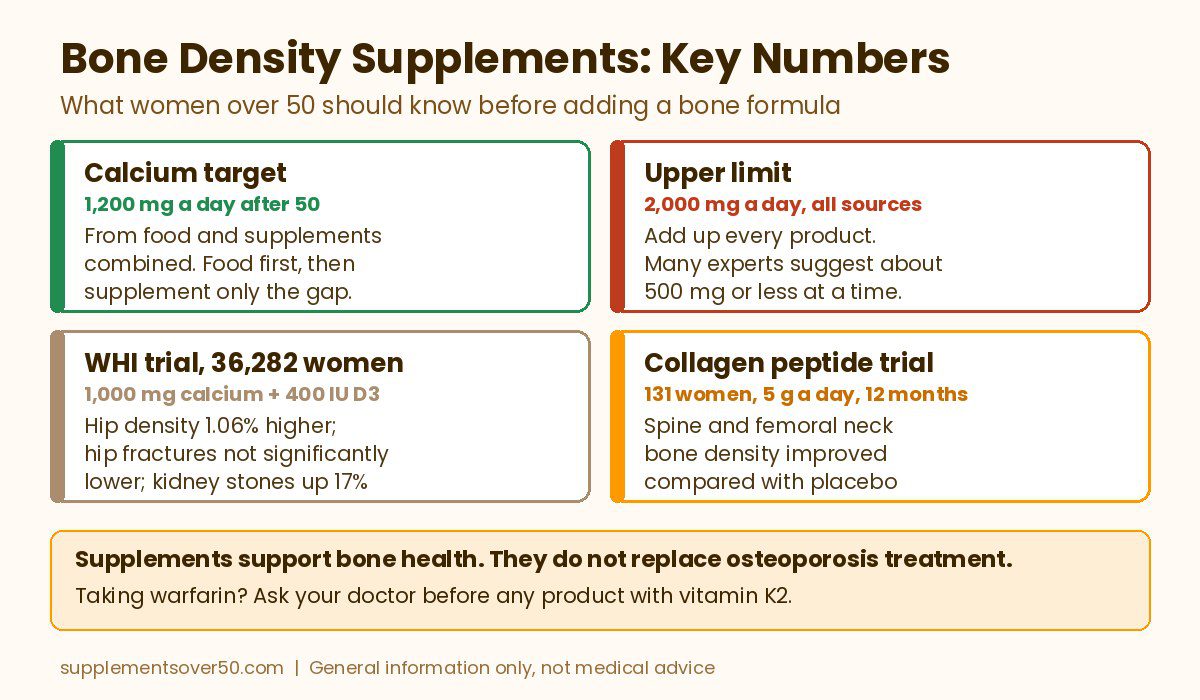
The NIH Office of Dietary Supplements calcium fact sheet lists a recommended intake of 1,200 mg of calcium a day for women over 50 and an upper limit of 2,000 mg a day from food and supplements combined. Most women can get a good share of that from dairy, fortified foods, canned fish with bones and leafy greens, and only need a supplement to close the gap.
Do Bone Density Supplements Actually Work?
The honest answer is that they help some women a little, and they work best when they fill a real gap. The biggest study to know is the Women’s Health Initiative calcium and vitamin D trial, which gave 36,282 postmenopausal women aged 50 to 79 either 1,000 mg of calcium with 400 IU of vitamin D3 or a placebo for about seven years. Hip bone density was 1.06% higher in the supplement group, but hip fractures were not significantly reduced in the main analysis, and kidney stones were 17% more common. Among women who kept taking their pills, the hip fracture benefit looked stronger.
Vitamin K2 has some encouraging data. In a three-year trial in 244 healthy postmenopausal women, 180 mcg a day of vitamin K2 as MK-7 slowed the age-related decline in bone mineral density at the lumbar spine and femoral neck compared with placebo, though not at the total hip. That is a modest effect, not a reversal of bone loss.
Collagen is the newer piece. In a randomized, placebo-controlled study published in Nutrients, 131 postmenopausal women with age-related bone loss took 5 g of specific collagen peptides or a placebo every day for 12 months. Bone mineral density at the spine and femoral neck increased in the collagen group compared with placebo, and bone markers shifted toward more bone building. The peptides used in that trial are sold under the brand name Fortibone. It was a single, fairly small trial, so it is promising rather than settled.
For magnesium and boron, the evidence is thinner. A review of the cardiovascular safety of calcium, magnesium and strontium concluded there is little evidence to support routine magnesium supplements for bone outcomes, though a good dietary intake appears protective for the heart. The NIH boron fact sheet says boron might matter for bone formation, but more research is needed to know whether boron supplements affect bone health in people. Both are reasonable as part of a combination formula, not as a stand-alone fix.
Most importantly, supplements are not a treatment for osteoporosis. If you have been diagnosed with osteoporosis or a fragility fracture, prescription medicines have far stronger evidence for preventing fractures. Supplements are there to make sure your body has the building blocks those medicines need, and many doctors recommend calcium and vitamin D alongside treatment. Never stop a prescribed bone medicine in favor of a supplement.
Calcium Limits, Heart Health and Kidney Stones
More calcium is not better. A BMJ meta-analysis (Bolland and colleagues, 2010) found that calcium supplements taken without vitamin D were linked to about a 30% higher risk of heart attack. That finding set off a long debate. The more recent review cited above concluded that calcium supplements carry gastrointestinal side effects and a small increased risk of kidney stones, but that the links with heart problems remain unconvincing, and it recommended using calcium with vitamin D and targeting it to people who are low in these nutrients or are on osteoporosis medication.
The practical takeaway is simple. Count the calcium from your food first, then supplement only the gap. Add up every product you take, because a multivitamin, an antacid and a bone formula can easily push you past the 2,000 mg upper limit. Many experts suggest taking no more than about 500 mg at a time and splitting larger amounts between meals, since absorption drops with bigger doses. If you have had kidney stones or have kidney disease, talk to your doctor before taking any calcium supplement, and see our guide to supplements to avoid with kidney disease.
For a deeper look at the latest research on calcium and vitamin D for this age group, read our guide Calcium and Vitamin D After the New BMJ Review: What Women Over 50 Should Do Now.
Vitamin K2 and Blood Thinners: An Important Warning
Vitamin K helps your blood clot, which is why it matters so much if you take warfarin (Coumadin). The NIH vitamin K fact sheet notes that vitamin K can interact with warfarin and other anticoagulants. A sudden change in your vitamin K intake can change how well warfarin works, so starting a bone formula with K2 can throw off your INR.
If you take warfarin, do not start any supplement with vitamin K2 without talking to the doctor or clinic that manages your dose. Several of the picks below contain K2, so this applies to them. If you take a different blood thinner, ask your pharmacist anyway. Our guide to supplements to avoid with blood thinners covers the other common interactions.
Strontium: Why It Is Not on Our List
You may see strontium supplements marketed for bone density. We left them out on purpose. The prescription form, strontium ranelate, reduces fractures but is linked to a higher risk of blood clots, and its license is limited to severe osteoporosis in people without cardiovascular risk factors, according to the review above. The strontium citrate sold as a supplement is a different product and has not been studied the same way.
There is also a measurement problem. Strontium absorbs X-rays more strongly than calcium, so it makes bone density look higher on a DEXA scan than it really is. A study in the Journal of Clinical Densitometry explains that scans in people taking strontium overestimate bone density and need correcting. If you have ever taken strontium, tell the person reading your DEXA scan.
What to Look for in Bone Density Supplements for Women
- Calcium plus its partners. Look for vitamin D3, and ideally vitamin K2 and magnesium, in the same formula or your daily routine.
- A sensible calcium dose. More is not better. Pick an amount that fills the gap left by your diet and keeps your total under 2,000 mg a day.
- A form that suits your stomach. Calcium carbonate is best taken with food, while calcium citrate can be taken any time. Our calcium citrate vs carbonate guide explains the difference.
- K2 that you can safely take. If you take warfarin, choose a product without K2 or get your doctor’s approval first.
- Specific collagen peptides if you want collagen for bone. General collagen powders are not the same as the Fortibone peptides used in the bone study.
- No strontium, unless your doctor has prescribed it and knows how it affects your scans.
- Quality you can check. Look for a certificate of analysis, third-party testing or a practitioner brand, and read our guide on how to read a supplement label.
Best Bone Density Supplements for Women: Quick Comparison
| Product | Best for | Key details | Daily dose |
|---|---|---|---|
| Life Extension Bone Restore with Vitamin K2 | Best all-in-one | Three forms of calcium, D3, K2, 300 mg magnesium, boron, zinc, manganese, silicon; non-GMO | See label |
| Thorne Advanced Bone Support | Best for postmenopausal women | Calcium, magnesium and D3 plus extra bone nutrients; free of gluten, soy, dairy and major allergens | See label |
| Jarrow Formulas BoneUp | Best bone-derived (MCHA) calcium | 1,000 mg calcium from MCHA, 25 mcg D3, K2, 200 mg vitamin C, boron, zinc, copper, manganese | 6 capsules |
| New Chapter Bone Strength | Best plant-based calcium | USDA organic red algae calcium with D3, K2, magnesium and trace minerals; slim tablets | See label |
| Designs for Health Whole Body Collagen | Best collagen with Fortibone | Fortibone, Fortigel and Verisol collagen peptides; no dairy, gluten or soy | About 1 scoop |
Top Picks for the Best Bone Density Supplements for Women
1. Life Extension Bone Restore with Vitamin K2 (Best All-in-One)
If you want one bottle that covers the main bone nutrients, this is the one to look at first. Life Extension combines three forms of calcium, including calcium carbonate, with vitamin D3 and vitamin K2. It also provides 300 mg of magnesium, plus zinc, manganese, silicon and a form of boron. That lines up well with the team approach to bone health described above.
A certificate of analysis is available for every Life Extension product, and most of the brand’s products are non-GMO and gluten free. It has more than 4,200 ratings and a 4.6 rating. Check the label for the serving size and calcium per serving, and count it against the calcium you already get from food. Because it contains K2, talk to your doctor first if you take warfarin.
2. Thorne Advanced Bone Support (Best for Postmenopausal Women)
Thorne designed this formula for people who need extra bone support, and it names postmenopausal women as a key group. It goes beyond the basics of calcium, magnesium and vitamin D3, which is the point of a bone density formula rather than a plain calcium pill.
Thorne products are made without gluten, soy, dairy, fish, shellfish, eggs, tree nuts or peanuts, which helps if you have food allergies or a sensitive stomach. The brand is widely used by health care practitioners. It has more than 800 ratings and a 4.7 rating, tied for the highest in this list. The listing does not spell out every nutrient amount, so read the supplement facts panel for the serving size and check for vitamin K if you take warfarin.
3. Jarrow Formulas BoneUp (Best Bone-Derived Calcium Formula)
BoneUp uses microcrystalline hydroxyapatite (MCHA), a calcium source made from bone (ossein) that the brand says contains active bone growth factors. A full daily serving of six capsules provides 1,000 mg of calcium, 25 mcg (1,000 IU) of vitamin D3, vitamin K2, 200 mg of vitamin C and trace minerals including boron, zinc, copper and manganese. The brand notes it has a published clinical trial.
The trade-off is the dose. Six capsules a day is a lot of pills, and 1,000 mg of calcium on top of a good diet may be more than you need. If your diet already provides a good amount of calcium, ask your doctor whether a partial serving, split between meals, makes more sense. It is non-GMO and gluten free, comes in a 360 capsule bottle and has more than 6,400 ratings with a 4.7 rating. Because it is bone-derived, it is not suitable for vegetarians.
4. New Chapter Bone Strength Take Care (Best Plant-Based Calcium)
New Chapter uses USDA organic calcium from wild red marine algae harvested off Iceland, which the brand says is backed by 27 studies. Each tablet pairs that calcium with vitamin D3 to help absorption and vitamin K2 to help guide calcium to bone. The algae also brings magnesium and more than 70 naturally occurring trace minerals.
The slim tablets are easier to swallow than many calcium pills, which matters if large tablets have put you off before. It is the most popular pick here, with more than 8,900 ratings and a 4.6 rating. Check the label for how many tablets make a serving and how much calcium that provides. As with the other K2 formulas, check with your doctor first if you take warfarin.
5. Designs for Health Whole Body Collagen (Best Collagen With Fortibone)
This is the pick if you want to add collagen for bone, not just skin. Designs for Health blends three patented collagen peptides: Fortibone for bone, Fortigel for joints and Verisol for skin, hair and nails. Fortibone is the same type of specific collagen peptide studied in the 12-month trial in postmenopausal women described above. The peptides are hydrolyzed into smaller pieces for absorption.
You mix about one scoop into water or another drink each day. It contains no dairy, gluten or soy, and has more than 1,400 ratings with a 4.6 rating. Collagen does not contain calcium, vitamin D or K2, so think of it as an add-on to a calcium and D3 plan, not a replacement. The listing does not state how much Fortibone is in each scoop, so it may not match the 5 g used in the study.
How to Choose the Best Bone Density Supplements for Women
- If you want one simple daily formula, pick Life Extension Bone Restore with Vitamin K2.
- If you have food allergies or want a practitioner brand, pick Thorne Advanced Bone Support.
- If you eat little dairy and need more calcium, Jarrow BoneUp gives a full 1,000 mg, but you may need less if your diet already provides some.
- If you want plant-based calcium in small tablets, pick New Chapter Bone Strength.
- If your calcium and vitamin D are already covered, add Designs for Health Whole Body Collagen for Fortibone peptides.
- If you take warfarin, skip K2 formulas unless your anticoagulation clinic approves, or ask about a calcium and D3 product without K.
- If you have osteoporosis, use any of these alongside, never instead of, the treatment your doctor prescribes.
Supplements work best with the basics in place. Strength and weight-bearing exercise, enough protein, not smoking and limiting alcohol all protect bone. Our guide to the best protein powder for women over 50 helps if you struggle to eat enough protein, our best magnesium for women over 50 roundup covers magnesium on its own, and our best liquid collagen for women over 50 guide compares collagen formats. If you want a stand-alone K2, see the best vitamin K2 supplement for seniors.
Get a DEXA Scan and Know When to See a Doctor
A supplement cannot tell you how strong your bones are. A DEXA scan, a quick, low-dose X-ray of the hip and spine, can. The U.S. Preventive Services Task Force recommends osteoporosis screening for all women 65 and older, and for postmenopausal women younger than 65 who have one or more risk factors, such as a parent who broke a hip, low body weight, smoking or heavy drinking. Your result comes as a T-score: -1.0 or higher is normal, between -1.0 and -2.5 is osteopenia, and -2.5 or lower is osteoporosis.
- You have broken a bone from a minor fall or a simple bump. That can be a sign of osteoporosis and needs a proper workup.
- You are losing height or developing a stooped posture or new back pain, which can signal spine fractures.
- You take warfarin and want to try a product with vitamin K2.
- You have kidney disease, a history of kidney stones or high blood calcium. Calcium and vitamin D need medical guidance in these cases.
- You take thyroid medicine, certain antibiotics or a bisphosphonate. Calcium can block their absorption, so ask your pharmacist how to space them.
- You have been prescribed an osteoporosis medicine and are thinking of stopping it. Talk to your doctor first.
Frequently Asked Questions
What is the best supplement for bone density in women over 50?
There is no single best supplement. For most women, the foundation is enough calcium, mostly from food, plus vitamin D3. Vitamin K2, magnesium and specific collagen peptides such as Fortibone may add modest benefits. An all-in-one formula like Life Extension Bone Restore with Vitamin K2 covers most of these in one product.
Can supplements reverse osteoporosis?
No. Supplements can support bone health and may slow bone loss slightly, but they do not reverse osteoporosis. Prescription medicines have much stronger evidence for preventing fractures. Calcium and vitamin D are often taken alongside those medicines, not instead of them.
How much calcium should a woman over 50 take?
The recommended intake is 1,200 mg a day from food and supplements combined, with an upper limit of 2,000 mg a day. Count what you get from food first and only supplement the gap. Taking about 500 mg or less at a time may help absorption.
Is it safe to take vitamin K2 with blood thinners?
Not without your doctor’s approval if you take warfarin. Vitamin K can change how warfarin works and affect your INR. If you take another type of blood thinner, ask your pharmacist before adding K2.
Does collagen help bone density?
Some evidence says yes. In one 12-month trial, postmenopausal women who took 5 g of specific collagen peptides (Fortibone) daily had better spine and femoral neck (hip) bone density than women on placebo. It was a single study, and general collagen powders may not have the same effect.
Do calcium supplements cause heart problems or kidney stones?
Calcium supplements slightly raise the risk of kidney stones. A link with heart attacks was found in a 2010 analysis of calcium taken without vitamin D, but later reviews call that link unconvincing. Staying within the upper limit and getting calcium from food first keeps risk low.
Our Take
The best bone density supplements for women over 50 do more than deliver calcium. Life Extension Bone Restore with Vitamin K2 is our top pick because it combines calcium, D3, K2, magnesium and boron, and Thorne Advanced Bone Support is a strong choice built for postmenopausal women. Get calcium from food first, keep your total under 2,000 mg a day, check with your doctor before taking K2 if you use warfarin, and skip strontium. Above all, get a DEXA scan when it is recommended, because no supplement replaces the treatment you need if your bones are already thin.
This article is for informational purposes only and is not medical advice. Talk to your doctor before taking bone supplements, especially if you have osteoporosis, kidney disease or a history of kidney stones, take a blood thinner such as warfarin, or take other prescription medications.