Best Black Cohosh Supplement for Hot Flashes: 5 Picks and What the Evidence Shows
This guide contains affiliate links. If you buy through them, we may earn a small commission at no extra cost to you.
Finding the best black cohosh supplement for hot flashes starts with an honest question: does black cohosh work at all? It is the most popular herb for menopause in the United States, and many women over 50 reach for it because they cannot or would rather not take hormone therapy. The research is genuinely mixed. Some trials of one specific extract show a modest benefit, while the most cited independent review found no clear difference from a placebo.
This guide walks through what the studies actually say, the rare but real liver concerns, who should skip it, and how long to try it before you decide. Then it covers five black cohosh supplements, each chosen for a different reason, with the trade-offs spelled out.
Table of Contents
Why Hot Flashes Hit So Hard After 50
Most women in the United States reach menopause around their early 50s. As estrogen falls, the brain’s temperature control center becomes more sensitive, so small changes in body heat can set off a sudden wave of warmth, flushing and sweating. At night the same thing shows up as night sweats, which is why poor sleep so often travels with hot flashes.
According to MedlinePlus, hot flashes are usually worst during the first one to two years, and menopause symptoms may last five or more years. Surgical menopause can bring on symptoms more suddenly and more severely, and menopause can also be triggered by chemotherapy or hormone-blocking therapy for breast cancer. That last group matters here, because black cohosh is often marketed to women who have been told to avoid estrogen.
Popular Supplement Guides:



Hormone therapy is still the most effective treatment for hot flashes. The North American Menopause Society, now called The Menopause Society, says so plainly in its nonhormone therapy position statement, and it also lists several prescription and behavioral options that work without hormones. Black cohosh sits in a different category: a supplement with a long history, a lot of users and an evidence base that is weaker than the marketing suggests.
Does Black Cohosh Actually Work for Hot Flashes?
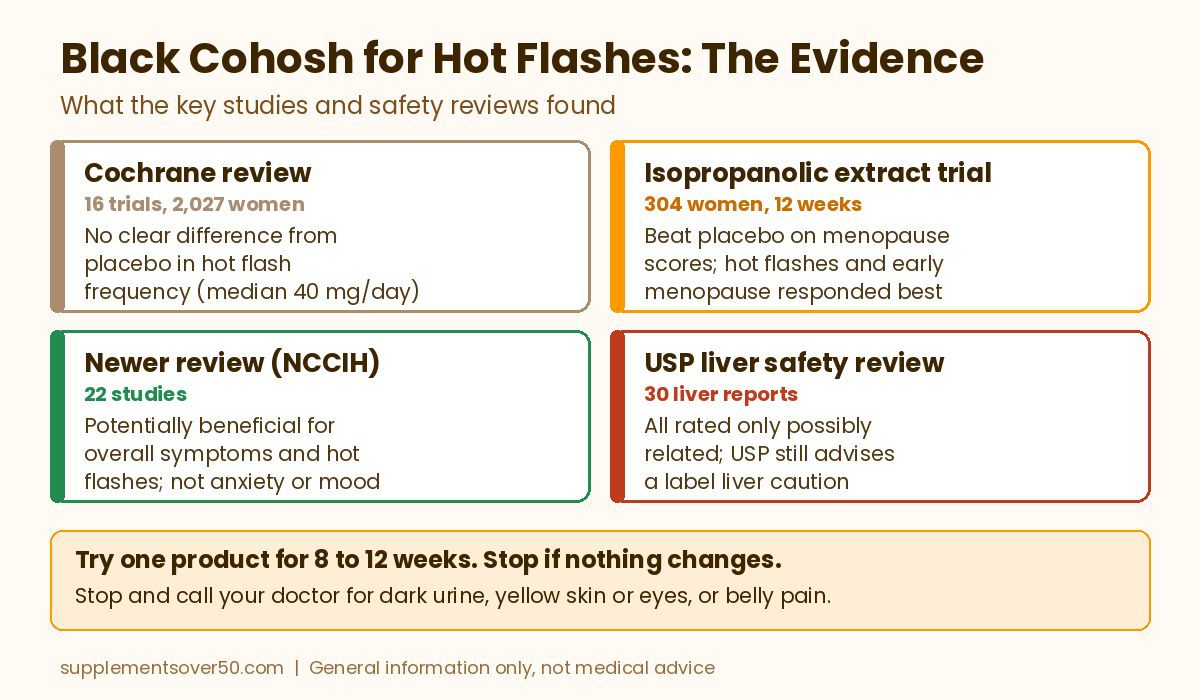
Here is the most important study to know about. A Cochrane review (Leach and Moore, 2012) pooled 16 randomized trials with 2,027 perimenopausal and postmenopausal women. The median dose was 40 mg a day for an average of 23 weeks. It found no significant difference between black cohosh and placebo in how often hot flashes happened, and no significant difference in overall menopause symptom scores. Hormone therapy did better than black cohosh. The authors concluded there is currently insufficient evidence to support black cohosh for menopause symptoms, while noting that the trials were often poorly reported and that more research is justified.
The more hopeful evidence comes mostly from one product. In a randomized, double-blind trial published in Obstetrics & Gynecology (Osmers and colleagues, 2005), 304 women took an isopropanolic black cohosh extract, the type used in Remifemin, or a placebo for 12 weeks. The extract group improved more on a standard menopause rating scale, hot flashes were the symptom that responded best, and women early in menopause benefited more than those further along. Side effects were similar to placebo. The study was supported by the extract’s manufacturer, which is worth keeping in mind.
The National Center for Complementary and Integrative Health (NCCIH) sums up the newer picture: a 2023 review of 22 studies of products containing black cohosh, alone or with other herbs, found them potentially beneficial for overall menopause symptoms and showed improvements in hot flashes, though not in anxiety or depression. It is uncertain whether black cohosh helps hot flashes caused by breast cancer treatment. The Menopause Society’s position statement does not recommend supplements and herbal remedies for hot flashes.
Our reading: black cohosh may give a modest lift for some women, especially with the most studied extract and earlier in menopause. It is not a substitute for hormone therapy or the proven nonhormone prescriptions, and it is fair to try it only with clear expectations and a set end date.
Is Black Cohosh Safe? The Liver Question
This is the safety issue every woman should understand before buying. The NIH Office of Dietary Supplements black cohosh fact sheet notes that reports from around the world describe at least 83 cases of liver damage associated with black cohosh, including hepatitis and liver failure, but that there is no evidence of a causal relationship. Some cases may have involved impurities, adulterants or the wrong Actaea species in the product.
A U.S. Pharmacopeia (USP) safety review (Mahady and colleagues, 2008) looked at 30 nonduplicate liver reports. All were rated as only possibly related to black cohosh, and none as probable or certain. Even so, the USP decided that black cohosh products should carry a cautionary statement, and it advises that people with liver disorders avoid black cohosh. The recommended wording tells users to stop and consult a healthcare practitioner if they have a liver disorder or develop symptoms of liver trouble, such as abdominal pain, dark urine or jaundice. The FDA does not require this warning, so it is a useful sign of a careful brand when you see it on the label.
NCCIH adds that black cohosh has been used safely in studies lasting as long as a year and is generally well tolerated, and that some commercial products have been found to contain the wrong herb or unlisted mixtures. The most commonly reported side effects in trials are mild stomach upset and rashes. Also, do not confuse black cohosh with blue cohosh, a different herb that NCCIH links to serious side effects.
What to Look for in a Black Cohosh Supplement
- A named, studied extract or a stated standardization. Remifemin uses an isopropanolic extract, and other brands standardize to triterpene glycosides. Products vary a lot in chemical makeup, so a defined extract is easier to compare with the research.
- A dose close to the studies. The trials in the Cochrane review used a median of 40 mg a day. Whole root powder products often list much larger milligram amounts, which is not the same thing as a concentrated extract.
- The correct species. Look for Actaea racemosa or Cimicifuga racemosa on the label. Identity testing matters because mislabeled herbs are one suspected cause of liver reports.
- The liver caution on the label. A brand that prints the USP-style warning is taking safety seriously.
- No surprise extras. Many menopause blends add soy isoflavones, red clover or other herbs. If you want to know whether black cohosh itself helps, start with a single-ingredient product.
- A label you can read. Our guide on how to read a supplement label explains extracts, serving sizes and quality seals.
Best Black Cohosh Supplement for Hot Flashes: Quick Comparison
| Product | Best for | Key details | Daily dose |
|---|---|---|---|
| Remifemin | Best overall, most studied | RemiSure black cohosh extract (iCR process); hormone free; made in Germany; 120 tablets | 2 tablets (equal to 40 mg root, per NIH ODS) |
| Nature’s Way Black Cohosh | Best standardized value | Extract standardized to 2.5% triterpene glycosides (1 mg per capsule); plant capsule; liver caution on label | 1 capsule twice daily |
| Herb Pharm Organic Black Cohosh Liquid | Best liquid, identity tested | Certified organic Actaea racemosa; potency checked by HPTLC; gluten free, non-GMO; 1 oz | See label |
| Zazzee Organic Black Cohosh | Best organic vegan capsule | USDA organic 10:1 extract; vegan capsule; made in USA in a GMP facility | 1 capsule (4-month bottle) |
| Nature’s Bounty Black Cohosh Root | Best budget whole root | 450 mg ground root; non-GMO; gelatin capsule; not a standardized extract | 1 capsule with a meal |
Top Picks for the Best Black Cohosh Supplement for Hot Flashes
1. Remifemin (Best Overall, Most Studied Extract)
If you are going to try black cohosh, it makes sense to try the version with the most research behind it. Remifemin uses its RemiSure black cohosh extract, made with what the brand calls an iCR extraction process. The brand says it has been studied for over 60 years, in more than 35 clinical studies involving over 13,000 women. The NIH fact sheet notes that Remifemin is standardized to be equivalent to 40 mg of black cohosh root per daily dose of two tablets, the same amount used in the Osmers trial.
It is hormone free and made in Germany, and the listing says full effects show up after about 8 weeks of regular use, which fits the trial timelines. It has more than 4,300 ratings. Its rating is slightly lower than some cheaper options, and remember that much of its research was funded by the manufacturer and that independent reviews are less positive. Still, this is the product we would start with.
2. Nature’s Way Black Cohosh (Best Standardized Extract for the Value)
Nature’s Way offers a black cohosh root and rhizome extract standardized to 2.5% triterpene glycosides, providing 1 mg per capsule, according to the ingredient list. You take one capsule twice daily with food or water. Standardization means each capsule should contain a consistent amount of the compounds the brand measures, which is what you want from an herb with variable chemistry.
The label tells you not to use it if you are pregnant, nursing or have a liver disorder, and to stop if you develop signs of liver trouble such as abdominal pain, dark urine or jaundice. That mirrors the USP caution. The capsule is plant based and free of gluten, dairy, gelatin, soy and corn. It has more than 1,500 ratings.
3. Herb Pharm Organic Black Cohosh Liquid (Best Liquid With Identity Testing)
Some women prefer drops in water to swallowing another pill. Herb Pharm’s liquid extract is made from certified organic Actaea racemosa, the correct species, and the brand says potency is checked using high performance thin layer chromatography (HPTLC), a lab method used to confirm a plant’s identity and profile. Given that mislabeled herbs are a suspected cause of some liver reports, that testing is a real plus.
The label states that in rare cases black cohosh has been reported to affect the liver and tells you to stop and see your practitioner if symptoms appear. It is gluten free and non-GMO, in a 1 ounce bottle. The listing does not state a standardized amount per serving, so follow the dosing on the bottle and do not compare drops to tablet milligrams. It has more than 500 ratings. Liquid herbal extracts usually contain alcohol, so check the label if you avoid it.
4. Zazzee Organic Black Cohosh (Best Organic Vegan Capsule)
Zazzee uses a USDA certified organic black cohosh 10:1 extract in vegan capsules, with organic rice powder and rice hulls as the other ingredients. One bottle of 120 capsules is described as a four-month supply. The brand says it is made in the USA in a certified facility that follows good manufacturing practices, and it is free of gluten, wheat, corn and sweeteners.
A 10:1 ratio means concentrated, but the listing does not state a triterpene glycoside standardization or link the extract to a studied product, so treat it as a clean, organic option rather than a research match. It has more than 700 ratings. If you want organic and vegan above all, this is the pick.
5. Nature’s Bounty Black Cohosh Root (Best Budget Whole Root)
Nature’s Bounty is the best-known name in this category, with more than 12,000 ratings. Each capsule contains 450 mg of ground black cohosh root, taken once daily with a meal, and the brand notes the capsules can be opened to make a tea. It is non-GMO and uses a gelatin capsule, so it is not suitable for vegetarians.
Be clear about what you are buying: this is powdered whole root, not a concentrated, standardized extract like the ones used in most trials. The 450 mg figure is not comparable to the 40 mg extract doses in the research. It is an affordable way to test whether black cohosh agrees with you, but if it does nothing after 12 weeks, that does not tell you much about a standardized extract.
How to Choose the Best Black Cohosh Supplement for Hot Flashes
- If you want the best chance of matching the research, pick Remifemin and take it as directed for 8 to 12 weeks.
- If you want a standardized extract at a lower cost, pick Nature’s Way Black Cohosh.
- If you dislike capsules, pick Herb Pharm’s liquid and follow the bottle’s dosing.
- If organic and vegan matter most, pick Zazzee.
- If you just want to test whether you tolerate the herb, Nature’s Bounty is the budget option, with the caveat that it is not an extract.
- If your hot flashes are severe or wreck your sleep, skip the supplement aisle first and ask your doctor about hormone therapy or proven nonhormone prescriptions.
How to run a fair trial: pick one single-ingredient product, track hot flashes for a week before you start, then take it consistently for 8 to 12 weeks and compare. If nothing has changed by 12 weeks, stop. Most studies lasted six months or less, and no published studies have assessed long-term safety, so if it does help, review it with your doctor at around six months rather than taking it indefinitely.
For a wider look at options beyond black cohosh, see our best menopause supplement for women over 50 roundup and our evidence-based menopause supplement stack. If night sweats are the main problem, our guide to the best magnesium for women over 50 covers sleep support, and shatavari for menopause looks at another herb women ask about.
Who Should Avoid Black Cohosh or Ask a Doctor First
- Liver disease or heavy alcohol use. The USP advises people with liver disorders to avoid black cohosh. If you take medicines that can stress the liver, ask your doctor first.
- Breast cancer or another hormone-sensitive condition. NCCIH says it is uncertain whether black cohosh is safe for women who have had hormone-sensitive conditions such as breast or uterine cancer, and its benefit for hot flashes caused by cancer treatment is unclear. Talk to your oncologist before taking it, especially if you take tamoxifen or an aromatase inhibitor.
- Pregnancy or breastfeeding. Black cohosh may not be safe, and it should never be used to induce labor.
- Any prescription medicines. The NIH fact sheet says black cohosh is not known to have clinically relevant drug interactions, but this has not been systematically studied. Bring the bottle to your doctor or pharmacist, and see our guide to supplements to avoid with blood thinners if you take one.
- Unexpected vaginal bleeding after menopause. This always needs a doctor’s visit. Do not assume it is a supplement side effect.
- Warning signs while taking it. Stop and call your doctor right away if you notice dark urine, yellowing of the skin or eyes, belly pain, or unusual tiredness.
Frequently Asked Questions
Does black cohosh really help hot flashes?
The evidence is mixed. A Cochrane review of 16 trials found no clear difference from placebo for hot flash frequency, while some trials of the isopropanolic extract used in Remifemin found a modest benefit, mainly early in menopause. It may help some women, but it is weaker than hormone therapy.
How long does black cohosh take to work for hot flashes?
Give it 8 to 12 weeks of daily use. The main Remifemin trial ran for 12 weeks, and the brand says full effects show after about 8 weeks. If you notice no change by 12 weeks, it is reasonable to stop and talk to your doctor about other options.
Can black cohosh damage your liver?
Liver damage is rare, and it is not proven that black cohosh caused the reported cases. Still, the USP recommends a label warning and advises people with liver disorders to avoid it. Stop and call your doctor if you notice dark urine, yellow skin or eyes, or belly pain.
Is black cohosh safe after breast cancer?
It is uncertain. NCCIH says the safety of black cohosh for women with a history of breast or other hormone-sensitive cancers is not established, and its benefit for hot flashes from cancer treatment is unclear. Talk to your oncologist before you take it.
How long can you safely take black cohosh?
Most studies lasted six months or less, and some ran up to a year, but long-term safety has not been studied. A sensible plan is to review it with your doctor at about six months rather than taking it indefinitely.
What is the best form of black cohosh for hot flashes?
A standardized extract is the best match for the research. Remifemin’s isopropanolic extract has the most trials, at a daily dose equal to 40 mg of root. Whole root powder capsules are cheaper but are not the same as the extracts used in studies.
Our Take
Black cohosh is worth a fair, time-limited trial for women over 50 with mild to moderate hot flashes who cannot or would rather not use hormone therapy. The best black cohosh supplement for hot flashes is Remifemin, because its extract is the most studied, with Nature’s Way as a standardized option at a lower cost. Keep expectations modest, take one single-ingredient product for 8 to 12 weeks, stop if it does nothing, and stop immediately if you see any sign of liver trouble. If your symptoms are severe, the bigger wins are prescription options your doctor can discuss with you.
This article is for informational purposes only and is not medical advice. Talk to your doctor before taking black cohosh, especially if you have liver disease, a history of breast or other hormone-sensitive cancer, are pregnant or breastfeeding, or take prescription medications.