Red yeast rice can lower LDL cholesterol, but only when it contains monacolin K, which is chemically the same as the prescription statin lovastatin. That means it can also cause statin-type side effects (muscle, liver and kidney problems) and the same drug interactions. In the U.S., products with more than trace monacolin K cannot legally be sold as supplements, labels rarely list how much is inside, and some products are contaminated with citrinin, a kidney toxin. Never take it with a statin. It is mainly worth discussing with your doctor if you truly cannot tolerate statins, and it is not for pregnancy or breastfeeding.
Red yeast rice is one of the most popular “natural” cholesterol remedies, and it often comes up when someone in their 60s or 70s hears the word statin for the first time. This guide to red yeast rice benefits and side effects explains what it really is, how well it works, why it overlaps with a prescription drug, and who should stay away from it.
Here is the short version. Red yeast rice works to the extent that it acts like a statin. That is both the reason it can lower cholesterol and the reason it carries real risks, especially for older adults who take several medicines.
Table of Contents
Why Red Yeast Rice Benefits and Side Effects Matter More After 50
Cholesterol tends to rise with age, and many people over 50 are offered a statin to cut their risk of heart attack and stroke. Some would rather try something natural first. Others stopped a statin because of muscle aches and are looking for another option. Red yeast rice is marketed to both groups.
The catch is that age changes the safety picture. The FDA-approved lovastatin prescribing label on DailyMed lists advanced age (65 or older) as a predisposing factor for myopathy, the statin muscle problem that can rarely become a serious breakdown of muscle tissue called rhabdomyolysis. The MedlinePlus lovastatin page also asks people to tell their doctor if they are 65 or older, drink more than two alcoholic drinks a day, or have kidney, thyroid or liver problems. Because red yeast rice can contain the same compound, the same cautions apply.
Older adults are also more likely to take several prescriptions, and many common ones interact with lovastatin. Kidney function often declines with age too, which matters because one contaminant found in red yeast rice targets the kidneys. And unlike a prescription, you cannot tell from the bottle how strong a product is.
What Red Yeast Rice Is and Why It Overlaps With Statins
According to the NCCIH red yeast rice fact sheet, red yeast rice is made by fermenting rice with a fungus, usually Monascus purpureus. Depending on the strain and how it is fermented, the fungus can enrich the rice with substances called monacolins. The main one, monacolin K, is structurally identical to lovastatin.
Lovastatin, like other statins, slows the body’s production of cholesterol so less of it can build up in artery walls. In other words, a red yeast rice capsule with meaningful monacolin K is a low, unmeasured dose of a statin drug sold in a supplement bottle.
The FDA’s Position on Red Yeast Rice
NCCIH explains that, according to the FDA, red yeast rice products with enhanced or added lovastatin (monacolin K) cannot be marketed as dietary supplements in the United States. The reason is that lovastatin was approved as a new drug before it was ever sold as a food or supplement. The FDA has sent warning letters on several occasions to companies selling products with enhanced or added lovastatin.
This creates an odd situation. Products with enough monacolin K to clearly lower cholesterol are treated by the FDA as unapproved drugs and are not legally sold in the U.S. Products with very little monacolin K may be legal, but NCCIH says it is unknown whether they lower cholesterol at all.
Red Yeast Rice Benefits: What the Research Shows
The cholesterol-lowering effect is real when monacolin K is present. A 2015 meta-analysis of 20 randomized studies, published in Atherosclerosis, looked only at trials that used red yeast rice with a known monacolin K content. Compared with placebo, it lowered LDL cholesterol by 1.02 mmol/L, which is roughly 39 mg/dL. In trials that compared it with a statin, the LDL drop was not different. The authors also said the quality of safety assessment was low in most studies.
A larger pooled look, a 2023 meta-analysis of randomized trials in Expert Review of Clinical Pharmacology, found average drops of about 29 mg/dL in LDL, 33 mg/dL in total cholesterol and 23 mg/dL in triglycerides, plus a small rise of about 2.5 mg/dL in HDL.
Studies in Statin-Intolerant and Older Adults
A small randomized trial in statin-intolerant patients, published in Annals of Internal Medicine in 2009, enrolled 62 people who had stopped statins because of muscle aches. Along with a 12-week lifestyle program, the red yeast rice group saw LDL fall by 43 mg/dL at 12 weeks and 35 mg/dL at 24 weeks, compared with 11 and 15 mg/dL on placebo. Muscle enzyme levels and pain scores were not different between the groups. The authors noted the study was small, short and focused on lab results.
The strongest outcome data come from the China Coronary Secondary Prevention Study, which randomly assigned nearly 5,000 Chinese adults who had already had a heart attack to placebo or Xuezhikang, a partially purified red yeast rice extract, for about 4.5 years. Major coronary events fell from 10.4% to 5.7%. An analysis of 1,530 participants aged 65 and older reported a 38% lower risk of coronary events. These results come from one specific extract in one population, so they cannot be applied to whatever is on a U.S. store shelf.
NCCIH sums it up this way: products with considerable monacolin K may lower cholesterol, blood sugar and blood pressure, but those are the products the FDA considers unapproved drugs. For low-monacolin products, the benefit is unknown. So any honest look at red yeast rice benefits and side effects starts with one question: how much monacolin K is in the bottle?
Red Yeast Rice Side Effects and Safety Concerns
Statin-Type Side Effects
NCCIH says red yeast rice products that contain significant monacolin K can have the same potential side effects as statin drugs, including muscle, kidney and liver damage, along with digestive problems such as diarrhea, nausea and stomach pain. The lovastatin label describes muscle pain, tenderness or weakness as the warning signs of myopathy, and reports that persistent rises in liver enzymes occurred in 1.9% of adults on lovastatin for at least a year in early trials.
The safety research on red yeast rice itself is mixed. A 2024 umbrella review of 15 meta-analyses concluded the products appear safe, but rated the confidence of most of those reviews as low or critically low, and it found some links to higher uric acid and liver enzymes. NCCIH points out that the European Food Safety Authority took the opposite view in 2018 and could not identify a safe dietary level of monacolins.
Monacolin Content Varies Wildly
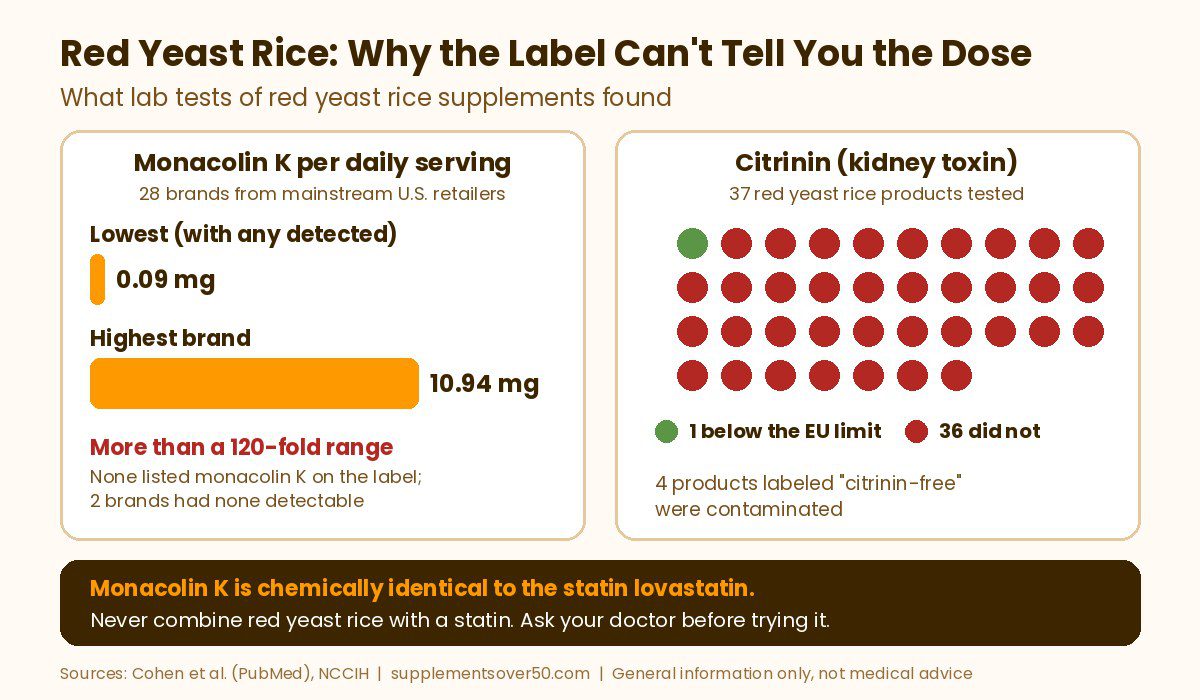
You cannot know how much statin you are taking. In a 2017 analysis of 28 brands sold by mainstream U.S. retailers, none listed monacolin K on the label. Two had none detectable. In the rest, the amount ranged more than 60-fold, from 0.09 to 5.48 mg per 1,200 mg of red yeast rice. Following each maker’s daily serving, intake would range from 0.09 to almost 11 mg a day, a more than 120-fold spread. One bottle may do nothing while another acts like a real prescription dose.
Citrinin, a Kidney Toxin
Some red yeast rice products are contaminated with citrinin, a toxin made during fermentation that can damage the kidneys. NCCIH reports that in a 2021 analysis of 37 red yeast rice products, only one had citrinin levels below the maximum level set by the European Union. Four products labeled “citrinin-free” were contaminated. That is why a “citrinin-free” claim on its own is not enough reassurance.
Kidney concerns are not only about citrinin. In Japan, a recent wave of kidney injuries was linked to specific Beni-koji (red yeast rice) tablets. A nationwide survey of Japanese kidney specialists, published in Kidney International, found citrinin was not produced by the strains involved, yet most of the 192 patients had reduced kidney function, and 87% still did at their last check after stopping the product. If you have chronic kidney disease, our Supplements to Avoid With Kidney Disease After 60 guide explains why many supplements carry extra risk.
Red Yeast Rice Benefits and Side Effects at a Glance
This summary puts the red yeast rice benefits and side effects next to a prescription statin, using the sources above.
Red yeast rice supplement
Prescription statin (such as lovastatin)
Active ingredient
Monacolin K (identical to lovastatin), if present at all
Known statin drug
Dose on the label
Usually not listed; 0 to about 11 mg per day across 28 tested U.S. brands
Exact dose in every tablet
LDL effect
About 29 to 39 mg/dL lower in pooled trials of products with monacolin K
Well established; dose can be adjusted
Heart outcome data
One large trial of a specific extract in China
Many large trials in many populations
Side effects
Same statin-type risks when monacolin K is present, plus digestive upset
Muscle and liver effects; monitored by your doctor
Contamination risk
In one analysis, only 1 of 37 products was below the EU citrinin limit
Made under drug manufacturing rules
Drug interactions
Same as lovastatin when monacolin K is present
Checked by your pharmacist
Pregnancy
Not recommended
Lovastatin is contraindicated
Red Yeast Rice vs Statins: Never Take Both
Taking red yeast rice with a statin means doubling up on the same type of drug, and a higher statin effect raises the risk of muscle and liver damage. The lovastatin label states that the risk of myopathy increases with higher levels of statin activity in the blood. If you already take any statin, such as atorvastatin, rosuvastatin, simvastatin, pravastatin or lovastatin, do not add red yeast rice.
Do not swap your statin for red yeast rice on your own either. A prescription comes with a known dose, outcome data and follow-up blood tests. A supplement with an unknown amount of monacolin K offers none of that.
Drug Interactions to Know
NCCIH says red yeast rice can have the same drug interactions as statins. The lovastatin label is the best guide to what those are. It lists the following as risky with lovastatin:
Strong CYP3A4 inhibitors (do not combine). These include the antifungals itraconazole, ketoconazole, posaconazole and voriconazole; the antibiotics erythromycin, clarithromycin and telithromycin; HIV protease inhibitors and cobicistat-containing products; certain hepatitis C drugs; and the antidepressant nefazodone. They block the liver enzyme that breaks lovastatin down, so levels climb.
Grapefruit juice. It also inhibits CYP3A4. In one study on the label, large amounts of double-strength grapefruit juice raised lovastatin levels about 15-fold. MedlinePlus advises talking to your doctor about grapefruit.
Gemfibrozil and cyclosporine, which the label says should be avoided with lovastatin, and caution with other fibrates and high-dose niacin.
Some heart medicines, including diltiazem, verapamil, dronedarone and amiodarone, which call for a lower lovastatin dose limit. Danazol is in this group too.
Colchicine, the gout medicine, with reported cases of muscle breakdown.
Because you can’t know the monacolin K dose in a red yeast rice product, you also can’t apply the label’s dose limits. Bring the bottle to your pharmacist and ask them to check it against every medicine you take, including short courses of antibiotics or antifungals.
Weighing Red Yeast Rice Benefits and Side Effects: What to Look For
Some doctors are open to red yeast rice for a patient who truly cannot tolerate any statin and has a lower overall heart risk. The 2015 meta-analysis authors said it might become an option for statin-intolerant patients, but only once its safety is confirmed in better studies. If you and your doctor decide to try it, these steps reduce the risk:
Choose a single-ingredient product rather than a blend, so you know what you are reacting to if side effects appear.
Look for a brand that names its monacolin content and publishes third-party testing for citrinin, while remembering that NCCIH found some “citrinin-free” labels were wrong.
Get baseline blood work, including cholesterol, liver enzymes and kidney function, and repeat it after a few months.
Stick with one brand. Since strength varies so much, switching products can change your dose without warning.
Report muscle pain, weakness or dark urine right away and stop the product until you have spoken with your doctor.
What to Do Instead
For most people over 50, the red yeast rice benefits and side effects tip toward safer first steps that do not involve an unmeasured statin:
If a statin gave you muscle aches, ask your doctor about a different statin, a lower dose, or a non-statin cholesterol medicine before turning to red yeast rice.
If your LDL is only mildly high, diet changes such as more soluble fiber and plant sterols are well studied and do not act like a drug.
If you take many medicines, ask your pharmacist for a full review before adding any cholesterol supplement.
Our Best Cholesterol Supplements for Seniors guide covers the options with better safety records, such as plant sterols, psyllium fiber and omega-3s, and explains why red yeast rice was left out. If muscle symptoms are what pushed you off a statin, you may have read about CoQ10; our Best CoQ10 Supplements for Seniors guide looks at what the research shows. Berberine is another popular cholesterol supplement, and it has its own interactions, covered in our Best Berberine Supplement for Seniors guide.
Who Should Avoid Red Yeast Rice
Anyone taking a statin or another cholesterol medicine, unless their doctor specifically approves it.
People who are pregnant, trying to conceive or breastfeeding. NCCIH says it is not recommended, and lovastatin is contraindicated in pregnancy and nursing.
People with liver disease or unexplained high liver enzymes, which are contraindications for lovastatin.
People with kidney disease, because of citrinin contamination and the kidney injuries reported in Japan.
Anyone on interacting drugs, such as the antifungals, antibiotics, heart medicines and transplant drugs listed above.
People who drink more than two alcoholic drinks a day, which MedlinePlus flags for lovastatin.
When to See a Doctor
Talk to your doctor before starting red yeast rice, and tell them and your pharmacist if you already take it. MedlinePlus lists symptoms on lovastatin that need a call to your doctor right away or emergency help: muscle pain, tenderness or weakness; fever or unusual tiredness; dark-colored urine; yellowing of the skin or eyes; pain in the upper right side of the stomach; nausea or loss of appetite; unusual bleeding or bruising; and rash, hives, swelling or trouble breathing or swallowing. Treat the same symptoms seriously on red yeast rice.
Also ask for a recheck of your cholesterol, liver and kidney tests a few months after starting, so you know whether the product is doing anything and whether it is safe for you.
Frequently Asked Questions
Is red yeast rice the same as a statin?
When it contains monacolin K, it acts like one. NCCIH says monacolin K is structurally identical to the prescription statin lovastatin. That is why red yeast rice can lower LDL cholesterol and why it can cause the same side effects and drug interactions as a statin.
Can I take red yeast rice with my statin?
No. Combining them doubles up on the same type of drug and raises the risk of muscle and liver damage. Do not add red yeast rice to any statin, and do not swap your statin for it without talking to your doctor.
How much does red yeast rice lower cholesterol?
In pooled trials of products with monacolin K, LDL fell by about 29 to 39 mg/dL compared with control groups. U.S. products vary widely, though, and NCCIH says it is unknown whether low-monacolin products lower cholesterol at all.
What are the side effects of red yeast rice?
Products with significant monacolin K can cause statin-type problems, including muscle pain or damage and liver or kidney injury, plus diarrhea, nausea and stomach pain. Some products are also contaminated with citrinin, a toxin that can harm the kidneys.
Is red yeast rice safe for seniors?
It needs extra care. Age 65 and older is a risk factor for statin muscle problems, many seniors take medicines that interact with lovastatin, and kidney function often declines with age. Only use it with your doctor’s approval and follow-up blood tests.
Should I avoid grapefruit with red yeast rice?
It is wise to ask your doctor. Grapefruit juice blocks the CYP3A4 enzyme that breaks down lovastatin, and the lovastatin label describes a study where large amounts raised drug levels about 15-fold. The same concern applies to red yeast rice with monacolin K.
Our Take
When you weigh the red yeast rice benefits and side effects, the two are hard to separate. Red yeast rice lowers LDL because it can contain a real statin, and that same ingredient brings statin side effects and interactions, without a known dose. Add the citrinin problem and the lack of label information, and it is a poor choice for most adults over 50. If you cannot tolerate statins, it may be worth a conversation with your doctor, with blood tests and a single trusted product. Never take it alongside a statin, and never use it in pregnancy.
This article is for informational purposes only and is not medical advice. Talk to your doctor or pharmacist before starting or stopping any supplement or medicine, especially if you take a statin or other prescription drugs, or have liver or kidney disease.
Alpha GPC, short for alpha-glycerophosphocholine, is the most bioavailable choline source available as a supplement. It crosses the blood-brain barrier…
Supplements to avoid with blood thinners: how vitamin K, St. John’s wort, ginkgo, garlic, vitamin E, fish oil and more can affect warfarin, Eliquis and Xarelto.
Discover the best joint supplement stack for seniors to reduce stiffness, improve mobility, and support healthy cartilage. Boost your active lifestyle today!
The best taurine supplement for seniors, honestly reviewed: what the mouse longevity study and newer NIH data show, safe doses, and 5 plain taurine picks.