Best Potassium Supplement for Adults Over 50
This guide contains affiliate links. If you buy through them, we may earn a small commission at no extra cost to you.
Choosing the best potassium supplement after 50 is a little different from choosing most vitamins. Potassium matters for your heart, muscles, nerves and fluid balance, and most Americans eat less of it than recommended. But potassium is also one of the few minerals where taking too much, or taking it with the wrong medicine, can become dangerous quickly. That is why the bottles on the shelf look surprisingly weak, and why the right answer for many people over 50 is a plate of beans and potatoes rather than a pill.
Below we explain how much potassium you actually need, why supplements are capped at 99 mg, how potassium citrate and gluconate compare, what the blood pressure research really shows and who should check with a doctor first. Then we share five budget-friendly, best-selling picks for people whose doctor is happy with a small daily top-up. Every product detail comes from the Amazon listing, and every health fact links to its source.
Table of Contents
Best Potassium Supplement: Quick Comparison
| Product | Best for | Key details (per listing) | Daily serving |
|---|---|---|---|
| NOW Potassium Citrate 99 mg | Best overall (top pick) | Potassium citrate; vegan veggie capsules; NPA A-rated GMP; 180 capsules | 1 capsule, preferably with food (99 mg) |
| Nature Made Potassium Gluconate | Best-selling tablet | 550 mg potassium gluconate tablet that provides 90 mg of potassium; 100 tablets | 1 tablet with water and a meal (90 mg) |
| Nature’s Bounty Potassium 99 mg | Best budget once-daily | Potassium gluconate caplets; vegetarian; no gluten, milk, lactose or sugar; 100 caplets | 1 caplet, preferably with a meal (99 mg) |
| NOW Potassium Gluconate 99 mg | Easiest to swallow | Easier-to-swallow tablet; vegan, non-GMO; NPA A-rated GMP; 100 tablets | Label allows up to 5 a day; ask your doctor before taking more than 1 |
| Nutricost Potassium Citrate 99 mg | Best big-bottle value | Potassium citrate; third-party tested; non-GMO, gluten and soy free; 500 capsules | 1 capsule (99 mg); do not exceed label serving |
Why Potassium Matters More After 50
Potassium is a mineral every cell in your body uses. According to the NIH Office of Dietary Supplements (ODS) potassium fact sheet, it keeps fluid balanced inside and outside your cells and is needed for nerve signals, muscle contraction and normal kidney function. It also works closely with sodium, which is why potassium comes up so often in conversations about blood pressure.
Most people fall short. ODS reports that dietary surveys consistently show people in the United States eat less potassium than recommended, with average intakes from food of about 3,016 mg a day for men and 2,320 mg a day for women. Both numbers sit below the targets for adults over 50.
Popular Supplement Guides:

The other side of the story matters just as much after 50. Your kidneys are what clear extra potassium from your blood, and kidney disease becomes much more common with age. The CDC estimates that chronic kidney disease affects about 34% of US adults aged 65 or older, compared with 13% of adults aged 45 to 64, and that about 9 in 10 adults with kidney disease do not know they have it. Add in the blood pressure and heart medicines many people start in their 50s and 60s, and potassium becomes a mineral to manage with your doctor, not guess at.
How Much Potassium Per Day Do You Need After 50?
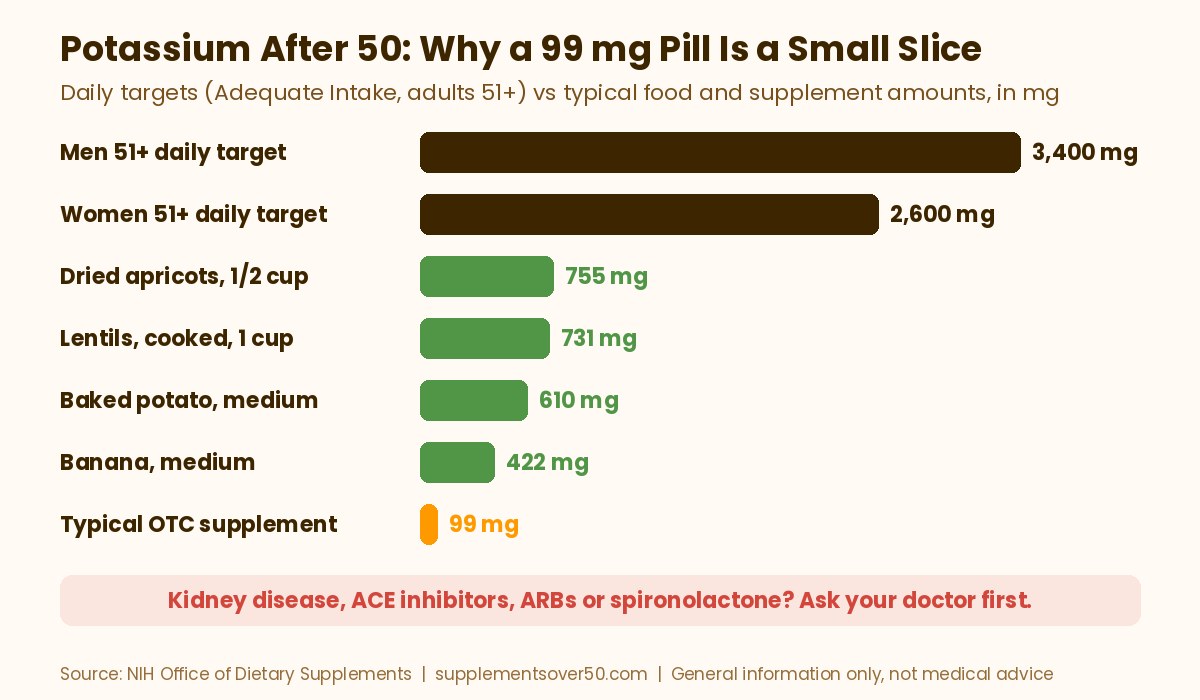
ODS lists an Adequate Intake (AI) for potassium rather than a firm requirement. For adults 51 and older, the AI is:
- Men 51+: 3,400 mg of potassium a day.
- Women 51+: 2,600 mg of potassium a day.
You may also see a Daily Value (DV) of 4,700 mg on food and supplement labels. That is the labeling reference, not a personal target. ODS also notes that experts did not set an upper limit for potassium from food, because healthy kidneys simply flush out the extra. That reassurance does not apply to people with kidney disease or those taking medicines that make the body hold on to potassium, which we cover below.
Food makes it easy to see why a 99 mg pill is a small player. Using figures from the ODS food table, half a cup of dried apricots has about 755 mg, a cup of cooked lentils about 731 mg, a medium baked potato about 610 mg, a cup of canned kidney beans about 607 mg and a medium banana about 422 mg. A single potato gives you roughly six times what a typical supplement capsule does.
Why Potassium Supplements Are Capped at 99 mg
If you have wondered why nearly every bottle says 99 mg, there is a safety story behind it. ODS explains that many manufacturers limit potassium to 99 mg per serving, which is only about 2% of the DV, because of two FDA actions on potassium drugs:
- Small-bowel injuries. FDA ruled that some oral drug products containing potassium chloride with more than 99 mg of potassium are not safe, because they were linked to lesions in the small intestine.
- Warning labels. FDA requires some potassium salts with more than 99 mg per tablet to carry a warning about reports of small-bowel lesions.
ODS adds that FDA has not formally ruled on whether supplements above 99 mg need that warning, and you will find some higher-dose products and loose potassium powders online. For most people over 50, those are not a do-it-yourself product. If you genuinely need more potassium than food provides, that is usually a prescription decision, with blood tests to keep you safe.
One more label tip: the Supplement Facts panel lists the amount of elemental potassium, not the weight of the whole compound. That is why Nature Made sells a 550 mg potassium gluconate tablet that provides 90 mg of actual potassium. Always read the potassium line, not the big number on the front.
Potassium Citrate vs Gluconate (and Other Forms)
ODS says potassium in supplements often comes as potassium chloride, but many other forms are used, including citrate, gluconate, phosphate, aspartate and bicarbonate. Here is how the two most common budget forms compare:
- Potassium gluconate: one of the few forms with human absorption data. ODS cites a dose-response trial that found people absorb about 94% of the potassium from gluconate supplements, similar to potassium from potatoes.
- Potassium citrate: widely sold and described by brands like NOW as well absorbed. ODS notes that only a few studies have compared how well the different supplement forms are absorbed, so we would not pay extra for one form over the other.
- Potassium glycinate and other chelates: these exist, but none of the glycinate products we checked were strong sellers, so we left them out. At 99 mg per serving, the form matters far less than the dose and your medicines.
Our practical take on potassium citrate vs gluconate: both are fine at 99 mg. Pick whichever capsule or tablet you find easier to take, and choose a single-ingredient product so you know exactly how much potassium you are getting.
Does a Potassium Supplement Help Blood Pressure?
This is the big question for many people over 50, and the honest answer is: potassium from your overall diet may help, but a 99 mg pill is unlikely to do much on its own. Here is what ODS reports:
- Diet: low potassium intakes are linked to a higher risk of high blood pressure, especially with high sodium intakes, and higher intakes may help lower blood pressure. The DASH eating pattern, rich in fruits, vegetables and low-fat dairy, lowered systolic blood pressure by an average of 5.5 mmHg, although it also adds magnesium and calcium, so potassium’s own share cannot be separated out.
- Higher-dose trials: a meta-analysis of 25 randomized trials in 1,163 people with high blood pressure found average drops of about 4.5 mmHg systolic and 3 mmHg diastolic. But those trials mostly used potassium chloride at 1,173 to 4,692 mg a day, many times what an over-the-counter capsule holds.
- Mixed findings: a Cochrane review of six of the highest-quality trials found reductions that were not statistically significant, and a federal AHRQ review called the links between dietary potassium and lower blood pressure in observational studies inconsistent.
So if blood pressure is your main reason for looking at potassium, the better plan is more potassium-rich food, less sodium and regular readings at home, all agreed with your doctor. Our guide to supplements to lower blood pressure after 50 explains where potassium fits alongside magnesium, beetroot and the other popular options, and our review of the best home blood pressure monitor picks will help you track whether anything you change is working. Never stop or reduce a prescribed blood pressure medicine because you started a supplement.
What to Look for in the Best Potassium Supplement
- 99 mg or less per serving. That is the standard over-the-counter amount. Be wary of products sold as high potency unless your doctor has prescribed that dose.
- A single-ingredient formula. Potassium blended with magnesium, sodium or herbs makes it harder to track your total intake.
- Elemental potassium on the label. Read the potassium line in Supplement Facts, not the compound weight on the front.
- Simple directions. One capsule or tablet a day with food is easiest to stay within a safe amount.
- Quality signals. Look for GMP manufacturing, third-party testing and a brand with a long track record.
- Easy swallowing. Some tablets are large; gluconate tablets marketed as easier to swallow or small capsules can help.
- No electrolyte stacking. If you already use an electrolyte drink mix or a potassium salt substitute, count that potassium too.
Top Picks for the Best Potassium Supplement Over 50
These picks are for people whose doctor has said a small daily potassium supplement is fine. We focused on budget-friendly, single-ingredient products that are in stock, sold by Amazon or the brand, and among the best sellers in the category. Ratings, review counts and monthly sales come from the Amazon listings at the time of writing.
1. NOW Potassium Citrate 99 mg (Best Overall)
NOW Potassium Citrate 99 mg is our top pick because it ticks every box for a simple, low-dose top-up. The listing says to take one veggie capsule a day, preferably with food, and each bottle of 180 capsules lasts about six months. It is one of the most popular potassium supplements on Amazon, with 10,000+ bought in the past month and a 4.7 rating from 23,000+ reviewers, and it is sold by Amazon.
NOW describes potassium citrate as a well absorbed form, and the capsules are listed as vegan, kosher, soy free, dairy free and made without gluten. The listing also notes NPA A-rated GMP certification and in-house lab testing for potency. If you want one sensible bottle and no guesswork, start here.
2. Nature Made Potassium Gluconate (Best-Selling Tablet)
Nature Made Potassium Gluconate 550 mg is the best-selling potassium supplement in our search, with 10,000+ bought in the past month and a 4.7 rating from 16,000+ reviewers. It is sold by Amazon, and a bottle of 100 tablets is a 100-day supply.
Do not let the 550 mg on the front confuse you. That is the weight of the potassium gluconate compound; the listing says each tablet provides 90 mg of potassium. The directions are one tablet a day with water and a meal. Some reviewers point out how small the dose is compared with food, which is exactly the point: this is a gentle top-up, not a replacement for potassium-rich meals.
3. Nature’s Bounty Potassium 99 mg (Best Budget Once-Daily)
Nature’s Bounty Potassium 99 mg is a classic budget pick. Each vegetarian caplet provides 99 mg of potassium as potassium gluconate, and the directions are one caplet a day, preferably with a meal. It carries Amazon’s Choice, has 10,000+ bought in the past month and a 4.7 rating from 15,000+ reviewers, and is sold by Amazon.
The listing says the caplets contain no gluten, milk, lactose or sugar and are suitable for vegetarians. A bottle of 100 caplets lasts just over three months. Choose this one if you want a well-known brand at a low cost with clear once-a-day directions.
4. NOW Potassium Gluconate 99 mg (Easiest to Swallow)
If large pills are a struggle, NOW Potassium Gluconate 99 mg Easier to Swallow is worth a look. NOW markets it as an easier-to-swallow tablet, and the listing describes it as vegan, non-GMO, halal, kosher and made without gluten, with the same NPA A-rated GMP certification as its citrate sibling. It has a 4.6 rating from 3,500+ reviewers and is sold by Amazon.
One caution: the label allows up to five tablets a day in separate servings. We suggest sticking to one tablet a day unless your doctor specifically tells you to take more, because the whole reason for the 99 mg format is to keep each dose small. This bottle holds 100 tablets.
5. Nutricost Potassium Citrate 99 mg (Best Big-Bottle Value)
For people who take potassium every day with their doctor’s blessing, Nutricost Potassium Citrate 99 mg comes in a 500-capsule bottle, well over a year’s supply at one a day. The listing states 99 mg of elemental potassium per capsule as the maximum serving and plainly says not to exceed the recommended serving, which we like to see.
Nutricost says the capsules are third-party tested, non-GMO, gluten free and soy free, made in an NSF certified, GMP compliant facility. It has 6,000+ bought in the past month and a 4.7 rating from 15,000+ reviewers, and it is sold by eSupplements. Because the bottle is so large, store it well out of reach of grandchildren.
How to Choose the Best Potassium Supplement for You
- If you want one simple, well-reviewed capsule, pick NOW Potassium Citrate 99 mg.
- If you prefer a tablet from a pharmacy brand, pick Nature Made Potassium Gluconate, remembering it provides 90 mg of potassium.
- If budget comes first, pick Nature’s Bounty Potassium 99 mg.
- If you have trouble swallowing pills, pick NOW Potassium Gluconate 99 mg and take one a day.
- If you take potassium daily long term with your doctor’s approval, pick Nutricost Potassium Citrate 99 mg for the large bottle.
- If you have leg cramps or low energy, do not assume it is potassium. Ask your doctor for a blood test before you start.
- If your doctor says your potassium is low, follow their plan. A prescription dose is very different from a 99 mg capsule.
Potassium rarely works alone. Our guide to the best magnesium supplements for seniors covers the mineral that most often travels with it, and if you are thinking about drink mixes, read our pick of the best electrolyte supplement for seniors so you can count the potassium in those as well. If you have any kidney problems, our guide to supplements to avoid with kidney disease after 60 is essential reading.
Who Should Check With a Doctor Before Taking Potassium
This is the most important section of this guide. According to MedlinePlus, a high potassium level, called hyperkalemia, happens when the kidneys cannot remove enough potassium, and it can be caused or worsened by certain blood pressure medicines and by taking extra potassium from supplements or salt substitutes. Talk to your doctor or pharmacist before taking any potassium supplement if you:
- Have chronic kidney disease or have been told your kidney function is reduced. ODS warns that in people with kidney disease, even potassium intakes from food below the AI can cause hyperkalemia.
- Take an ACE inhibitor such as benazepril (Lotensin), or an ARB such as losartan (Cozaar). ODS explains these medicines reduce how much potassium the kidneys release.
- Take a potassium-sparing diuretic such as spironolactone (Aldactone) or amiloride. ODS says these can cause hyperkalemia and experts recommend monitoring potassium levels.
- Use a salt substitute. ODS reports many contain potassium chloride, from about 440 mg to 2,800 mg of potassium per teaspoon, far more than any supplement capsule.
- Have heart failure, type 1 diabetes, adrenal insufficiency or liver disease, which ODS lists as other conditions linked to hyperkalemia.
- Take a loop or thiazide diuretic such as furosemide (Lasix). These can lower potassium instead, and ODS says experts recommend monitoring and supplementing only if warranted, so let your doctor decide the dose.
High potassium often causes no symptoms at all, which is why blood tests matter. MedlinePlus says your provider will likely check your potassium and kidney function regularly if you take prescribed potassium, have chronic kidney disease, take medicines for heart disease or high blood pressure, or use salt substitutes.
Get emergency care right away if you have chest pain, trouble breathing, palpitations, a slow, weak or irregular pulse, or you feel faint. MedlinePlus lists these among the symptoms of a high potassium level, and a very high level can stop the heart.
Frequently Asked Questions
What is the best potassium supplement for adults over 50?
For a simple daily top-up, we like NOW Potassium Citrate 99 mg: one capsule a day with food, sold by Amazon and very well reviewed. Nature Made and Nature’s Bounty are good budget alternatives. Check with your doctor first, especially if you take blood pressure medicine or have kidney problems.
How much potassium per day do you need after 50?
The NIH Office of Dietary Supplements lists an Adequate Intake of 3,400 mg a day for men and 2,600 mg a day for women aged 51 and older. Most of that should come from food such as beans, lentils, potatoes, dried fruit, bananas, milk and leafy greens.
Why do potassium supplements only contain 99 mg?
Many brands cap potassium at 99 mg because FDA ruled that some potassium chloride drugs above 99 mg were unsafe after links to small intestine injuries, and it requires warnings on some higher-dose potassium tablets. Higher doses are usually prescribed and monitored by a doctor.
Potassium citrate vs gluconate: which is better?
At 99 mg, either is fine. Gluconate has human data showing about 94% absorption, similar to potassium from potatoes, and citrate is widely described as well absorbed. Few studies compare forms directly, so pick the one you find easiest to take.
Can a potassium supplement lower blood pressure?
Trials that lowered blood pressure mostly used 1,173 mg to 4,692 mg of potassium a day, far more than a 99 mg pill, and the highest-quality reviews show mixed results. Eating more potassium-rich food and less sodium is the safer approach. Do not change blood pressure medicine without your doctor.
Who should not take potassium supplements?
People with kidney disease and those taking ACE inhibitors, ARBs or potassium-sparing diuretics such as spironolactone should not take potassium supplements or potassium salt substitutes unless their doctor approves, because potassium can build up to dangerous levels.
Our Take
The best potassium supplement for most adults over 50 is a small, single-ingredient 99 mg capsule taken with your doctor’s approval, and our favorite is NOW Potassium Citrate 99 mg. But be realistic about what it can do: one capsule adds less potassium than a few bites of potato. Food is where the real gains are, and the real risks sit with kidney disease, certain blood pressure medicines and potassium salt substitutes. Get your levels checked, build meals around beans, vegetables and fruit, and use a supplement only as a modest top-up.
This article is for general information only and is not medical advice. Potassium supplements are dietary supplements and are not intended to diagnose, treat, cure or prevent any disease. Talk to your doctor or pharmacist before starting any supplement, especially if you take medication or have a health condition.