Supplements to Avoid With Kidney Disease After 60
If you or someone you care for has been told your kidneys are not working as well as they used to, knowing the supplements to avoid with kidney disease is one of the most practical things you can learn. Many adults over 60 take a handful of vitamins, minerals and herbal products on top of their prescriptions. With healthy kidneys, extra amounts are usually filtered out. With CKD, some of those same products can build up, push blood minerals out of range, or interact with your medicines.
This safety guide covers the main groups kidney organizations warn about, why each is a concern, and what to ask your care team. Use it to prepare for a conversation with your nephrologist, kidney dietitian or pharmacist, not to make changes on your own.
Table of Contents
Why Supplements Affect Your Kidneys Differently After 60
Your kidneys filter waste and extra fluid from your blood, and they keep minerals like potassium, phosphorus and magnesium in balance. According to the NIDDK, the most common causes of CKD in adults are diabetes and high blood pressure, If you live with either one, kidney health deserves extra attention after 60.
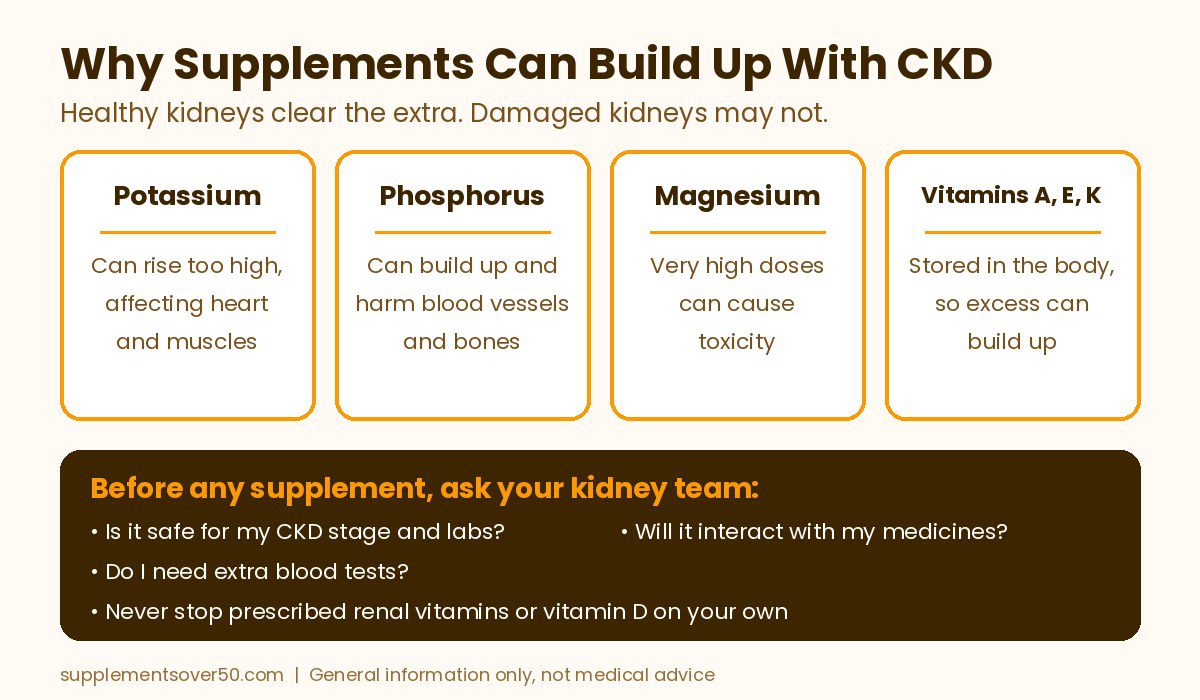
When kidney function drops, the body loses some of its ability to get rid of what it does not need. The NIDDK healthy eating guide for adults with CKD explains that damaged kidneys cannot remove phosphorus from the blood as well as healthy kidneys, and that CKD can make potassium levels in the blood become very high. Too much phosphorus can harm blood vessels and weaken bones, while potassium that is too high or too low can cause heart and muscle problems.
Vitamins work the same way. The National Kidney Foundation page on vitamins in CKD notes that with CKD, some vitamins may build up too much while others are lost too easily, and that people on dialysis lose some vitamins during each treatment. That is why the right plan for one person with CKD can be wrong for another.
Popular Supplement Guides:

Many older adults also take several medicines. A pharmacist quoted by the National Kidney Foundation said dialysis patients take anywhere from eight to twelve prescription medicines a day. Every supplement added on top is another chance for an interaction.
What Kidney Experts Say About Supplements and CKD
The clearest guidance comes from the National Kidney Foundation guide to herbal supplements and kidney disease. It says that for people living with CKD, herbal supplements can carry many risks, including making kidney disease worse, interacting with prescription medicines, and raising the risk of CKD complications. It also reminds readers that the FDA does not regulate herbal supplements for dose, content or purity.
The NKF lists several specific safety concerns:
- Drug interactions that can make prescription medicines less effective or too strong. After a kidney transplant, an interaction can raise the risk of losing the new kidney.
- Contaminants such as heavy metals, including lead, mercury and arsenic.
- Ingredients known to cause kidney damage, such as aristolochic acid, which is banned in many countries but still found in some traditional remedies.
- Build-up in the body. Some herbal products leave the body through the kidneys, so toxic levels can develop with kidney disease, and this is not always stated on the label.
- Unreliable dosing, because plant quality and recipes vary between brands and batches.
Vitamins are a slightly different story. The NKF says kidney teams do prescribe vitamins when there is a deficiency, such as low vitamin D. But it also says to take only the vitamins your healthcare professional recommends, at the doses recommended, and not to start or stop any vitamin on your own. The NIDDK guide to managing chronic kidney disease adds that your pharmacist and provider need to know about everything you take, including over-the-counter medicines, vitamins and supplements.
Supplements to Avoid With Kidney Disease: Summary Table
This table pulls together the main groups that kidney organizations and the NIH flag. It is not a complete list, and your own risk depends on your stage, labs and medicines.
| Supplement or group | Why it is a concern with reduced kidney function | What to do |
|---|---|---|
| Potassium supplements, salt substitutes, “electrolyte” products | CKD can make it harder to clear potassium, and blood levels can get too high (hyperkalemia), which affects the heart and muscles | Do not add potassium unless your kidney team prescribes it; ask before using salt substitutes |
| High-dose magnesium, magnesium laxatives and antacids | Healthy kidneys clear excess magnesium; very high doses can cause magnesium toxicity | Ask before taking any magnesium supplement or magnesium-containing laxative or antacid |
| Phosphorus-rich products: seaweed, kelp, chlorella, spirulina, green powders, seed-based products | Damaged kidneys cannot remove phosphorus well; high levels can harm blood vessels and bones | Avoid unless approved; check labels for hidden phosphorus additives |
| Vitamins A, E and K | The body stores them, so taking too much can build up and cause harm; most people with CKD get enough from food | Do not take separately unless your doctor recommends it |
| High-dose vitamin C | With CKD the kidneys may not remove the extra; too much can raise the risk of calcium oxalate stones | Use only the dose your team recommends, especially with a stone history |
| High-risk herbals: licorice root, St. John’s wort, aristolochia products, yohimbe, chaparral, comfrey and others | Kidney damage, contamination, toxic build-up or serious drug interactions | Avoid unless your nephrologist approves; tell your team about any you already take |
| Creatine | Listed by the NKF among products with a high safety risk for people with kidney disease | Do not start creatine without your kidney doctor’s approval |
| “Kidney detox” or “cleanse” teas and proprietary blends | Limited evidence they work; some ingredients may interact with medicines or damage kidneys; blends hide doses | Skip them; choose single-ingredient products only after approval |
The Main Supplements to Avoid With Kidney Disease, Explained
1. Potassium and “Electrolyte” Products
The NIH Office of Dietary Supplements potassium fact sheet says people with chronic kidney disease, and people taking certain medicines such as ACE inhibitors and potassium-sparing diuretics, can develop high blood potassium even from typical amounts of food. It also warns that potassium in many salt substitutes could push levels too high if you have kidney disease.
The NKF adds that some herbal products are naturally high in potassium, including alfalfa, dandelion, noni, nettle, kelp, coconut water based products and turmeric. Labels that promote “electrolyte support”, “high in minerals” or “superfood green powders” are a warning sign. If you use a hydration drink after exercise or in hot weather, ask your kidney team which ones fit your plan.
2. High-Dose Magnesium
Magnesium is a popular supplement for sleep, cramps and constipation. The NIH magnesium fact sheet explains that in healthy people the kidneys get rid of any excess in the urine, and it sets the adult upper limit at 350 mg a day from supplements and medicines. Very high doses can lead to magnesium toxicity, with symptoms that include low blood pressure, vomiting, irregular heartbeat and, in extreme cases, cardiac arrest.
With reduced kidney function, that built-in safety valve does not work as well. Magnesium also hides in some laxatives and antacids. If you take magnesium for any reason, ask your kidney doctor whether it is safe for you and at what dose. For general dosing background, our guide on How Much Magnesium Should Seniors Take Daily? explains the forms, but the CKD advice from your own team comes first.
3. Phosphorus-Rich Supplements
The NKF says seaweed and algae products, green powders and supplements made from seeds are the herbal products most likely to be high in phosphorus. Its list includes chlorella, spirulina, kelp and dulse, flaxseed, milk thistle, pumpkin seed products, sunflower lecithin and turmeric.
Phosphorus can also hide in inactive ingredients. A kidney dietitian interviewed by the NKF noted that a label may say “preservatives” when that could be a phosphorus additive.
4. Vitamins A, E and K, and High-Dose Vitamin D
According to the NKF, vitamins A, E and K usually do not need to be taken as supplements with CKD. Most people get enough from their diet, and because the body stores these vitamins, taking too much can build up and be harmful. Check your multivitamin too, since it may already contain all three.
Vitamin D is different, and this is where people get confused. Your kidneys help “turn on” vitamin D, and the NKF explains that in stage 4 or 5 CKD they may not do this well, so your doctor may prescribe a special form. A kidney dietitian quoted by the NKF also said people with kidney disease hold on to things longer, so vitamin levels can get too high without monitoring. The safe approach is to avoid high-dose over-the-counter vitamin D on your own, while continuing any vitamin D your doctor prescribed.
5. High-Dose Vitamin C
The NKF says that with CKD the kidneys may not be able to remove extra vitamin C, and that too much can raise the risk of calcium oxalate kidney stones. It adds that people with a history of these stones may need a low dose or may need to avoid vitamin C supplements. Vitamin C is often sold in large doses, so check the amount per serving on the label. Our guide to the Best Vitamin C Supplement for Seniors covers forms and doses for healthy adults, but with CKD, your kidney team sets the limit.
6. High-Risk Herbal Supplements
The NKF lists a number of herbal products as having a high overall safety risk for people with kidney disease, especially with kidney failure, dialysis or a transplant. Examples include:
- Licorice root (Glycyrrhiza glabra)
- St. John’s wort, which has many drug interactions. The NKF describes an early report where it lowered levels of the anti-rejection drug cyclosporine, leading to transplant rejection.
- Aristolochia products (birthwort, wild ginger), linked to aristolochic acid
- Astragalus and alfalfa, especially after a kidney transplant
- Yohimbe, chaparral, comfrey, cat’s claw, uva ursi (bearberry), horsetail, stinging nettle, goldenrod, parsley root and others
- Aloe vera taken by mouth and arnica, especially by mouth
Turmeric is not on the NKF high-risk list, but it does appear on its lists of herbs that can be high in both potassium and phosphorus. If you have been taking turmeric for joint pain, as many readers of our Best Turmeric Supplement for Seniors guide do, ask your kidney team whether it fits your lab results.
7. Creatine
Creatine is not an herb, but the NKF includes it on its list of products with a high safety risk for people with kidney disease, whether sold alone or mixed into other formulas. Creatine may help muscle strength in healthy older adults, which we cover in our Creatine for Seniors article. With CKD, though, do not start it without your nephrologist’s approval, and remember it is sometimes hidden inside protein powders and pre-workout blends.
A Note on Pain Relievers
Many older adults try supplements because they are trying to avoid pain pills. The NIDDK warns that NSAIDs, including ibuprofen and naproxen, can damage the kidneys and lead to acute kidney injury, especially in people with kidney disease, diabetes and high blood pressure. They are sold under many brand names and in cold medicines, so ask your pharmacist about any “joint” or “pain” product, supplement or medicine, before you take it.
What to Look for on a Supplement Label With CKD
- Single ingredients over blends. The NKF advises avoiding combination products and “proprietary blends”, “complexes” or “matrices” that hide how much of each ingredient you are getting.
- Words that signal minerals. “Electrolyte support”, “high in minerals” and “superfood greens” can point to potassium or phosphorus.
- Inactive ingredients. Look past the front of the bottle, since phosphorus additives can hide among the fillers and preservatives.
- Independent testing. The NKF names USP, NSF and ConsumerLab as groups that check products for quality and contaminants.
- Anything marketed for “kidney detox” or “kidney cleanse”. The NKF says to avoid these.
What to Do Instead
Avoiding the wrong supplements is only half the plan. Here is what kidney organizations suggest focusing on:
- Food first. A kidney dietitian quoted by the NKF said supplements do not make a bad diet better, and she pointed to plant-forward eating patterns such as Mediterranean-style diets.
- Work with a kidney dietitian. The NIDDK recommends working with a registered dietitian to find the right amounts of potassium, phosphorus, protein and sodium for you.
- Ask about a renal vitamin. The NKF notes that prescription vitamins designed for CKD, combining vitamin C and B vitamins, are available. If you have been prescribed one, keep taking it.
- Get your levels checked. Your team may test vitamin D and folic acid, plus potassium and phosphorus, before suggesting a supplement.
- Choose healthy habits over cleanses. The NKF recommends a healthy diet, regular exercise and quitting tobacco over any kidney detox product.
Talk to Your Nephrologist About These Supplements
The NKF suggests bringing the actual bottles, or photos of the labels, to your appointment so your team can check the exact ingredients. Questions worth asking:
- Is this supplement safe for my stage of kidney disease and my other health conditions?
- Could it harm my kidneys or make my kidney disease worse?
- Will it interact with any of my medicines?
- Will I need extra blood tests if I start it?
- Should I take a multivitamin, a renal vitamin or separate vitamins?
- Can you help me find a reliable brand?
When to See a Doctor
Never stop a prescribed renal vitamin, prescribed vitamin D, phosphate binder or potassium plan on your own. Call your kidney doctor or pharmacist before starting or stopping any supplement, and tell them about everything you already take, including teas and powders.
Seek prompt medical advice if you have muscle weakness, an irregular or pounding heartbeat, new swelling, itchy skin, bone or joint pain, or signs of a kidney stone such as severe side or back pain. Some of these can be signs that potassium, phosphorus or another mineral is out of range. If you have chest pain or trouble breathing, call emergency services.
Frequently Asked Questions
What supplements should you avoid with kidney disease?
Kidney organizations most often flag potassium and electrolyte products, high-dose magnesium, phosphorus-rich products like seaweed and green powders, vitamins A, E and K, high-dose vitamin C, creatine, and herbals such as licorice root, St. John’s wort and aristolochia products. Your safe list depends on your stage, labs and medicines, so check with your kidney team.
Can I take a multivitamin with chronic kidney disease?
Sometimes, but ask first. The National Kidney Foundation says a multivitamin can sometimes cause harm with CKD and its doses may not match your needs. Your team may suggest a prescription renal vitamin or specific single vitamins based on your blood tests.
Is vitamin D safe with kidney disease?
Vitamin D is often needed with CKD, but it should be guided by your doctor. In stage 4 or 5 CKD your kidneys may not activate vitamin D well, so a special prescribed form may be used. Avoid high-dose over-the-counter vitamin D on your own, and never stop a prescribed vitamin D without talking to your doctor.
Is magnesium bad for your kidneys?
Magnesium from food is not a concern, but supplements are different with CKD. Healthy kidneys clear extra magnesium, and reduced kidney function makes that harder. Very high doses can cause magnesium toxicity. Ask your kidney doctor before taking magnesium supplements, laxatives or antacids.
Is turmeric safe with kidney disease?
Turmeric is not on the National Kidney Foundation high-risk list, but the NKF lists it among herbs that can be high in potassium and phosphorus. If you need to limit those minerals, ask your kidney team before taking it.
Should I stop all my supplements if I have kidney disease?
Not on your own. Some supplements, such as renal vitamins or prescribed vitamin D, are part of your treatment. Bring every bottle to your nephrologist or pharmacist and decide together which to keep, change or stop.
Our Take
Most of the supplements to avoid with kidney disease share one problem: healthy kidneys would normally clear the extra, and kidneys with CKD cannot. That covers minerals like potassium, phosphorus and magnesium, stored vitamins like A, E and K, high-dose vitamin C, creatine, and a long list of herbals. The fix is not to fear every bottle. It is to keep your team informed, choose single-ingredient tested products only after approval, lean on food first, and never drop a prescribed renal vitamin or vitamin D because of something you read online.
This article is for informational purposes only and is not medical advice. Supplement needs with kidney disease depend on your CKD stage, lab results, medicines and whether you are on dialysis or have a transplant. Talk to your nephrologist, kidney dietitian or pharmacist before starting or stopping any supplement.