This guide contains affiliate links. If you buy through them, we may earn a small commission at no extra cost to you.
⚡ Quick Answer
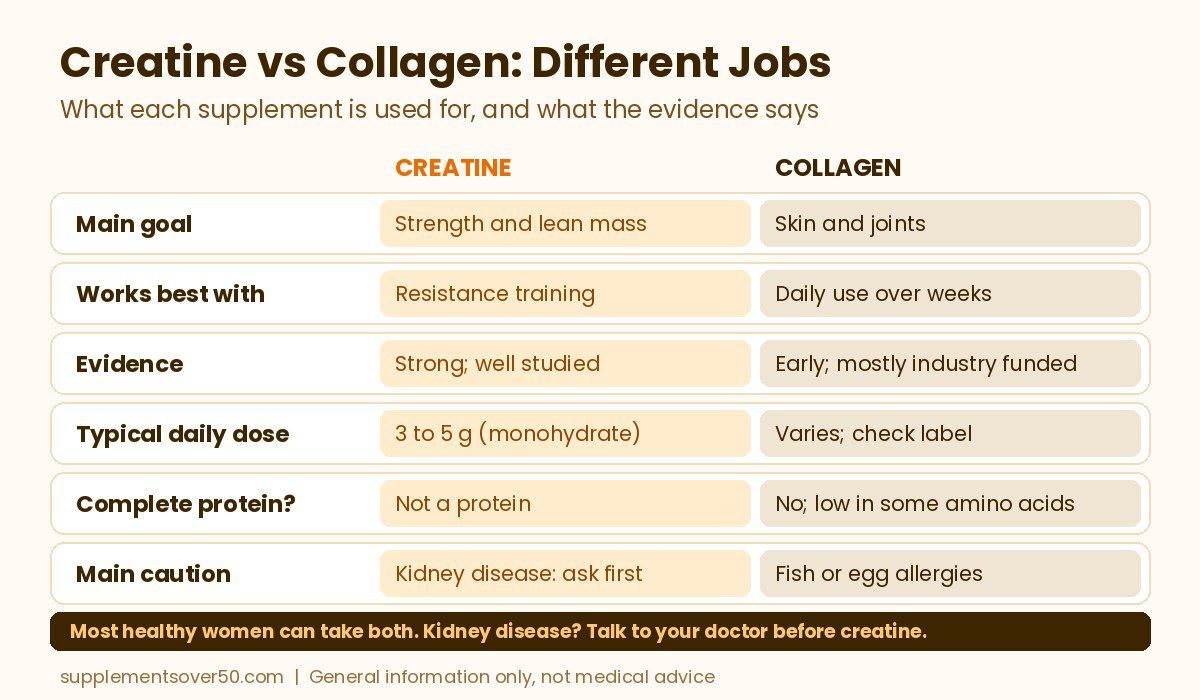
Yes, most healthy women over 50 can take creatine and collagen together. They do different jobs: creatine supports strength when paired with resistance training, while collagen is studied for skin and joints. Our 5 picks: (1) Clean Nutra Shelf Builder Creatine for Women, best all-in-one scoop; (2) Bold Buns Creatine for Women with Collagen, best simple 2-in-1; (3) Thorne Creatine, best third-party certified creatine; (4) Nutricost Micronized Creatine Monohydrate, best budget creatine; (5) Vital Proteins Collagen Peptides Advanced, best collagen to pair with your own creatine. Taking two single products gives you more control over the dose. If you have kidney disease, ask your doctor first.
Creatine used to be a gym-bro supplement. Now it sits next to collagen in the women’s aisle, and combined creatine and collagen powders now sell by the tens of thousands each month on Amazon. If you have been wondering about creatine and collagen for women, especially after 50, you are asking a good question, because the two supplements are often sold as a pair but work in completely different ways.
After 50, women lose muscle and bone faster, skin gets thinner and drier, and joints tend to complain more. Creatine and collagen are both marketed at those changes. This guide explains what each one actually does, what the research says, whether combining them makes sense, how to take them, and who should be careful. Then we cover two combined powders and three single products you can stack yourself.
Table of Contents
Why Muscle, Skin and Joints Change for Women After 50
Menopause speeds up several changes that started in your 30s and 40s. Here is how they line up with what creatine and collagen are sold for:
Muscle and strength. Muscle mass and strength drop with age, a process called sarcopenia. Losing strength makes everyday tasks like climbing stairs or getting up from a chair harder. Resistance training is the main tool against it, and that is where creatine comes in.
Skin. According to Harvard Health, the body’s own collagen production falls as we age, which contributes to visible skin aging. Collagen supplements are mostly marketed for skin elasticity and hydration.
Joints. The same drop in collagen is linked to joint discomfort. Some collagen products are aimed at joint comfort and mobility.
Protein needs. Many women over 50 do not eat enough protein spread across the day. Neither creatine nor collagen is a replacement for that, which we explain below.
Does Creatine and Collagen for Women Actually Work?
Creatine: the stronger evidence
Creatine is one of the most researched supplements available. The NIH Office of Dietary Supplements fact sheet on supplements for exercise and athletic performance explains that your liver and kidneys make about 1 gram of creatine a day, and you get small amounts from meat and fish. Creatine helps muscles produce energy for short, intense efforts like lifting. The fact sheet notes that creatine monohydrate is the most widely used and studied form, and that pricier forms have not been shown to work better.
For older adults, the key point is that creatine works with resistance training. A 2014 meta-analysis in Medicine & Science in Sports & Exercise pooled randomized trials in 357 older adults (average age around 64) who did resistance training for about 12 weeks. Those who added creatine gained more lean mass and more chest press and leg press strength than those who trained alone, and did better on a chair stand test. The authors called the results encouraging but said more studies are needed. If you take creatine and do not train, expect much less.
Collagen: promising but early
The Harvard T.H. Chan School of Public Health Nutrition Source says some randomized controlled trials have found collagen supplements improve skin elasticity, and others found improvements in joint mobility and joint pain. It also points out that most of this research is funded at least in part by the collagen industry, and that human studies are still limited. Harvard Health describes the evidence as early and says larger studies are needed.
One more thing matters here. Collagen is a protein, but it is not a complete protein: it is low in some essential amino acids, so it does not support muscle the way whey, eggs, fish or meat do. A scoop of collagen in your coffee is not a substitute for a protein-rich breakfast.
So should you combine them?
There is no known reason the two cannot be taken together, and no evidence that the combination works better than either alone. Think of it as two separate decisions. Take creatine if you lift weights or do resistance exercise and want to get more out of it. Take collagen if skin or joint support is your goal and you are comfortable with early evidence. If both apply, combining them in one drink is simply convenient.
What to Look for in Creatine and Collagen for Women
Creatine monohydrate. It is the form with the most research behind it, according to the NIH.
Around 3 to 5 grams of creatine a day. The NIH fact sheet describes a maintenance dose of 3 to 5 grams daily. Some combined products contain less, so check the label.
A meaningful amount of collagen. Combined powders vary widely, from about 1 gram to 5 grams or more per scoop. Check the Supplement Facts panel.
Third-party testing. Look for seals such as NSF Certified for Sport. Supplements are not FDA approved, and Mayo Clinic suggests choosing products that use third-party testing.
Short ingredient list. Extra ingredients like biotin, maca or inositol add cost and more things to check with your doctor.
Allergens and sources. Collagen can come from cows, fish or chicken. Check if you avoid fish or other ingredients.
Creatine and Collagen for Women: Quick Comparison
Product
Best for
Key details
Daily dose
Clean Nutra Shelf Builder Creatine for Women
All-in-one scoop
5,000 mg creatine monohydrate, 1,143 mg multi-source collagen blend, biotin, BCAAs, vitamin D3, inositol; flavored, stevia; contains egg and fish
1 scoop
Bold Buns Creatine for Women with Collagen
Simple 2-in-1
5 g creatine monohydrate plus 2.5 g Verisol collagen peptides, 1 g BCAA, 1 g L-glutamine; unflavored; third-party tested per listing
1 serving
Thorne Creatine
Third-party certified
Micronized creatine monohydrate; NSF Certified for Sport; 90 servings
Grass-fed bovine collagen peptides with vitamin C (100% DV) and 120 mg hyaluronic acid; unflavored; dairy and gluten free
See label
Top Picks for Creatine and Collagen for Women
1. Clean Nutra Shelf Builder Creatine for Women (Best All-in-One)
This is one of the top-selling creatine products for women on Amazon, with more than 40,000 bought in the past month at the time of writing. The listing says each scoop provides 5,000 mg of creatine monohydrate, which matches the 3 to 5 gram range the NIH describes, plus a 1,143 mg multi collagen peptide blend from bovine, fish and chicken sources with eggshell membrane. It comes in a tropical orange flavor sweetened with stevia, and the brand says it has 10 calories per scoop.
It packs in a lot more: 10,000 mcg of biotin, hyaluronic acid, vitamin D3, zinc, 1 mg of iron, BCAAs, myo-inositol, maca extract, folate and digestive enzymes, according to the listing. That is convenient if you want one drink, but it means many ingredients to clear with your doctor, and high-dose biotin can interfere with some blood tests. The collagen amount is also modest compared with a standalone collagen powder. It contains egg and fish.
🏆 Best All-in-One
Clean Nutra Shelf Builder Creatine for Women
5 g creatine monohydrate plus multi-source collagen, biotin, BCAAs and more in one flavored scoop.
2. Bold Buns Creatine for Women with Collagen (Best Simple 2-in-1)
If you want creatine and collagen in one scoop without a long list of extras, this is a cleaner option. The listing says each serving combines 5 g of creatine monohydrate with 2.5 g of Verisol bioactive collagen peptides, a branded collagen the company says is clinically studied for skin elasticity. It also adds 1 g of BCAAs and 1 g of L-glutamine. More than 6,000 were bought in the past month at the time of writing.
The powder is unflavored and the brand says it dissolves easily, with no artificial colors, flavors or sweeteners. The listing states it is third-party tested, GMP compliant and made in the USA. Treat its glute and cellulite marketing as brand claims. What you are really getting is a full creatine dose and a moderate collagen dose in one unflavored scoop.
✨ Best Simple 2-in-1
Bold Buns Creatine for Women with Collagen
5 g creatine monohydrate plus 2.5 g Verisol collagen. Unflavored, no artificial sweeteners.
Thorne Creatine is a single-ingredient micronized creatine monohydrate, and one of the most popular creatine powders on Amazon, with more than 100,000 bought in the past month at the time of writing. The big draw is that it is NSF Certified for Sport, which the listing says means it is tested for label accuracy and for nearly 300 substances banned in sports.
Thorne says creatine supports lean body mass, muscle endurance and power output, and that it may support cognitive function. A tub holds 90 servings. Pair it with a separate collagen powder if you want both, so you can adjust each dose on its own.
✅ Best Third-Party Certified
Thorne Creatine
Micronized creatine monohydrate. NSF Certified for Sport. 90 servings.
Nutricost carries a Best Seller badge in Amazon’s creatine search results and has more than 61,000 ratings. It is plain, unflavored micronized creatine monohydrate, which is exactly the form the research supports. The listing says each 500 g bottle provides 100 servings of 5 g, and a scoop is included.
It is non-GMO and gluten free, according to the product title. There is nothing extra here, which is the point: a simple, low-cost way to add creatine to your routine.
💰 Best Budget
Nutricost Micronized Creatine Monohydrate
Pure unflavored creatine monohydrate. 5 g per scoop, 100 servings. Non-GMO, gluten free.
5. Vital Proteins Collagen Peptides Advanced (Best Collagen to Pair)
Vital Proteins is one of the most popular collagen powders on Amazon, with more than 215,000 ratings and more than 100,000 bought in the past month at the time of writing. The listing says it uses hydrolyzed collagen peptides from grass-fed, pasture-raised cows, which are easy to digest and absorb. This Advanced version adds 100% of the daily value of vitamin C, which helps the body make collagen, plus 120 mg of hyaluronic acid for skin hydration.
It is unflavored and dissolves in hot or cold drinks like coffee, tea or smoothies. The brand says it is paleo friendly and made without dairy and gluten. Mix one serving with a scoop of Thorne or Nutricost creatine and you have your own creatine and collagen drink with a bigger collagen dose than most combined products.
🌿 Best Collagen to Pair
Vital Proteins Collagen Peptides Advanced
Grass-fed bovine collagen peptides with vitamin C and 120 mg hyaluronic acid. Unflavored.
Together is fine. Both are unflavored or mild powders that mix into the same glass. Timing matters less than taking them every day.
Skip the loading phase if you prefer. The NIH describes an optional loading phase of 20 g a day for 5 to 7 days. It also describes taking about 3 to 6 g daily without loading, which reaches the same effect over 3 to 4 weeks. Most women over 50 find the lower daily dose easier.
Drink enough water. Creatine draws water into muscle. Keep up your fluid intake, especially in hot weather.
Expect a small weight gain. The NIH notes that creatine often causes weight gain from water retention. That is not fat, but it can show on the scale.
Pair it with strength training. The research on older adults is about creatine plus resistance exercise.
Keep eating protein. Collagen does not count as complete protein. Aim for protein-rich foods at each meal.
Combined product or two separate ones?
A combined powder is simpler: one scoop, one habit. Two separate products give you more control. You can hit a full 3 to 5 g creatine dose and a bigger collagen dose, drop one if you change your mind, and avoid extras like biotin or maca. If you are new to both, starting with single products also makes it easier to tell which one, if either, is helping.
How to Choose the Best Creatine and Collagen for Women
If you want one scoop that covers a lot, pick Clean Nutra Shelf Builder, and review the extras with your doctor.
If you want a 2-in-1 with fewer extras, pick Bold Buns Creatine for Women with Collagen.
If third-party certification matters most, pick Thorne Creatine and add a separate collagen.
If you want the lowest-cost creatine, pick Nutricost Micronized Creatine Monohydrate.
If your main goal is skin, pick Vital Proteins Collagen Peptides Advanced and add creatine only if you strength train.
You have kidney disease. Your kidneys clear creatinine, a waste product of creatine. Mayo Clinic says research in people with kidney disease is limited and advises talking with your healthcare team first. Studies in healthy people have not found harm at recommended doses.
You have diabetes or high blood pressure. These conditions affect kidney health, so check with your doctor before starting creatine.
You have kidney function blood tests coming up. Your body turns creatine into creatinine, and labs use creatinine to estimate kidney function, so creatine may affect the reading. Tell your doctor you take it so results are read correctly.
You take several medications or other supplements. Combined products often add biotin, vitamin D, iron or herbs. Add up totals across everything you take.
You drink a lot of coffee. Mayo Clinic notes that caffeine may reduce how well creatine works, though more research is needed.
You have fish, egg or other food allergies. Collagen can come from fish, and some blends contain eggshell membrane.
Frequently Asked Questions
Can women over 50 take creatine and collagen together?
Yes, most healthy women can. There is no known interaction between them, and they do different jobs: creatine supports strength with resistance training, while collagen is studied for skin and joints. Check with your doctor first if you have kidney disease or take several medications.
Will creatine make me gain weight or look bulky?
Creatine often causes a small weight gain from extra water held in muscle, according to the NIH. It will not make you bulky on its own. Any muscle you gain depends on your training and how much protein you eat.
Is creatine safe for my kidneys after 50?
Studies in healthy people have not found that creatine harms kidney function at recommended doses, according to Mayo Clinic. Research in people with kidney disease is limited, so if you have kidney problems, diabetes or high blood pressure, ask your doctor first.
Is collagen enough protein to build muscle?
No. Collagen is not a complete protein because it is low in some essential amino acids. It does not replace protein from foods like eggs, dairy, fish, meat or a complete protein powder.
When is the best time to take creatine and collagen?
Any time you will remember. Taking them daily matters more than timing. Many women mix both into a morning drink or a smoothie after a workout.
How long does it take to notice results?
Without a loading phase, the NIH describes taking about 3 to 6 grams of creatine a day for 3 to 4 weeks to produce its effects. Strength gains build with consistent training over weeks to months. Any effect of collagen on skin or joints is not immediate, so give it time before you judge it.
Our Take
Creatine and collagen for women over 50 can work well together, but they are two separate tools. Creatine has the stronger research, and it pays off when you pair it with strength training. Collagen has early, mostly industry-funded evidence for skin and joints. If you want one simple scoop, Bold Buns is a clean 2-in-1, and Clean Nutra Shelf Builder covers the most ground. If you want control and the best value, combine Thorne or Nutricost creatine with Vital Proteins collagen. Drink enough water, keep your protein up, and talk to your doctor if you have any kidney concerns.
This article is for informational purposes only and is not medical advice. Talk to your doctor before starting any new supplement, especially if you have kidney disease, diabetes or high blood pressure, take prescription medications, or have food allergies.
Looking for the best magnesium for women over 50? Compare 5 top picks for sleep, cramps, mood and bone support, plus the dose limit to know after menopause.
Find the best probiotic for women over 50. Compare 5 top picks for vaginal pH, odor, UTI and gut support after menopause, plus what the research shows.
Looking for the best cortisol supplement for women over 50? See what ashwagandha, magnesium and L-theanine can and cannot do, plus red flags and 5 picks.
Looking for a hair dryer for thinning hair? Compare 5 gentle picks with real heat control, from the Dyson Supersonic Nural to a budget Revlon, for fine hair over 50.
Sea moss has attracted remarkable attention, fueled largely by social media claims about its mineral content and the cultural popularity of Dr. Sebi’s…