Are Popular Supplements Bad for the Aging Brain? What the New Research Means
If you take a daily vitamin D, a fish oil capsule or a glucosamine tablet for your joints, you may have seen headlines about supplements linked to cognitive decline and wondered whether your pill organizer is quietly working against your memory. It is a fair question. These are some of the most popular supplements in America, and most of the people taking them are over 50.
A Washington Post report syndicated by the Anchorage Daily News pulled together three new studies that raised the same uncomfortable idea: something that seems helpful, or at least harmless, in a younger body might behave differently in an aging brain. Below we walk through what each study on supplements linked to cognitive decline actually found, where the evidence is weak, and what a sensible adult over 50 can do with this information today.
Table of Contents
Why the Aging Brain May Respond Differently After 50
The brain changes with age in ways that go beyond memory. According to the researchers quoted in the report, a younger brain tends to clear waste more efficiently, control inflammation better and bounce back faster from cellular stress. An older brain can still work very well, but it has less reserve, so it is less able to compensate when something disrupts normal function.
One key player is the blood-brain barrier, the protective lining of the brain’s blood vessels that decides what gets in and what stays out. As we age, the cells that maintain this barrier and the connections between them can deteriorate, and the transport systems that move nutrients in and out may change too. The scientists describe this less as a leaky barrier and more as a different gateway into the brain. Aging also changes how the brain handles fats, calcium and glucose.
Doctors already adjust many medicines for age, such as blood thinners and opioids, because kidney function and drug sensitivity change over time. Supplements rarely come with age-specific dosing guidance. That gap is the real point of the new research: not that these supplements are dangerous, but that the question may need to shift from “is it good for me?” to “is it good for me at my age, at this dose?”
Popular Supplement Guides:

What the New Research on Supplements Linked to Cognitive Decline Found
Each study looked at a different supplement, used a different method and studied a different group of people. That matters, so we cover them one at a time.
Vitamin D: Faster Decline Only in People Who Already Had Normal Levels
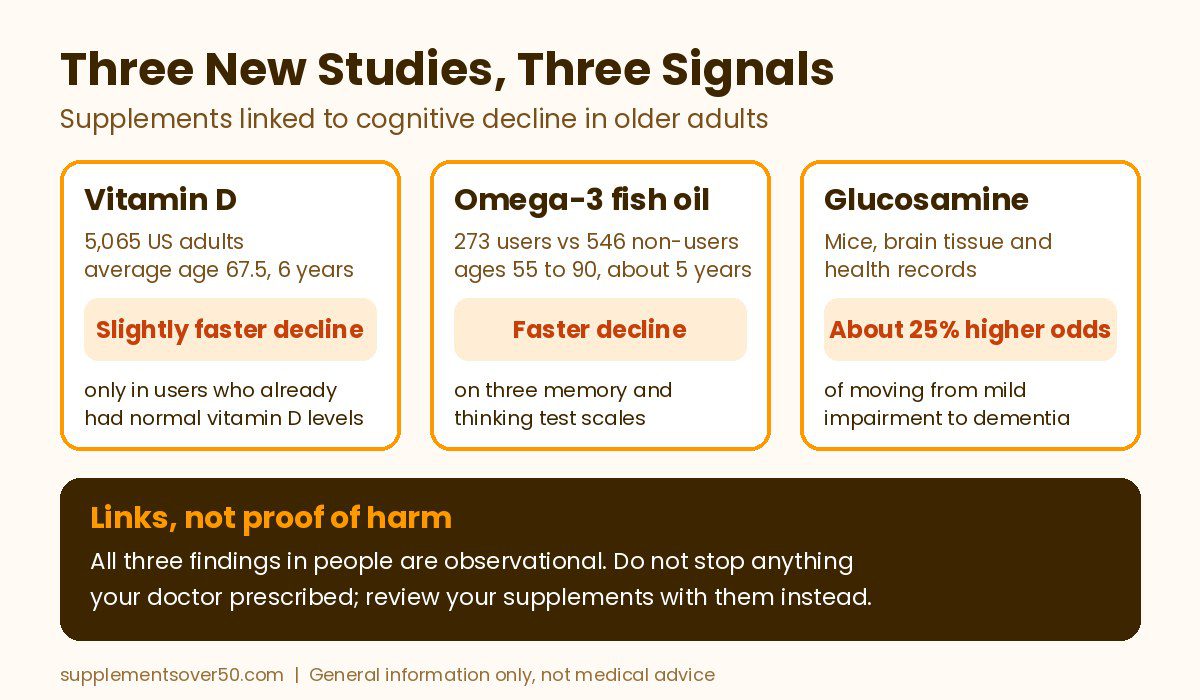
The vitamin D study published in BMJ Open in January 2026 followed 5,065 adults from the Health and Retirement Study, a nationally representative survey of Americans over 50. The average age was 67.5, and about 40% of participants used a vitamin D supplement. Over six years, supplement users showed a slightly faster decline in overall cognitive scores and in executive function (planning, focus and mental flexibility) than non-users.
The most important detail: the faster decline showed up only in people whose blood vitamin D level was already normal at the start. It did not appear in people who were insufficient or deficient. The authors concluded that their findings do not support vitamin D supplements as a way to prevent or slow cognitive decline in older adults with adequate vitamin D status, and that doctors should be cautious about recommending them without a clear reason. The effect was also small, a difference of about 0.05 points per year on the global cognition score.
Omega-3 Fish Oil: A Link With Faster Decline on Memory Tests
The omega-3 analysis in The Journal of Prevention of Alzheimer’s Disease, published in April 2026, used data from the Alzheimer’s Disease Neuroimaging Initiative, a long-running NIH-funded study of adults aged 55 to 90 that ranges from people with healthy memory to people with significant disease. According to the report, researchers compared 273 omega-3 supplement users with 546 non-users over a median of about five years.
Omega-3 users declined faster on three standard clinical scales that measure things like memory, attention, orientation and language. The link was not explained by amyloid plaques, tau tangles or brain shrinkage. Instead, users showed lower glucose use in brain regions vulnerable to Alzheimer’s, which accounted for part of the association. The authors called for a cautious reassessment of omega-3 use for brain protection.
Not everyone agrees with that reading. The same journal has since published a letter from two omega-3 researchers asking whether methodological limitations and confounding factors explain the apparent effect, along with another letter suggesting oxidation of fish oil could be part of the story. This debate is ongoing.
Glucosamine: A Signal From Mice, Brain Tissue and Health Records
The glucosamine study in Nature Metabolism, published in June 2026 by a team including University of Florida researcher Ramon Sun, approached the question three ways. In mouse models of Alzheimer’s, the brains made unusually high levels of glycans (sugar structures attached to proteins). Slowing that process genetically improved the animals’ cognitive performance, while oral glucosamine made it worse. Post-mortem human Alzheimer’s brains showed the same buildup of glycans.
Finally, the team looked at electronic health records. According to the report, glucosamine use was associated with roughly a 25% greater likelihood of progressing from mild cognitive impairment to Alzheimer’s or a related dementia, and among people who already had dementia, about a 25% higher death rate. Supplement use was identified from doctors’ notes and prescription records, so some use may have been missed, and users may differ from non-users in other ways.
Supplements Linked to Cognitive Decline: Evidence Summary
| Supplement | Study type | Who was studied | What was found | Key limits |
|---|---|---|---|---|
| Vitamin D | Prospective cohort (observational) | 5,065 US adults, average age 67.5, followed 6 years | Slightly faster cognitive decline in users, only among those with normal vitamin D levels | Small effect; cannot prove cause; no link in people who were low |
| Omega-3 fish oil | Longitudinal cohort (observational) | Adults 55 to 90 in a memory and aging study; 273 users vs 546 non-users | Faster decline on three memory and thinking scales | Group includes people with memory problems; experts question confounding |
| Glucosamine | Mouse, post-mortem tissue and health record analysis | Alzheimer’s mouse models; patients with MCI or dementia | Worse cognition in mice; about 25% higher odds of progressing from MCI to dementia | Mice are not people; records may miss use; users may differ |
What These Studies Can and Cannot Tell You
None of these findings are conclusive on their own, and the scientists involved say so. Here is why the evidence is weaker than the headlines suggest:
- They are observational in people. They show that two things happened together, not that one caused the other. A link can be driven by something else entirely.
- Supplement users are different. People who take supplements often differ from non-users in income, education, diet and health habits.
- Reverse causation is possible. Some people may start a brain or joint supplement because they already notice symptoms, which would make the supplement look worse than it is.
- Doses and products vary. The study summaries we reviewed do not report results by dose, and formulations differ widely between brands.
- Self-reported use is messy. Records and surveys can miss when people start, stop or switch products.
- Three different compounds. Three separate signals do not prove there is one shared aging mechanism behind them.
What the studies do show is useful, though. They add to a long line of research in which vitamin D and fish oil supplements have largely failed to deliver the brain protection people hoped for. If a supplement is not clearly helping your brain, any small chance of harm deserves more weight.
What to Look for Before Taking a Supplement for Your Brain or Joints
Rather than sorting supplements into good and bad, use these questions to decide whether a product belongs in your routine:
- A clear reason. Do you have a measured deficiency, a diagnosis, or a doctor’s recommendation? “Just in case” is not a strong reason after 60.
- A sensible dose. More is not better. For vitamin D, the NIH vitamin D fact sheet sets the recommended amount at 600 IU a day up to age 70 and 800 IU from age 71, with an upper limit of 4,000 IU for adults from all sources.
- Your current blood levels. The vitamin D link appeared only in people who were already at normal levels, which is a good reason to test before you supplement.
- Overlap with other products. Multivitamins, calcium blends and “brain” formulas often contain the same ingredients, so totals add up quickly.
- Interactions. Fish oil and some other supplements may interact with prescription drugs. Ask your pharmacist.
- Whether it is working. If you have taken something for months with no noticeable benefit, it may be time to talk about stopping.
What to Do Instead: A Brain-Friendly Plan After 50
The researchers did not tell older adults to empty their medicine cabinets. They did make the point that supplements are biologically active substances, not harmless extras, and should be treated that way. Here is a practical plan:
- Food first. The case for omega-3s from eating fish is stronger than the case for capsules. Eating fish regularly is a simple goal to discuss with your doctor.
- Get vitamin D the low-risk way. Fortified foods, oily fish and short periods of sun exposure all contribute. Nutrition expert Marion Nestle, quoted in the report, favors brief sun exposure in summer.
- Test, do not guess. Ask for a vitamin D blood test if you are unsure. Supplement at the dose your clinician suggests if you are low.
- Do a yearly bottle review. Bring every supplement to an appointment and decide together what still has a purpose.
- Protect the basics. Regular movement, good sleep, managing blood pressure and staying socially active all support the aging brain.
How to Decide About Your Own Supplements
- Taking vitamin D with normal blood levels and no medical reason? Ask your doctor whether you still need it, or whether a lower dose makes sense.
- Taking vitamin D for a diagnosed deficiency or osteoporosis plan? Keep taking it as directed. The study found no link in people with low levels.
- Taking fish oil for your brain? The brain benefit has been hard to prove. Discuss whether eating more fish could replace it. If it was prescribed for heart or triglyceride reasons, do not stop on your own.
- Taking glucosamine and diagnosed with mild cognitive impairment or dementia? Raise this study with your doctor soon and weigh the joint benefit against the possible risk.
- Taking glucosamine with healthy memory? The human data came from people who already had memory problems. Still, if it is not clearly helping your joints, it may not be worth continuing.
For more background, see our guides Can Omega-3s Really Slow Brain Decline After 60?, 7 Best Brain Supplements for Seniors, and Natural Alternatives to Prevagen. If you are unsure about your vitamin D status, our article on Signs of Vitamin D Deficiency in Seniors explains what to watch for.
When to See a Doctor
Do not stop a supplement your doctor prescribed because of a headline. Instead, book a review and bring your bottles. It is especially worth a conversation if you take several supplements, take prescription medications alongside them, or have kidney or liver problems that affect how your body handles them.
See a doctor promptly if you or a family member notice new memory lapses, confusion, trouble finding words, getting lost in familiar places, or changes in mood or personality. These symptoms have many possible causes, some of them treatable, such as vitamin B12 deficiency, thyroid problems, medication side effects or sleep disorders. Early evaluation matters far more than any supplement decision.
Frequently Asked Questions
Should I stop taking fish oil because of the new study?
Not on your own. The omega-3 study found an association with faster cognitive decline, not proof of harm, and other researchers have questioned its methods. If you take fish oil only for brain health, talk to your doctor about whether eating fish could replace it. If it was prescribed for your heart or triglycerides, keep taking it until you have discussed it.
Is vitamin D bad for the brain?
The study found slightly faster cognitive decline only in vitamin D supplement users who already had normal blood levels. There was no link in people who were low. Vitamin D is still important, so the practical step is to test your level and supplement only if you need to, staying under 4,000 IU a day.
Does glucosamine cause dementia?
That has not been shown. The study found glucosamine worsened cognition in Alzheimer’s mice and was linked with faster progression in people who already had mild cognitive impairment or dementia. Health record studies cannot prove cause, but if you have memory problems, it is worth discussing with your doctor.
Why would a supplement affect an older brain differently?
Aging changes the blood-brain barrier and how the brain uses fats, glucose and calcium. Researchers think this could change how nutrients reach and act on brain tissue. This idea is still being tested and is not proven.
Are there supplements proven to prevent memory loss?
None of the research discussed here supports a supplement as a way to prevent cognitive decline, and trials of vitamin D and fish oil for brain protection have been largely disappointing. If you have a true deficiency, such as low vitamin B12 or vitamin D, correcting it under a doctor’s care is reasonable.
What is the safest way to take supplements after 50?
Take them for a specific reason, use standard doses rather than megadoses, check for overlap between products, ask a pharmacist about drug interactions, and review everything you take with your doctor at least once a year.
Our Take
The new research on supplements linked to cognitive decline is a reason to be thoughtful, not frightened. All three human findings are associations, and the effects for vitamin D were small. What they do challenge is the habit of taking popular supplements for brain protection without a clear need, especially when the evidence for benefit was already thin. Test before you take vitamin D, favor fish on your plate over fish oil in a capsule for brain health, mention glucosamine to your doctor if you have memory concerns, and treat every supplement as something that deserves a reason to be in your routine.
This article is for informational purposes only and is not medical advice. Talk to your doctor before starting or stopping any supplement, especially if you take prescription medications or have been diagnosed with a memory or thinking problem.