This guide contains affiliate links. If you buy through them, we may earn a small commission at no extra cost to you.
⚡ Quick Answer
Taurine made lab animals live longer, but there is no solid proof yet that it slows aging in people. If you still want to try it, plain taurine is inexpensive and has a good safety record up to 3 grams a day. Our 5 picks: (1) NOW Taurine 1,000 mg, best overall; (2) Pure Encapsulations Taurine 500 mg, best low dose for beginners and sensitive stomachs; (3) Life Extension Taurine 1,000 mg, best for people who want a certificate of analysis; (4) Nutricost Taurine 1,000 mg, best value for long-term use; (5) BulkSupplements Taurine Powder, best powder for flexible dosing. Check with your doctor first if you take blood pressure medicine.
If you are searching for the best taurine supplement, you have probably seen the headlines calling taurine an anti-aging amino acid. Those headlines came from a widely covered study in which taurine helped mice and worms live longer. Since then, taurine has moved from energy drink labels to longevity podcasts and supplement shelves.
The real story is more nuanced. The animal results are striking. The human evidence on aging is weak, and a later NIH study found that taurine levels do not reliably fall as people get older. There are some small human trials on blood pressure, blood sugar and triglycerides that look encouraging. This guide explains what the research does and does not show, the doses that have been studied, who should be careful, and five plain taurine products worth considering if you decide to try it.
Table of Contents
Why Taurine Gets Attention After 50
Taurine is a conditionally essential amino acid. Your liver can make some of it, and you get the rest from food. According to News-Medical, dietary taurine comes from foods like meat and dairy, with the highest levels in shellfish and other seafood, and vegetarians and vegans have lower intake. It is concentrated in the heart, muscles, eyes and nervous system, which is part of why it gets linked to healthy aging.
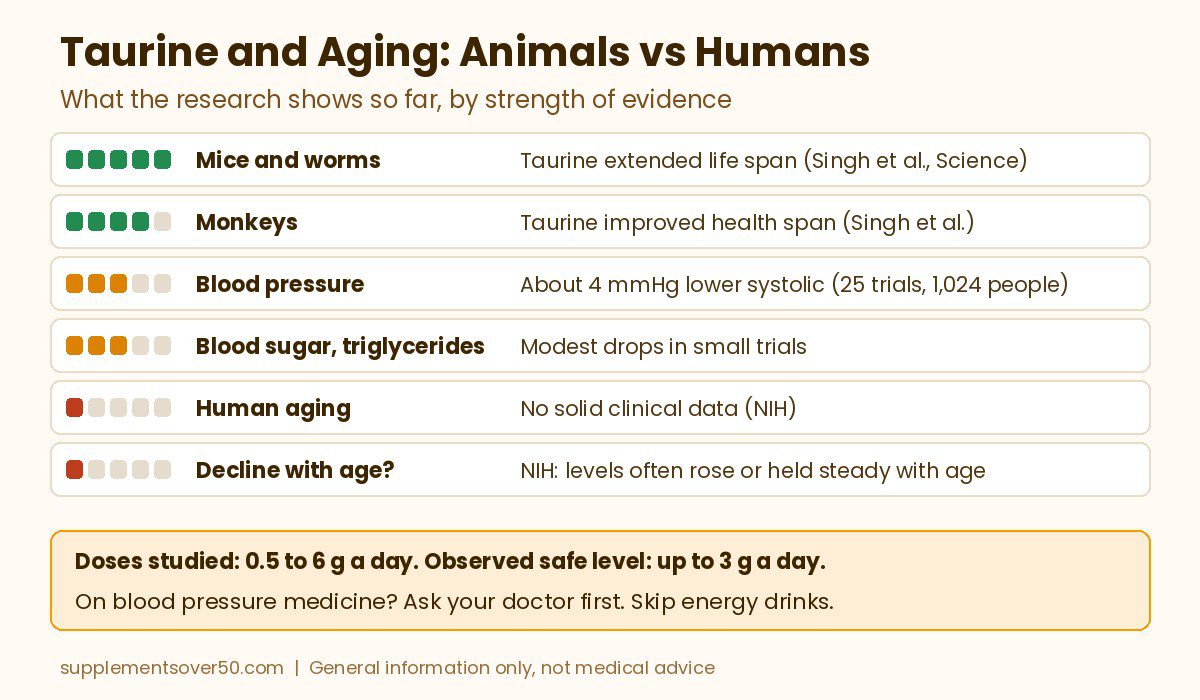
Interest exploded after a study published in Science by Singh and colleagues. The researchers reported that blood taurine declined with age in mice, monkeys and humans. Giving taurine to middle-aged animals increased health span (the years spent in good health) in mice and monkeys and increased life span in mice and worms. In the lab, taurine reduced several hallmarks of aging, including cellular senescence, DNA damage, mitochondrial problems and age-related inflammation. In humans, lower taurine levels were linked with several age-related diseases. The authors were careful to say that human clinical trials are needed.
That last point is what many headlines skipped. A link between low taurine and disease in people does not prove that taking more taurine will prevent that disease. Sick people may simply have lower levels for other reasons.
Does Taurine Actually Slow Aging? What Newer Research Shows
A follow-up study published in Science in 2025 challenged the idea that taurine falls as we age. Researchers at the National Institutes of Health (NIH) measured taurine in repeated blood samples from people aged 26 to 100 in the Baltimore Longitudinal Study of Aging, along with monkeys and mice. Taurine levels often increased or stayed the same with age rather than declining. Differences between samples from the same person were often bigger than any change linked to age, and taurine levels were inconsistently tied to muscle strength, body weight and other health measures.
The NIH also stated plainly that there is no solid clinical data showing taurine supplements benefit humans for aging. So the honest summary is this: the animal data are strong, the human aging data are weak, and nobody yet knows whether a daily taurine capsule will help you live longer or age better.
Where the human evidence is more interesting is in heart and metabolic health. A meta-analysis of 25 randomized trials in Nutrition & Diabetes included 1,024 participants. Doses ranged from 0.5 to 6 grams a day, for anywhere from 5 to 365 days. Compared with control groups, taurine lowered:
Systolic blood pressure by about 4 mmHg
Diastolic blood pressure by about 1.5 mmHg
Fasting blood glucose by about 5.9 mg/dL
Triglycerides by about 18 mg/dL
HDL (good) cholesterol did not change significantly, and the authors reported no significant adverse effects compared with control groups. These are modest effects from mostly small trials, so taurine is not a replacement for blood pressure or diabetes medicine. It may be a reasonable add-on to discuss with your doctor if your numbers are borderline. The Singh study also found that taurine levels in people rose after a bout of endurance exercise, which fits with the idea that staying active matters more than any pill.
How Much Taurine Should Seniors Take?
There is no official recommended daily amount for taurine. The human trials in the meta-analysis above used 0.5 to 6 grams a day. A safety review in Regulatory Toxicology and Pharmacology found strong evidence that supplemental taurine is safe for healthy adults at intakes up to 3 grams a day, which it set as the observed safe level. Higher amounts have been tested without clear harm, but the authors said the data were not strong enough to be confident about long-term safety above 3 grams.
For most people over 50, a sensible approach is to start with 500 mg to 1 gram a day and stay at or below 3 grams unless your doctor advises otherwise. Taurine is generally well tolerated. If you notice an upset stomach, take it with food or lower the dose.
Why not just drink energy drinks? Many energy drinks contain taurine, but they also deliver caffeine and often a lot of sugar. The FDA lists energy drinks at roughly 41 to 246 mg of caffeine per 12 ounces and cites 400 mg of caffeine a day as an amount not generally associated with negative effects for most adults. For older adults with high blood pressure, heart rhythm problems, poor sleep or diabetes, energy drinks are a poor way to get taurine. A plain capsule or powder gives you the taurine without the stimulants.
What to Look for in a Taurine Supplement
Plain taurine, listed as taurine or L-taurine, without caffeine or proprietary energy blends.
A dose you can adjust. 500 mg capsules make it easy to start low; 1,000 mg capsules or a powder cut the pill count.
Quality checks such as a GMP-certified facility, a certificate of analysis or third-party testing. See our guide on how to read a supplement label.
Vegan capsules if you avoid gelatin. Most taurine supplements are synthetic, so they are suitable for vegetarians.
Easy to swallow. If large capsules are a problem, an unflavored powder can be stirred into water or juice.
No big health claims. Be wary of products promising to reverse aging. No human study shows that.
Best Taurine Supplement for Seniors: Quick Comparison
Unflavored powder; dissolves in water or juice; cGMP facility, batch tested
See label
Top Picks for the Best Taurine Supplement for Seniors
1. NOW Taurine 1,000 mg (Best Overall)
NOW Taurine Double Strength packs 1,000 mg into each vegan capsule, twice the amount of the brand’s regular 500 mg version. The listing describes taurine’s role in nerve impulses, fluid balance and visual pathways, and lists the product as dairy-free, egg-free, kosher, made without gluten, non-GMO, nut-free and soy-free. NOW holds an NPA A-rated GMP certification, which covers its lab and testing methods.
It had the most purchases in the past month among the taurine listings in our Amazon search, and it has more than 4,700 ratings with a 4.6 rating. One capsule a day sits at the low end of the doses used in human trials, which makes it a sensible starting point. NOW also sells a 500 mg version if you want to go lower.
🏆 Best Overall
NOW Supplements Taurine 1,000 mg, Double Strength
1,000 mg per vegan capsule. Non-GMO, made without gluten. 100 veg caps.
2. Pure Encapsulations Taurine 500 mg (Best Low Dose)
If you want to start gently, Pure Encapsulations offers taurine at 500 mg per capsule. The brand is known for keeping formulas simple: the listing says its products are free from common allergens, artificial or unnecessary ingredients and GMOs, and are manufactured and tested to verify potency and purity. It highlights taurine’s role in heart muscle support and notes it is the most abundant free amino acid in the brain, heart and nervous system.
This pick suits people with sensitive stomachs, those who take many medicines and want to add things slowly, and anyone who prefers to take a smaller dose twice a day. It has more than 1,800 ratings and a 4.7 rating, the highest rating in our list. A 1,000 mg version is also available.
🌱 Best Low Dose
Pure Encapsulations Taurine 500 mg
500 mg capsules. Free from common allergens and GMOs. 60 capsules.
3. Life Extension Taurine 1,000 mg (Best for Transparency)
Life Extension Taurine provides 1,000 mg per vegetarian capsule. The brand says a certificate of analysis is available for every product, which is useful if you like to see testing results. Most of its products are non-GMO and gluten-free and made in the USA with internationally sourced ingredients.
Be aware that the listing leans into the longevity angle, describing observational population studies that link taurine with longevity and healthy aging. Observational links are not proof, as the NIH study above shows. The product itself is a straightforward, well-reviewed taurine with more than 3,300 ratings and a 4.6 rating.
📜 Best for Transparency
Life Extension Taurine 1,000 mg
1,000 mg per vegetarian capsule. Certificate of analysis available. 90 capsules.
If you plan to take taurine for months, the cost of a large bottle adds up less. Nutricost Taurine comes in a 400-capsule bottle with 1,000 mg per capsule. The listing says it is non-GMO and gluten free and made in an NSF certified, GMP compliant, FDA registered facility.
It is the most reviewed taurine in our search, with more than 8,100 ratings and a 4.6 rating. Note that the facility certification is not the same as the product itself being NSF Certified for Sport. The large bottle also means you should check the expiration date and store it somewhere cool and dry.
💰 Best Value
Nutricost Taurine 1,000 mg
1,000 mg per capsule. Non-GMO, gluten free. 400 capsules.
Pills piling up? BulkSupplements Taurine Powder is unflavored and, according to the listing, dissolves in water, juice or shakes. That makes it easy to take a precise dose, and to start small. The brand says it is made in a cGMP-compliant facility and that every batch is tested. It is also gluten free.
You will need a small measuring scoop or kitchen scale, and the listing is aimed mainly at athletes and active adults, so follow the serving size on the label rather than workout-style doses. It has more than 4,200 ratings and a 4.6 rating.
🥤 Best Powder
BulkSupplements.com Taurine Powder
Unflavored taurine powder. Gluten free, batch tested. 500 g.
Taurine has a good safety record in healthy adults, but older adults are more likely to have conditions or take medicines that change the picture.
Blood pressure medicine.Drugs.com lists a moderate interaction between taurine and lisinopril: taurine may add to the blood pressure lowering effect, so you may need a dose adjustment or more monitoring. Its database flags similar interactions with other blood pressure drugs such as amlodipine and losartan. Watch for dizziness, lightheadedness or fainting, and stand up slowly.
Lithium or other medicines with a narrow safety margin. Check with your prescriber or pharmacist before adding taurine or any new supplement.
Kidney disease. Little is known about taking extra taurine when kidney function is reduced, and kidney disease changes how many supplements are handled. Talk to your nephrologist first, and see our guide to supplements to avoid with kidney disease.
Diabetes medicines. Because taurine may modestly lower fasting blood sugar, monitor your levels if you take insulin or other glucose-lowering drugs.
Heart rhythm problems. Avoid taurine-containing energy drinks, because of the caffeine.
See your doctor if you have high blood pressure, diabetes or heart disease and want to use taurine as part of your plan. A supplement should never replace prescribed treatment.
Frequently Asked Questions
Does taurine really slow aging?
Not in humans, as far as we know. A study in Science found taurine extended life span in mice and worms and improved health span in monkeys. But a later NIH study found taurine levels do not reliably fall with age in people, and the NIH says there is no solid clinical data showing taurine supplements benefit humans for aging.
How much taurine should a senior take?
There is no official recommended amount. Human trials have used 0.5 to 6 grams a day, and a safety review found strong evidence of safety up to 3 grams a day for healthy adults. Starting with 500 mg to 1 gram a day is a sensible approach. Ask your doctor first if you take medicines.
Can taurine lower blood pressure?
Modestly. A meta-analysis of 25 randomized trials found taurine lowered systolic blood pressure by about 4 mmHg and diastolic by about 1.5 mmHg compared with controls. It is not a substitute for blood pressure medicine, and it may add to the effect of those drugs.
Are energy drinks a good source of taurine?
No. Energy drinks can contain up to about 246 mg of caffeine per 12 ounces according to the FDA, and many are high in sugar. For older adults, especially with high blood pressure, heart rhythm problems or diabetes, a plain taurine capsule or powder is the better choice.
Is taurine safe for the kidneys?
Taurine is generally well tolerated in healthy adults, but there is little research on supplementing it with reduced kidney function. If you have kidney disease, talk to your nephrologist before taking taurine or any amino acid supplement.
When is the best time to take taurine?
There is no proven best time. Many people take it with a meal to avoid stomach upset. If you take a larger dose, splitting it between morning and evening is a common approach. Follow the label and your doctor’s advice.
Our Take
The best taurine supplement for seniors is a plain, well-made product at a modest dose, not a miracle pill. The animal research on taurine and aging is impressive, but newer human data do not support the idea that taurine falls with age, and there is no proof it slows aging in people. The small trials on blood pressure, blood sugar and triglycerides are more promising. If you want to try it, NOW Taurine 1,000 mg is our top pick, Pure Encapsulations 500 mg is the gentlest start, and Nutricost is the best value. Stay at or below 3 grams a day, skip the energy drinks, and talk to your doctor first if you take blood pressure or diabetes medicine or have kidney disease.
This article is for informational purposes only and is not medical advice. Talk to your doctor before taking taurine, especially if you take blood pressure, diabetes or psychiatric medicines, or have kidney or heart disease.
Gifts for aging parents they will actually use: 7 picks for staying connected, safety, health and comfort, from Echo Show 8 and Aura to Omron and Ring.
Looking for the best cortisol supplement for women over 50? See what ashwagandha, magnesium and L-theanine can and cannot do, plus red flags and 5 picks.
The best supplements for men over 50, nutrient by nutrient: vitamin D, B12, omega-3, magnesium and creatine, with 5 budget picks and who should check with a doctor.