
Best Hyaluronic Acid Supplement for Skin and Joints Over 50
This guide contains affiliate links. If you buy through them, we may earn a small commission at no extra cost to you.
If you are looking for the best hyaluronic acid supplement, you have probably used it in a serum already. Hyaluronic acid is the moisture magnet in half the skin care aisle, and it is also the gel doctors inject into arthritic knees. Now it comes in capsules and liquids that promise plumper skin and smoother joints from the inside.
Some of that is supported by research, and some of it is marketing. This guide walks through what the human trials actually tested, the doses they used, how a capsule differs from a knee injection, who should be careful, and five well-reviewed hyaluronic acid supplements worth considering after 50.
Table of Contents
Why Hyaluronic Acid Matters More After 50
Hyaluronic acid, also called hyaluronan, is a natural substance found throughout your connective tissue. According to WebMD, it is present in your skin, tendons, ligaments and joints, where it helps maintain tissue structure and holds large amounts of water. That water-holding ability is why it keeps skin plump and helps joint fluid stay slippery.
The same WebMD overview notes that your body makes less hyaluronic acid as you age, which can contribute to wrinkles, dryness and other signs of skin aging. For many people over 50, that coincides with menopause-related skin thinning, drier skin in winter, and the first creaks of knee osteoarthritis. It is easy to see why a supplement that targets both skin and joints sounds appealing.
Popular Supplement Guides:






The open question is whether swallowing hyaluronic acid actually reaches your skin and knees in a useful way. Some foods such as bone broth contain it, and WebMD says taking it by mouth can increase your levels, but it also says plainly that its benefits are not well defined. That is the honest starting point.
Does Oral Hyaluronic Acid Actually Work?
For skin: small trials at 120 mg a day
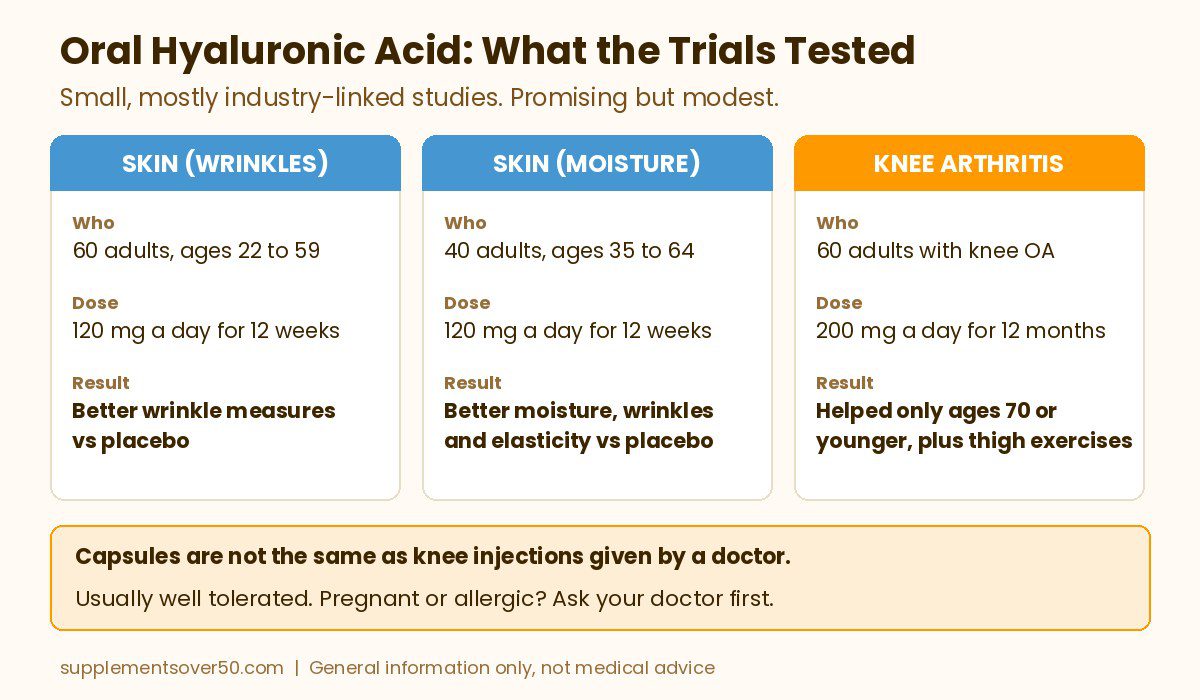
The best-known skin study is a 12-week trial in Clinical, Cosmetic and Investigational Dermatology. Researchers randomly assigned 60 Japanese men and women aged 22 to 59 with crow’s feet wrinkles to take 120 mg of hyaluronic acid a day (in two different molecular weights) or a placebo. After 12 weeks, both hyaluronic acid groups showed better wrinkle measurements than placebo, and skin condition improved compared with baseline.
A second 12-week trial published in Nutrients tested the same 120 mg daily dose in 40 healthy Asian men and women aged 35 to 64. Compared with placebo, the hyaluronic acid group had significant improvements in wrinkle scores, skin moisture in the outer layer, water loss through the skin and elasticity.
Two caveats matter. Both trials were small, and both involved researchers from Kewpie Corporation, a Japanese company that manufactures hyaluronic acid. That does not mean the results are wrong, but independent replication in larger and more diverse groups, including people well past 60, is still missing.
For knees: one notable trial, with a twist
For joints, the most cited study is a 12-month knee osteoarthritis trial of 60 people with mild to moderate knee osteoarthritis. Half took 200 mg of hyaluronic acid once a day for a year, and half took a placebo. According to the full text, the ingredient was Hyabest (J) from Kewpie. Everyone was also asked to do daily quadriceps (front thigh) strengthening exercises.
Symptoms improved in both groups over time, which shows how much the exercise itself helps. The hyaluronic acid group tended to do better, and in participants aged 70 or younger the difference reached statistical significance at months 2 and 4. The authors concluded that oral hyaluronic acid may improve knee symptoms in people 70 or younger when combined with quadriceps exercises. That is a cautious, narrow finding, not proof that a capsule fixes knee pain.
Capsules vs injections: not the same thing
Hyaluronic acid knee injections are a prescription treatment. Mayo Clinic describes them as a medicine used for knee pain from osteoarthritis in people who have already tried pain relievers and other treatments that did not work well, and says they should be given only by or under the direct supervision of a doctor. The injection puts a gel directly into the joint. A supplement goes through your digestive system first, at a far smaller dose. Results from injection studies do not transfer to capsules, and a supplement should not replace a conversation with your doctor about injections or other treatment.
What to Look for in a Hyaluronic Acid Supplement
- A dose close to the studies. The skin trials used 120 mg a day and the knee trial used 200 mg a day. Many capsules contain 50 to 100 mg, so check how many you need.
- Clear labeling. Look for the amount of hyaluronic acid (or sodium hyaluronate) per serving, not just a total blend weight. Products that pair it with MSM or other ingredients sometimes list only the combined total.
- Branded ingredients, read carefully. You will see names such as Hyabest, Injuv, Mobilee, HyaMax and BioCell Collagen on labels. A brand name tells you who made the ingredient, but only some brands have published human trials, so treat ingredient claims as marketing unless you can find the study.
- Source and allergens. Many hyaluronic acid supplements are made by fermentation and are vegan. Others, like BioCell Collagen, come from chicken cartilage.
- Quality checks. GMP-certified manufacturing, testing for potency and purity, and few unnecessary additives. Our guide on how to read a supplement label explains what to look for.
- Extra ingredients you may not want. Some beauty-focused hyaluronic acid products add high-dose biotin, which can interfere with some lab tests. Tell your doctor about any biotin you take before blood work.
Best Hyaluronic Acid Supplement Over 50: Quick Comparison
| Product | Best for | Key details | Daily dose |
|---|---|---|---|
| NOW Hyaluronic Acid 100 mg | Best overall | 100 mg per veg capsule; with L-proline, alpha lipoic acid and grape seed extract; NPA A-rated GMP | 1 capsule, 1 to 2 times daily with food |
| Jarrow Hyaluronic Acid 120 mg | Single ingredient | Hyaluronic acid only; made by fermentation; veggie capsules | 2 capsules, once or twice daily |
| NOW BioCell Collagen | Skin and joints together | Hydrolyzed type II collagen from chicken sternal cartilage with chondroitin and hyaluronic acid | See label |
| NeoCell Liquid Hyaluronic Acid | No pills | 100 mg hyaluronic acid and 20 mg vitamin C per serving; blueberry flavor | 1 serving daily per label |
| Pure Encapsulations Hyaluronic Acid | Allergy-conscious | 70 mg low molecular weight HyaMax per capsule; vegan; free from common allergens | 1 capsule, 1 to 2 times daily |
Top Picks for the Best Hyaluronic Acid Supplement Over 50
1. NOW Hyaluronic Acid 100 mg (Best Overall)
NOW’s Double Strength formula provides 100 mg of hyaluronic acid in each veggie capsule, twice the amount in the brand’s regular version. The listing suggests one capsule once or twice a day with food, which means two capsules land you right between the 120 mg used in the skin trials and the 200 mg used in the knee trial. It also contains L-proline, alpha lipoic acid and grape seed extract.
It is non-GMO, vegetarian and made without gluten, dairy, soy or nuts, and NOW holds an NPA A-rated GMP certification covering its lab testing. With more than 5,200 ratings at 4.6 stars and steady monthly sales, it is the most popular plain hyaluronic acid capsule in our Amazon search.
2. Jarrow Hyaluronic Acid 120 mg (Best Single Ingredient)
If you want hyaluronic acid and nothing else, Jarrow Formulas keeps it simple. The listing describes a single-ingredient formula, naturally derived through biological fermentation, in veggie capsules. The product is labeled at 120 mg, the same daily amount used in both skin trials above.
The suggested use is two capsules once or twice a day, so check the Supplement Facts panel to see exactly how much each serving provides before you settle on a dose. It has more than 2,000 ratings at 4.6 stars. This is a good fit if you already take a multivitamin and other supplements and want to avoid doubling up on extra antioxidants.
3. NOW BioCell Collagen (Best for Skin and Joints Together)
BioCell Collagen is a patented ingredient made from chicken sternal cartilage. According to the listing, it naturally contains hydrolyzed type II collagen along with chondroitin and hyaluronic acid. NOW positions it for both joint comfort and moisture in mature skin, and the listing describes it as clinically validated, which is the brand’s claim rather than something we have reviewed.
This is the pick if you would rather take one product than separate collagen and hyaluronic acid capsules. It is not suitable for vegetarians, and anyone with a poultry allergy should skip it. It has more than 2,600 ratings at 4.6 stars and was the top seller in our search for BioCell products. If collagen is your main interest, compare it with the options in our best collagen supplement for joint health over 50 guide.
4. NeoCell Liquid Hyaluronic Acid (Best Liquid)
If you already swallow a handful of pills each morning, a liquid can be easier. NeoCell’s blueberry-flavored liquid provides 100 mg of hyaluronic acid and 20 mg of vitamin C per serving, plus a fruit blend of elderberry, blueberry, pomegranate and cranberry. The listing says it is gluten free and free of soy, wheat and lactose.
The marketing here is focused on skin hydration rather than joints. If you watch your sugar intake or have diabetes, check the label for sweeteners before buying. It has more than 3,000 ratings at 4.6 stars.
5. Pure Encapsulations Hyaluronic Acid (Best for Allergy-Conscious Buyers)
Pure Encapsulations uses HyaMax sodium hyaluronate, which the listing describes as a low molecular weight form of hyaluronic acid. Each vegan capsule contains 70 mg, with only cellulose as the other ingredient, and the suggested use is one capsule once or twice a day. The brand says its products are free from common allergens, artificial or unnecessary ingredients and GMOs, and are tested for potency and purity.
Two capsules a day give you 140 mg, just above the dose in the skin trials. It is the cleanest label in this list, which suits people with food sensitivities or those who take many medicines. It has more than 800 ratings at 4.6 stars.
How to Choose the Best Hyaluronic Acid Supplement for You
- If you want one reliable all-rounder, pick NOW Hyaluronic Acid 100 mg.
- If you want nothing but hyaluronic acid, choose Jarrow.
- If you want collagen and hyaluronic acid in one capsule, go with NOW BioCell Collagen (not for vegetarians or people with poultry allergies).
- If you dislike swallowing pills, try NeoCell Liquid.
- If you have allergies or a sensitive stomach, Pure Encapsulations has the simplest ingredient list.
- If knee pain is your main problem, pair any supplement with quadriceps strengthening, which helped both groups in the knee trial, and talk to your doctor about proven treatments.
Give any hyaluronic acid supplement about 8 to 12 weeks, the length of the skin trials, before judging it. For skin, collagen peptides have a larger body of research; see our best collagen supplement for skin over 50 and best liquid collagen for women over 50 guides. For joints, compare options in our 5 best joint supplements for seniors ranked by evidence, the best glucosamine supplement for seniors, our best joint supplement stack for seniors and turmeric vs boswellia for knee pain after 50.
Who Should Avoid It or Ask a Doctor First
WebMD describes oral hyaluronic acid as usually well tolerated. It also points out that the FDA has not reviewed hyaluronic acid for safety and effectiveness, so quality varies by brand. A few groups should be more careful:
- Allergies. Hyaluronic acid can cause allergic reactions. Stop taking it and get help right away if you notice hives, swelling of the face or throat, wheezing or trouble breathing. People allergic to hyaluronic acid or any ingredient in a product should not use it.
- Poultry allergy. Avoid chicken cartilage products such as BioCell Collagen.
- Pregnancy and breastfeeding. According to WebMD, it is not known whether hyaluronic acid could affect a pregnancy or pass into breast milk. Ask your health care provider first.
- Several medicines or health conditions. Tell your doctor or pharmacist before starting any new supplement, especially if you take many prescriptions.
- Biotin in the formula. If your hyaluronic acid product also contains biotin, tell your doctor before blood tests.
See your doctor if your knee is swollen, red, hot or locking, if pain wakes you at night, or if you cannot bear weight. Those are not signs to treat with a supplement. Sudden skin changes, a rash that spreads, or very dry skin with itching all over also deserve a medical check.
Frequently Asked Questions
Does taking hyaluronic acid by mouth really help wrinkles?
Possibly a little. Two small 12-week trials found that 120 mg a day improved wrinkle measurements and skin moisture compared with placebo. Both were small and involved researchers from a hyaluronic acid manufacturer, so the evidence is promising but modest.
Can hyaluronic acid supplements help knee arthritis?
The evidence is limited. In a 12-month trial of 60 people with knee osteoarthritis, 200 mg a day plus daily thigh-strengthening exercises helped more than placebo only in people aged 70 or younger, and only at certain time points. Exercise helped both groups.
How much hyaluronic acid should I take after 50?
There is no official recommended amount. The skin trials used 120 mg a day and the knee trial used 200 mg a day. Follow the product label and ask your doctor if you take other medicines.
Are hyaluronic acid pills the same as knee injections?
No. Injections are a prescription treatment given by a doctor directly into the joint, usually after pain relievers and other treatments have not worked well. A supplement goes through the digestive system at a much smaller dose.
How long does hyaluronic acid take to work?
The skin studies lasted 12 weeks, and one saw differences from about 8 weeks. Give it at least two to three months before deciding whether it helps you.
Can I take hyaluronic acid with collagen?
Yes, many people do, and some products like BioCell Collagen combine them. Both are generally well tolerated. Check that you are not doubling up on other ingredients and tell your doctor what you take.
Our Take
The best hyaluronic acid supplement over 50 is one that matches the doses actually studied, lists its hyaluronic acid content clearly, and fits your needs. The research is real but small: around 120 mg a day for skin moisture and fine lines, and a single knee trial where 200 mg plus exercise helped people 70 and younger. NOW Hyaluronic Acid 100 mg is our top pick, Jarrow is the simplest formula, and NOW BioCell Collagen is the one-capsule option for skin and joints. Keep your expectations modest, give it 12 weeks, keep up your leg exercises, and talk to your doctor about knee pain that is not improving.
This article is for informational purposes only and is not medical advice. Talk to your doctor before taking hyaluronic acid, especially if you are pregnant or breastfeeding, have allergies, or take prescription medicines.