Best Quercetin Supplement for Seniors: Absorption, Senolytics and 5 Picks
This guide contains affiliate links. If you buy through them, we may earn a small commission at no extra cost to you.
If you are shopping for the best quercetin supplement, you have probably heard quercetin described as a senolytic, a natural antihistamine or an anti-aging flavonoid. It shows up in longevity stacks next to fisetin and NAD+ boosters, and in allergy formulas next to bromelain and vitamin C.
Some of that reputation is earned and much of it is borrowed from lab and drug studies. This guide explains why the form of quercetin you buy matters so much, what the senolytic research actually tested, what human trials show for blood pressure, who should be careful, and five well-reviewed quercetin supplements worth considering after 50.
Table of Contents
Why Quercetin Gets Attention After 50
Quercetin is a plant pigment in the flavonoid family. According to RxList, it is found in foods such as onions, apples, berries and green tea, and buckwheat tea is especially rich in it. If you eat plenty of fruit and vegetables, you already get some quercetin every day.
Interest in quercetin supplements grew for two reasons that matter more as we age. First, researchers studying cellular senescence (aging cells that stop dividing but linger and release inflammatory signals) found that quercetin, combined with a prescription drug, could clear some of those cells. Second, high blood pressure becomes far more common after 50, and quercetin has a small body of human trials on blood pressure.
Popular Supplement Guides:



The catch is that supplement doses are much higher than what you get from food, and most of the exciting claims come from cell, animal or drug-combination research. That is the honest starting point for choosing a product.
The Absorption Problem: Why the Form Matters
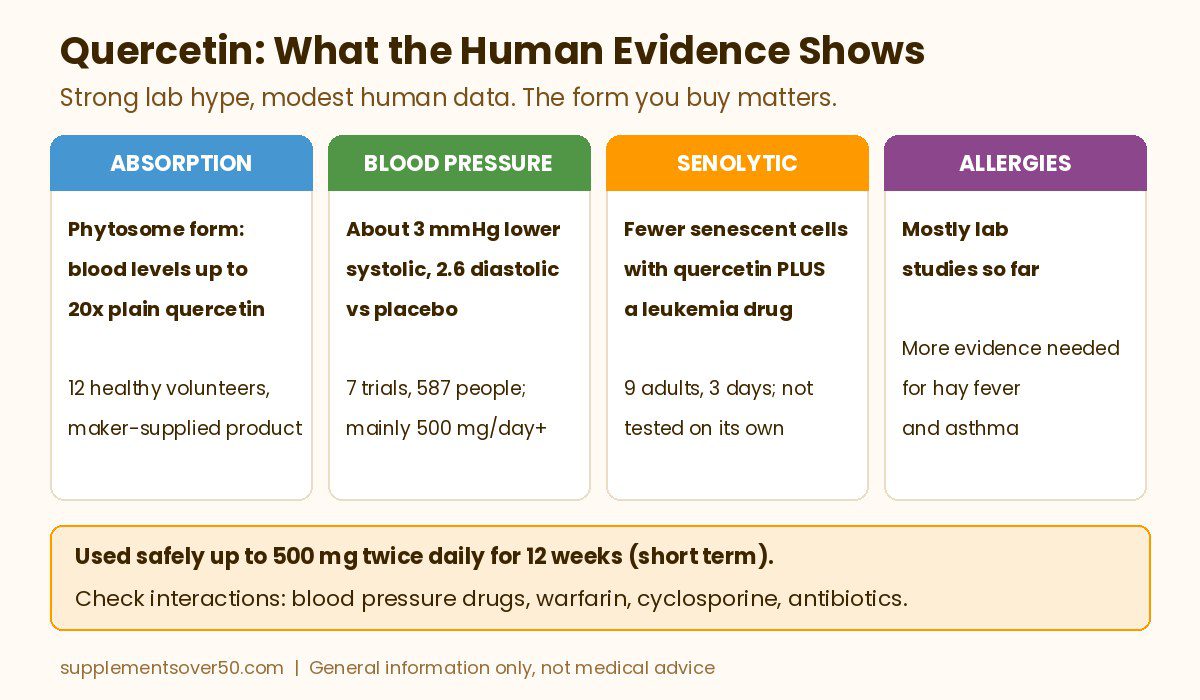
Plain quercetin does not dissolve well and is poorly absorbed from the gut. A pharmacokinetic study of Quercetin Phytosome, a form that binds quercetin to sunflower lecithin, compared it with unformulated quercetin in 12 healthy volunteers aged 18 to 50. The phytosome form reached blood levels of quercetin up to 20 times higher than a usual dose of plain quercetin, with no notable side effects reported.
Two cautions apply. The study was small and the test materials were supplied by Indena, the company that makes Quercetin Phytosome (sold under the trade name Quercefit). And higher blood levels are not the same as proven health benefits. Still, if you want to try quercetin, a phytosome product lets you take a smaller capsule and expect more of it to reach your bloodstream.
Other common pairings are bromelain (an enzyme from pineapple) and vitamin C. Brands often combine them with quercetin, but we did not find solid human data showing that these partners improve quercetin absorption in the way the phytosome study did, so treat those claims as marketing until better studies appear.
Does Quercetin Actually Work? What Human Studies Show
Blood pressure: small but real effects
The best human evidence for quercetin is on blood pressure. A meta-analysis of randomized controlled trials in the Journal of the American Heart Association pooled 7 trials with 587 participants. Quercetin lowered systolic blood pressure by about 3 mmHg and diastolic by about 2.6 mmHg compared with placebo. When the researchers split trials by dose, the effect was seen at 500 mg a day or more and was not significant below 500 mg, although the authors noted the comparison between doses was indirect.
A 3-point drop is modest. It will not replace blood pressure medicine, but it is in the same range as some lifestyle changes. If your doctor already has you on blood pressure drugs, quercetin may add to their effect, which is a safety issue covered below.
Senolytics: the drug combination, not quercetin alone
Most of the anti-aging buzz traces back to a combination called D + Q: dasatinib plus quercetin. Dasatinib is a prescription leukemia drug; MedlinePlus describes it as a treatment for certain types of chronic myeloid leukemia and acute lymphoblastic leukemia. It is not a supplement.
In a small pilot trial published in EBioMedicine, 9 adults with diabetic kidney disease, average age about 69, took 100 mg of dasatinib plus 1,000 mg of quercetin for 3 days. Eleven days later, biopsies showed fewer senescent cells in fat tissue and skin, along with lower levels of several inflammatory markers in the blood. The trial was open label, had no placebo group, and tested the drug combination. It did not test quercetin by itself. The authors noted that quercetin alone showed some effects in mice, but human evidence that quercetin alone works as a senolytic is lacking.
So if you see a quercetin capsule labeled as a senolytic, remember that the human data come from a prescription drug pairing given in short pulses under medical supervision. For a closer look at another flavonoid with senolytic interest, see our guide to the best fisetin supplement for seniors.
Allergies and histamine: mostly lab data
Quercetin is widely sold for seasonal allergies because lab studies suggest it can calm the cells that release histamine. Human evidence is thin. RxList lists hay fever, asthma and exercise performance among the uses where more evidence is needed before quercetin can be rated. The one use it rates as possibly effective is prostate pain and swelling from chronic prostatitis, at 500 mg twice daily.
If allergies are your main concern, quercetin is not a substitute for antihistamines or nasal sprays your doctor recommends.
What to Look for in a Quercetin Supplement
- The form. Phytosome (lecithin-bound) quercetin has the strongest human absorption data. Plain quercetin dihydrate is cheaper but less well absorbed.
- The real quercetin dose. Check how much quercetin is in a serving, not just the capsule weight, and how many capsules make a serving.
- Sensible amounts. RxList says quercetin has been used safely at up to 500 mg twice daily for 12 weeks. Longer use or higher amounts are less well studied.
- Extra ingredients. Bromelain, vitamin C, zinc or herbs add more things to check against your medicines.
- Quality checks such as third-party testing, a certificate of analysis or a GMP-certified facility. See our guide on how to read a supplement label.
- No big promises. Be wary of labels claiming to clear aging cells or cure allergies. No human study of quercetin alone shows that.
Best Quercetin Supplement for Seniors: Quick Comparison
| Product | Best for | Key details | Daily dose |
|---|---|---|---|
| Thorne Quercetin Phytosome | Best absorption | 250 mg Quercetin Phytosome (Sophora japonica flower, sunflower phospholipid) per capsule; third-party certified | See label |
| NOW Quercetin with Bromelain | Most popular | Quercetin plus bromelain; vegan, non-GMO, kosher; NPA A-rated GMP | Label: 2 caps twice daily |
| Pure Encapsulations Quercetin | Plain quercetin | 500 mg per serving; free from common allergens and GMOs | See label |
| Nutricost Quercetin with Bromelain | Best value | 880 mg quercetin + 165 mg bromelain per serving; 240 veg caps; 3rd party tested | 120 servings per bottle |
| Life Extension Optimized Quercetin | Lower dose + vitamin C | 250 mg quercetin with vitamin C and camu-camu; certificate of analysis available | See label |
Top Picks for the Best Quercetin Supplement for Seniors
1. Thorne Quercetin Phytosome (Best for Absorption)
Thorne’s capsule contains 250 mg of Quercetin Phytosome, made from Sophora japonica flower extract bound to a sunflower phospholipid complex. The listing claims it is 20 times more bioavailable than quercetin alone, which matches the maker-supplied absorption study described above. Thorne says the product has been third-party tested and certified to confirm the contents match the label and that it has no unsafe levels of contaminants.
Because the phytosome form is absorbed so much better, the dose per capsule is modest. That suits older adults who want to try quercetin without swallowing large tablets. It has more than 2,400 ratings with a 4.7 rating. The label also notes that people who are pregnant should consult a practitioner first.
2. NOW Quercetin with Bromelain (Most Popular)
NOW Quercetin with Bromelain is the most reviewed quercetin product in our search, with more than 21,900 ratings and a 4.7 rating. It pairs quercetin with bromelain, which the listing describes as having a long history of use by herbalists. The capsules are vegan, non-GMO, kosher and made without gluten, soy, dairy, eggs or nuts, and NOW holds an NPA A-rated GMP certification.
The label directions are 2 capsules 20 minutes before meals, twice daily, and say people with sensitive stomachs may prefer taking them with food. That is a fairly high daily intake of capsules, so start lower if you are new to quercetin and check the total dose against the safety range above. If you take a blood thinner or several prescriptions, ask your pharmacist to check both ingredients, not just the quercetin.
3. Pure Encapsulations Quercetin 500 mg (Best Plain Quercetin)
If you want quercetin with nothing added, Pure Encapsulations offers 500 mg of high-concentration quercetin per serving. The brand says its products are free from common allergens, artificial or unnecessary ingredients and GMOs, and that they are manufactured and tested to verify potency and purity. The listing positions it for cellular, cardiovascular and immune support.
A 500 mg serving lines up with the doses used in the blood pressure trials and the prostatitis dosing listed by RxList. Keep in mind this is plain quercetin, not a phytosome, so absorption will be lower than Thorne’s. It has more than 3,200 ratings with a 4.7 rating.
4. Nutricost Quercetin with Bromelain (Best Value)
Nutricost packs 880 mg of quercetin and 165 mg of bromelain into each serving, with 240 vegetarian capsules and 120 servings per bottle. The listing says it is non-GMO, gluten free and third-party tested, and made in a GMP compliant, FDA registered facility.
This is the strongest dose in our list, close to the upper end of the range RxList describes as used safely short term. That makes it good value, but it is not the right starting point for everyone. Many seniors may do better taking less than a full serving at first, and anyone with kidney problems should talk to a doctor before using high doses. It has more than 3,900 ratings with a 4.7 rating.
5. Life Extension Optimized Quercetin (Best Lower Dose with Vitamin C)
Life Extension Optimized Quercetin delivers 250 mg of quercetin in a blend that adds vitamin C and camu-camu berry extract, which the brand includes for complementary immune support. A certificate of analysis is available for every Life Extension product, and most of its products are non-GMO, gluten-free and made in the USA with internationally sourced ingredients.
The lower dose is a reasonable way to test how you tolerate quercetin, and the vitamin C makes it a convenient two-in-one if you already planned to take vitamin C. If you are comparing vitamin C products, our vitamin C for seniors guide covers forms and doses. It has more than 2,400 ratings with a 4.7 rating.
How to Choose the Best Quercetin Supplement for You
- If absorption matters most, choose Thorne Quercetin Phytosome.
- If you want the most widely used formula, NOW Quercetin with Bromelain has the most reviews by far.
- If you want quercetin and nothing else, go with Pure Encapsulations 500 mg.
- If cost is your priority, Nutricost offers the most quercetin per bottle, but start below a full serving.
- If you also want vitamin C, Life Extension Optimized Quercetin combines both at a lower quercetin dose.
- If you take blood pressure drugs, warfarin, cyclosporine or antibiotics, talk to your doctor or pharmacist before any of them.
Quercetin is one of several longevity supplements with more promise in the lab than proof in people. If you are building a plan, compare our guides to the best NAD+ supplement for seniors, the best spermidine supplement for seniors and the best taurine supplement for seniors. If blood pressure is your main goal, our guide to supplements to lower blood pressure covers options with stronger evidence.
Who Should Avoid Quercetin or Ask a Doctor First
RxList rates quercetin as possibly safe for most people when taken by mouth short term, with use of up to 500 mg twice daily for 12 weeks. It is not known whether longer use or larger amounts are safe. Reported side effects include headache and tingling in the arms and legs, and very high doses might cause kidney damage. Older adults are more likely to take medicines that change the picture. RxList lists moderate interactions with:
- Blood pressure medicines. Quercetin seems to lower blood pressure, so taking it with drugs such as captopril, enalapril, losartan, valsartan or diltiazem might drop blood pressure too low.
- Warfarin. A small test tube study suggests quercetin might increase warfarin’s effects, raising the chance of bruising and bleeding. See our guide to supplements to avoid with blood thinners.
- Cyclosporine. In a small study of healthy volunteers, quercetin taken before cyclosporine raised blood levels of the drug.
- Quinolone antibiotics such as ciprofloxacin and levofloxacin. Quercetin might reduce how well some of these antibiotics work, although it is too soon to know if this is a big concern.
- Drugs broken down by liver enzymes or moved by P-glycoprotein. These include CYP3A4, CYP2C8, CYP2C9 and CYP2D6 substrates, which covers many common prescriptions. Ask your pharmacist to check your list.
- Kidney disease. Because very high doses have been linked to kidney damage, talk to your nephrologist first. See our guide to supplements to avoid with kidney disease.
Not enough is known about quercetin during pregnancy and breastfeeding, so it is best avoided then. See your doctor if you want to use quercetin for blood pressure, allergies or prostate symptoms, because those problems deserve a proper diagnosis and a supplement should never replace prescribed treatment.
Frequently Asked Questions
Is quercetin a senolytic?
Not on its own in humans, as far as current evidence shows. The human senolytic data come from short courses of quercetin combined with dasatinib, a prescription leukemia drug. A small pilot trial in 9 adults with diabetic kidney disease found fewer senescent cells after 3 days of that combination, but it did not test quercetin alone.
How much quercetin should a senior take?
There is no official recommended amount. RxList says quercetin has been used safely at up to 500 mg twice daily for 12 weeks, and a blood pressure meta-analysis saw effects mainly at 500 mg a day or more. Starting lower and checking with your doctor is sensible.
Is quercetin phytosome better than regular quercetin?
For absorption, yes. In a study of 12 healthy volunteers, Quercetin Phytosome reached blood levels up to 20 times higher than a usual dose of plain quercetin. The study was small and the materials came from the manufacturer, and better absorption does not by itself prove better results.
Can quercetin lower blood pressure?
Modestly. A meta-analysis of 7 trials with 587 participants found quercetin lowered systolic blood pressure by about 3 mmHg and diastolic by about 2.6 mmHg. It may add to the effect of blood pressure medicines, so talk to your doctor first.
Does quercetin help with allergies?
The evidence is mostly from lab studies. RxList lists hay fever and asthma among uses where more evidence is needed. Quercetin should not replace antihistamines or other treatments your doctor recommends.
Is quercetin safe for the kidneys?
At typical short-term doses it is generally well tolerated, but very high doses have been linked to kidney damage. If you have kidney disease or reduced kidney function, ask your nephrologist before taking quercetin.
Our Take
The best quercetin supplement for seniors is one you absorb well, at a modest dose, bought for realistic reasons. Quercetin has small but real effects on blood pressure in human trials. The senolytic headlines come from a prescription drug combination, and the allergy claims rest mostly on lab work. If you want to try it, Thorne Quercetin Phytosome is our top pick for absorption, NOW Quercetin with Bromelain is the most popular classic formula, and Pure Encapsulations is the cleanest plain option. Stay within the studied range, and check with your doctor or pharmacist first if you take blood pressure medicine, warfarin, cyclosporine or antibiotics, or have kidney disease.
This article is for informational purposes only and is not medical advice. Talk to your doctor before taking quercetin, especially if you take prescription medicines or have kidney or heart disease.