

5 Best Probiotics for Women Over 50 for Vaginal, Urinary and Gut Health
This guide contains affiliate links. If you buy through them, we may earn a small commission at no extra cost to you.
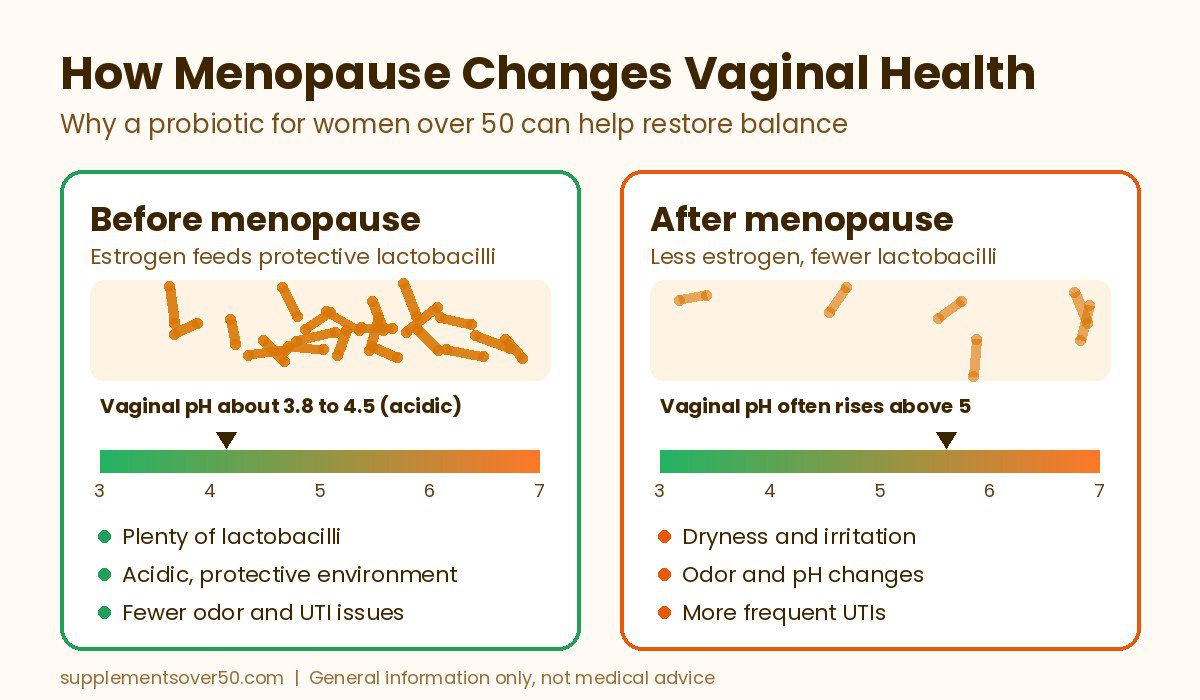
Finding the best probiotic for women over 50 matters more than most women realize, especially for vaginal and urinary health, because the vaginal microbiome changes a lot after menopause. Falling estrogen means less of the glycogen that protective Lactobacillus bacteria feed on. Vaginal pH rises, the good bacteria thin out, and dryness, odor, irritation and repeat urinary tract infections become more common.
A probiotic will not reverse menopause, and it is not a substitute for seeing your doctor. But for many women it is a low-risk, inexpensive way to support a healthier balance. Here is what the research supports, what to look for on a label, and the five options most women over 50 choose on Amazon right now.
Table of Contents
Why Vaginal Health Changes After 50
Before menopause, estrogen keeps the vaginal lining thick and stocked with glycogen. Lactobacilli convert that glycogen into lactic acid, which keeps the environment acidic (a pH of roughly 3.8 to 4.5) and makes it hard for unwanted bacteria and yeast to take hold.
After menopause, estrogen drops and that system weakens. Doctors call the resulting cluster of symptoms genitourinary syndrome of menopause, or GSM. A clinical review of genitourinary syndrome of menopause describes how common it is and why it tends to worsen over time rather than improve on its own. Typical signs include:
Popular Supplement Guides:






- Vaginal dryness, burning or itching
- Discomfort or pain during sex
- A change in odor or discharge
- Urinary urgency and more frequent UTIs
Low-dose vaginal estrogen is the treatment doctors most often use for moderate to severe GSM. Probiotics are a supporting player, not the main event. They make the most sense for mild symptoms, for women prone to bacterial vaginosis or yeast imbalance, and for those who get recurrent UTIs.
Do Vaginal Probiotics Actually Work?
The honest answer is that the evidence is promising but still developing. Certain Lactobacillus strains taken by mouth can reach the vaginal tract, and some trials show improvements in vaginal flora, especially alongside standard treatment for bacterial vaginosis. The NIH’s National Center for Complementary and Integrative Health notes that probiotics look safe for healthy people but that results depend heavily on the specific strain, and many claims have not been proven.
That is why the strain matters more than the CFU count on the front of the bottle. Look for products that name their strains, choose Lactobacillus species studied for women’s health, and be patient. Most brands suggest giving it 4 to 8 weeks before judging results.
What to Look for in a Vaginal Probiotic
- Named Lactobacillus strains. Species such as L. reuteri, L. rhamnosus, L. crispatus and L. fermentum are the most studied for vaginal health.
- A clear daily dose. Higher CFU is not automatically better. Consistency matters more than chasing the biggest number.
- Urinary support if you need it. If UTIs are your main problem, formulas that add cranberry or D-mannose cover both bases.
- Shelf stability. Capsules that do not need refrigeration are easier to stick with.
- Third-party testing. Supplements are not FDA approved, so independent testing for purity and potency is a meaningful quality signal.
- A format you will actually take. If you skip capsules, a gummy you take every day beats a better formula you forget.
Best Probiotic for Women Over 50: Quick Comparison
| Product | Best for | Key details | Daily dose |
|---|---|---|---|
| URO Vaginal Probiotics | Overall odor and pH support | Proprietary probiotic blend plus XOS prebiotic, vegan, third-party tested | 2 capsules |
| Physician’s Choice Probiotics for Women | UTI-prone women | 6 strains, 50 billion CFU, D-mannose and cranberry, prebiotics | 1 capsule |
| Garden of Life Once Daily Women’s | Gut and vaginal health together | 16 strains, 50 billion CFU, includes L. reuteri and L. fermentum | 1 capsule |
| vH Essentials Probiotics with Cranberry | Budget pick | Probiotics, prebiotics and cranberry | See label |
| Lemme Purr Vaginal Probiotic Gummies | Capsule-free option | SNZ-1969 strain, pectin-based, vegetarian | 2 gummies |
Top Picks for the Best Probiotic for Women Over 50
1. URO Vaginal Probiotics (Best Overall)
URO carries an Amazon Best Seller badge in women’s probiotics at the time of writing, and it is built for exactly the issues that tend to show up after menopause: odor, pH and yeast balance. It pairs the brand’s proprietary probiotic blend with XOS, a prebiotic fiber that feeds beneficial bacteria. The capsules are vegan, gluten-free and third-party tested.
The trade-off is that the blend is proprietary, so you cannot see every strain and amount. URO says some women notice a difference within a week, with full benefits after about two months. You take two capsules a day.
2. Physician’s Choice Probiotics for Women (Best for UTI-Prone Women)
If repeat urinary tract infections are part of your story, this is the one to look at first. Alongside six targeted probiotic strains at 50 billion CFU, it adds D-mannose and cranberry, two ingredients commonly used for urinary tract support, plus organic prebiotics. It is a single daily capsule in an acid-resistant shell, and the company says each batch is third-party tested.
Because it does double duty, it is a good fit for women who would otherwise buy a probiotic and a separate D-mannose supplement. For a deeper look at that ingredient on its own, see our guide to the best D-mannose supplement for women over 50.
3. Garden of Life Dr. Formulated Once Daily Women’s (Best Gut and Vaginal Combo)
Garden of Life’s women’s formula is the broadest of the five, with 16 probiotic strains and 50 billion CFU in one capsule. It includes L. reuteri and L. fermentum, two strains the company highlights for vaginal pH, along with a whole-food prebiotic fiber blend for digestion and immune support.
It is shelf stable, so there is no refrigeration to worry about, and you can open the capsule into a drink if swallowing pills is difficult. If digestive comfort matters to you as much as vaginal health, this is the most complete everyday option.
4. vH Essentials Probiotics with Cranberry (Best Budget Pick)
vH Essentials combines probiotics, prebiotics and cranberry for both vaginal and urinary tract support. It is typically one of the lower-cost options per month, which makes it a sensible way to try a vaginal probiotic before committing to a premium brand.
It does not list the same level of strain detail as some competitors, so check the label to see whether it fits your needs. As a simple, affordable daily habit, it earns its place here.
5. Lemme Purr Vaginal Probiotic Gummies (Best Capsule-Free Option)
Plenty of women over 50 already take a handful of pills each morning, and one more capsule is the one that gets skipped. Lemme Purr is a gummy built around a single named probiotic strain, SNZ-1969, which the brand promotes for vaginal health, odor and freshness. It is pectin-based, vegetarian and gelatin-free.
Gummies usually carry fewer strains than capsules and may contain some sugar, so check the label if you are watching your intake. If convenience is what keeps you consistent, though, this is a smart choice. The dose is two gummies a day.
How to Choose the Best Probiotic for Women Over 50
- Mostly odor, pH or yeast issues? Start with URO.
- Frequent UTIs? Physician’s Choice covers probiotics plus D-mannose and cranberry in one capsule.
- Want gut support too? Garden of Life Once Daily Women’s has the broadest strain lineup.
- Trying one for the first time on a budget? vH Essentials is a low-cost starting point.
- Hate swallowing pills? Lemme Purr gummies make the habit easier.
Whichever you choose, give it at least a month at the full daily dose before deciding. If you are already taking a general probiotic, you probably do not need two; our guide to the best probiotic for women over 60 covers broader gut-focused formulas, and our article on UTI prevention after menopause explains the other habits that help.
When to See a Doctor Instead
A probiotic is not the right tool for every symptom. Book an appointment rather than self-treating if you have any vaginal bleeding after menopause, pain that does not go away, a fever with urinary symptoms, blood in your urine, or symptoms that keep coming back despite treatment. Moderate to severe dryness and painful sex are usually better treated with prescription options, which your doctor can discuss with you.
Frequently Asked Questions
Do vaginal probiotics help with menopause dryness?
They may help the overall vaginal balance, but they do not replace the estrogen that keeps vaginal tissue moist. For true dryness, doctors usually recommend vaginal moisturizers, lubricants or low-dose vaginal estrogen. A probiotic works best as support alongside those options.
How long do vaginal probiotics take to work?
Most brands suggest 4 to 8 weeks of daily use. Some women notice changes in odor or comfort sooner, but give any product at least a month at the full dose before judging it.
Can a probiotic prevent UTIs after menopause?
Some women find that probiotics, especially formulas with cranberry or D-mannose, help reduce how often UTIs return. The evidence is mixed, and a probiotic will not treat an active infection. If you have UTI symptoms, see your doctor.
Is it safe to take a vaginal probiotic every day?
For most healthy adults, daily probiotics are considered low risk. People with weakened immune systems or serious illnesses should check with their doctor first, and anyone on multiple medications should mention it to their pharmacist.
Should I take a vaginal probiotic and a regular probiotic?
Usually one is enough. Women’s formulas like Garden of Life Once Daily Women’s and Physician’s Choice cover both digestive and vaginal support in a single capsule.
Are probiotic gummies as effective as capsules?
Gummies often contain fewer strains and may include some sugar, but the best one is the one you take every day. If capsules are a struggle, a well-made gummy is a reasonable choice.
Our Take
For most women over 50, URO is the easiest place to start if odor and pH are the main concerns, and Physician’s Choice is the better fit if UTIs keep coming back. Either way, pair your probiotic with a conversation with your doctor about vaginal estrogen if dryness or discomfort is affecting your quality of life. For a broader look at menopause support, see our guide to the best menopause supplement for women over 50.
This article is for informational purposes only and is not medical advice. Talk to your doctor before starting any new supplement, especially if you take prescription medications.