Best Eye Health Supplements for Seniors
This guide contains affiliate links. If you buy through them, we may earn a small commission at no extra cost to you.
The best eye vitamins for older adults depend on whether you are managing macular degeneration risk or just want daily lutein and zeaxanthin. If you’re over 60 and noticing changes in your vision, you’re not imagining it. Age-related macular degeneration (AMD), cataracts, and dry eye disease are among the most common conditions affecting older adults, and they can accelerate faster than most people expect. The good news: certain nutrients have solid clinical backing for slowing that decline. This guide covers what actually works, what to look for on a label, and the five eye supplements that consistently earn high marks from both researchers and real users.
Table of Contents
Top Picks for the Best Eye Vitamins for Older Adults
Quick Comparison
| Product | Best for | Key fact |
|---|---|---|
| PreserVision AREDS 2 Eye Vitamin | Best overall | AREDS 2 formula |
| Ocuvite Eye Vitamin 50+ | Best daily eye vitamin | Lutein, zeaxanthin, omega-3, zinc |
| NOW Foods Lutein 20mg | Best standalone lutein | 20mg lutein with zeaxanthin |
| Life Extension MacuGuard Ocular Support | Best premium formula | Lutein, zeaxanthin, saffron, meso-zeaxanthin |
| Jarrow Lutein 20 mg with Zeaxanthin | Best budget lutein + zeaxanthin | 20 mg lutein, 4 mg zeaxanthin |
Why Vision Declines After 60
The lens of the eye becomes less flexible with age, making it harder to focus on close objects. That’s normal presbyopia. But the more serious threats are AMD and cataracts, both of which involve oxidative damage to the retina and lens. Free radicals, UV exposure, and years of cumulative stress on ocular tissue eventually overwhelm the eye’s natural antioxidant defenses.
AMD affects the macula, the central part of the retina responsible for sharp, detailed vision. Early AMD often has no symptoms, which is why regular eye exams matter so much after 60. Late-stage AMD can result in severe central vision loss. Cataracts, meanwhile, cloud the lens of the eye and are the leading cause of preventable blindness worldwide. Both conditions are heavily influenced by nutritional status.
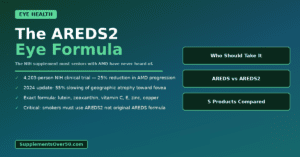
The National Eye Institute summarizes the trials behind these formulas on its Age-Related Eye Disease Studies (AREDS/AREDS2) page. For more detail, read The AREDS2 Supplement: The NIH Eye Health Formula Most Seniors Have Never Heard Of and our ranked guide 5 Best Eye Health Supplements for Seniors.
Popular Supplement Guides:



The Role of Lutein and Zeaxanthin
Lutein and zeaxanthin are carotenoids that concentrate in the macula, where they act as a natural filter against high-energy blue light and protect against oxidative damage. Research consistently shows that people with higher macular pigment density, which is directly increased by lutein and zeaxanthin intake, have a lower risk of AMD progression. The body cannot synthesize these compounds on its own, so diet and supplementation are the only sources.
Most seniors aren’t getting enough through food alone. Leafy greens like kale and spinach are the richest dietary sources, but many older adults eat these infrequently. The recommended amounts in eye health research range from 10mg to 20mg of lutein daily, typically paired with at least 2mg of zeaxanthin. Most multivitamins fall well short of these levels, which is why targeted eye supplements exist.
A newer form called meso-zeaxanthin also appears in some premium formulas. It’s the third carotenoid found in the macula and is not present in most foods at all, making it particularly interesting for people looking to fully support macular pigment.
The AREDS 2 Formula Explained
The Age-Related Eye Disease Study 2 (AREDS 2), funded by the National Eye Institute, is the gold standard in eye supplement research. The updated formula includes vitamin C (500mg), vitamin E (400 IU), zinc (80mg), copper (2mg), lutein (10mg), and zeaxanthin (2mg). The original study showed this combination reduced the risk of advanced AMD progression by about 25% in people with intermediate or late AMD in one eye.
The AREDS 2 formula replaced beta-carotene from the original study after it was linked to increased lung cancer risk in smokers. If a supplement still uses beta-carotene, that’s a red flag, especially if you smoke or recently quit. Ophthalmologists now recommend the AREDS 2 version universally for patients at risk of AMD progression.
What to Look for in an Eye Supplement
Not all eye supplements are worth the money. The label should clearly list the amounts of lutein and zeaxanthin in milligrams. “Proprietary blends” that hide individual doses are a workaround that makes it impossible to know whether you’re getting therapeutic amounts. Look for at least 10mg of lutein and 2mg of zeaxanthin as a starting baseline.
Third-party testing matters too. USP, NSF, or ConsumerLab verification means the product was independently checked to contain what it claims and to be free of contaminants. For a nutrient you’re taking daily for years, quality control is worth the extra few dollars. Finally, check whether omega-3 fatty acids (specifically DHA) are included. DHA is a structural component of the retina and dry eye disease in particular responds well to omega-3 supplementation.
Dosage Notes and How to Take Eye Supplements
Eye supplements contain fat-soluble nutrients, so taking them with a meal that includes some fat significantly improves absorption. Lutein and zeaxanthin are carotenoids and behave like vitamin A in this respect. If you take your supplement on an empty stomach, you may be absorbing far less than the label suggests.
Consistency matters more than anything else for eye health supplements. These nutrients work by slowly building up macular pigment density over months, not days. Most clinical studies showing benefits ran for at least 12 months. If you stop taking them after six weeks because you didn’t notice a dramatic change, you’ve essentially wasted the investment. Think of eye supplements the way you think of sunscreen: a long-term protective strategy, not an acute treatment.

How to Choose the Best Eye Vitamins for Older Adults
PreserVision AREDS 2 is the clear choice for anyone who has been diagnosed with early or intermediate AMD, or has a family history of it. It’s the only formula directly based on the landmark clinical trial. Ocuvite 50+ works well as an everyday eye vitamin for seniors who want comprehensive coverage without clinical-level intervention. NOW Lutein 20mg is the smart pick for anyone who wants to add standalone lutein to an existing supplement routine without duplicating everything else. Life Extension MacuGuard is worth the premium for those who want the meso-zeaxanthin angle and the saffron extract, which has emerging evidence for retinal cell protection. Jarrow Lutein 20 mg with Zeaxanthin rounds out the list as a simple one-a-day softgel with 20 mg lutein and 4 mg zeaxanthin for people who want the two core carotenoids without a full multi-nutrient formula.
Frequently Asked Questions
Can eye supplements reverse vision loss?
No supplement can reverse vision loss that has already occurred. What the research supports is slowing or preventing further progression, particularly in AMD. If you have early-stage AMD, the AREDS 2 formula can meaningfully reduce your risk of moving to advanced AMD. But no pill restores macula cells that have already deteriorated.
Do eye supplements help with cataracts?
The evidence for eye supplements and cataracts is weaker than for AMD. Some antioxidants, particularly vitamin C and E, may help slow cataract development, but no supplement has been shown to dissolve an existing cataract or prevent surgery. The primary treatment for cataracts remains surgical lens replacement.
How long before eye supplements show results?
Most people won’t notice subjective improvements in a short period. Macular pigment density increases gradually over months of consistent supplementation. Clinical studies typically ran for 5 to 10 years. The goal is long-term eye health preservation, not short-term symptom relief. Your ophthalmologist can measure macular pigment density with specialized equipment if you want objective feedback.
Are eye supplements safe to take with other medications?
Most eye supplements are well tolerated, but the high-dose zinc (80mg) in the AREDS 2 formula can interfere with copper absorption, which is why copper is included in the formula. Very high zinc doses can also interact with certain antibiotics. Always tell your doctor or pharmacist what supplements you’re taking, especially before starting a new prescription.
Should I take an eye supplement if I don’t have AMD?
A lower-dose lutein and zeaxanthin supplement is reasonable as a preventive measure, particularly if your diet is low in leafy greens. The full AREDS 2 formula, however, is specifically designed for people who already have AMD. For general eye health maintenance, a formula with 10–20mg lutein and 2mg zeaxanthin is a sensible baseline.
Vision is one of those things most people don’t think about until they start losing it. The supplement evidence for eye health is more robust than for almost any other organ system, which makes this a relatively easy decision for seniors who want to be proactive. Pick a product with clinical-level doses, take it with food, and stay consistent. That’s genuinely the whole strategy.