Best Lutein and Zeaxanthin Supplement for Adults Over 50
This guide contains affiliate links. If you buy through them, we may earn a small commission at no extra cost to you.
A lutein and zeaxanthin supplement is one of the most common eye products people over 50 reach for, and it is easy to see why. Lutein and zeaxanthin are yellow carotenoid pigments found in leafy green vegetables, and they collect in the macula, the small central part of the retina you use for reading, driving and recognizing faces. Researchers measure that yellow layer as macular pigment, and supplements can raise it.
The confusing part is that the most famous eye formula, AREDS2, also contains lutein and zeaxanthin, plus high doses of zinc, copper and vitamins C and E. So which one do you actually need? This guide explains what the National Eye Institute (NEI) research shows, when a standalone lutein and zeaxanthin product makes sense, when AREDS2 is the better choice, and five budget-friendly best sellers worth considering. Every product detail comes from the Amazon listing.
Table of Contents
Lutein and Zeaxanthin Supplement: Quick Comparison
| Product | Best for | Key details (per listing) | Daily dose |
|---|---|---|---|
| NOW Lutein & Zeaxanthin | Best overall (top pick) | Take with a fat-containing meal; NPA A-rated GMP | 25 mg lutein + 5 mg zeaxanthin (1 softgel) |
| Nutricost Zeaxanthin with Lutein | Best budget value | 120 servings; ISO-accredited lab tested | 20 mg lutein + 4 mg zeaxanthin (1 softgel) |
| Sports Research Lutein + Zeaxanthin | Best plant-based | Vegan Plantgel with organic coconut oil; Lute-Gen marigold lutein | 20 mg lutein + 4 mg zeaxanthin (1 capsule) |
| Puritan’s Pride Lutigold 40 mg | Best higher dose | 60 softgels, 2-month supply; sold by Amazon | 40 mg lutein; zeaxanthin amount not stated on listing |
| PreserVision AREDS 2 | Best if you have intermediate AMD | Matches the NEI AREDS2 formula: lutein, zeaxanthin, zinc, copper, vitamins C and E | Follow the label (AREDS2 doses) |
Why Lutein and Zeaxanthin Matter More After 50
Your eyes do not get these carotenoids on their own. They come from food, mainly dark leafy green vegetables. The NEI notes that earlier studies linked diets rich in leafy greens to a lower risk of age-related macular degeneration (AMD), the leading worry for many people over 50 when it comes to central vision.
Age matters here for two reasons. First, AMD becomes more common with age, and it develops quietly: early AMD often has no symptoms, which is why regular dilated eye exams matter so much after 50. Second, many older adults simply do not eat many leafy greens. In the large AREDS2 trial, the people who seemed to gain the most from added lutein and zeaxanthin were those with the lowest intake from food. That is the honest case for a supplement: it is a way to cover a gap in your diet, not a cure for anything.
Popular Supplement Guides:



Does a Lutein and Zeaxanthin Supplement Actually Work?
Here is what the strongest human research found, in plain language.
- It raises macular pigment. A meta-analysis of 20 randomized controlled trials covering 938 people with AMD and 826 healthy adults found that lutein and zeaxanthin supplements increased macular pigment optical density compared with placebo in both groups. In healthy adults, doses above 10 mg a day raised it more than lower doses. Most trials were small and lasted under two years.
- AREDS2 tested it in people at risk of advanced AMD. The AREDS2 randomized trial enrolled 4,203 people aged 50 to 85 who already had large drusen (signs of intermediate AMD) or advanced AMD in one eye. Adding 10 mg of lutein and 2 mg of zeaxanthin to the original AREDS formula did not further reduce progression to advanced AMD in the main analysis over a median of five years.
- It worked well as a beta-carotene replacement. The original AREDS formula used beta-carotene, and AREDS2 found more lung cancers in the beta-carotene group, mostly in former smokers. The researchers concluded lutein and zeaxanthin could be an appropriate substitute, and that is why today’s AREDS2 formula has lutein and zeaxanthin instead.
- Low dietary intake made a difference. According to the NEI’s AREDS/AREDS2 FAQ, participants with the lowest dietary lutein and zeaxanthin who took the supplement had a 26% lower risk of progressing to advanced AMD than those taking the original formula, and a 32% reduction in progression to cataract surgery.
- No benefit was shown for early AMD or for people without AMD. The NEI is clear that the AREDS formulas helped people with intermediate or late AMD, and that supplements cannot prevent AMD.
So, does it work? A standalone lutein and zeaxanthin supplement reliably raises macular pigment, which is a reasonable goal if you rarely eat leafy greens. What it has not been shown to do is prevent AMD or restore lost vision. Think of it as dietary insurance for your eyes, alongside sunglasses, not smoking and regular eye exams.
AREDS2 vs Lutein: Which Do You Need?
This is the most important decision in the whole guide, and it depends on what your eye doctor has found, not on your age alone.
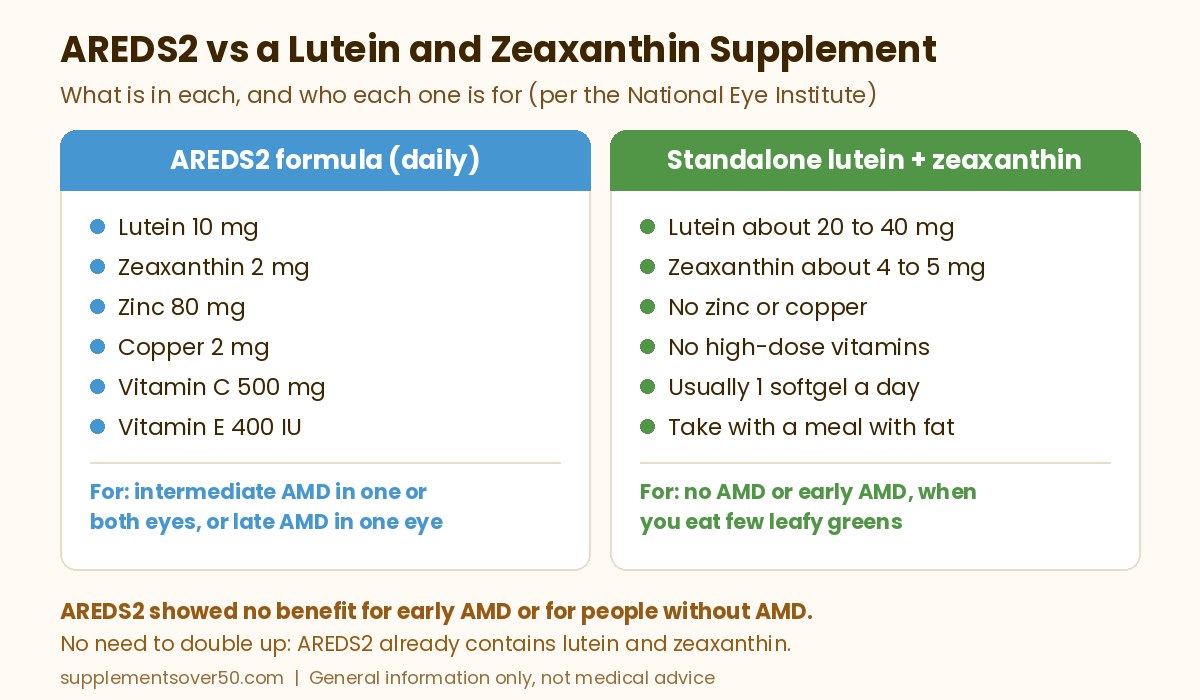
- Choose AREDS2 if you have intermediate AMD in one or both eyes, or late AMD in one eye. According to the NEI’s guide to AMD supplements, AREDS2 may help keep intermediate AMD from turning into late AMD and may slow progression in the other eye if one eye already has late AMD. It contains 500 mg vitamin C, 400 IU vitamin E, 80 mg zinc, 2 mg copper, 10 mg lutein and 2 mg zeaxanthin.
- A standalone lutein and zeaxanthin supplement fits if you have no AMD or early AMD and simply want more of these carotenoids than your diet provides. The NEI says AREDS2 does not stop early AMD from becoming intermediate AMD, so there is no proven reason to take its high zinc dose without a diagnosis.
- Do not double up. AREDS2 already includes lutein and zeaxanthin. If you take AREDS2, you do not need a separate lutein product unless your eye doctor suggests it.
- Smokers and former smokers: avoid the original AREDS formula with beta-carotene. AREDS2 has none.
We go deeper into the formula, the trial history and the zinc overlap with multivitamins in our full guide to the AREDS2 supplement.
Lutein and Zeaxanthin Dosage: How Much?
There is no official daily requirement for lutein or zeaxanthin. AREDS2 used 10 mg of lutein and 2 mg of zeaxanthin a day, a 5 to 1 ratio. Most standalone products on Amazon give more: 20 to 25 mg of lutein with 4 to 5 mg of zeaxanthin, and some go to 40 mg of lutein. The meta-analysis above found a dose response for macular pigment, but higher doses have not been shown to protect vision better, so more is not automatically better.
Because lutein and zeaxanthin are fat soluble, take them with a meal that contains some fat, as the NOW listing suggests. Give it time: the trials that measured macular pigment ran for months, not days.
What to Look for in a Lutein and Zeaxanthin Supplement
- Clear amounts of both. Look for milligrams of lutein and zeaxanthin listed separately. Some labels list only the lutein dose.
- A sensible dose. 10 to 25 mg of lutein with 2 to 5 mg of zeaxanthin covers the range most products and studies use.
- Quality signals. Third-party or ISO-accredited lab testing and GMP certified manufacturing are good signs.
- The right formula for your eyes. If you have been told you have intermediate AMD, choose an AREDS2 formula instead of a standalone product.
- Realistic claims. Skip products that promise to fix your vision, replace glasses or treat eye disease.
- Format you will take. Most come as one softgel a day; Sports Research offers a vegan capsule.
Top Picks for the Best Lutein and Zeaxanthin Supplement
1. NOW Lutein & Zeaxanthin (Best Overall)
NOW Lutein & Zeaxanthin is our top pick because it hits a mainstream dose in one softgel: 25 mg of lutein and 5 mg of zeaxanthin, the same 5 to 1 ratio used in AREDS2, at a higher amount. The bottle has 120 softgels, a four-month supply at one a day, and NOW suggests taking it with a fat-containing meal.
NOW says its manufacturing holds an NPA A-rated GMP certification, which covers its lab testing for stability and potency, and the product is packaged in the USA. It has a 4.7 rating from 3,100+ reviewers, 4,000+ bought in the past month, and it is sold and shipped by Amazon.
2. Nutricost Zeaxanthin with Lutein (Best Budget Value)
Nutricost Zeaxanthin with Lutein gives 20 mg of lutein and 4 mg of zeaxanthin per softgel, with 120 servings per bottle. That is a lot of days for a budget product, and the dose is a touch lower than NOW, which some people prefer.
Nutricost says it is third-party tested by independent, ISO-accredited laboratories, and made in an NSF certified, GMP compliant, FDA registered facility. It is non-GMO and gluten free. It has a 4.6 rating from 2,300+ reviewers, 3,000+ bought in the past month, and it is sold by eSupplements.
3. Sports Research Lutein + Zeaxanthin (Best Plant-Based)
If you avoid gelatin, Sports Research Lutein + Zeaxanthin uses a vegan Plantgel capsule that the listing says is free of carrageenan, gluten, fillers and animal byproducts. One capsule gives 20 mg of lutein and 4 mg of zeaxanthin with organic coconut oil, which helps since these carotenoids are fat soluble.
The lutein comes from Lute-Gen, a marigold flower ingredient the brand says has seed-to-drum traceability. Sports Research says it is third-party tested, made in a cGMP compliant facility in the USA, and Non-GMO Project Verified. It is the best seller of the standalone picks here by monthly sales, with 5,000+ bought in the past month and a 4.7 rating from 3,000+ reviewers. It is sold by Sports Research.
4. Puritan’s Pride Lutigold 40 mg (Best Higher Dose)
Puritan’s Pride Lutigold Lutein 40 mg with Zeaxanthin is the pick if you want a higher lutein dose from a long-running budget brand. The listing describes 40 mg of carotenoids per softgel, and the bottle of 60 is labeled as a two-month supply. It is sold by Amazon.
The catch: the listing does not say how much zeaxanthin is in each softgel, so check the Supplement Facts panel if the ratio matters to you. And remember that 40 mg is well above the 10 mg AREDS2 used; higher doses raise macular pigment more in studies, but they are not proven to protect vision better. It has a 4.6 rating from 14,000+ reviewers and 3,000+ bought in the past month.
5. PreserVision AREDS 2 (Best if You Have Intermediate AMD)
This one is different. PreserVision AREDS 2 is not a standalone lutein product. It is a full AREDS2 formula, and the listing says it includes lutein, zeaxanthin, zinc, copper, vitamin C and vitamin E to exactly match the NEI’s recommended formula. It is by far the best seller in this guide, with 60,000+ bought in the past month and a 4.7 rating from 56,000+ reviewers, sold by Amazon.
Choose it only if your eye doctor has told you that you have intermediate AMD, or late AMD in one eye. If you would rather spend less, Amazon Basics Eye Vitamin AREDS 2 Formula also says it matches the AREDS2 formulation, with 10 mg lutein and 2 mg zeaxanthin per daily serving of two mini softgels. Because AREDS2 has 80 mg of zinc, ask your doctor before taking it with a multivitamin or other zinc product.
How to Choose the Best Lutein and Zeaxanthin Supplement for You
- If you have no AMD and want a simple daily softgel, pick NOW Lutein & Zeaxanthin.
- If you want the longest-lasting bottle for the least fuss, pick Nutricost Zeaxanthin with Lutein.
- If you avoid gelatin or animal products, pick Sports Research Lutein + Zeaxanthin.
- If you want a higher lutein dose, pick Puritan’s Pride Lutigold 40 mg, and check the zeaxanthin amount on the label.
- If your eye doctor says you have intermediate AMD, or late AMD in one eye, pick PreserVision AREDS 2 or another AREDS2 formula, and skip the standalone products.
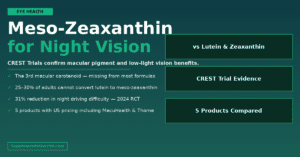
- If you mostly care about night driving and glare, read about the third macular carotenoid before buying.
For more on the eye health category, see our rankings of the best eye health supplements for seniors and 5 best eye health supplements for seniors, ranked by evidence. If night vision is your main concern, meso-zeaxanthin for night vision after 60 covers the third carotenoid found in the macula.
Who Should Check With a Doctor First
Lutein and zeaxanthin from supplements are generally well tolerated at the doses studied, but they are not a substitute for an eye exam. Talk to your eye doctor or pharmacist before you start if any of these apply:
- You have noticed changes in your central vision, such as straight lines looking wavy, blurry spots or trouble reading. Get a dilated eye exam before buying any supplement.
- You have been diagnosed with AMD. Your stage decides whether AREDS2 or a standalone product makes sense.
- You are considering AREDS2. The NEI notes that its high doses may change how your body digests food and how other medicines work, and the zinc can add up with a multivitamin.
- You take prescription medication or have a chronic condition, including liver or kidney disease.
- You smoke or used to smoke. Avoid any eye formula with beta-carotene.
Stop taking it and call your doctor if you notice any new or unusual symptoms after starting.
Frequently Asked Questions
What is the best lutein and zeaxanthin supplement for adults over 50?
For most adults over 50 without AMD, a simple softgel with about 20 to 25 mg of lutein and 4 to 5 mg of zeaxanthin is a sensible choice. Our top pick is NOW Lutein & Zeaxanthin, with 25 mg lutein and 5 mg zeaxanthin in one softgel a day.
Is AREDS2 better than lutein alone?
It depends on your eyes. The NEI says AREDS2 helps people with intermediate AMD in one or both eyes, or late AMD in one eye. It showed no benefit for early AMD or for people without AMD, so a standalone lutein and zeaxanthin supplement is the simpler choice if you have neither.
Can I take lutein with AREDS2?
AREDS2 already contains 10 mg of lutein and 2 mg of zeaxanthin, so most people do not need a separate lutein product on top. Ask your eye doctor before combining them.
How much lutein should I take a day?
There is no official daily requirement. AREDS2 used 10 mg of lutein and 2 mg of zeaxanthin. Most supplements give 20 to 25 mg of lutein with 4 to 5 mg of zeaxanthin. Higher doses raise macular pigment more but are not proven to protect vision better.
Does lutein improve eyesight?
Lutein and zeaxanthin supplements raise macular pigment in studies, but they have not been shown to restore lost vision or replace glasses. If your vision has changed, see an eye doctor first.
When is the best time to take lutein and zeaxanthin?
Take it with a meal that contains some fat, since lutein and zeaxanthin are fat soluble. The time of day matters less than taking it consistently.
Our Take
A lutein and zeaxanthin supplement is a reasonable, low-key choice after 50 if you do not eat many leafy greens and your eyes are healthy. It raises macular pigment, and the research suggests people with low dietary intake have the most to gain. For most people, NOW Lutein & Zeaxanthin or the budget Nutricost softgel is plenty. If your eye doctor has found intermediate AMD, switch to an AREDS2 formula like PreserVision AREDS 2 instead, and whatever you take, keep up your yearly dilated eye exams.
This article is for general information only and is not medical advice. Lutein and zeaxanthin supplements are not intended to diagnose, treat, cure or prevent any disease. Talk to your eye doctor or pharmacist before starting any supplement, especially if you have an eye condition, take medication or have a health condition.