Astaxanthin for Seniors: The Most Powerful Antioxidant You’ve Never Heard Of
astaxanthin for seniors: Astaxanthin is a carotenoid — the pigment that makes salmon pink and flamingos orange. Synthesized naturally by microalgae (primarily Haematococcus pluvialis), it’s consumed by krill, shrimp, and salmon that eat those algae, concentrating it up the food chain. As an antioxidant, it’s roughly 6,000 times more potent than vitamin C and 550 times more potent than vitamin E by some measurements — though potency comparisons between antioxidants are complicated and context-dependent.
What separates astaxanthin for seniors from most antioxidants is its unique molecular structure: it can span the entire cell membrane, providing simultaneous antioxidant protection on both the inside and outside of cells. It also crosses the blood-brain barrier and the blood-retinal barrier — two fortified boundaries that block most supplements. For seniors, those two properties have direct clinical relevance.
Eye Health: The Best Case for Astaxanthin for Seniors After 60
The most consistent body of evidence for astaxanthin in older adults centers on eye health. Multiple Japanese randomized controlled trials (Japan has driven most astaxanthin research given its prominence in aquaculture) show that 6 to 12mg daily reduces eye strain, improves visual acuity in people with macular degeneration, and may slow progression of age-related macular degeneration (AMD).

AMD is the leading cause of vision loss in adults over 60, affecting 2.1 million Americans. The retina is one of the most metabolically active tissues in the body and particularly vulnerable to oxidative damage. The fact that astaxanthin can reach retinal tissue is what makes it relevant here — most oral antioxidants can’t.
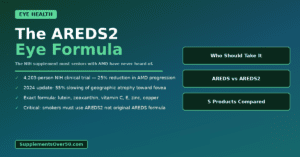
A 2016 study in the journal Nutrients found that 12mg daily for 4 weeks improved visual acuity and reduced eye fatigue in participants with mild AMD. The CREST AMD trial currently underway in Europe is the largest to date. Current evidence is promising but not yet at the level of established standards like the AREDS2 formula (lutein + zeaxanthin + zinc + vitamin C + vitamin E), which has stronger evidence. Consider astaxanthin an adjunct, not a replacement, for AREDS2 supplementation for AMD.
Popular Supplement Guides:


Exercise Recovery and Muscle Function
Oxidative stress and inflammation after exercise increase with age, and recovery takes longer. Astaxanthin reduces oxidative damage markers after exercise and may improve power output and reduce perceived exertion. A 2018 trial in elderly adults showed that 12mg daily for 12 weeks combined with resistance training improved muscle strength more than exercise alone. For seniors working to maintain or rebuild muscle mass — one of the most important longevity interventions available — this is worth noting.
It also reduces exercise-induced lactic acid accumulation, which may explain reduced post-exercise soreness reported subjectively across multiple trials.
Skin Health and Photoprotection
Astaxanthin provides measurable internal photoprotection — it reduces UV-induced DNA damage in skin cells. It doesn’t replace sunscreen, but it provides an additional layer of defense. Studies show improvements in skin elasticity, moisture, and reduced appearance of age spots with 4 to 6mg daily for 8 to 16 weeks.
For post-menopausal women particularly concerned with skin changes, the evidence here is fairly consistent across multiple smaller trials funded by Japanese companies (worth noting as potential bias, though mechanistic evidence supports the claims).
Inflammation and Cardiovascular Markers
Astaxanthin reduces C-reactive protein (CRP) and other inflammatory markers in clinical trials. A 2010 meta-analysis found reductions in triglycerides and increases in HDL cholesterol at 6 to 18mg daily. For seniors managing borderline lipids, these are modest but meaningful effects — 8 to 10 percent triglyceride reduction and 5 to 6 percent HDL increase in clinical populations.
How to Choose: Natural vs. Synthetic Astaxanthin
This matters. Natural astaxanthin from Haematococcus pluvialis algae contains a mixture of astaxanthin esters — the biologically active forms that match what’s found in salmon and krill. Synthetic astaxanthin (used primarily in aquaculture, not supplements) is a different stereochemical form with lower bioactivity in humans.
Always look for “Haematococcus pluvialis” or “AstaReal” on the label. AstaReal is a patented natural astaxanthin ingredient with the most human clinical trial backing. Nutrex Hawaii produces BioAstin — another well-validated natural source from Hawaiian algae farms.
Top Astaxanthin Supplements for Adults Over 60
Cognitive Health: Can Astaxanthin Cross the Blood-Brain Barrier?
Most antioxidants can’t reach the brain in meaningful concentrations. The blood-brain barrier — a tight layer of endothelial cells that separates circulating blood from brain tissue — blocks most water-soluble compounds and many fat-soluble ones. Astaxanthin is one of the few antioxidants that crosses it, owing to its unique ability to integrate into lipid bilayers and its molecular size and polarity characteristics.
Human trial data on cognition is early but encouraging. A 2012 randomized controlled trial in the Journal of Clinical Biochemistry and Nutrition found that 12mg of astaxanthin daily for 12 weeks significantly improved compound memory and attention scores in healthy adults over 60 compared to placebo. A follow-up Japanese trial using 6mg daily for 12 weeks showed improved psychomotor processing speed. The effect sizes are modest — this is not a dramatic nootropic, but a mild cognitive support with a favorable safety profile.
The proposed mechanisms: reduction of oxidative stress in neuronal mitochondria, suppression of neuroinflammation via NF-kB pathway modulation, and improved cerebral blood flow. Neuroinflammation is increasingly recognized as a driver of age-related cognitive decline, and astaxanthin’s anti-inflammatory profile is particularly relevant here.
Metabolic Health and Insulin Sensitivity
Astaxanthin improves insulin sensitivity through several mechanisms — it activates AMPK (the cellular energy sensor that metformin also activates), reduces hepatic fat accumulation, and decreases oxidative stress in pancreatic beta cells, which are highly vulnerable to oxidative damage. In adults with pre-diabetes or metabolic syndrome, 12mg of astaxanthin daily for 8 weeks reduced fasting glucose, improved insulin sensitivity scores, and reduced triglycerides in a 2018 trial published in Nutrients.
For seniors managing pre-diabetes or metabolic syndrome — a population where exercise and dietary intervention may be insufficient on their own — astaxanthin is a reasonable adjunct to standard of care. It is not a substitute for metformin when that’s indicated, but it works through complementary mechanisms and has essentially no side effect risk at standard doses.
Food Sources: Why Diet Alone Won’t Get You There
Astaxanthin is found naturally in seafood that consumes astaxanthin-producing algae and yeast. Wild-caught salmon contains 1-4mg per 3oz serving — the richest dietary source by far. Arctic shrimp and krill contain 0.5-1mg per serving. Farmed salmon, unless fed astaxanthin-supplemented feed, contains essentially none (some producers use synthetic astaxanthin as a pigment, not the same as natural ester-form astaxanthin).
To reach the 12mg dose used in most clinical trials from wild salmon alone, you’d need to eat approximately 3-12 servings of wild salmon daily, depending on astaxanthin content (which varies by species, season, and fat content). Even the 4-6mg dose shown effective for eye health would require at least one large daily serving of wild salmon — achievable in theory but impractical and expensive. Supplementation is the only realistic way to reach therapeutic doses consistently.
AstaReal vs BioAstin vs Synthetic: Does the Source Matter?
This is one of the more meaningful distinctions in the astaxanthin supplement category — not marketing.
Natural astaxanthin from Haematococcus pluvialis exists primarily as astaxanthin esters — astaxanthin bound to fatty acid molecules. AstaReal (grown in Sweden and Japan) and BioAstin from Nutrex Hawaii (grown in closed bioreactor ponds in Hawaii) are both natural ester-form sources. The ester form requires digestion to release free astaxanthin, but the fatty acid attachment actually improves stability and may extend biological activity in tissues.
Synthetic astaxanthin is produced via petrochemical synthesis and exists as free astaxanthin (not esterified). It’s the dominant form in animal feed and aquaculture (most farmed salmon are given synthetic astaxanthin). In the supplement market, synthetic astaxanthin is less common but present in cheaper products. Research comparing natural vs synthetic suggests natural ester-form astaxanthin has 20-90% higher bioavailability depending on the study methodology.
For supplements, look for “Haematococcus pluvialis,” “AstaReal,” or “BioAstin” on the label. These are verified natural ester-form sources. A product listing only “astaxanthin” or “astaxanthin 12mg” without a source is likely synthetic or unspecified.
Stacking Astaxanthin With Other Supplements
Astaxanthin works particularly well as part of a targeted stack depending on your primary health concern:
For eye health: Astaxanthin 12mg + lutein 20mg + zeaxanthin 4mg + omega-3 (EPA/DHA 2g). Astaxanthin reaches the retina; lutein and zeaxanthin concentrate in the macular pigment and filter blue light. Together, they cover multiple mechanisms of age-related retinal protection. This combination exceeds the evidence base of any single supplement alone.
For inflammation and cardiovascular support: Astaxanthin 12mg + CoQ10 100mg + omega-3 2g. Astaxanthin and CoQ10 both support mitochondrial function and reduce oxidative stress — they work synergistically in cardiac tissue. Omega-3 rounds out the anti-inflammatory effects through a different mechanism (EPA competes with arachidonic acid for inflammatory enzyme access).
For skin health: Astaxanthin 6-12mg + collagen peptides 10g + vitamin C 500mg. Astaxanthin provides internal photoprotection and reduces UV-induced collagen degradation. Collagen peptides supply the amino acid substrate for new collagen synthesis. Vitamin C is required for the hydroxylation step in collagen formation — without it, collagen synthesis is impaired regardless of substrate availability.
Who Should Be Cautious With Astaxanthin
Astaxanthin has a favorable safety profile and no established upper tolerable limit, but a few precautions apply:
Blood pressure medications: Astaxanthin has mild blood pressure-lowering effects in some studies. For people on antihypertensives — particularly ACE inhibitors, ARBs, or calcium channel blockers — adding astaxanthin could produce additive hypotensive effects. Monitor blood pressure when starting supplementation if you’re on these medications.
5-alpha reductase inhibitors (finasteride, dutasteride): Astaxanthin has a theoretical inhibitory effect on 5-alpha reductase — the enzyme that converts testosterone to DHT and that finasteride inhibits for BPH and prostate health. If you’re taking finasteride or dutasteride, the combination has no established safety concern, but it’s worth mentioning to your prescribing doctor.
Pregnancy: No human safety data. Not relevant for the over-50 demographic but worth noting.
Skin pigmentation: Very high doses (long-term consumption of hundreds of mg daily, far above supplement doses) can cause carotenodermia — an orange discoloration of the skin similar to what happens with very high beta-carotene intake. At 4-12mg daily from supplements, this has not been reported.
Dosing and Practical Notes
Most clinical trials use 4 to 12mg daily. For eye health specifically, 6 to 12mg shows better results than lower doses. For general antioxidant and skin benefits, 4 to 6mg daily is the common maintenance dose.
Always take with a fat-containing meal. Astaxanthin is fat-soluble and absorption increases significantly when taken with dietary fat. Products like Sports Research that include coconut oil in the softgel provide built-in fat for absorption, but any high-quality astaxanthin taken with meals containing fat will absorb well.
It’s generally very safe — no serious adverse effects reported in human trials at supplemental doses. It can cause a very slight orange tint to skin at extremely high doses (above 20mg), similar to beta-carotene excess, but this isn’t seen at normal supplemental doses.
For adults over 60 primarily concerned with eye health, astaxanthin at 12mg daily from a natural algae source is a reasonable addition to an AREDS2 protocol. For those focused on muscle recovery and inflammation, 12mg with exercise training has the most trial support. It’s one of the more legitimately interesting supplements to emerge from Japanese clinical research — undeservedly obscure in American mainstream supplement culture given its evidence profile.