Vitamin B12 is quietly becoming one of the most widespread — and most underdiagnosed — nutrient deficiencies among American women over 60. The NIH Office of Dietary Supplements estimates that 3.2% of U.S. adults over 50 are clinically deficient, and up to 20% have borderline-low levels that can affect neurological function — yet many have no obvious symptoms until damage has accumulated for years.
For post-menopausal women, the stakes are high. B12 deficiency is linked to elevated stroke risk, peripheral neuropathy, memory decline, and a form of anemia that causes profound fatigue. The good news: the right supplement, in the right form, can address the problem effectively. This guide covers everything you need to know about choosing the best vitamin B12 supplement for women over 60.
Why B12 Absorption Declines So Dramatically After 60
Understanding why B12 deficiency is so common in older adults requires a brief look at how B12 is normally absorbed — because this process becomes less reliable with age in ways that aren’t fixed by simply eating more B12-rich foods.
In most adults, vitamin B12 from food follows a multi-step absorption pathway: stomach acid and enzymes separate B12 from proteins in food, then the freed B12 binds to a protein called intrinsic factor (IF) produced by stomach cells, and the IF-B12 complex is absorbed in the final section of the small intestine. After age 60, this process frequently breaks down at the first step.
Atrophic gastritis — a condition in which the stomach lining thins and acid production drops — affects an estimated 10–30% of older adults. With less stomach acid, food-bound B12 cannot be separated from its carrier proteins and never becomes available for absorption. According to data from the CDC’s National Health and Nutrition Examination Survey (NHANES), suboptimal B12 levels are alarmingly common in adults over 60 — even those eating diets rich in meat, eggs, and dairy.
The critical insight: B12 in supplements and fortified foods is in a free, crystalline form that does NOT require stomach acid to be absorbed. This is why supplementation — rather than dietary changes alone — is often the most effective solution for older adults.
Methylcobalamin vs. Cyanocobalamin: Which Form Is Best for Women Over 60?
🏆 Best B12 for Women Over 60
Jarrow Formulas Methyl B-12 1000mcg
Methylcobalamin sublingual lozenges, most bioavailable form, dissolves under tongue for fast uptake
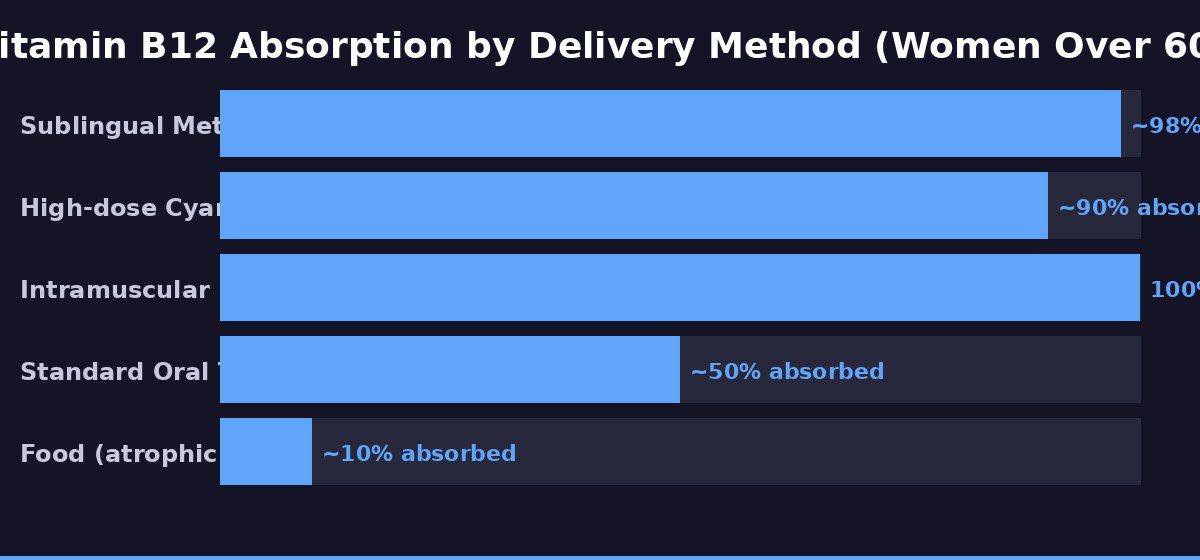
Vitamin B12 absorption rates by delivery method — sublingual and injections lead for older adults
This is the most important decision you’ll make when choosing a B12 supplement. The two dominant forms differ in how your body processes them and how effectively they reach tissues where B12 is needed.
Methylcobalamin — Active, Ready-to-Use
Methylcobalamin is one of two active coenzyme forms of B12 that the body actually uses. It is directly bioavailable — your cells can use it without any enzymatic conversion. This matters for women over 60 because the conversion of cyanocobalamin to active coenzyme forms depends on adequate levels of riboflavin (B2), niacin (B3), and the enzyme methylenetetrahydrofolate reductase (MTHFR). Many older adults are less efficient at this conversion process, and those with common genetic variants in the MTHFR enzyme have an even harder time.
Methylcobalamin also has a particular affinity for neurological tissue, making it the preferred form when the goal is protecting against neuropathy and cognitive decline — two of the most serious consequences of B12 deficiency in this age group. The American Academy of Neurology has highlighted B12 deficiency as a reversible cause of cognitive symptoms that is frequently overlooked in older patients.
Best for: Neurological protection, memory, neuropathy prevention, those with MTHFR variants Delivery: Sublingual tablets, sprays, or lozenges for best absorption Typical dose: 500–1000 mcg daily
Cyanocobalamin is the synthetic form used in most mass-market supplements and B12 injections. It is highly stable and well-absorbed in oral form — particularly in the high doses (500–1000 mcg) at which a small percentage of B12 is absorbed by passive diffusion rather than through the intrinsic factor pathway. This passive absorption mechanism bypasses the stomach acid issue entirely, making high-dose cyanocobalamin effective for most older adults even with atrophic gastritis.
Best for: General supplementation, cost-conscious shoppers, those well-studied on the supplement Delivery: Oral tablets, capsules Typical dose: 500–2000 mcg daily for older adults
Feature
Methylcobalamin
Cyanocobalamin
Form in body
Already active (coenzyme)
Must be converted to active forms
Neurological affinity
High
Moderate
Stability
Moderate (light-sensitive)
Excellent (very stable)
Cost
Higher
Lower
Best delivery
Sublingual
Oral tablet or injection
Suitable for MTHFR variants
Yes
Less ideal
Key Health Benefits of Vitamin B12 for Women Over 60
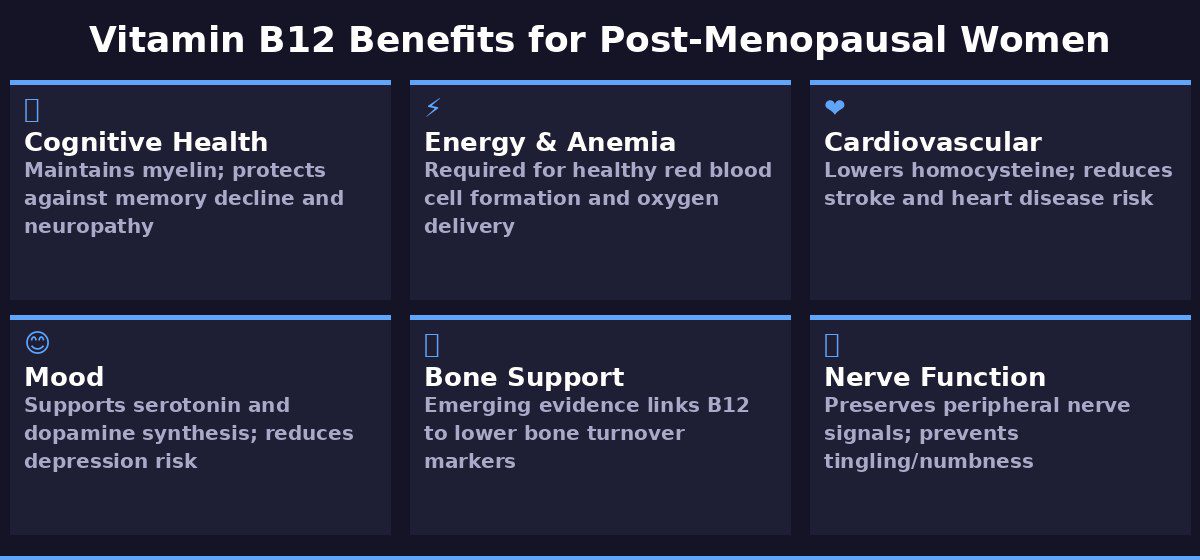
The key health domains where vitamin B12 makes the greatest difference for post-menopausal women
Neurological Health and Cognitive Protection
Vitamin B12 is essential for synthesizing and maintaining the myelin sheath — the protective insulating layer that surrounds nerve fibers throughout the brain and spinal cord. Without adequate B12, myelin breaks down, nerve signals become erratic, and neurological symptoms emerge: tingling in the hands and feet, memory lapses, difficulty concentrating, mood changes, and in advanced deficiency, irreversible nerve damage.
What makes this particularly alarming is that neurological symptoms from B12 deficiency can appear before blood tests show deficiency, because the neurological threshold for B12 is higher than the hematological threshold. Many women over 60 with “normal” blood B12 levels still experience neurological effects from borderline-low status. A growing body of research, including work cited by the Endocrine Society, points to B12 repletion as a clinically important intervention for older adults showing early cognitive changes.
Energy Levels and Anemia Prevention
🔬 Best Cyanocobalamin B12 for Women
Nature Made B12 1000mcg Softgels
1000mcg B12 softgels, USP verified, widely recommended for energy and nerve health in seniors
Vitamin B12 is required for the maturation of red blood cells in the bone marrow. Without it, red blood cells develop abnormally large and are unable to exit the marrow efficiently — a condition called megaloblastic anemia. The result is fewer functional red blood cells carrying oxygen to tissues, causing profound fatigue, weakness, and shortness of breath that can mimic the symptoms of cardiovascular disease or general aging.
This is especially important for women over 60 because fatigue is often dismissed as a normal part of aging. If you experience persistent fatigue that doesn’t improve with rest, ask your doctor to test both your serum B12 and your methylmalonic acid (MMA) level — MMA is a more sensitive marker of functional B12 deficiency than serum B12 alone.
Cardiovascular Protection via Homocysteine Reduction
Vitamin B12 works alongside folate and vitamin B6 to metabolize homocysteine, an amino acid that, when elevated, significantly increases the risk of heart disease and stroke. Elevated homocysteine damages the inner lining of arteries (endothelium), promotes blood clotting, and accelerates atherosclerosis — already a major concern for post-menopausal women whose protective estrogen levels have declined.
Studies show that B12 supplementation, particularly when combined with folate and B6, can reduce homocysteine levels by 25–30%. According to the Endocrine Society, maintaining B12 adequacy is an important component of a comprehensive heart health strategy for women over 60.
B12 is involved in serotonin and dopamine synthesis — neurotransmitters that regulate mood. Low B12 levels have been associated with higher rates of depression and anxiety in older adults. Emerging research from the Endocrine Society also links low B12 to increased bone turnover markers, suggesting a possible role in bone density preservation alongside other key nutrients.
Who Is at Highest Risk for B12 Deficiency After 60?
While all women over 60 face increased risk due to age-related absorption decline, certain groups are at significantly higher risk:
PPI or H2 blocker users: Medications like omeprazole, pantoprazole, and ranitidine reduce stomach acid and therefore B12 absorption from food. Long-term use is strongly associated with B12 deficiency.
Metformin users: This commonly prescribed diabetes medication interferes with B12 absorption in the small intestine. Women taking metformin should have B12 tested annually.
Vegetarians and vegans: B12 is found almost exclusively in animal products. Plant-based eaters who don’t supplement are at very high risk.
Those with autoimmune gastritis or pernicious anemia: The immune system attacks stomach cells that produce intrinsic factor, making oral supplementation less effective. Very high-dose oral supplements (1000–2000 mcg daily) or intramuscular injections may be needed.
Post-bariatric surgery patients: Altered GI anatomy significantly reduces B12 absorption capacity.
💰 Best B12 + B Complex for Women Over 60
Thorne B-Complex #12
B12 with full B-complex, NSF Certified, supports energy, mood, and neurological function over 60
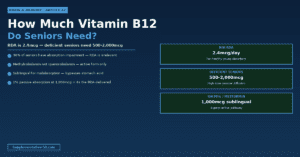
The RDA for B12 is 2.4 mcg/day, but this figure was established for adults with normal absorption. For women over 60 — particularly those with atrophic gastritis or risk factors — most practitioners recommend supplementing at much higher doses to compensate:
Prevention (healthy, no deficiency): 500–1000 mcg daily via oral supplement
Correction of mild deficiency: 1000–2000 mcg daily, orally or sublingually
Severe deficiency or pernicious anemia: Intramuscular injections (typically 1000 mcg cyanocobalamin weekly until levels normalize, then monthly maintenance)
B12 is water-soluble and has no established upper tolerable intake level — excess is excreted in urine, making toxicity from oral supplementation essentially non-existent at standard doses. For personalized guidance, see: Vitamin B12 Dosage for Seniors.
Delivery Methods: Which Works Best?
Sublingual tablets/sprays: Dissolve under the tongue, allowing some B12 to absorb directly through oral mucosa into the bloodstream — bypassing the stomach entirely. Best choice for those with absorption concerns.
High-dose oral capsules/tablets: At doses of 500–2000 mcg, a small but meaningful percentage of B12 absorbs by passive diffusion throughout the intestine — no intrinsic factor required. Effective for most older adults.
Intramuscular injection: Gold standard for severe deficiency, pernicious anemia, or post-surgical patients. Administered by a healthcare provider or self-injected at home with training.
Nasal spray (prescription Nascobal): Delivers B12 through the nasal mucosa. Effective but less commonly prescribed.
B12 and Other Supplements: How They Work Together
Folate (B9): B12 and folate work as a metabolic pair in the methylation cycle. Supplementing with a B-complex that includes both is often recommended.
Vitamin B6: Works alongside B12 and folate to convert homocysteine — the three together are more effective for cardiovascular protection than any single B vitamin.
Iron: B12 deficiency anemia and iron deficiency anemia can coexist; if you’re being evaluated for anemia, both should be assessed.
Methylcobalamin is generally considered the best form of vitamin B12 for women over 60. It is already in the active, bioavailable form that your body can use immediately without conversion. Sublingual methylcobalamin tablets or sprays are particularly effective for older adults because they bypass digestive absorption issues.
How much vitamin B12 do women over 60 need per day?
The RDA is 2.4 mcg/day, but because absorption is impaired after 60, many practitioners recommend 500–1000 mcg daily for older adults. For more detailed guidance: Vitamin B12 Dosage for Seniors.
Does B12 help with energy in women over 60?
Yes — if low energy is related to B12 deficiency. B12 is essential for red blood cell formation; without it, cells become abnormally large and carry less oxygen, causing fatigue. If B12 levels are already normal, additional supplementation won’t provide an energy boost, which is why testing your level first is helpful.
Can B12 deficiency cause memory problems in older women?
Yes. B12 is critical for maintaining the myelin sheath that insulates nerve fibers. Chronic deficiency can cause memory lapses, difficulty concentrating, and dementia-like symptoms sometimes mistakenly attributed to Alzheimer’s. The American Academy of Neurology has noted B12 deficiency as an underdiagnosed, reversible cause of cognitive decline in older adults.
Who is most at risk for B12 deficiency after 60?
Women over 60 taking PPIs or metformin, those following vegetarian or vegan diets, and those with autoimmune gastritis or a history of GI surgery are at highest risk. See: Signs of Vitamin B12 Deficiency in Adults Over 60.
Should I take methylcobalamin or cyanocobalamin?
For women over 60, methylcobalamin is generally preferred — it is already in the active coenzyme form your cells use, and it has stronger neurological affinity. However, high-dose cyanocobalamin (1000 mcg daily) is well-studied, more stable, significantly cheaper, and highly effective for most older adults.
Best Vitamin B12 Supplements for Women Over 60
Methylcobalamin sublingual is the preferred B12 form for seniors — it bypasses the intrinsic factor pathway that becomes impaired with age. Jarrow Methylcobalamin 5000mcg dissolves under the tongue for direct absorption.
Adenosylcobalamin supports mitochondrial energy production and is the form used inside cells. Country Life Dibencozide (adenosylcobalamin) is a US-available option that complements methylcobalamin for comprehensive B12 support.
Struggling with recurrent UTIs after menopause? Learn how declining estrogen impacts bladder health and explore proven natural supplements like D-mannose, cranberry, and lifestyle fixes.
Looking for a moisturizer for dry mature skin? Compare 5 creams from Kiehl’s, First Aid Beauty, Lancome, Charlotte Tilbury and CeraVe, plus what to look for after 50.