Best Supplements for Restless Legs After 50: Iron First, Then 4 More Picks
This guide contains affiliate links. If you buy through them, we may earn a small commission at no extra cost to you.
If you are searching for the best supplements for restless legs, you probably know the feeling: you finally sit down or get into bed, and your legs start to ache, crawl or tingle until you have to get up and move. It can wreck your evenings and your sleep, and it often gets worse with age.
Here is the honest picture. Most supplements sold for restless legs have little or no good evidence behind them. One does: iron, but only for people whose iron stores are low on a blood test. Taking iron when you do not need it can do real harm after 50. This guide explains what restless legs syndrome (RLS) is, which tests to ask for, what the research shows for iron, magnesium, vitamin D, vitamin C and B vitamins, the everyday triggers to cut first, and five products worth considering, each with a clear reason to use it.
Table of Contents
Why Restless Legs Get Worse After 50
According to the National Institute of Neurological Disorders and Stroke (NINDS), RLS is a neurological condition that causes an irresistible urge to move the legs, usually with uncomfortable sensations described as aching, throbbing, pulling, itching, crawling or creeping. Symptoms appear when you are resting, ease when you move and tend to be worst in the late afternoon and evening, with a symptom-free stretch in the early morning. Most people with RLS also have periodic limb movements during sleep, which are jerks or twitches every 15 to 40 seconds.
NINDS notes that RLS can start at any age but most often begins in middle age, is more common in women and often runs in families. Symptoms may come and go early on, but often return and become more severe over time. That is one reason so many people first notice a real problem in their 50s and 60s.
Popular Supplement Guides:



Several things that become more common with age are linked to RLS. NINDS lists end-stage kidney disease and dialysis, nerve damage (neuropathy), sleep apnea, sleep deprivation and Parkinson’s disease. Low iron in the brain may also be responsible, which is why iron is the centre of any honest conversation about restless legs supplements. Low iron is not always obvious, either: you can have low iron stores without being anemic.
Check Your Triggers Before Buying Any Supplement
The AASM guideline says the first step in managing RLS should be dealing with things that make it worse. That costs nothing and often helps more than a pill. Common triggers named by the guideline and NINDS include:
- Alcohol, caffeine and nicotine. Try cutting caffeine after noon and skipping evening drinks for two weeks to see if your legs calm down.
- Sedating antihistamines. Diphenhydramine, found in many “PM” sleep aids and allergy pills, is a common example. Ask your pharmacist about alternatives.
- Some antidepressants. NINDS lists antidepressants that increase serotonin. Never stop one on your own; ask your doctor whether a switch makes sense.
- Anti-nausea and antipsychotic drugs that block dopamine can also aggravate symptoms.
- Untreated sleep apnea. If you snore loudly or wake up gasping, ask about a sleep study.
- Short or irregular sleep. NINDS suggests a regular sleep schedule and moderate, consistent exercise.
Simple comfort measures from NINDS can help on bad nights: massaging your legs, a warm bath, a heating pad or ice pack, and foot wraps or vibration pads designed for RLS.
Do Supplements for Restless Legs Actually Work?
Some can, but only in the right person. Here is what the evidence says for each ingredient you will see in lists of the best supplements for restless legs.
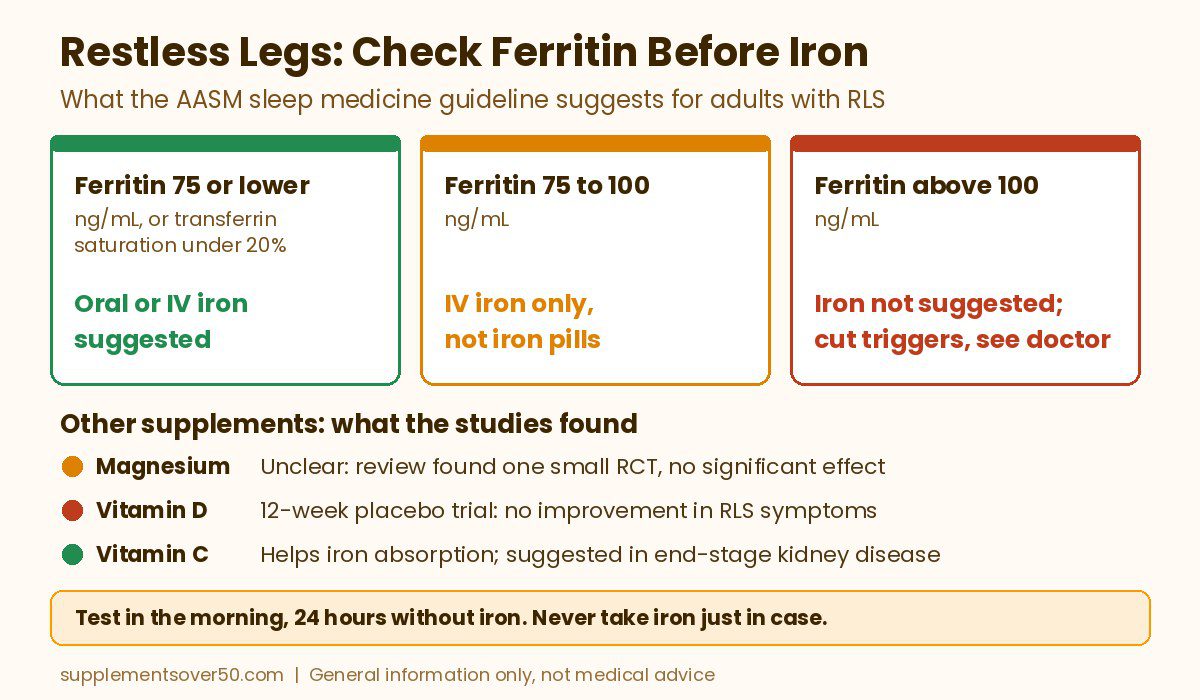
Iron (the strongest evidence, if you are low). The American Academy of Sleep Medicine (AASM) clinical practice guideline, published in the Journal of Clinical Sleep Medicine, tells clinicians to regularly test iron levels in everyone with clinically significant RLS, including ferritin and transferrin saturation. It says the blood draw should ideally be in the morning, after avoiding iron supplements and iron-containing foods for at least 24 hours.
Based on expert consensus, the guideline suggests iron for adults with RLS when ferritin is 75 ng/mL or lower, or transferrin saturation is under 20%. When ferritin is between 75 and 100 ng/mL, it suggests IV iron only, not pills. Above 100 ng/mL, it does not suggest iron supplementation. The guideline notes these thresholds are higher than the ones used for the general population, so a ferritin result your lab calls “normal” may still be low for RLS.
For the form of iron, the guideline makes a conditional recommendation for oral ferrous sulfate in adults with suitable iron levels (moderate certainty of evidence), and a strong recommendation for IV ferric carboxymaltose given by a clinician. In other words, iron pills are a reasonable first try when your numbers fit, and your doctor has stronger options if they do not work.
Magnesium (unclear). Magnesium is the supplement most people try first, mostly because it is linked with leg cramps. A systematic review in Sleep Medicine Reviews found only eight studies with relevant data, and just one was a randomized placebo-controlled trial, which did not find a significant effect (though it may have been too small). The authors could not conclude whether magnesium helps RLS. It may still be worth a try if your diet is low in magnesium or you also get night cramps, but keep expectations modest.
Vitamin D (no proven RLS benefit). In a 12-week randomized, placebo-controlled trial published in Sleep and Breathing, 35 people with RLS took 50,000 IU of vitamin D weekly or a placebo. Symptom severity did not improve more with vitamin D than with placebo. Correcting low vitamin D is good for your bones and muscles, but do not expect it to fix restless legs.
Vitamin C (helps iron, and may help on dialysis). The NIH Office of Dietary Supplements iron fact sheet notes that vitamin C (ascorbic acid) can significantly affect how well your body absorbs non-heme iron from plant foods and supplements. The AASM guideline also suggests vitamin C for adults with RLS and end-stage kidney disease, though the evidence is low certainty.
Folate and vitamin B12 (only if deficient). There is no strong evidence that these vitamins treat RLS on their own. But low B12 can contribute to nerve problems, and NINDS lists neuropathy among the conditions that can occur alongside RLS. If your doctor is already running iron tests, ask whether B12 and folate should be checked too.
What the guideline advises against. The AASM suggests against using valerian for RLS. Many products sold as “restless legs relief” on Amazon are homeopathic tablets, and we did not include them because there is no solid evidence they work.
What to Look for in the Best Supplements for Restless Legs
- Iron only after a blood test. Ask for ferritin, iron, total iron binding capacity and transferrin saturation, ideally a morning draw after 24 hours without iron. Without those numbers, you are guessing.
- Elemental iron on the label. A tablet of 325 mg ferrous sulfate provides 65 mg of elemental iron. Compare products by elemental iron, not by the weight of the iron salt.
- A form you can tolerate. The NIH notes that 45 mg a day or more of iron can cause nausea and constipation. Gentler forms such as iron bisglycinate or carbonyl iron may suit sensitive stomachs, though ferrous sulfate is the form named in the guideline.
- Vitamin C with iron. Taking iron with vitamin C, or a product that includes it, can help absorption.
- Third-party testing. USP Verified or NSF Certified seals show a product was checked for quality. Our guide on how to read a supplement label after 50 explains these seals.
- Sensible magnesium doses. Stay within the NIH upper limit of 350 mg a day from supplements unless your doctor advises more.
- No “cure” claims. No supplement cures RLS. Be wary of blends that promise instant relief.
Best Supplements for Restless Legs: Quick Comparison
| Product | Best for | Key details | Daily dose |
|---|---|---|---|
| Nature Made Iron 65 mg | Best overall (if ferritin is low) | 65 mg iron from 325 mg ferrous sulfate; USP Verified; gluten free | 1 tablet with a meal |
| Thorne Iron Bisglycinate | Gentlest option | 25 mg iron as bisglycinate; NSF Certified for Sport | See label |
| Vitron-C | Iron plus vitamin C | 65 mg carbonyl iron with 125 mg vitamin C; vegan, gluten-free | 1 tablet |
| Pure Encapsulations Magnesium Glycinate | Low magnesium or night cramps | 120 mg magnesium per capsule as glycinate; free from common allergens | See label |
| Nature Made Vitamin D3 2000 IU | Correcting low vitamin D | 2000 IU (50 mcg) D3 softgels; gluten free | 1 softgel with a meal |
Top Picks for the Best Supplements for Restless Legs After 50
1. Nature Made Iron 65 mg (Best Overall)
If your blood test shows ferritin at or below 75 ng/mL or transferrin saturation under 20%, and your doctor agrees oral iron is right for you, this is the most straightforward choice. Each tablet supplies 65 mg of iron from 325 mg of ferrous sulfate, which is the oral form the AASM guideline suggests for RLS. It is USP Verified, gluten free and made without synthetic dyes or artificial flavors. It has more than 59,100 ratings with a 4.7 rating.
The label says to take one tablet a day with water and a meal to help absorption. Be aware that 65 mg is above the 45 mg adult upper limit set by the NIH for unsupervised use, and it is a treatment dose, so use it only under a doctor’s care with follow-up blood tests. Constipation and stomach upset are common with ferrous sulfate. If that happens, ask your doctor about a gentler form like the next pick.
2. Thorne Iron Bisglycinate (Gentlest Option)
Thorne Iron Bisglycinate gives 25 mg of elemental iron per capsule as iron bisglycinate, a chelated form the brand describes as well absorbed and non-constipating. It is NSF Certified for Sport, meaning it is tested for label accuracy and screened for banned substances. With more than 9,300 ratings and a 4.7 rating, it is a popular pick for people who cannot handle ferrous sulfate.
The trade-off is the dose and the evidence. At 25 mg, it is well under the upper limit, but your doctor may want you to take more than one capsule a day to raise ferritin into the range that matters for RLS. The guideline’s oral iron suggestion is based on ferrous sulfate, not bisglycinate, so ask your doctor whether it fits your plan, and recheck your levels after a few months.
3. Vitron-C (Best Iron With Vitamin C)
Vitron-C pairs 65 mg of elemental iron, as carbonyl iron, with 125 mg of vitamin C in one tablet. Since vitamin C helps absorption of non-heme iron, this saves you taking a second pill. The brand says carbonyl iron is gentle on the stomach and may help reduce constipation. The tablets are vegan, gluten-free and dye-free, with no artificial flavors.
It is one of the most reviewed iron products on Amazon, with more than 31,800 ratings and a 4.6 rating. The recommended use is one tablet a day. Like the Nature Made pick, 65 mg is a treatment-level dose above the NIH upper limit, so it is only for people with confirmed low iron who are being monitored.
4. Pure Encapsulations Magnesium Glycinate (Best Magnesium to Try)
If your iron is fine and you still want to try something, magnesium glycinate is a gentle, well-tolerated form. Each Pure Encapsulations capsule provides 120 mg of magnesium as magnesium glycinate. The brand says it may help support the sleep cycle and relaxation, and its products are free from common allergens, GMOs and unnecessary ingredients. It has more than 53,700 ratings with a 4.7 rating and is a Best Seller in its category.
Remember that the evidence for magnesium in RLS is unclear. Try it for a few weeks, keep notes on your nights and stop if nothing changes. The 120 mg capsule makes it easy to stay under the 350 mg daily supplement limit. If night cramps are your main problem rather than the urge to move, our guide to the best magnesium supplement for leg cramps at night after 50 covers that separately.
5. Nature Made Vitamin D3 2000 IU (Best for Low Vitamin D)
This pick is about overall health, not a direct RLS fix. Vitamin D did not beat placebo for RLS symptoms in the trial above, but many older adults run low, and low vitamin D matters for bones and muscles. Each softgel gives 2000 IU (50 mcg) of vitamin D3. The label says to take one a day with water and a meal, ideally one that contains some fat. It is gluten free with no added color.
It has more than 40,600 ratings with a 4.8 rating, the highest in this roundup, and one bottle lasts 250 days. If your doctor is already checking your iron, ask for a vitamin D level too. Our guide to signs of vitamin D deficiency in seniors explains what to watch for.
How to Choose the Best Supplements for Restless Legs
- If your ferritin is 75 ng/mL or lower, or transferrin saturation is under 20%, ask your doctor about Nature Made Iron 65 mg, the guideline’s oral form.
- If ferrous sulfate upsets your stomach, ask about Thorne Iron Bisglycinate or Vitron-C instead.
- If you want vitamin C included, pick Vitron-C.
- If your ferritin is between 75 and 100 ng/mL, skip iron pills. The guideline suggests only IV iron in that range, so talk to your doctor.
- If your iron is normal or high, do not take iron. Cut triggers first, and consider trying magnesium glycinate.
- If a blood test shows low vitamin D, pick Nature Made D3 for your general health.
- If you are on dialysis or have kidney disease, do not choose any of these yourself. Your kidney team needs to guide iron, vitamin C and magnesium.
For a deeper look at iron after 50, read Iron Supplements for Seniors: What the Evidence Actually Says and our best iron supplement for women over 60 roundup. If you want to compare magnesium forms, see the best magnesium glycinate for seniors. And if RLS has wrecked your sleep, our best sleep supplement for seniors guide covers options that do not make restless legs worse.
Iron Overload, Kidney Disease and Other Safety Concerns
- Iron overload is a real risk after 50. Men and women past menopause no longer lose iron through monthly bleeding, so extra iron can build up. The NIH Office of Dietary Supplements iron fact sheet notes that people with hereditary hemochromatosis are at risk of too much iron. Only take iron when a test shows you need it, and recheck your levels while you take it.
- Mind the upper limit. The NIH sets the adult upper limit for iron at 45 mg a day and warns that high doses can cause stomach problems, while extremely high doses can be dangerous. Keep iron away from grandchildren.
- Medication interactions. The NIH says iron supplements may interact with levodopa (used for Parkinson’s and sometimes RLS) and levothyroxine (thyroid medicine), and that proton pump inhibitors for heartburn can reduce iron absorption. Ask your pharmacist how to space doses.
- Kidney disease. RLS is common with end-stage kidney disease and dialysis. The AASM guideline has separate advice for this group, including IV iron sucrose and vitamin C. Magnesium can build up when kidneys do not work well. Read our guide to supplements to avoid with kidney disease after 60 before adding anything.
- Pregnancy. RLS is common in pregnancy, especially the last trimester, and the AASM says treatment choices should account for pregnancy safety. This is less relevant after 50, but worth knowing for daughters and granddaughters.
- Magnesium side effects. The NIH Office of Dietary Supplements notes that high intakes from supplements can cause diarrhea, nausea and abdominal cramping.
Prescription Medicines and the Augmentation Warning
Many people with RLS have been prescribed dopamine drugs such as pramipexole, ropinirole or rotigotine. The AASM guideline now suggests against their standard use, because of side effects with long-term use, particularly augmentation. Augmentation means the medicine starts making RLS worse over time: symptoms start earlier in the day, become more intense or spread to the arms. NINDS also notes that long-term use of dopamine drugs such as carbidopa/levodopa may worsen symptoms.
Instead, the guideline gives strong recommendations for gabapentin, gabapentin enacarbil and pregabalin, along with IV iron when iron levels fit. If you are on a dopamine drug and your symptoms seem to be creeping earlier or getting stronger, do not stop it suddenly. Talk to your doctor, ask for iron tests and discuss whether a change is right. Supplements do not replace that conversation.
When to See a Doctor
Restless legs are not just a nuisance. They can point to low iron, kidney problems, nerve damage or a sleep disorder. See your doctor if:
- Symptoms disturb your sleep more than once or twice a week, or leave you exhausted, foggy or low in mood during the day.
- You have never had your iron checked. Ask for ferritin and transferrin saturation, not just a hemoglobin test.
- Symptoms started after a new medicine, such as an antidepressant, antihistamine or anti-nausea drug.
- You also have numbness, burning feet or weakness, which can point to neuropathy, including from diabetes or low B12.
- You snore loudly or stop breathing during sleep, which can signal sleep apnea.
- Your RLS medicine seems to be making things worse, or symptoms are starting earlier in the day.
- You have kidney disease or are on dialysis, before taking any supplement.
Some people with restless legs also find a light weighted blanket calming at night. The evidence is limited, so see our guide to the best weighted blankets for older adults for what the research says and who should skip one.
Frequently Asked Questions
What is the best supplement for restless legs?
Iron is the only supplement with real guideline support, and only if a blood test shows low iron stores. The American Academy of Sleep Medicine suggests iron for adults with RLS when ferritin is 75 ng/mL or lower or transferrin saturation is under 20%. Get tested before you take it.
What ferritin level is too low for restless legs?
For RLS, the AASM guideline suggests treating with oral or IV iron when ferritin is 75 ng/mL or lower, or transferrin saturation is under 20%. Between 75 and 100 ng/mL, it suggests IV iron only. These thresholds are higher than those used for anemia, so a normal lab result may still be low for RLS.
Does magnesium help restless legs?
It is not clear. A systematic review found only one placebo-controlled trial, and it did not show a significant benefit. Magnesium may still be worth trying if you are low or also have night cramps. Stay under 350 mg a day from supplements unless your doctor says otherwise.
Can I take iron for restless legs without a blood test?
It is not a good idea, especially after 50. Iron can build up in the body, and people with hereditary hemochromatosis are at risk of iron overload. The guideline recommends testing ferritin and transferrin saturation first, ideally in the morning after 24 hours without iron.
What makes restless legs worse at night?
Common triggers include alcohol, caffeine and nicotine, sedating antihistamines found in many PM sleep aids, some antidepressants that increase serotonin, some anti-nausea drugs and untreated sleep apnea. Cutting these is the first step the guideline recommends.
Does vitamin D help restless legs?
A 12-week placebo-controlled trial found that weekly high-dose vitamin D did not improve RLS symptoms more than placebo. Correcting a vitamin D deficiency is still good for bones and muscles, but it is not a treatment for restless legs.
Our Take
The best supplements for restless legs start with a blood test, not a shopping cart. If your ferritin is 75 ng/mL or lower or your transferrin saturation is under 20%, iron is the one supplement the sleep medicine guideline backs, and Nature Made Iron 65 mg is our top pick, with Thorne Iron Bisglycinate and Vitron-C as gentler or vitamin C options. Magnesium glycinate is a reasonable experiment with unclear evidence, and vitamin D is for general health. Cut caffeine, alcohol and trigger medicines first, never take iron without testing, and see your doctor if your nights keep getting worse.
This article is for informational purposes only and is not medical advice. Talk to your doctor before taking iron or other supplements for restless legs, especially if you have kidney disease, hemochromatosis or another iron disorder, take prescription medicines such as levodopa, levothyroxine or antidepressants, or are pregnant.