Best Cholesterol Supplements for Seniors: What Works Alongside Your Doctor’s Plan
This guide contains affiliate links. If you buy through them, we may earn a small commission at no extra cost to you.
The best cholesterol supplements for seniors are the few with real human trials behind them: plant sterols and stanols, psyllium fiber, berberine, and omega-3 fish oil for triglycerides. They can trim LDL cholesterol by a modest amount when you take a meaningful dose every day. What they cannot do is match a prescription drug, and that matters more after 50, when heart risk climbs and many people already take a statin.
This guide explains what each one does, how much of a drop you can realistically expect, which ones clash with common medicines, and how to fit them around the plan you have with your doctor. Then it walks through five picks from the top organic Amazon results, each chosen for a different job.
Table of Contents
Why Cholesterol Changes After 50
The MedlinePlus guide to cholesterol levels lists age as one of the factors you cannot change: cholesterol levels tend to rise as you get older. For women the shift is sharper. Between 20 and 39, men are more likely to have high total cholesterol, but after menopause a woman’s risk goes up, because menopause lowers the hormones that may protect against high blood cholesterol.
Testing becomes more frequent for the same reason. MedlinePlus says men 45 to 65 and women 55 to 65 should usually be tested every 1 to 2 years, and people over 65 every year. A standard lipid panel reports total cholesterol, LDL (the “bad” cholesterol and the main source of artery buildup), HDL, non-HDL cholesterol and triglycerides.
Popular Supplement Guides:
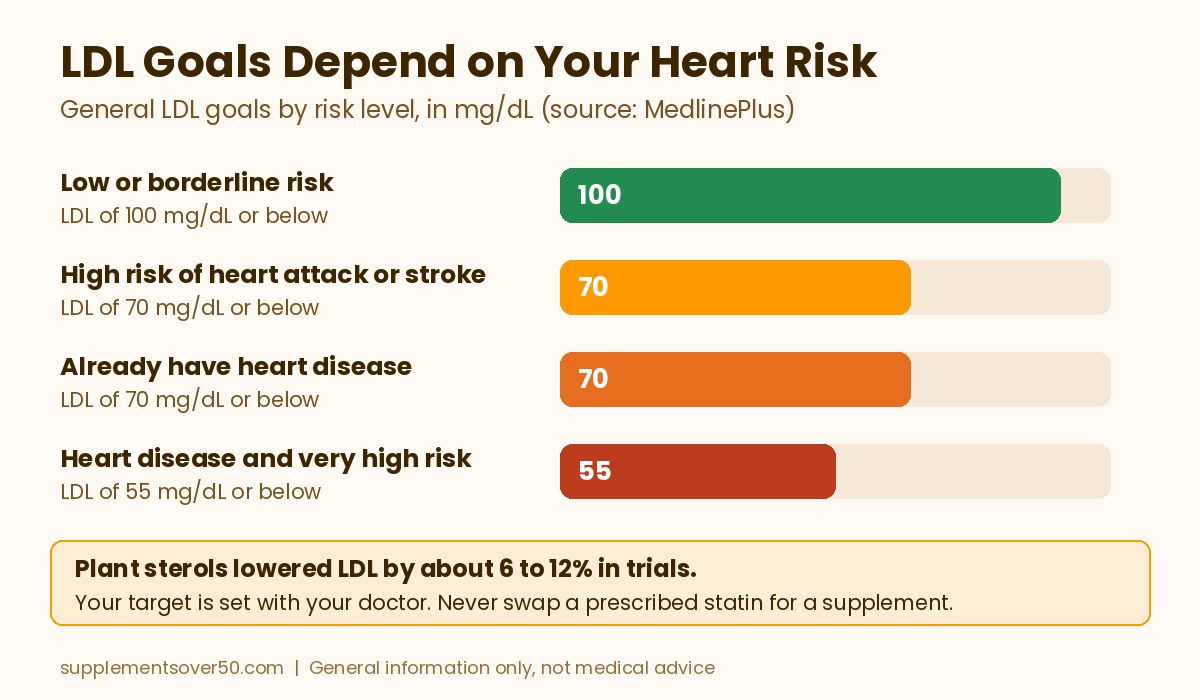
The most useful point for anyone over 50 is that there is no single “good” LDL number. MedlinePlus explains that providers increasingly set LDL goals by risk level. For most adults at low or borderline risk, the general goal is 100 mg/dL or below. If you are at high risk of a heart attack or stroke, or already have heart disease, the goal is typically 70 mg/dL or below, and for those with heart disease at very high risk it can be 55 mg/dL or below. Your doctor may use a risk tool called PREVENT, which weighs age, health history and family history, to place you in a group.
That is why your LDL target is something you set with your doctor, not something a supplement label can decide. A 10 percent drop might be plenty for someone with a borderline result and no other risk factors. For someone who needs to get from 160 down to 70, it is nowhere near enough on its own.
Do Cholesterol Supplements Actually Work?
Some do, modestly. Here is what the better human evidence shows for the four ingredients in this guide.
Plant sterols and stanols. According to the NCCIH research summary on high cholesterol and natural products, foods with added sterols or stanols are already an option in conventional treatment for high cholesterol, and studies show sterol or stanol supplements taken with meals can also reduce cholesterol. A 2014 meta-analysis of 124 plant sterol and stanol studies (Ras and colleagues) found that intakes of 0.6 to 3.3 grams a day lowered LDL by an average of 6 to 12 percent, with the effect leveling off at around 3 grams a day.
Psyllium. A 2018 meta-analysis of 28 psyllium trials with 1,924 participants (Jovanovski and colleagues) found that a median dose of about 10 grams of psyllium a day lowered LDL by about 0.33 mmol/L, which is roughly 13 mg/dL. It also lowered non-HDL cholesterol and apolipoprotein B.
Berberine. A 2013 meta-analysis of 11 berberine trials with 874 participants (Dong and colleagues) reported reductions in LDL of about 0.65 mmol/L (roughly 25 mg/dL), along with lower total cholesterol and triglycerides. The authors rated the quality of the included trials as generally low and called for larger studies, so treat that number as hopeful rather than settled.
Omega-3 fish oil. This one targets a different number. The NIH Office of Dietary Supplements omega-3 fact sheet says fish oil supplements lower triglyceride levels, and the American Heart Association concludes that 4 grams a day of prescription omega-3s lowers triglycerides. Fish oil is not an LDL-lowering supplement.
Now the reality check. NCCIH describes a 2023 randomized trial of 190 people that compared a low-dose statin, a placebo and six popular supplements, plant sterols among them. None of the supplements lowered LDL significantly compared with placebo, while the statin did. And NCCIH’s tips on high cholesterol and dietary supplements are blunt: if you have high cholesterol, follow your provider’s treatment plan and do not take supplements instead of prescribed medicine.
What We Left Out, and Why
Red yeast rice is the best-selling cholesterol supplement in many searches, but it is a special case. NCCIH explains that some red yeast rice contains monacolin K, which is chemically identical to the statin lovastatin. Products with more than trace amounts cannot legally be sold as dietary supplements in the U.S., they can cause the same side effects and drug interactions as lovastatin, and some have been contaminated with citrinin, which may damage the kidneys. Never combine it with a statin. We cover it separately in our upcoming red yeast rice guide for seniors.
Garlic, soy, green tea and bergamot show small or limited effects in the NCCIH summary, so they did not make our list of picks. Citrus bergamot is popular on Amazon, but NCCIH describes the evidence as limited.
What to Look for in Cholesterol Supplements After 50
- An ingredient with human evidence. Plant sterols or stanols, psyllium, and berberine for LDL; omega-3s for triglycerides.
- A dose close to what trials used. Roughly 1.5 to 3 grams a day of sterols or stanols, and about 10 grams a day of psyllium in the trials above. Low-dose blends often fall well short.
- Timing that fits your day. Sterols need to be taken with meals. Psyllium needs a full glass of water.
- Third-party verification. Look for USP Verified, NSF, IFOS or a stated third-party certification, since supplements are not approved before they are sold.
- An honest label. Avoid products promising to replace your medicine or “detox” your arteries. Our guide on how to read a supplement label explains seals, serving sizes and claims.
- A check against your medicine list. Berberine and fish oil both have interactions worth discussing with a pharmacist.
Best Cholesterol Supplements for Seniors: Quick Comparison
| Product | Best for | Key details | Daily dose (per label) |
|---|---|---|---|
| Nature Made CholestOff Plus | Best overall for LDL | 900 mg plant sterols and stanols per serving; USP Verified; gluten free | 2 softgels twice daily with meals (1,800 mg) |
| Metamucil 4-in-1 Sugar-Free Powder | Best soluble fiber | Psyllium husk; supports heart health by lowering cholesterol; orange flavor | See label; powder mixed in water |
| Metamucil Psyllium Fiber Capsules | Fiber without mixing | Psyllium husk capsules; supports heart health by lowering cholesterol | See label; take daily |
| Thorne Berberine | Blood sugar plus cholesterol | Phytosome and HCl berberine; third-party tested and certified | See label |
| Sports Research Omega-3 Fish Oil | Triglycerides | 1,040 mg omega-3 (690 mg EPA, 260 mg DHA) per softgel; triglyceride form; IFOS 5-Star | 1 softgel |
Top Picks for the Best Cholesterol Supplements for Seniors
1. Nature Made CholestOff Plus (Best Overall for LDL)
Plant sterols and stanols have the deepest evidence of any cholesterol supplement, and CholestOff Plus delivers a dose in the useful range. According to the listing, each serving provides 900 mg of plant sterols and stanols, for a daily total of 1,800 mg when you take two softgels twice a day with your two largest meals. That sits within the 0.6 to 3.3 gram range linked to 6 to 12 percent lower LDL in the Ras meta-analysis.
It is USP Verified, gluten free and has no synthetic dyes or artificial flavors, and it has more than 5,900 ratings on Amazon. The catch is the routine: four softgels a day, with food. A 100-count bottle lasts 25 days. Sterols also lower blood levels of some carotenoids, which we cover in the safety section below.
2. Metamucil 4-in-1 Sugar-Free Psyllium Powder (Best Soluble Fiber)
Psyllium is the most practical cholesterol helper for many older adults, because it also helps with regularity, which tends to become a bigger issue with age. Metamucil’s listing says its psyllium husk fiber helps support heart health by lowering cholesterol, along with digestive health, healthy blood sugar levels and appetite control. This sugar-free version is orange flavored, and it is the Amazon Best Seller in its category, with more than 35,000 ratings.
The trials behind psyllium used a median of about 10 grams a day, so check the label for how many grams each dose provides and build up slowly to limit gas and bloating. Always mix it with a full glass of water. If you take other medicines, ask your pharmacist how far apart to space them, since fiber can affect how some drugs are absorbed. For more options, see our Best Psyllium Husk Supplement for Seniors guide.
3. Metamucil Psyllium Fiber Capsules (Best Fiber Option Without Mixing)
Some people simply will not drink a fiber shake every day. Metamucil’s capsules give you the same psyllium husk with no spoon or mixing, and the listing says they help support heart health by lowering cholesterol, digestive health and healthy blood sugar levels. The brand recommends taking them daily for best results. They have more than 27,000 ratings.
Capsules hold much less fiber than a scoop of powder, so you will need several to approach the amounts used in trials. Read the serving size, take them with plenty of water, and skip them if you have trouble swallowing, because psyllium swells as it absorbs liquid.
4. Thorne Berberine (Best for Blood Sugar and Cholesterol Together)
Berberine is the most interesting option for adults whose cholesterol and blood sugar are both creeping up. Thorne’s version combines two berberine extracts, a phytosome and berberine HCl, and the listing says it helps maintain blood sugar and cholesterol levels already within a normal range and supports a healthy liver. Thorne states that the product is third-party tested and certified to confirm label accuracy and screen for unsafe levels of contaminants. It has more than 6,700 ratings.
This is also the pick with the most cautions, which is why it is not ranked higher. Berberine may lower blood sugar, so stacking it on insulin, a sulfonylurea or other diabetes drugs can push glucose too low. In a small clinical study in healthy volunteers, two weeks of berberine reduced the activity of liver enzymes such as CYP2D6 and CYP2C9, which process many common prescriptions. Check with your pharmacist before starting. Our Best Berberine Supplement for Seniors guide compares forms and doses.
5. Sports Research Omega-3 Fish Oil (Best for Triglycerides)
If your lipid panel shows high triglycerides alongside your LDL, omega-3s are the supplement with the clearest role. Each Sports Research softgel provides 1,250 mg of fish oil with at least 1,040 mg of omega-3s, including 690 mg EPA and 260 mg DHA, in the triglyceride form. It is sourced from wild Alaska pollock, carries MSC certification and an IFOS 5-Star rating, and the brand says a 10-step distillation process is designed to avoid fishy burps. It has more than 61,000 ratings.
Keep expectations straight: fish oil helps triglycerides, not LDL. The ODS fact sheet notes that triglyceride-lowering trials used about 4 grams a day of prescription omega-3s, far more than one softgel, and that large trials at 4 grams a day found a slightly higher risk of atrial fibrillation. Talk to your doctor before going above a standard dose. Our Best Fish Oil for Seniors: EPA vs DHA and Why Triglyceride Form Matters guide explains forms and doses.
How to Choose the Best Cholesterol Supplements for You
- If your LDL is borderline and you are not on medication, start with CholestOff Plus at meals and recheck your lipid panel in a few months.
- If you also want help with regularity, pick Metamucil powder, or the capsules if you will not drink it daily.
- If you are already on a statin, ask your doctor whether sterols or psyllium make sense as add-ons. Do not swap your statin for a supplement.
- If your blood sugar is also high and you take no diabetes medicine, berberine may be worth discussing, after a pharmacist checks your medicine list.
- If your main problem is triglycerides, fish oil is the relevant pick, and prescription doses are a conversation for your doctor.
Food still matters more than any capsule. MedlinePlus notes that saturated fat is the main dietary driver of high blood cholesterol, and that losing at least 5 percent of body weight is recommended if you have high cholesterol and are overweight. For a wider look at heart supplements, see our 5 Best Heart Health Supplements for Seniors ranking. If your blood pressure is up too, read Supplements to Lower Blood Pressure After 50.
Who Should Avoid These Supplements or Ask a Doctor First
- Anyone prescribed a statin or other cholesterol drug. NCCIH is clear that supplements should not replace prescribed medicine. Keep taking it and ask before adding anything.
- People on blood thinners. The ODS fact sheet says fish oil might prolong clotting times when taken with warfarin, although most research at 3 to 6 grams a day found no significant effect, and package inserts advise monitoring people on anticoagulants. Our guide to Supplements to Avoid With Blood Thinners covers this in detail.
- People on diabetes medicines or drugs processed by CYP liver enzymes. This applies mainly to berberine. Bring the bottle to your pharmacist.
- Sterol users who eat few fruits and vegetables. A 2017 meta-analysis on fat-soluble vitamins and carotenoids (Baumgartner and colleagues) found that sterols and stanols lowered blood beta-carotene by about 16 percent and lycopene by about 12 percent, although levels stayed within normal ranges. Eating more carotenoid-rich produce, such as carrots, sweet potatoes and tomatoes, is a sensible counterweight.
- People with sitosterolemia, a rare inherited condition. NCCIH notes that high plant sterol levels in this group are linked to premature heart disease, so sterol supplements are not appropriate.
- Anyone with swallowing problems or a history of bowel blockage. Psyllium swells with liquid, so check with your doctor first.
Frequently Asked Questions
Can supplements replace statins for seniors?
No. In a 2023 randomized trial described by NCCIH, none of six popular supplements lowered LDL significantly compared with placebo, while a low-dose statin did. NCCIH advises following your provider’s treatment plan and not taking supplements instead of prescribed medicine.
What is the most effective supplement to lower LDL cholesterol?
Plant sterols and stanols have the strongest evidence. A large meta-analysis found that 0.6 to 3.3 grams a day lowered LDL by an average of 6 to 12 percent. Psyllium is a close second, lowering LDL by about 13 mg/dL at roughly 10 grams a day.
How long do cholesterol supplements take to work?
The psyllium trials in the main meta-analysis each lasted at least 3 weeks. A practical approach is to take a supplement consistently and recheck your lipid panel with your doctor after a few months.
Can I take plant sterols with a statin?
Sterols work in the gut by limiting cholesterol absorption, while statins reduce how much cholesterol the liver makes, so they are sometimes used together. Ask your doctor first, and do not stop or lower your statin on your own.
Does fish oil lower cholesterol?
Fish oil mainly lowers triglycerides, not LDL. The NIH Office of Dietary Supplements notes that triglyceride-lowering doses are about 4 grams a day of prescription omega-3s, and that high doses slightly increased atrial fibrillation risk in large trials. Discuss higher doses with your doctor.
Is berberine safe for older adults?
It can be, but it has more interactions than other cholesterol supplements. Berberine may lower blood sugar, which matters if you take diabetes medicine, and it reduced the activity of several drug-processing liver enzymes in a clinical study. Have a pharmacist review your medicines first.
Our Take
For most seniors, the best cholesterol supplement is a plant sterol and stanol product such as Nature Made CholestOff Plus taken with meals, or daily psyllium if you also want help with regularity. Berberine is a reasonable option only after a pharmacist checks your medicines, and fish oil belongs on the list when triglycerides are the problem. Expect modest drops, retest your lipids, and let your doctor set your LDL target. If you have been prescribed a statin, these are add-ons at most, never replacements.
This article is for informational purposes only and is not medical advice. Talk to your doctor or pharmacist before starting a cholesterol supplement, especially if you take a statin, blood thinner, diabetes medicine or other prescriptions, or have a digestive, liver or kidney condition.