Berberine vs Ozempic: What Berberine Can and Can’t Do
Search social media for weight loss tips and you will soon see berberine called “nature’s Ozempic”. The comparison is catchy, but it falls apart once you look at the research. This guide to berberine vs ozempic explains what each one is, how big the effects really are in trials, and what berberine can and can’t do for blood sugar and weight after 50.
The short version: semaglutide, the drug in Ozempic and Wegovy, is a prescription medicine with large, well-run trials behind it. Berberine is a supplement with real but much smaller effects in mostly small studies. Both can be reasonable tools for the right person, but they are not interchangeable.
Table of Contents
Why the Berberine vs Ozempic Question Matters After 50
For many people in their 50s, 60s and 70s, blood sugar, cholesterol and weight start to creep up at the same time. A doctor may mention prediabetes, a higher A1c or a statin. It is natural to want a gentler, cheaper or “natural” option first, and GLP-1 drugs can be expensive, hard to get covered, or come with side effects that put people off.
That is exactly the gap berberine marketing aims at. The risk is that someone who needs medical treatment delays it, or quietly stops a prescription, because a supplement was described as an equal. Older adults are also more likely to take several medicines, and berberine can interact with some of them. Knowing the real size of each effect helps you make a safer choice with your doctor.
What Ozempic (Semaglutide) Actually Does
Ozempic and Wegovy are brand names for semaglutide, a once-weekly injection. The MedlinePlus semaglutide page lists its uses, which include controlling blood sugar in certain people with type 2 diabetes, lowering the risk of heart attack, stroke or death in some adults with heart and blood vessel disease, and helping with weight loss in certain people with obesity or overweight and weight-related health problems.
Popular Supplement Guides:


Semaglutide is a GLP-1 receptor agonist, which MedlinePlus describes as an incretin mimetic. It copies a natural gut hormone: it helps the pancreas release the right amount of insulin when blood sugar is high, slows how fast the stomach empties, and may decrease appetite. Doctors usually start with a low dose and raise it every four weeks or so.
How Big Are Semaglutide’s Effects?
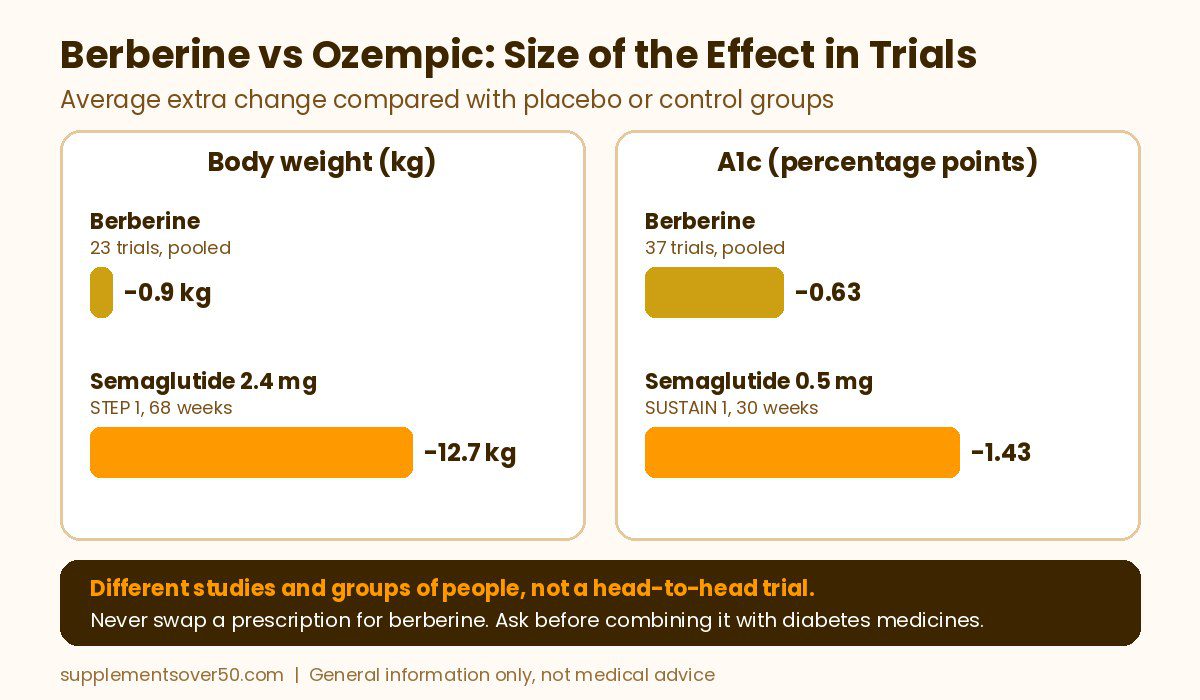
For weight, the best-known study is the STEP 1 trial, published in the New England Journal of Medicine in 2021. It enrolled 1,961 adults with obesity or overweight who did not have diabetes. Over 68 weeks, people on semaglutide 2.4 mg weekly plus lifestyle support lost an average of 14.9% of their body weight, compared with 2.4% on placebo. That was about 15.3 kg (roughly 34 pounds) versus 2.6 kg, a difference of about 12.7 kg. Half of the semaglutide group lost 15% or more of their weight. The trial was funded by the drug’s maker, Novo Nordisk.
For blood sugar, the SUSTAIN 1 trial tested semaglutide alone in 388 adults with type 2 diabetes and a starting A1c of about 8%. After 30 weeks, A1c fell by 1.45 points on the 0.5 mg dose and 1.55 points on the 1 mg dose, compared with almost no change on placebo. On the lower dose, that was 1.43 points more than placebo.
These benefits come with real side effects. In STEP 1, nausea and diarrhea were the most common problems, usually mild to moderate and fading over time, and 4.5% of people on semaglutide stopped because of stomach side effects. MedlinePlus also lists a warning about thyroid tumors seen in rats and serious risks such as pancreatitis, so semaglutide is a medicine that needs a prescriber and follow-up.
Does Berberine Actually Work? What the Research Shows
Berberine is a yellow compound found in plants such as barberry, goldenseal, goldthread, Oregon grape and tree turmeric. It has a long history in traditional Chinese and Ayurvedic medicine and is now sold as a capsule, usually marketed for blood sugar and cholesterol support.
The research is real but modest. A meta-analysis of 37 randomized trials with 3,048 people with type 2 diabetes, published in 2022 in Frontiers in Pharmacology, found that berberine lowered A1c by an average of 0.63 points and fasting blood sugar by 0.82 mmol/L (about 15 mg/dL) compared with control groups. The effect was larger in people who started with higher blood sugar. Many of the included trials came from Chinese databases.
For weight, a meta-analysis of berberine and obesity measures of 23 randomized trials, published in the International Journal of Obesity, found an average weight loss of 0.88 kg (under 2 pounds) and a BMI drop of about 0.5 compared with control groups. The authors called for better trials, noting problems such as poor reporting of product purity and potency and a lack of blinding.
Independent health sources are cautious. The NCCIH guide to diabetes and dietary supplements says some studies suggest berberine might help with blood sugar control, especially as an add-on therapy, but notes that a large 2021 review was mostly based on Chinese patients, results varied widely and some studies were of poor quality. The Memorial Sloan Kettering berberine profile says limited evidence suggests berberine may lower cholesterol, triglycerides and blood sugar, that the effect on cholesterol may be small, and that the body absorbs berberine poorly when taken by mouth.
Berberine vs Ozempic: Side-by-Side Comparison
The numbers below come from different studies in different groups of people, so this is not a head-to-head comparison. It does show the difference in scale.
| Berberine | Ozempic / Wegovy (semaglutide) | |
|---|---|---|
| What it is | Plant compound sold as a dietary supplement | Prescription GLP-1 receptor agonist |
| How you take it | Capsules by mouth, often two to three times a day | Injection once a week, dose raised slowly |
| How it works | Not a GLP-1 drug; thought to act through several metabolic pathways in the liver, gut and cells | Mimics the gut hormone GLP-1: insulin release when sugar is high, slower stomach emptying, less appetite |
| A1c effect in trials | About 0.6 points lower than control (pooled small trials) | About 1.5 points lower over 30 weeks (SUSTAIN 1) |
| Weight effect in trials | About 0.9 kg (under 2 lb) more than control | About 15% of body weight over 68 weeks at 2.4 mg (STEP 1) |
| Quality of evidence | Many small trials, limited quality, mostly from one region | Large, double-blind, multinational trials |
| Common side effects | Nausea, diarrhea, bloating, constipation | Nausea, vomiting, diarrhea, stomach pain, constipation |
| Oversight | Not approved to treat any disease; product quality varies | FDA-approved; prescribed and monitored by a doctor |
Why the “Nature’s Ozempic” Label Is Misleading
Calling berberine “nature’s Ozempic” suggests it works the same way and gets similar results. Neither is true.
- Different mechanism. Semaglutide directly activates GLP-1 receptors, which is why it has such a strong effect on appetite. Berberine is not a GLP-1 receptor agonist. Researchers think it works through other routes, including an energy-sensing enzyme called AMPK and changes in liver cholesterol handling, much of it shown in lab and animal studies.
- Different size of effect. In the trials above, average weight loss with semaglutide was more than ten times larger than with berberine. For A1c, semaglutide’s effect was more than double.
- Different level of proof. Semaglutide was tested in large, multinational, double-blind trials. Berberine’s evidence comes mainly from smaller trials that independent reviewers describe as limited in quality.
- Different product control. A prescription drug has a set, tested dose. Berberine supplements vary in form and strength, and the obesity meta-analysis noted poor reporting of purity and potency in trials.
None of this means berberine is useless. A modest drop in blood sugar or cholesterol can matter, especially for someone with mildly raised numbers. It just means berberine belongs in a different category from a GLP-1 medicine.
What Berberine Can and Can’t Do
What Berberine May Do
- Modestly lower fasting blood sugar and A1c, especially when levels start higher.
- Modestly improve cholesterol and triglycerides, which MSKCC notes may help some people with mildly high cholesterol who can’t tolerate statins.
- Possibly lead to small changes in weight, BMI and waist size.
- Serve as an add-on to diet and activity, with your doctor’s agreement.
What Berberine Can’t Do
- Produce weight loss anywhere near what semaglutide showed in trials.
- Replace a diabetes, cholesterol or heart medicine your doctor prescribed.
- Offer the heart and kidney outcome data that semaglutide has for certain patients.
- Guarantee a consistent dose, since supplement quality varies.
What to Look for If You Try Berberine
If you and your doctor decide berberine is worth a try, a few points can make it safer:
- Check the label for berberine HCl content per capsule, not just the weight of a plant extract, so you know how much you are actually taking.
- Look for third-party testing such as USP or NSF seals, since supplements are not checked for strength before sale.
- Choose single-ingredient products over “GLP-1” or “metabolism” blends that add several herbs at once.
- Start low and take it with meals. NCCIH notes that doses used in studies range from 200 to 1,000 mg two to three times a day, but your doctor should set your dose.
- Recheck your numbers. Ask for a repeat A1c or lipid test after a few months to see whether it is doing anything for you.
For product comparisons and forms such as berberine HCl and dihydroberberine, see our Best Berberine Supplement for Seniors guide, and our Berberine Supplement for Seniors article goes deeper into how it compares with metformin and how to start safely.
Can You Take Berberine and Ozempic Together?
This is one of the most searched questions, and there is no good research to answer it. No large trial has tested berberine together with semaglutide. That means any extra benefit, or extra risk, is unknown.
The MedlinePlus semaglutide page asks you to tell your doctor and pharmacist about every vitamin, supplement and herbal product you take, because doses may need changing. It also notes semaglutide may cause changes in blood sugar. Berberine lowers blood sugar too. The berberine meta-analysis above did not find a significant increase in low blood sugar, but people also taking insulin or a sulfonylurea (such as glipizide or glyburide) have more reason to be careful. MSKCC lists sulfonylureas among the drugs to avoid combining with berberine, based on lab studies.
Both berberine and semaglutide commonly cause nausea, diarrhea and constipation, so taking them together may make stomach side effects harder to manage. If you want to add berberine while on any GLP-1 medicine, ask your prescriber first.
Who Should Avoid Berberine
According to NCCIH and MSKCC, berberine is not a good fit, or needs a doctor’s sign-off first, if:
- You take diabetes medicines, especially insulin or sulfonylureas, because blood sugar could drop further and doses may need adjusting.
- You take drugs processed by certain liver enzymes. MSKCC reports that berberine lowered the activity of the CYP2D6, CYP2C9 and CYP3A4 enzymes in human studies, which handle many common medicines.
- You take tacrolimus or cyclosporine (transplant or immune medicines), since berberine raised their levels in reports.
- You are pregnant or breastfeeding, or caring for an infant. NCCIH says berberine has been linked to a harmful buildup of bilirubin in infants.
- You have frequent stomach upset, since nausea, diarrhea, bloating and constipation are the most common side effects.
How to Decide Between Berberine and Ozempic
- If you have type 2 diabetes or obesity with health problems, talk to your doctor about proven treatments, which may include a GLP-1 medicine. Don’t use berberine as a stand-in.
- If you already take Ozempic, Wegovy or another diabetes medicine, don’t stop it or swap it for berberine. Ask before adding anything.
- If you have mildly raised blood sugar or cholesterol and no medicines yet, berberine may be a reasonable, modest add-on to diet and activity, if your doctor agrees.
- If you mainly want weight loss, expect small effects at most from berberine and focus on eating patterns, protein and strength training.
If you are on a GLP-1 medicine, protecting muscle matters, and our Best Protein Powder for Seniors on GLP-1 Medications (Ozempic and Wegovy) guide explains how. For a wider look at what does and doesn’t help, see Weight Loss Supplements for Women Over 50.
When to See a Doctor
See your doctor before starting berberine if you have diabetes, prediabetes, heart disease, liver or kidney problems, or take any regular medicines. The NCCIH guide to diabetes and dietary supplements stresses that it is very important not to replace medical treatment for diabetes with an unproven product, and it notes the FDA has warned about products claiming to replace diabetes medicine.
Call your doctor promptly if you have signs of low blood sugar such as shakiness, sweating, dizziness, confusion or a fast heartbeat, or ongoing vomiting or diarrhea. On semaglutide, MedlinePlus says to seek care right away for severe stomach pain that may spread to the back, a lump or swelling in the neck, trouble swallowing, or signs of an allergic reaction.
Frequently Asked Questions
Is berberine as effective as Ozempic?
No. In trials, semaglutide lowered A1c by about 1.5 points and the Wegovy dose reduced weight by about 15% over 68 weeks. Pooled berberine trials found about a 0.6 point drop in A1c and under 1 kg of weight loss on average, from studies of lower quality.
Is berberine a natural GLP-1?
No. Berberine is not a GLP-1 receptor agonist like semaglutide. Researchers think it works through other pathways, such as the AMPK enzyme and liver cholesterol handling. Calling it “nature’s Ozempic” overstates what it does.
Can you take berberine and Ozempic together?
There is no good research on the combination. Both can lower blood sugar and both commonly cause stomach upset. MedlinePlus advises telling your doctor about every supplement you take with semaglutide, so ask your prescriber before adding berberine.
Can berberine replace my diabetes medicine?
No. NCCIH says it is very important not to replace medical treatment for diabetes with an unproven product. Berberine may be a modest add-on for some people, but only with your doctor’s agreement and regular blood tests.
How much weight can you lose with berberine?
Not much on average. A meta-analysis of 23 randomized trials found about 0.88 kg (under 2 pounds) more weight loss than control groups. Diet, activity and, when appropriate, prescribed medicines have much larger effects.
What are the side effects of berberine?
The most common are nausea, diarrhea, bloating and constipation. Berberine can interact with some medicines, including certain diabetes drugs and drugs processed by CYP liver enzymes, and it should not be used during pregnancy or breastfeeding.
Our Take
On berberine vs ozempic, the evidence is not close. Semaglutide is a prescription GLP-1 medicine with large trials showing big effects on weight and A1c. Berberine is a supplement with modest effects on blood sugar and cholesterol and very small effects on weight, from studies that still need improving. Berberine can be a reasonable add-on for some people with mildly raised numbers, but it is not a natural Ozempic. Never swap a prescription for it, and check with your doctor or pharmacist before combining it with any diabetes medicine.
This article is for informational purposes only and is not medical advice. Talk to your doctor or pharmacist before starting or stopping any supplement or medicine, especially if you have diabetes or take prescription drugs.