Best Overactive Bladder Supplements for Seniors: 5 Picks and What to Try First
This guide contains affiliate links. If you buy through them, we may earn a small commission at no extra cost to you.
If you are hunting for overactive bladder supplements, you are probably tired of planning your day around bathrooms, getting up two or three times a night, or feeling that sudden “I have to go now” urge at the worst moment. Overactive bladder is common after 50 in both women and men, and it is not something you just have to put up with.
Supplements can help some people a little, but the evidence is limited and mostly comes from small trials. They also work best on top of the simple first steps that doctors recommend, not instead of them. This guide covers what overactive bladder is, the behavior changes to try first, what the research really shows for pumpkin seed, Urox, cranberry, vitamin D and magnesium, the warning signs that need a doctor, and five supplements worth considering, each picked for a different reason.
Table of Contents
Why Overactive Bladder Becomes More Common After 50
Your bladder is a muscle. Normally it stays relaxed while it fills, then squeezes when you decide to go. With overactive bladder, the bladder muscle squeezes too early or too often, so you feel a strong, sudden urge to urinate, go more often than usual, and may wake at night to pee (nocturia). Some people also leak on the way to the toilet, which is called urge incontinence.
According to the National Institute on Aging, bladder control problems are more common in older people, especially women. Weak bladder or pelvic floor muscles, overactive bladder muscles, nerve damage from conditions such as diabetes or Parkinson’s disease, and pelvic organ prolapse can all play a part. The NIA also notes that most incontinence in men is related to the prostate, including an enlarged prostate (benign prostatic hyperplasia). Infections, constipation and some medicines can cause bladder problems that come and go.
Popular Supplement Guides:




For women, the drop in estrogen at menopause affects the tissues of the bladder and urethra. For men, a growing prostate can squeeze the urethra and leave the bladder working harder. In both cases, getting up more at night disrupts sleep, which matters a lot as we age. That is why it pays to understand the cause before reaching for a bottle.
Try These First: Bladder Training, Pelvic Floor Exercises and Drink Timing
The NIA says the simplest and safest treatments should be tried first, and a combination often works best. These steps cost nothing and have better support than any supplement:
- Bladder training (timed voiding). Go to the bathroom on a schedule, for example every hour, then slowly stretch the time between trips. This retrains your bladder to hold more.
- Urge suppression. When an urge hits, stand still, take slow breaths, squeeze your pelvic floor muscles and distract yourself until it passes, then walk calmly to the toilet.
- Pelvic floor (Kegel) exercises. Strengthening the muscles that support the bladder helps both women and men hold urine and avoid leaks. A pelvic floor physical therapist can check you are doing them correctly.
- Cut back on bladder irritants. The NIA suggests limiting caffeinated coffee, tea and sodas, and saying no to alcohol.
- Time your fluids, do not cut them. Choose water over other drinks and limit drinks in the two or three hours before bed. Drinking too little makes urine more concentrated and can irritate the bladder.
- Prevent constipation and manage weight. Both put pressure on the bladder. Quitting smoking helps too.
- Keep a bladder diary. Write down what you drink, when you pee and when you leak for a few days. It shows patterns and helps your doctor.
Do Overactive Bladder Supplements Actually Work?
Some have encouraging early results, but none has strong, large-scale proof. Here is an honest look at the main ingredients.
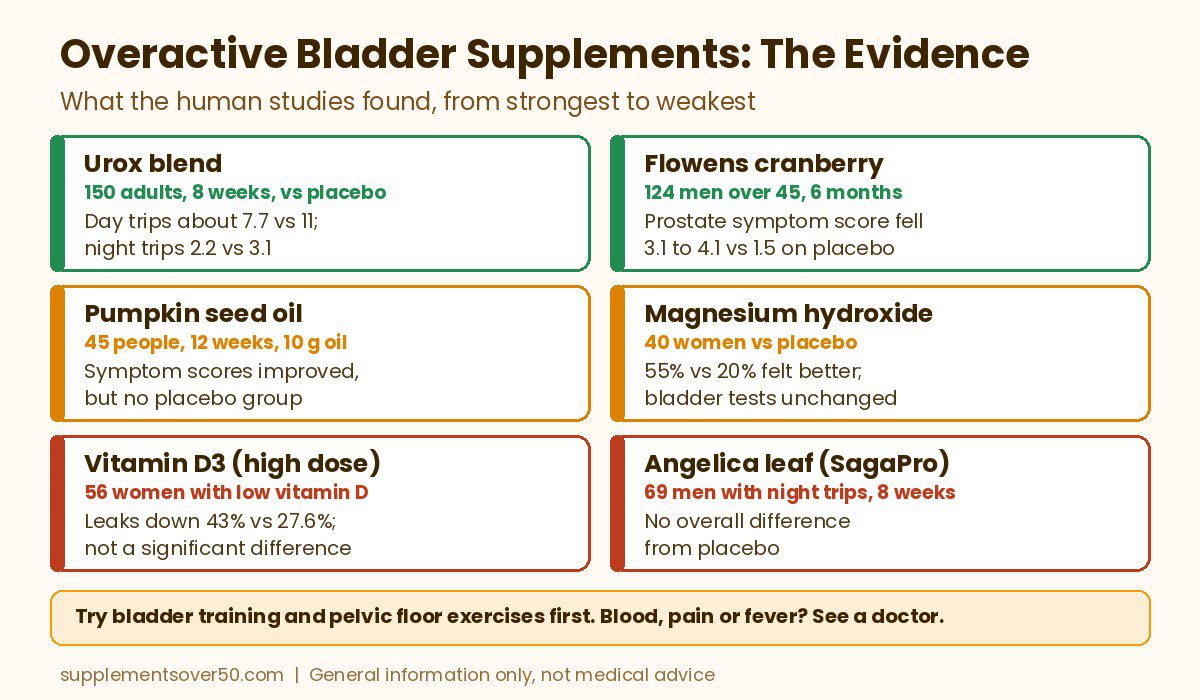
Urox (Crateva, horsetail and lindera). Urox is a branded blend of Crateva nurvala stem bark, horsetail (Equisetum arvense) and Lindera aggregata root. In a phase 2 randomized, double-blind, placebo-controlled trial, 150 adults (59% women, average age about 63) took Urox or a placebo for eight weeks. By week 8, daytime trips to the toilet averaged about 7.7 a day with Urox versus about 11 with placebo, and nighttime trips about 2.2 versus 3.1. Urgency and leakage also improved, and no significant side effects caused people to drop out. That is the strongest result in this category, but it is still one phase 2 trial run over two months.
Pumpkin seed. Pumpkin seed extract is the most common ingredient in bladder supplements. In a small Japanese study, 45 people with overactive bladder took 10 g a day of pumpkin seed oil from Cucurbita maxima for 12 weeks, and their overactive bladder symptom scores improved. The catch: there was no placebo group, the dose was an oil rather than a capsule extract, and it used a different pumpkin species from the Cucurbita pepo found in most US products. So the results do not transfer directly to any capsule on the shelf.
Cranberry for men (Flowens). In a six-month placebo-controlled study in World Journal of Urology, 124 men over 45 with lower urinary tract symptoms took 250 mg or 500 mg of a cranberry powder called Flowens, or a placebo. After six months, prostate symptom scores dropped by 3.1 and 4.1 points in the cranberry groups versus 1.5 with placebo. Flowens is sold in a few men’s formulas, but we could not find a well-reviewed Flowens product on Amazon to recommend, so check labels for that exact ingredient name. Regular cranberry pills are mainly studied for urinary tract infections, which our guide to UTI prevention after menopause covers.
Vitamin D. In a pilot randomized trial, 56 postmenopausal women with urge incontinence and low vitamin D took 50,000 IU of vitamin D3 once a week or a placebo for 12 weeks. Leaks dropped by 43% with vitamin D and 27.6% with placebo, but the difference was not statistically significant, and urgency, frequency and nighttime trips did not differ between groups. If your vitamin D level is low, correcting it makes sense for many reasons, but that weekly dose is far higher than a normal supplement and should only be taken under a doctor’s care.
Magnesium. In a small double-blind, placebo-controlled study, 40 women with urgency or an unstable bladder took magnesium hydroxide or a placebo. 55% of the magnesium group reported feeling better versus 20% on placebo, but bladder test results did not change. The authors called the results preliminary, and that is still a fair word for it.
Angelica leaf (SagaPro). In a randomized, placebo-controlled study, 69 men aged 45 and older who got up at least twice a night took SagaPro or a placebo. SagaPro did not reduce nighttime trips overall compared with placebo after eight weeks. A subgroup with smaller nighttime bladder capacity did better, which the authors said needs more study.
The takeaway: if you want to try a supplement, Urox has the best placebo-controlled data, pumpkin seed has a long history of use with weaker evidence, and everything else is a maybe. Give any product six to eight weeks, track your bladder diary, and stop if it does nothing.
What to Look for in Overactive Bladder Supplements
- An ingredient with at least some human data. Pumpkin seed extract, the Urox blend and Flowens cranberry have been studied for bladder symptoms. Long “kitchen sink” blends with a little of everything are harder to judge.
- Clear amounts. Proprietary blends hide how much of each ingredient you get. A stated amount per capsule, like 262 mg or 840 mg, is easier to compare with research.
- A realistic timeline. Brands such as AZO say to allow up to six weeks, and the Urox trial ran for eight. Be wary of anything promising overnight results.
- Ingredients that suit you. Soy germ extract is in several formulas, and saw palmetto is mostly a men’s prostate herb. Check labels against your allergies, medicines and health history.
- Quality signals. Look for third-party testing or a certificate of analysis, and read our guide on how to read a supplement label.
- No disease claims. A supplement cannot cure overactive bladder, a prostate problem or an infection. Labels that claim to are a red flag.
Overactive Bladder Supplements: Quick Comparison
| Product | Best for | Key details | Daily dose |
|---|---|---|---|
| AZO Bladder Control with Go-Less | Best overall | Go-Less blend of pumpkin seed and soy germ extracts; for women and men | 3 capsules for 2 weeks, then 2 |
| Uqora In Control | Best herbal blend | Urox blend 840 mg: horsetail, lindera, Crateva; gluten-free, vegetarian | See label |
| Life Extension Water-Soluble Pumpkin Seed Extract | Best single ingredient | 262 mg water-soluble pumpkin seed extract per capsule; certificate of analysis | 3 capsules for 2 weeks, then see label |
| URO Bladder Support by O Positiv | Best vegan formula | Pumpkin seed, soy germ and saw palmetto; vegan, gluten-free, third-party tested | 2 to 3 capsules |
| Terry Naturally SagaPro Bladder | Best one-a-day for night | 100 mg angelica leaf extract; vegan, free of soy, gluten, dairy and corn | 1 capsule |
Top Picks for the Best Overactive Bladder Supplements for Seniors
1. AZO Bladder Control with Go-Less (Best Overall)
AZO Bladder Control is the best-known product in this category, with more than 22,400 ratings and a 4.3 rating. It uses the Go-Less blend, a mix of pumpkin seed extract and soy germ extract, and the brand says it is made for both women and men. It is designed to support bladder strength, reduce the urge to go day and night, and cut down on occasional leaks from laughing, coughing or sneezing.
The label calls for one capsule three times a day for the first two weeks, then one capsule twice a day. AZO says some people notice a change in about two weeks but to allow up to six weeks for the full effect. It is drug-free, but it is not meant for pregnant or nursing women, and because it contains soy germ, ask your doctor first if you have been told to avoid soy, for example after a hormone-sensitive cancer. The blend amounts are not listed separately.
2. Uqora In Control (Best Herbal Blend)
If you want the ingredient with the best placebo-controlled data, this is it. Uqora In Control contains an 840 mg Urox blend of horsetail, lindera root and Crateva stem bark (sold as Cratevox, standardized to at least 3 mg of lupeol). That is the same branded combination studied in the eight-week trial described above, where people in the Urox group made noticeably fewer daytime and nighttime trips than those on placebo.
Uqora says it supports healthy bladder function and helps against urgency, frequency and occasional leaks that come with aging, with day and night support for better sleep. The capsules are gluten-free and vegetarian. It has more than 1,800 ratings with a 4.0 rating, the lowest here, so results clearly vary. The listing does not state the serving size, so check the label, and ask your pharmacist if you take several prescription medicines, since herbal blends can interact.
3. Life Extension Water-Soluble Pumpkin Seed Extract (Best Single Ingredient)
This is the simplest option on the list: one ingredient, clearly dosed. Each capsule provides 262 mg of water-soluble pumpkin seed extract, with no soy, saw palmetto or other herbs. Life Extension says pumpkin seed extract helps support bladder muscle function and healthy urinary function in both men and women.
The directions start with one capsule three times a day for the first two weeks, then step down, so check the label for the ongoing dose. A certificate of analysis is available for every Life Extension product, and most of the brand’s products are non-GMO and gluten free. It has more than 1,000 ratings and a 4.4 rating, the highest in this roundup. It is a good choice if you want to avoid soy, or if you want to test whether pumpkin seed alone helps you.
4. URO Bladder Support by O Positiv (Best Vegan Formula)
URO Bladder Support combines pumpkin seed extract, soy germ extract and saw palmetto in vegan capsules. The brand says 90% of people reported an improvement in bladder issues in a 12-week clinical study using a daily dose of its pumpkin seed and soy germ ingredients. That is a brand claim we could not check against a published paper, so treat it with caution.
O Positiv recommends two capsules a day with water, and the label allows two to three. The capsules are third-party tested, vegan, gluten-free, non-GMO and cruelty free, and the brand offers a 30-day happiness commitment. It has more than 1,300 ratings and a 4.3 rating. Saw palmetto is best known as a men’s prostate herb; our guide to the best prostate supplement for men over 50 explains it in more detail.
5. Terry Naturally SagaPro Bladder (Best One-a-Day for Nighttime Trips)
SagaPro uses 100 mg of a water extract of Angelica archangelica leaf, an herb from Iceland. The brand says it supports the smooth muscles of the urinary tract for bladder comfort. It is one capsule a day, which is easier than the three-a-day starting doses of the pumpkin seed products.
Be clear about the evidence: in the eight-week study in men who got up at night, SagaPro was safe but did not beat placebo overall, though men with smaller nighttime bladder capacity seemed to do better. The vegan capsules contain no sugar, salt, yeast, wheat, gluten, corn, soy, dairy or artificial colors. It has fewer ratings than the others, about 190, with a 4.3 rating. Consider it if the pumpkin seed or Urox products did not help, and you mainly struggle with nighttime trips.
How to Choose the Best Overactive Bladder Supplements
- If you want the most popular, easy option, pick AZO Bladder Control with Go-Less.
- If you want the ingredient with the best placebo-controlled trial, pick Uqora In Control with Urox.
- If you avoid soy or want one clearly dosed ingredient, pick Life Extension Pumpkin Seed Extract.
- If you want vegan capsules with a men’s herb included, pick URO Bladder Support.
- If nighttime trips are your main problem and you prefer one pill a day, try SagaPro, knowing the evidence is weak.
- If you are a man with a weak stream or trouble starting, see a doctor about your prostate before picking any bladder supplement.
- If you have burning or cloudy urine, skip supplements for now and get checked for an infection.
Pick one product at a time so you can tell what works, and give it six to eight weeks alongside bladder training. If you are a man, our saw palmetto vs beta-sitosterol prostate review covers the prostate side. Women prone to infections may find our best D-mannose supplement for women over 50 guide useful. If nighttime trips are wrecking your sleep, see our best sleep supplement for seniors roundup, and for magnesium on its own, read best magnesium for women over 50.
Interactions and Who Should Avoid These Supplements
- Pregnant or nursing women should not use these products unless a doctor approves. AZO states its formula is not intended for them.
- Anyone told to avoid soy, including some people with a history of hormone-sensitive cancer, should check with their doctor before soy germ formulas such as AZO or URO.
- People taking several prescription medicines, especially blood thinners, diuretics or diabetes medicines, should ask a pharmacist before adding herbal blends. Our guide to supplements to avoid with blood thinners covers common interactions.
- People with kidney disease should not take magnesium supplements without medical advice.
- Magnesium users: the NIH Office of Dietary Supplements sets an upper limit of 350 mg a day from supplements and medicines for adults, notes that high doses can cause diarrhea, nausea and cramping, and says magnesium can reduce absorption of osteoporosis drugs (bisphosphonates) and some antibiotics if taken too close together.
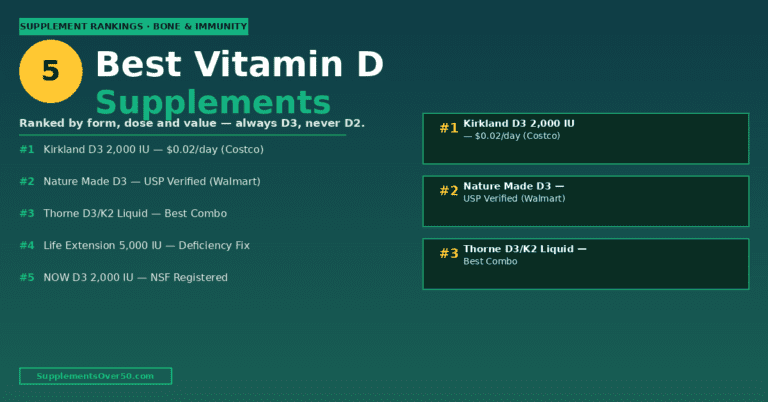
- High-dose vitamin D should only be taken with a doctor checking your blood levels. Our best vitamin D supplement for seniors guide explains normal daily doses.
- People on prescription bladder medicine should not stop or swap it for a supplement without talking to their doctor.
When to See a Doctor
Overactive bladder is a diagnosis your doctor makes after ruling out other causes. Some urinary symptoms point to problems that a supplement can hide or delay. Talk to your doctor promptly if you notice any of these:
- Blood in your urine, even once, or urine that looks pink, red or brown.
- Pain or burning when you urinate, cloudy or strong-smelling urine, fever, chills or back pain, which can signal a urinary tract or kidney infection.
- Trouble starting, a weak stream, dribbling or feeling you cannot empty your bladder. In men this is often the prostate, and a bladder that does not empty can cause overflow leaks.
- Being unable to pass urine at all. This is urinary retention and needs urgent care.
- A sudden change in how often or how urgently you need to go, especially with new confusion, numbness, weakness or back problems.
- Peeing eight or more times a day or passing only small amounts after strong urges, which the NIA lists as signs worth discussing.
- Frequent urination with heavy thirst or unexplained weight loss, which can be a sign of high blood sugar, so ask about a diabetes check.
Your doctor may check a urine sample, ask you to keep a bladder diary and use an ultrasound to see whether your bladder empties fully. Treatments include pelvic floor therapy, medicines, vaginal estrogen for women, nerve stimulation and other options. The NIA notes that some overactive bladder medicines have been linked to a higher risk of cognitive decline in adults over 65, so ask your doctor which options suit you best.
Frequently Asked Questions
What is the best supplement for overactive bladder?
There is no single best supplement. The Urox blend of Crateva, horsetail and lindera has the best placebo-controlled trial so far, and it is in Uqora In Control. Pumpkin seed extract, found in AZO Bladder Control with Go-Less, is the most widely used. Evidence for all of them is limited, so try bladder training and pelvic floor exercises first.
Does pumpkin seed help an overactive bladder?
It may help some people. A small study found that pumpkin seed oil improved overactive bladder symptom scores over 12 weeks, but it had no placebo group and used a high dose of oil. Capsule products differ, so give one six to eight weeks and track your symptoms.
How long do bladder supplements take to work?
Expect to wait several weeks. AZO says some people notice a change in about two weeks but to give it up to six weeks. The Urox trial measured results after eight weeks. If nothing changes after about two months, it is probably not working for you.
Can vitamin D or magnesium help overactive bladder?
Possibly, but the evidence is weak. A pilot trial of high-dose vitamin D in women with low levels did not show a significant difference from placebo. A small magnesium trial found more women felt better, but bladder test results did not change. Correct a deficiency if you have one, and stay within safe limits.
Is overactive bladder a normal part of aging?
It is common, but it is not something you have to accept. Bladder training, pelvic floor exercises, limiting caffeine and alcohol, and timing your fluids help many people, and doctors have several effective treatments if those are not enough.
When are bladder symptoms a sign of something serious?
See a doctor if you have blood in your urine, pain or burning, fever, cloudy urine, a weak stream, trouble emptying your bladder or a sudden change in symptoms. These can point to an infection, a prostate problem or another condition that needs testing, not a supplement.
Our Take
The best overactive bladder supplements for seniors are a helpful extra, not a fix. AZO Bladder Control with Go-Less is our top pick for most people because it is easy to find, made for both women and men and widely used, while Uqora In Control is the one to try if you want the ingredient with the best placebo-controlled data. Start with bladder training, pelvic floor exercises and smarter drink timing, try one supplement at a time for six to eight weeks, and see your doctor first if you notice blood, pain, fever or trouble emptying your bladder.
This article is for informational purposes only and is not medical advice. Talk to your doctor before taking bladder supplements, especially if you have prostate problems, kidney disease or a history of hormone-sensitive cancer, take prescription medications such as blood thinners or bladder medicines, or are pregnant or nursing.