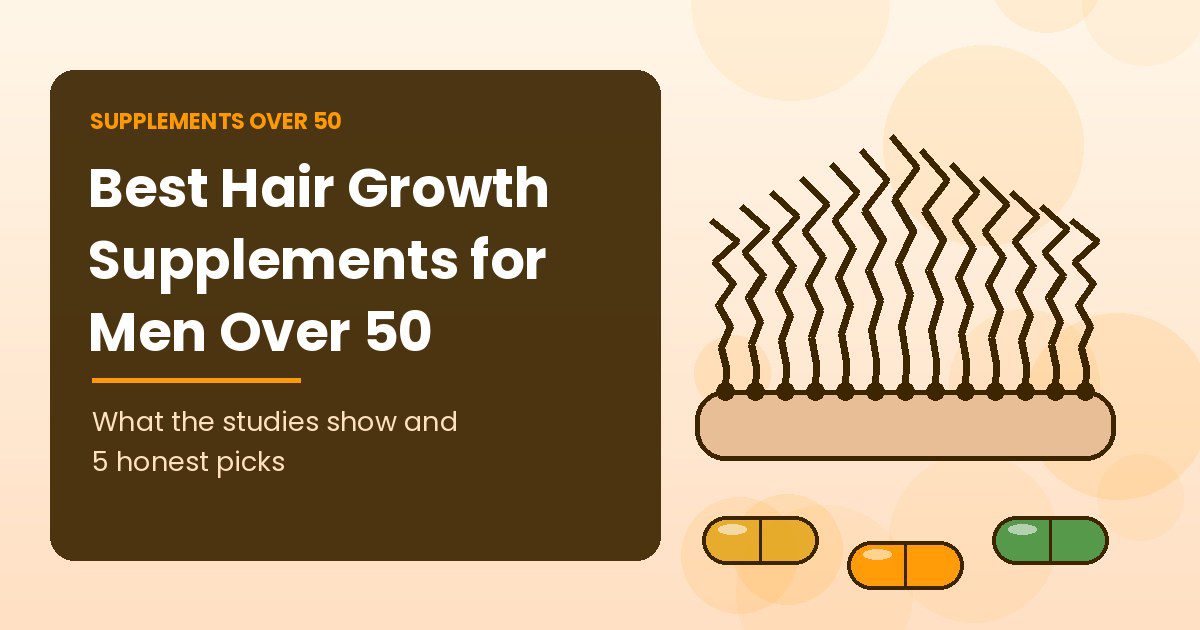
Best Hair Growth Supplements for Men Over 50: What Works and 5 Picks
This guide contains affiliate links. If you buy through them, we may earn a small commission at no extra cost to you.
If your hairline has crept back or the crown is looking thin in photos, you have probably wondered about the best hair growth supplements for men over 50. You are not alone. Thinning hair is one of the most common changes men notice in their 50s, and the supplement aisle is packed with bottles that promise to block DHT and bring hair back.
Here is the honest version. Most hair loss in men this age is hereditary, and the treatments with the strongest evidence are medicines, not supplements. Some supplements do have small trials behind them, and fixing a real deficiency can help. This guide explains why hair thins after 50, what the studies actually show, what to look for on a label, five well-reviewed products, and the warning signs that mean you should see a doctor instead.
Table of Contents
Why Hair Thins in Men After 50
According to Mayo Clinic, the most common cause of hair loss is a hereditary condition that happens with aging, called androgenic alopecia or male pattern baldness. In men it usually starts at the hairline or the top of the head and can progress to partial or complete baldness. It is driven by genes and by the way hair follicles respond to DHT, a stronger form of testosterone. It is not caused by a vitamin shortage, which is why a multivitamin alone rarely changes it.
Pattern baldness is not the only possibility, though. Mayo Clinic lists thyroid problems and other medical conditions, a very stressful event, significant weight loss, poor nutrition and conditions such as diabetes as possible causes or risk factors. A physical or emotional shock can loosen hair so that handfuls come out when you wash it, usually several months after the event, and that type is temporary.
Popular Supplement Guides:


Medicines can play a role
This is easy to miss after 50, when many men start new prescriptions. Mayo Clinic notes that hair loss can be a side effect of drugs used for cancer, arthritis, depression, heart problems, gout and high blood pressure. If your shedding picked up after a new medicine, ask your doctor or pharmacist. Do not stop anything on your own, but there may be an alternative.
Where nutrients fit in
A review on diet and hair loss calls iron deficiency a well-known cause of hair loss and looks at zinc, vitamin D, biotin and other nutrients. Its conclusion is worth reading twice: deficiencies should be corrected, but research is lacking on whether supplements help when you are not deficient, and too much selenium, vitamin A or vitamin E has actually been linked to hair loss. In other words, more is not better.
Do Hair Growth Supplements Work for Men Over 50?
Some have modest evidence, most of it from small or company-funded studies. None matches the proven medicines. Here is what we found.
The proven treatments come first
Per Mayo Clinic’s treatment guide, the most common medicines for hereditary baldness are minoxidil (Rogaine), sold without a prescription and applied to the scalp twice daily for men, and finasteride (Propecia), a daily prescription pill. Minoxidil takes at least six months to show whether it is stopping loss and starting regrowth, and you need to keep using it to keep the benefit. Many men on finasteride see slower hair loss and some see new growth.
Mayo Clinic adds two points that matter at this age: finasteride may not work as well for men over 60, and rare side effects include lower sex drive and sexual function. A recent network meta-analysis of over-the-counter treatments for male pattern hair loss found that among the topical options, 5% minoxidil applied twice daily was the most effective.
Saw palmetto: a weaker cousin of finasteride
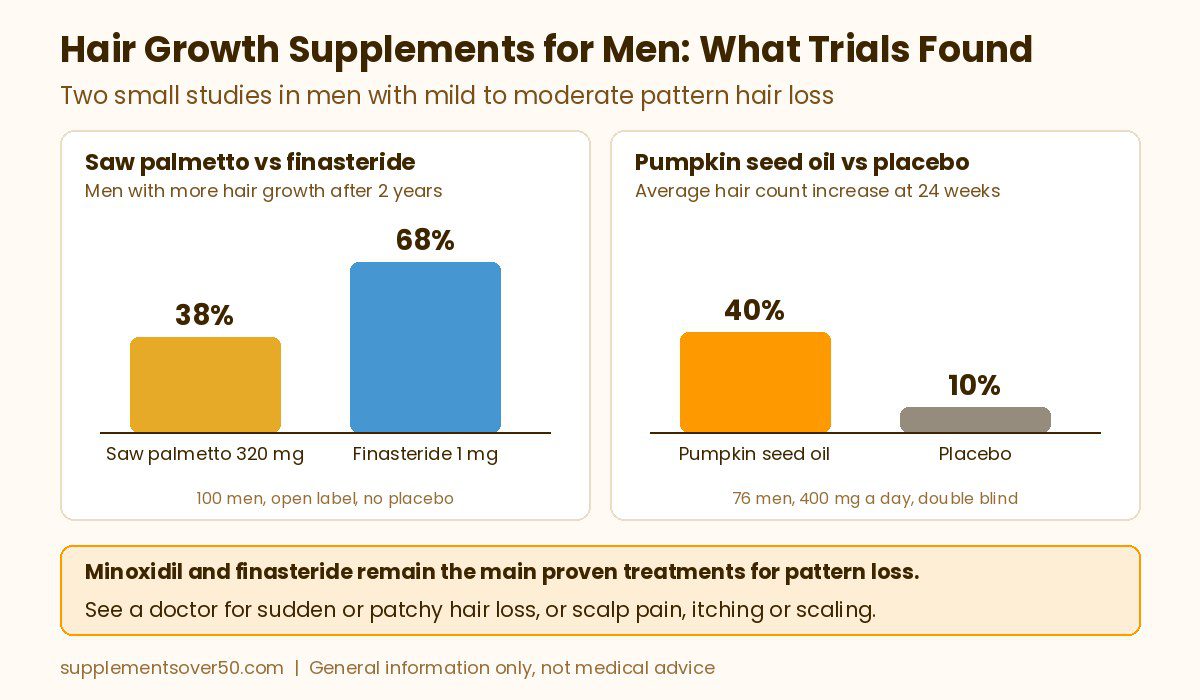
Saw palmetto is thought to slow the same enzyme that finasteride targets, the one that turns testosterone into DHT. In a two-year open-label study of 100 men with mild to moderate pattern hair loss, half took saw palmetto 320 mg a day and half took finasteride 1 mg a day. After 24 months, 38% of the saw palmetto group had more hair growth, compared with 68% of the finasteride group. That is something, but it was not blinded, had no placebo group, and finasteride clearly won.
Pumpkin seed oil: one small, positive trial
In a randomized, double-blind trial in 76 men with mild to moderate pattern hair loss, those taking 400 mg of pumpkin seed oil a day for 24 weeks had a 40% average increase in hair count, compared with 10% on placebo, and side effects did not differ between groups. It is an encouraging result, but it is a single short study, and one trial is not enough to call it proven.
Marine protein (Viviscal Men)
Viviscal’s men’s formula was tested in a 6-month placebo-controlled trial in men with clinically diagnosed male pattern hair loss, taken twice daily. After 180 days, total hair count and hair density rose significantly compared with placebo, fewer hairs came out on a pull test, and no treatment-related side effects were reported. It is one study with a single author, so treat it as promising rather than settled.
Nutrafol: company-run trials
Nutrafol says it ran a multi-center, 6-month randomized, double-blind, placebo-controlled trial in men, and its company’s own summary reports that 85% of the active group felt the supplement slowed their thinning, compared with 55% on placebo. The trial registration lists an industry sponsor and enrolled 112 men aged 21 to 55, so it says little about men in their 60s or 70s. Results that come from the manufacturer are not worthless, but they need independent confirmation.
Biotin: skip it unless you are deficient
Biotin is in many hair products, yet the NIH Office of Dietary Supplements says biotin deficiency is rare. The bigger concern for men over 50 is lab tests. High biotin intakes can cause falsely high or falsely low results on common tests, including thyroid tests and vitamin D. According to the FDA, as reported by the ODS, a patient taking high-dose biotin died after a troponin test, used to help diagnose a heart attack, gave a falsely low result. That is why none of our picks is a high-dose biotin product. If any supplement you take contains biotin, tell your doctor before blood work.
What to Look for in Hair Growth Supplements for Men Over 50
- A reason to take it. Ask for a blood test for iron, vitamin D and thyroid function if your doctor thinks it makes sense. Fixing a real shortfall is where supplements earn their keep.
- Ingredients with at least some human data. Saw palmetto, pumpkin seed oil and marine protein have small trials. Long lists of trendy extracts mostly do not.
- Biotin amounts. Check the Supplement Facts panel. Very high biotin doses can mess with lab tests, including the troponin test for a heart attack.
- No megadoses of vitamin A, vitamin E or selenium. Too much of these has been linked to hair loss, not growth.
- A realistic daily routine. Some formulas need 4 capsules a day. Pick one you will actually take for 3 to 6 months.
- Quality seals. Our guide on how to read a supplement label explains what USP and other seals mean.
Best Hair Growth Supplements for Men Over 50: Quick Comparison
| Product | Best for | Key details | Daily dose |
|---|---|---|---|
| Nutrafol Men 50+ | Made for men over 50 | Blend of 19 vitamins, minerals and botanicals incl. saw palmetto, tocotrienols, curcumin, ashwagandha | Label: 4 capsules daily |
| Viviscal Men | Marine protein | AminoMar collagen complex with vitamin C, zinc, horsetail and flax seed extract; 3-month supply | Label: 2 tablets daily |
| NOW Saw Palmetto Extract 320 mg | Single-herb DHT pick | 320 mg saw palmetto extract in a pumpkin seed oil base; 90 softgels | Check label for serving |
| NOW Pumpkin Seed Oil | Budget add-on | 1,000 mg cold-pressed pumpkin seed oil; 200 softgels | Check label for serving |
| Nature Made Vitamin D3 2000 IU | Low vitamin D | 50 mcg vitamin D3; USP Verified; 250 softgels | Label: 1 softgel daily with a meal |
Top Picks for the Best Hair Growth Supplements for Men Over 50
1. Nutrafol Men 50+ (Best Formula for Men Over 50)
Nutrafol makes a version of its men’s formula specifically for men 50 and older, which is rare in this category. The listing describes a physician-formulated blend of 19 vitamins, minerals and natural ingredients, including a tocotrienol complex, saw palmetto, curcumin and ashwagandha, aimed at causes of thinning such as stress and DHT. The label calls for 4 capsules a day, and the brand says to expect visible results in 3 to 6 months. It also says the formula can be used alongside GLP-1 medicines.
The listing reports that in a clinical study, 97% of men saw better hair quality and 81% saw better scalp coverage after 9 months. That is the company’s own data, and we could not review that study. The listing asks you to check with your doctor first, especially if you take other medicines or supplements. Check the Supplement Facts panel for biotin before blood work. It has more than 350 ratings with a 4.0 rating, so it is newer and less reviewed than the regular Nutrafol Men.
2. Viviscal Men (Best Marine Protein Option)
Viviscal Men is the product behind the placebo-controlled marine protein trial in men described above. The listing says the formula combines its AminoMar collagen complex with vitamin C, zinc, horsetail stem extract and flax seed extract. You take 2 tablets a day, one in the morning and one at night with water after food, and the brand says you could see thicker hair in as little as 3 months.
It is drug-free, so it will not replace minoxidil or finasteride, but it can be used alongside a treatment plan if your doctor agrees. The study describes the marine complex as shark and mollusk powder, so men with a seafood allergy should check the label and ask a doctor. This 3-month pack has more than 2,700 ratings with a 4.2 rating.
3. NOW Saw Palmetto Extract 320 mg (Best Single-Herb DHT Pick)
If you want to try saw palmetto by itself, this NOW softgel provides 320 mg of saw palmetto extract, the same daily amount used in the two-year study above. NOW uses pumpkin seed oil as the base, which adds essential fatty acids and phytosterols, so you get a little of both studied ingredients. The listing positions it for prostate and urinary health, and it carries NPA A-rated GMP certification.
Keep expectations modest: in that study, saw palmetto helped fewer men than finasteride. Do not combine it with finasteride or dutasteride without asking your doctor, since they work on the same pathway. It has more than 2,300 ratings with a 4.6 rating. Men already taking saw palmetto for the prostate can read our guide to the best prostate supplement for men over 50 before doubling up.
4. NOW Pumpkin Seed Oil 1000 mg (Best Budget Add-On)
Pumpkin seed oil has the one small positive trial in men described above, which used 400 mg a day. This NOW product is cold pressed without solvents from non-GMO pumpkin seeds and provides 1,000 mg per softgel, with essential fatty acids and phytosterols. The 200-softgel bottle lasts a long time, which makes it the cheapest way in this list to run your own 6-month trial.
Remember that the evidence rests on a single study of 76 men, so this is a hopeful add-on, not a treatment. Check the label for the serving size. It has more than 11,400 ratings with a 4.5 rating, the most reviewed of our picks after vitamin D.
5. Nature Made Vitamin D3 2000 IU (Best If Your Vitamin D Is Low)
This pick is only for men whose blood test shows low vitamin D. The diet and hair loss review notes that vitamin D plays a role in hair follicle cycling in animal studies, but data on supplements for hair loss is lacking, especially if you are not deficient. If you are low, correcting it is reasonable for your bones and muscles anyway. Each Nature Made softgel provides 2,000 IU (50 mcg) of vitamin D3, taken once a day with a meal, ideally one with some fat.
It is USP Verified, gluten free and has no added color or artificial flavors. With more than 40,600 ratings and a 4.8 rating, it is the most popular product here. For more options and dosing, see our guide to the best vitamin D supplement for seniors.
How to Choose the Best Hair Growth Supplements for Men Over 50
- If you want one product built for your age group, pick Nutrafol Men 50+.
- If you prefer a drug-free formula with a placebo-controlled trial in men, pick Viviscal Men.
- If you want to target DHT with a single herb and are not on finasteride, pick NOW Saw Palmetto Extract 320 mg.
- If you are on a budget, NOW Pumpkin Seed Oil is the cheapest way to test the pumpkin seed oil idea.
- If your blood test shows low vitamin D, Nature Made Vitamin D3 fixes that first.
- If you want the best odds of keeping your hair, ask your doctor about minoxidil or finasteride, with or without a supplement.
Give anything you try 3 to 6 months and take photos of your hairline and crown in the same light at the start, so you can judge honestly. If iron is the issue, our guide to iron supplements for seniors explains why men should only take iron when a test shows they need it. For zinc, see the best zinc supplement for seniors. If your partner is dealing with thinning too, our best hair growth supplement for women over 50 and Nutrafol vs Viviscal comparison cover the women’s formulas.
Who Should Talk to a Doctor First
- Men taking finasteride or dutasteride. Drugs.com notes that saw palmetto and finasteride are thought to work the same way, so doubling up is unlikely to help more and may add side effects. Ask before combining them.
- Men on blood thinners. Drugs.com also cites case reports of bleeding in people taking saw palmetto with blood thinners. The evidence is not strong, but check with your doctor if you take warfarin, rivaroxaban or a similar drug. Our guide to supplements to avoid with blood thinners has more detail.
- Men taking iron. Saw palmetto contains tannins that may reduce iron absorption, so Drugs.com suggests taking them at least 2 hours apart.
- Men getting PSA or other blood tests. NCCIH says saw palmetto does not appear to affect PSA readings, but tell your doctor about every supplement anyway, and especially about any biotin before blood work.
- Men with a seafood allergy should check marine-based formulas carefully.
NCCIH describes saw palmetto as well tolerated, with mild and infrequent side effects such as digestive symptoms, dizziness and headache.
When to See a Doctor About Hair Loss
Slow thinning at the hairline or crown is usually hereditary. Other patterns deserve a proper look, and Mayo Clinic advises seeing a doctor for sudden or patchy hair loss, because it can signal an underlying condition that needs treatment. Book an appointment with your doctor or a dermatologist if you notice:
- Sudden shedding, or handfuls of hair coming out when you comb or wash it
- Round or patchy bald spots on the scalp, beard or eyebrows
- Itching, pain, redness, scaling or oozing on the scalp
- Hair loss along with other new symptoms, since thyroid problems are one listed cause
- Hair loss that started after a new medicine
- Hair loss all over the body, not just the scalp
Your doctor may order blood tests and look at your scalp closely. Bring a list of every medicine, vitamin and supplement you take, as Mayo Clinic suggests.
Frequently Asked Questions
Do hair growth supplements work for men over 50?
Some have modest evidence. Saw palmetto, pumpkin seed oil and marine protein each have small trials, and Nutrafol has company-run trials. None works as well as minoxidil or finasteride for male pattern baldness. Supplements help most when they correct a real deficiency.
Is saw palmetto as good as finasteride for hair loss?
No. In a two-year study of 100 men, 38% taking saw palmetto 320 mg a day had more hair growth, compared with 68% taking finasteride. Do not combine them without asking your doctor.
Should men over 50 take biotin for hair?
Usually not. Biotin deficiency is rare, and high-dose biotin can cause false lab results, including on the troponin test used to help diagnose a heart attack. Tell your doctor about any biotin before blood work.
How long do hair growth supplements take to work?
Give them 3 to 6 months. The trials we cover ran from 24 weeks to 2 years, and Mayo Clinic says minoxidil needs at least six months. Take photos at the start so you can judge honestly.
Does saw palmetto affect PSA tests?
According to NCCIH, saw palmetto does not appear to affect PSA readings, even in higher than usual amounts. Still tell your doctor about all supplements you take, especially if you take blood thinners or prostate medicine.
When should I see a doctor about hair loss?
See a doctor or dermatologist for sudden or patchy hair loss, scalp itching, pain or scaling, hair loss after a new medicine, or symptoms that could point to a thyroid problem. Sudden hair loss can signal a condition that needs treatment.
Our Take
The best hair growth supplements for men over 50 are add-ons, not cures. Male pattern baldness responds best to minoxidil and finasteride, and a quick conversation with your doctor about those is worth more than any bottle. If you want to add a supplement, Nutrafol Men 50+ is the only formula here built for your age group, Viviscal Men has a placebo-controlled trial in men, and NOW saw palmetto or pumpkin seed oil let you test the DHT idea cheaply.
Get your iron, vitamin D and thyroid checked if your doctor agrees, skip high-dose biotin, and ask first if you take finasteride or a blood thinner. Sudden or patchy loss always deserves a doctor’s visit.
This article is for informational purposes only and is not medical advice. Talk to your doctor or a dermatologist before starting a hair growth supplement, especially if you take prescription medicines or have a medical condition.