Medical Reviewer: Content reviewed for accuracy against current published clinical literature. Last updated: 2026.
Affiliate Disclosure: SupplementsOver50.com may earn a commission on qualifying purchases at no extra cost to you. We only recommend products we’ve independently evaluated.
Best Ashwagandha for Women Over 60: Why the US Market Is Paying Attention
The U.S. adaptogen supplement market hit $1.4 billion in 2024 and is projected to reach $2.1 billion by 2028 — driven largely by consumer demand for natural solutions to stress, sleep disruption, and cognitive decline. Among all adaptogens, ashwagandha (Withania somnifera) has emerged as the most clinically studied and the top-selling single-herb adaptogen in American pharmacies and online retailers.
For women over 60 specifically, the interest is rooted in biology. Post-menopausal women face a convergence of challenges that ashwagandha’s mechanism of action directly addresses: chronically elevated cortisol, poor sleep quality, cognitive fog, thyroid changes, and reduced physical energy. If you’re looking at adaptogens as part of a broader supplement strategy, our guide to best supplements for women over 60 covers the full picture. If you’ve already read our ashwagandha for women over 50 overview, this guide goes deeper on the specific physiology and product landscape for the 60+ age group.
The Post-Menopausal Stress Burden: A US Health Context
🏆 Best Ashwagandha for Women Over 60
KSM-66 Ashwagandha by Jarrow Formulas
300mg KSM-66 full-spectrum root extract, clinically studied for stress, energy and mood
Cortisol dysregulation: Estrogen modulates the HPA (hypothalamic-pituitary-adrenal) axis. After menopause, declining estrogen leads to impaired cortisol regulation — many post-menopausal women show flatter diurnal cortisol curves and higher baseline cortisol, contributing to fatigue, weight gain, and sleep disruption.
Anxiety and depression: The American Psychological Association reports that women aged 55–64 show the steepest increase in anxiety disorder prevalence of any demographic between 2015 and 2024. Nearly 1 in 4 American women in this age group meets criteria for clinically significant anxiety.
Sleep disruption: The National Sleep Foundation finds that 61% of post-menopausal women report frequent sleep problems. For women whose disruption is cortisol-driven rather than hot-flash-driven, this is where ashwagandha has its clearest application. See also our roundup of best sleep supplements for seniors.
Cognitive concerns: The Alzheimer’s Association notes that women make up approximately 65% of Americans with Alzheimer’s disease. Chronic cortisol elevation is a confirmed contributor to hippocampal atrophy and memory consolidation failure. Our guide to best brain supplements for seniors covers the broader cognitive health landscape.
⚡ Best Practitioner Ashwagandha for Women
Thorne Ashwagandha 600mg Sensoril
Sensoril ashwagandha 600mg, NSF Certified, clinically backed for cortisol and sleep support
Ashwagandha’s primary bioactive compounds — withanolides (steroidal lactones concentrated in the root) — work through several mechanisms particularly relevant to women over 60:
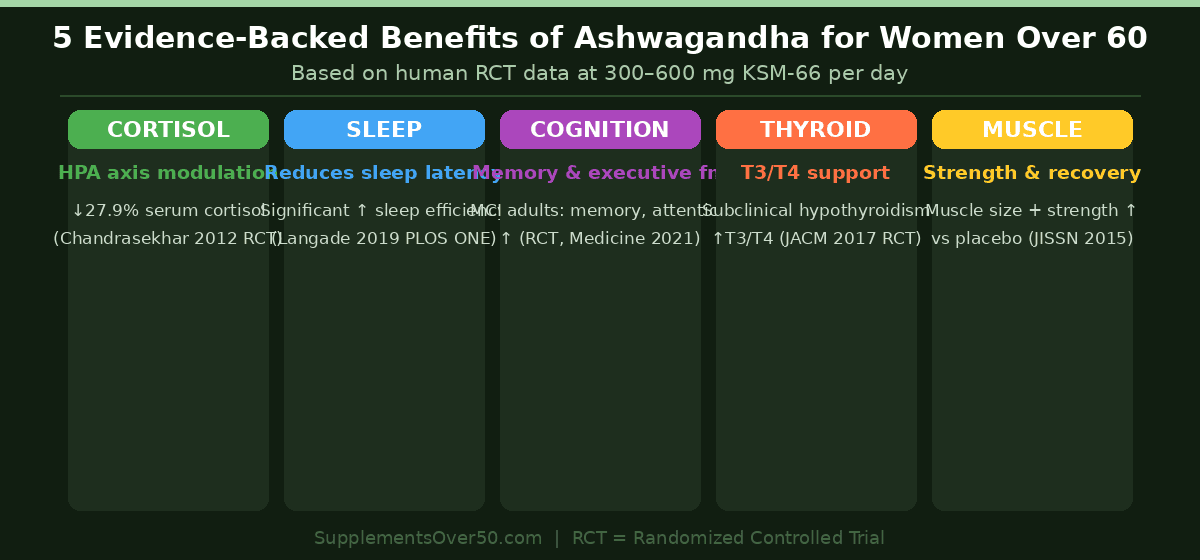
All five benefits shown above are backed by published randomized controlled trials at 300–600 mg KSM-66 per day. RCT = Randomized Controlled Trial.
1. HPA Axis Modulation
A landmark 2012 double-blind, placebo-controlled RCT published in the Indian Journal of Psychological Medicine (Chandrasekhar et al.) found that 300 mg KSM-66 ashwagandha root extract twice daily reduced serum cortisol by 27.9% versus 7.9% placebo after 60 days.
2. Sleep Quality Improvement
A 2019 RCT in PLOS ONE (Langade et al.) found that 300 mg KSM-66 taken twice daily significantly improved sleep onset latency, total sleep time, sleep efficiency, and self-reported quality of life in adults with insomnia.
3. Thyroid Support
Approximately 20% of American women over 60 have hypothyroidism (American Thyroid Association). A 2017 RCT in the Journal of Alternative and Complementary Medicine found 600 mg ashwagandha root extract daily significantly increased serum T3 and T4 levels in adults with subclinical hypothyroidism. This is a benefit for those with sluggish thyroid, but a reason for caution in women already on thyroid medication.
4. Cognitive Function
A 2021 RCT published in Medicine found that 300 mg KSM-66 twice daily for 8 weeks significantly improved immediate and general memory, executive function, sustained attention, and information-processing speed in adults with mild cognitive impairment.
5. Muscle Strength and Recovery
Sarcopenia affects an estimated 13% of U.S. women aged 60–70 and up to 50% of those 80+. A 2015 RCT in the Journal of the International Society of Sports Nutrition found ashwagandha supplementation significantly increased muscle strength, muscle size, and reduced exercise-induced muscle damage versus placebo. This pairs well with protein supplementation — our guide on whey vs plant protein for sarcopenia after 60 covers the diet side of the equation.
KSM-66 vs. Sensoril: Choosing the Right Extract
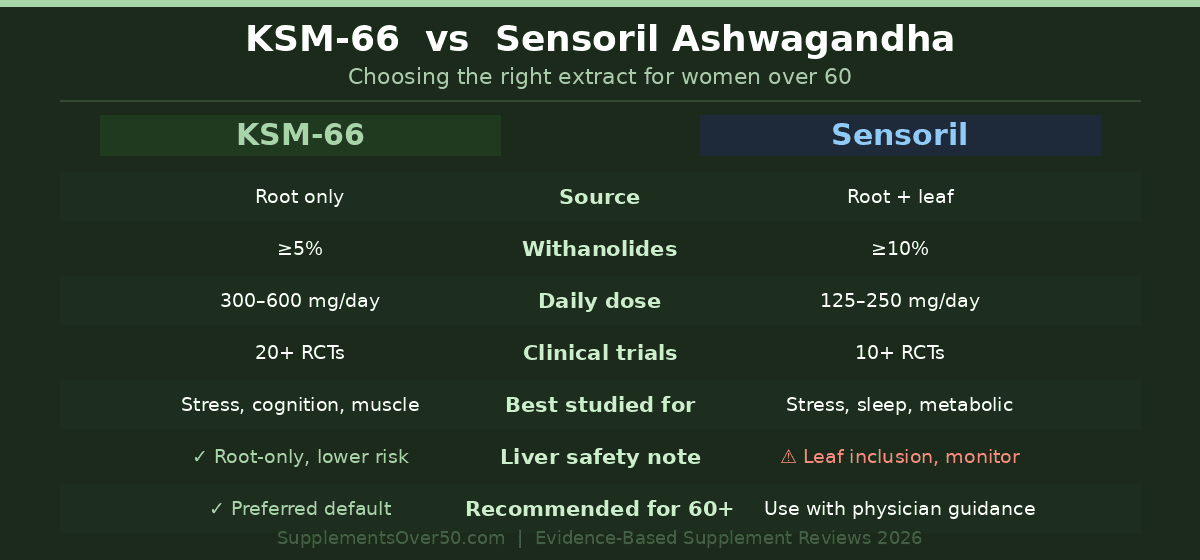
Not all ashwagandha extracts are equivalent. Two standardized, clinically studied extracts dominate the U.S. premium supplement market:
For most women over 60, KSM-66 is the safer, better-studied default. Sensoril may suit lower-dose protocols but warrants more caution regarding hepatic safety given the leaf-inclusion.
Feature
KSM-66
Sensoril
Source
Root only
Root + leaf
Withanolide content
≥5%
≥10%
Best studied for
Stress, anxiety, cognition, physical performance
Stress, sleep, metabolic health
Typical dose
300–600 mg/day
125–250 mg/day
Clinical trials
20+ RCTs
10+ RCTs
Safety profile
Root-only; lower hepatic concern
Leaf extracts; some liver concern reports
Top Ashwagandha Picks for Women Over 60 in the USA (2026)
1. Jarrow Formulas Ashwagandha KSM-66 — Best Overall
Key specs: 300 mg KSM-66 per capsule | ≥5% withanolides | Non-GMO, gluten-free | Manufactured in USA
Jarrow Formulas (Los Angeles, CA) is sold at Whole Foods, Sprouts, Vitamin Shoppe, and major online retailers nationwide. Their KSM-66 formula uses the most clinically studied extract form at the dose used in the landmark 2012 cortisol study. Jarrow uses third-party testing and maintains transparency about sourcing.
Best for: Women starting ashwagandha for the first time, looking for a reliable, well-documented option. Price range: $22–$30 (60 capsules; available at Whole Foods, Amazon, Vitamin Shoppe)
2. Thorne Botanicals Ashwagandha — Best for Quality-Focused Women
Key specs: 300 mg KSM-66 | NSF Certified for Sport | No unnecessary additives | Physician-grade quality
Thorne is one of the few supplement brands with NSF Certified for Sport status — meaning independent verification of label accuracy, absence of contaminants, and no prohibited substances. For women over 60 taking multiple medications, Thorne sets the standard for purity confidence.
Best for: Women who prioritize third-party verified quality, or those recommended by a physician. Price range: $32–$40 (available on Thorne.com, Amazon, and Fullscript via practitioners)
3. NOW Foods Ashwagandha 450 mg — Best Budget Pick
Key specs: 450 mg ashwagandha root extract (2.5% withanolides) | GMP certified | Non-GMO | Made in USA
NOW Foods delivers solid, GMP-certified ashwagandha at a fraction of the price of premium extracts. Widely available at Walmart, Target, Kroger pharmacies, and iHerb — making it one of the most accessible options for women in rural U.S. communities. ConsumerLab has repeatedly verified NOW products meet label claims.
Best for: Budget-conscious women wanting a reliable, widely accessible ashwagandha supplement. Price range: $14–$20 (90 capsules; available at Walmart, Target, iHerb, Amazon)
4. Gaia Herbs Ashwagandha Root — Best for Whole-Herb Enthusiasts
Key specs: 600 mg organic ashwagandha root per capsule | Liquid phyto-caps | Certified organic, non-GMO | Grown in the Blue Ridge Mountains, NC
Gaia Herbs (Brevard, NC) grows much of its own ashwagandha organically in the U.S. — a rarity in the supplement industry. Their Phyto-Caps format delivers the herb in a concentrated liquid extract within a vegetarian capsule. QR-code traceability on every bottle connects consumers directly to testing results.
Best for: Women who prioritize organic sourcing and prefer whole-herb over isolated extract formats. Price range: $28–$36 (60 capsules; available at Whole Foods, Natural Grocers, Amazon)
5. Natrol Ashwagandha + Melatonin — Best for Sleep-Focused Use
For women over 60 whose primary complaint is sleep disruption, Natrol’s combination of KSM-66 ashwagandha with low-dose melatonin targets both the cortisol-driven sleep disruption and the circadian rhythm component. Natrol is one of the largest U.S. supplement brands — their sleep products are among the top-selling at CVS, Walgreens, and Walmart nationally. For more on melatonin dosing in older adults, see our guide to melatonin for seniors.
Best for: Women whose primary goal is improving sleep quality, and who want a combination product. Price range: $18–$26 (60 capsules; available at CVS, Walgreens, Walmart, Amazon)
Safety Profile and Drug Interactions for Women Over 60
Ashwagandha has a well-established safety record in clinical research at doses of 300–600 mg/day KSM-66 for periods up to 12 weeks. However, several specific cautions apply to women over 60:
Thyroid medications (levothyroxine/Synthroid): Ashwagandha may increase thyroid hormone levels. Women on thyroid replacement therapy should consult their endocrinologist and monitor TSH levels when starting.
Sedatives/benzodiazepines: Ashwagandha has mild GABAergic activity. Combining it with sedative medications (clonazepam, lorazepam, zolpidem) may enhance CNS depression.
Immunosuppressants: Ashwagandha may stimulate immune function, potentially counteracting drugs used after organ transplant or for autoimmune conditions.
Liver caution: While KSM-66 (root-only) has not been associated with hepatotoxicity in clinical trials, rare case reports of liver injury have been associated with high-dose supplementation. Women with existing liver conditions or on hepatically-processed medications should discuss with their physician.
Autoimmune conditions: Women with rheumatoid arthritis, lupus, or Hashimoto’s thyroiditis should use ashwagandha cautiously. Disclose all supplements to your rheumatologist or endocrinologist.
How to Take Ashwagandha: Practical Guidance
Dose: 300 mg KSM-66 twice daily (morning and evening) OR 600 mg once daily with dinner
Timing: Taking one dose in the evening, with dinner, aligns with sleep quality goals
With food: Food improves tolerability and slightly improves absorption
Trial period: Allow 6–8 weeks before evaluating effectiveness
Cycling: Some practitioners recommend 8–12 week cycles with 2–4 week breaks
When to stop: If you notice unusual fatigue, GI upset, or any liver-related symptoms (jaundice, dark urine), discontinue and consult your physician
Frequently Asked Questions
Will ashwagandha help with hot flashes and menopause symptoms?
Evidence here is emerging. A 2021 study in the Journal of Ethnopharmacology found ashwagandha root extract significantly reduced menopause symptoms including hot flashes. It works indirectly — by reducing cortisol and supporting hormonal balance generally — rather than directly replacing estrogen. Women with severe vasomotor symptoms should discuss evidence-based options with their gynecologist. Our guide to best supplements for menopause covers the broader range of options.
How is ashwagandha different from other adaptogens like rhodiola or ginseng?
Rhodiola rosea tends to be more stimulating and is better suited for daytime energy and focus. American ginseng is particularly studied for immune support. Ashwagandha is unique in having the most robust evidence for cortisol reduction, sleep quality, and muscle strength — making it the best-studied adaptogen for the specific profile of concerns common in U.S. women over 60.
Can I take ashwagandha indefinitely?
Long-term safety data beyond 12 weeks is limited, though traditional use spans millennia at moderate doses. Most U.S. integrative medicine practitioners recommend periodic (quarterly) reassessment of whether supplementation is still providing benefit, and occasionally cycling off to reassess baseline. Women taking multiple medications should review their supplement regimen annually with their prescriber.
Ashwagandha for Weight Management After 60
Weight gain after menopause is a near-universal experience — driven by declining estrogen, increased cortisol, and a reduction in resting metabolic rate. The average American woman gains 5–8 lbs in the first few years post-menopause. Ashwagandha addresses two of the key drivers: cortisol-driven abdominal fat accumulation and insulin sensitivity changes.
A 2017 study published in the Journal of Evidence-Based Integrative Medicine found that 300 mg KSM-66 twice daily significantly reduced body weight, body mass index, and serum cortisol in chronically stressed adults over an 8-week period. The mechanism isn’t direct fat-burning — it’s cortisol reduction that lowers the hormonal signal driving visceral fat storage.
This is meaningful for women over 60 because visceral (abdominal) fat is the metabolically dangerous type — it’s associated with elevated cardiovascular risk, insulin resistance, and inflammatory cytokine production. Managing cortisol is a legitimate lever for managing this accumulation, not just a stress management benefit.
Ashwagandha and Bone Density: An Emerging Research Area
💰 Best High-Potency Ashwagandha for Women
Transparent Labs KSM-66 Ashwagandha 600mg
600mg KSM-66, clean label, no fillers, Informed Choice certified, great for hormonal balance
Bone loss after menopause is primarily driven by estrogen decline, but cortisol plays a significant secondary role. Chronic cortisol elevation inhibits osteoblast (bone-building cell) activity and accelerates osteoclast (bone-resorbing cell) activity — a dual mechanism that progressively depletes bone density. This is the same mechanism behind corticosteroid-induced osteoporosis seen in women on long-term prednisone.
By reducing baseline cortisol, ashwagandha may indirectly support bone health. A 2015 study found ashwagandha supplementation improved markers of bone formation in thyroid-deficient patients. While more research in the post-menopausal population is needed, the mechanistic link is clear. Women combining ashwagandha with vitamin D3+K2 are addressing both the cortisol-driven and vitamin D-related contributors to bone loss simultaneously.
Comparing Ashwagandha to Prescription Stress Medications
This comparison matters because many American women over 60 are prescribed benzodiazepines or SSRIs for anxiety and sleep disruption — medications with significant side-effect profiles in older adults. The American Geriatrics Society Beers Criteria explicitly flags benzodiazepines as potentially inappropriate for older adults due to fall risk, cognitive impairment, and dependence potential.
Ashwagandha is not a drug replacement — it doesn’t produce the acute anxiolytic effect of a benzodiazepine. But for women with subclinical anxiety and stress-driven sleep disruption (rather than a clinical anxiety disorder), it offers meaningful, evidence-backed relief without the Beers Criteria concerns. Women currently taking prescribed anxiolytics should discuss any supplement changes with their prescribing physician rather than making unilateral adjustments.
What to Track When Starting Ashwagandha
Supplements without outcome tracking are guesswork. When starting ashwagandha, keep a simple log for the first 8 weeks:
Sleep onset time: How long does it take to fall asleep? Note within 15 minutes of waking
Morning energy rating: 1–10 scale on waking, before coffee
Perceived stress (1–10): End-of-day rating of stress load and resilience
Exercise recovery: How do your legs feel 24 hours after a workout or long walk?
Cognitive clarity: Subjective rating of focus and word retrieval
At 8 weeks, review the log. If you’re not seeing meaningful improvement in at least 2–3 of these areas, the supplement may not be providing benefit for your specific physiology. Not everyone responds equally — about 70% of participants in KSM-66 trials show meaningful cortisol reduction; roughly 30% are non-responders.
Ashwagandha Across a Full Senior Supplement Stack
Ashwagandha pairs well with several other supplements commonly taken by women over 60:
Magnesium glycinate: Synergistic for sleep quality — magnesium acts on GABA receptors while ashwagandha reduces cortisol. Taking both at dinner is a common protocol among integrative practitioners.
B-complex vitamins: B vitamins are depleted by chronic stress and support the adrenal function ashwagandha is modulating. See our guide to best B12 supplement for seniors.
Omega-3 (EPA/DHA): Anti-inflammatory and mood-supportive, complements ashwagandha’s cortisol work for the anxiety/cognitive profile.
Vitamin D3+K2: Addresses the bone and immune gap that ashwagandha doesn’t directly target. See our D3+K2 guide for women over 60.
For a full curated stack, our guide to the best supplements for women over 60 covers prioritization and sequencing for the most common health goals.
Stack additions for women over 60:Choline (Alpha-GPC) addresses the acetylcholine side of the cognitive picture that ashwagandha’s cortisol work supports indirectly. And Urolithin A targets the mitochondrial energy piece for women experiencing the post-menopausal fatigue and muscle decline that ashwagandha’s cortisol reduction alone can’t fully address.
This article is for informational purposes only and does not constitute medical advice. Always consult your healthcare provider before starting any new supplement regimen, particularly if you take prescription medications.
Skincare for menopausal skin: what changes after 50, a simple 5-step routine, and the best serum, moisturizer and sunscreen picks for dry, thinning skin.
Looking for a moisturizer for dry mature skin? Compare 5 creams from Kiehl’s, First Aid Beauty, Lancome, Charlotte Tilbury and CeraVe, plus what to look for after 50.
Looking for a hair dryer for thinning hair? Compare 5 gentle picks with real heat control, from the Dyson Supersonic Nural to a budget Revlon, for fine hair over 50.