Collagen Supplements vs Topical Collagen: What Works Better After 50?
This guide contains affiliate links. If you buy through them, we may earn a small commission at no extra cost to you.
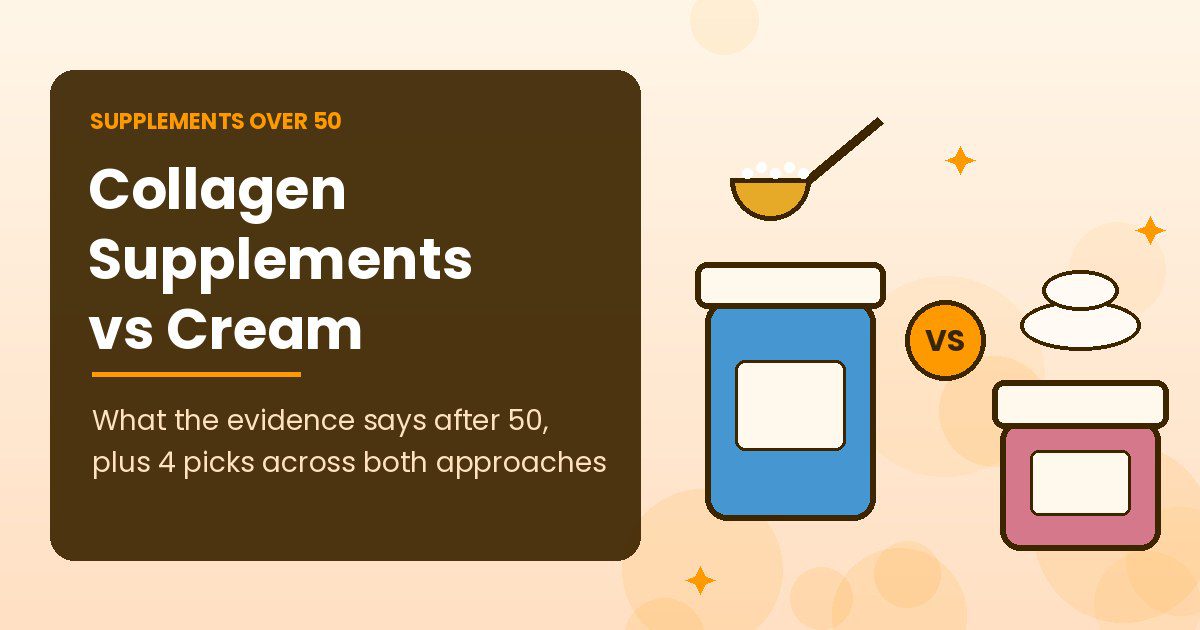
Walk down any beauty aisle after 50 and you will see collagen everywhere: in powders for your coffee, in shots, and in jars of face cream. So which one actually earns a spot in your routine? The honest answer to collagen supplements vs cream is that they do different jobs, the evidence for each is weaker than the marketing suggests, and the cream that helps most is usually not a cream full of collagen at all.
Below we walk through what the American Academy of Dermatology (AAD), Harvard, Cleveland Clinic and two recent research reviews say about swallowing collagen versus putting it on your skin. Then we share four well-reviewed products, two for each side, with every product detail taken from its Amazon listing. Skin results here are cosmetic: skin that looks smoother, feels more hydrated and appears firmer. No supplement or cream treats a disease.
Table of Contents
Collagen Supplements vs Cream: Quick Comparison
| Product | Type | Best for | Key details (per listing) | How to use |
|---|---|---|---|---|
| The INKEY List Peptide Moisturizer | Topical peptide cream | Best place to start (top pick) | 2% Royal Epigen P5, 1% hydrating peptide solution; fragrance-free; all skin types | Pea-sized amount, face and neck, AM and PM |
| Lancôme Rénergie H.P.N. 300-Peptide Cream | Topical peptide cream | Best luxury firming cream | 300 peptides, hyaluronic acid, niacinamide; brand 8-week study | Daily, morning routine |
| Vital Proteins Collagen Peptides Advanced | Oral collagen powder | Best collagen supplement for most | Bovine collagen peptides, 100% DV vitamin C, 120 mg hyaluronic acid; unflavored | 1 serving a day in a hot or cold drink |
| Sports Research Collagen Peptides | Oral collagen powder | Best simple high-dose powder | 11 g type I and III collagen peptides, 10 g protein, 40 calories; no added sugar | 1 scoop a day in coffee, water or a smoothie |
Short on time? If you buy only one thing, choose a peptide moisturizer and pair it with sunscreen you will wear every morning. Add a collagen powder only if you like the idea and are comfortable with evidence that is still being argued over.
Why Collagen Matters More After 50
Collagen is the most abundant protein in your body, according to the Harvard T.H. Chan School of Public Health, and it is a major part of skin, bone, muscle, tendons and cartilage. It is what helps skin stay strong and able to stretch and spring back. Our bodies make less of it every year, and Harvard says production drops fastest with too much sun, smoking, heavy drinking, and too little sleep and exercise. With age, collagen in the deeper layers of skin shifts from a tidy network of fibers to a disorganized maze.
Popular Supplement Guides:


For women, menopause speeds things up. The American Academy of Dermatology says studies show women’s skin loses about 30% of its collagen during the first five years of menopause, then about 2% a year for the next 20 years. As collagen falls, skin loses firmness and begins to sag. Cleveland Clinic also notes that collagen production drops significantly after menopause and that the collagen you still have is lower in quality than when you were younger.
That is why the collagen question feels so urgent in your fifties. The key detail for this comparison is where collagen lives: in the dermis, the deeper layer of skin, not on the surface. Anything you put on your face has to get past the outer layer, and anything you swallow has to survive digestion. Those two hurdles shape everything below.
Do Collagen Supplements Work for Skin?
Oral collagen is usually sold as hydrolyzed collagen or collagen peptides. Cleveland Clinic explains that collagen cannot be absorbed whole, so it has to be broken down into smaller peptides or amino acids, which are then absorbed through your digestive tract. Here is what the research looks like.
- The positive case. A 2023 meta-analysis in the journal Nutrients pooled 26 randomized controlled trials with 1,721 participants and found that hydrolyzed collagen improved skin hydration and elasticity compared with placebo. The authors also flagged several biases in the trials and called for larger studies.
- The skeptical case. A 2025 meta-analysis in The American Journal of Medicine looked at 23 trials with 1,474 participants. Taken together, collagen improved hydration, elasticity and wrinkles. But when the authors split the studies by funding, trials without industry funding showed no effect, and high-quality trials showed no significant effect either. They concluded there is currently no clinical evidence to support collagen supplements to prevent or treat skin aging.
- What Harvard and Cleveland Clinic say. Harvard notes that some randomized trials found collagen improved skin elasticity, but that most, if not all, collagen research is funded at least in part by related industries. Cleveland Clinic rates collagen peptides as possibly effective for skin hydration and elasticity, and reminds readers that the FDA does not require supplements to prove they work before they are sold.
- Where it ends up. Cleveland Clinic points out that the peptides you swallow cannot be directed to your face. Your body uses them for whatever it needs, whether that is collagen or other protein.
So oral collagen is possible, not proven. On the plus side, Harvard says the available research has not shown negative side effects, and a powder also adds a little protein to your day. Just remember that collagen is not a complete protein, so it does not replace eggs, fish, dairy, legumes or meat.
Does Collagen Cream Work?
This is where many shoppers get a surprise. Harvard says collagen first appeared as an ingredient in skin creams and serums, but even dermatologists doubted it worked on the skin, because collagen fibers are too large to get through the skin’s outer layers. Harvard adds that research has not shown that shorter collagen chains do any better.
That does not mean collagen creams are useless. A rich cream still moisturizes, and the AAD’s guide to anti-aging products says moisturizer traps water in your skin and can plump up fine lines in a few days. You are paying for hydration, though, not for collagen that moves into your skin and stays there.
The more interesting topical story is ingredients that may help your own skin make more collagen. The AAD advises women in menopause to consider a skin care product with retinol or peptides, saying these ingredients can increase collagen in your skin, along with sun protection. That is why the two creams we picked are peptide moisturizers, not collagen creams. The AAD is also realistic: most anti-aging products take at least six weeks to work, and creams, gels and lotions cannot reduce all signs of aging skin.
Collagen Supplements vs Cream: Which Works Better After 50?
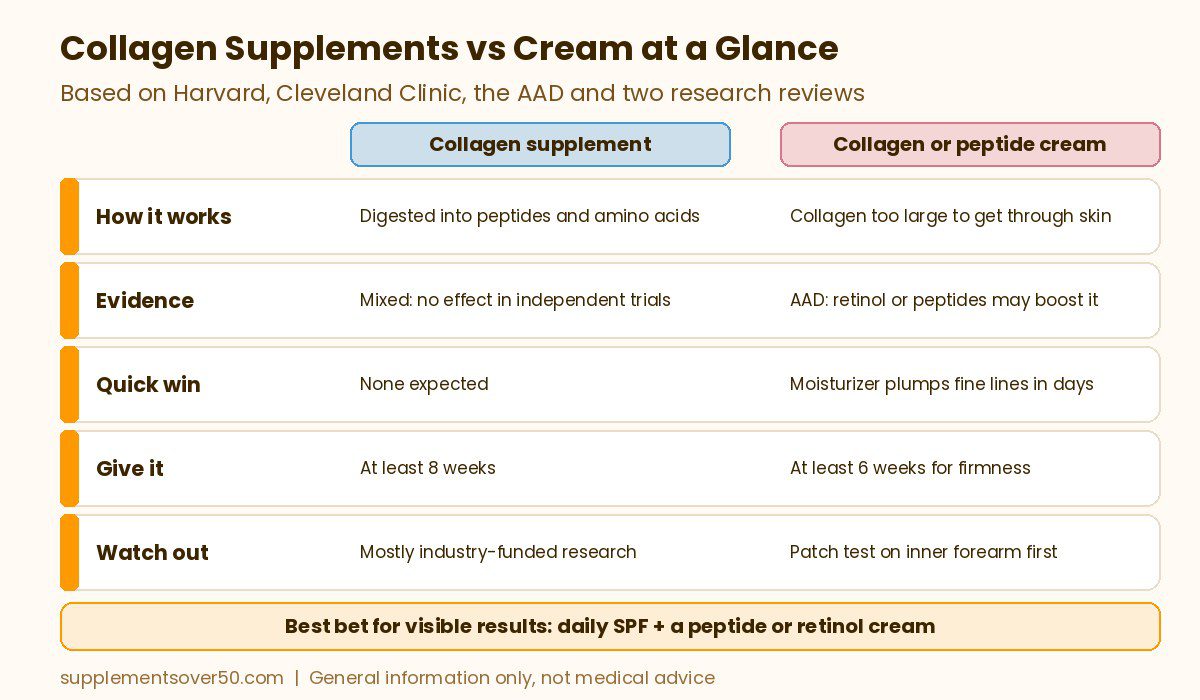
Here is how the two approaches compare on the points that matter most:
| Collagen supplements | Collagen or peptide creams | |
|---|---|---|
| How it works | Digested into peptides and amino acids; the body decides where they go | Works on the skin you apply it to; collagen itself is too large to get through |
| Evidence for skin | Positive pooled results, but no effect in independent or high-quality trials in a 2025 review | AAD recommends retinol or peptides to increase collagen; moisturizer plumps fine lines |
| What you will notice | Possibly hydration and elasticity, if anything | Softer, more hydrated skin within days; firmness takes six weeks or more |
| Main downside | Research largely industry funded; results not guaranteed | Can irritate sensitive skin; patch test first |
| Best for | Women who want an easy daily add-on and some extra protein | Women who want visible results on the face and neck |
Our verdict: for skin you can see, start with your skin care. Sunscreen every morning and a peptide or retinol product are the steps dermatologists actually recommend for collagen loss, and a moisturizer gives you a quick visible win. A collagen supplement is a reasonable extra if you enjoy it and accept that the best independent research has not shown a clear benefit. Plenty of women do both, and there is no reason the two cannot be combined.
What to Look for in Collagen Supplements and Creams
For a collagen supplement:
- Hydrolyzed collagen or collagen peptides. These are the broken-down forms Harvard and Cleveland Clinic describe as more easily absorbed.
- A clear dose on the label. Look for the grams of collagen per serving on the Supplement Facts panel, so you can compare products.
- Third-party testing. Harvard raises concerns about what supplements contain, including heavy metals. Independent testing adds some reassurance.
- Simple extras. Vitamin C helps your body make collagen. You do not need a long list of herbs or high-dose biotin.
- A form you will use. An unflavored powder that disappears into coffee is easier to stick with than a chalky one.
For a topical cream:
- Peptides or retinol, not just collagen. These are the ingredients the AAD names for increasing collagen in your skin.
- Hydrators. Hyaluronic acid, peptides and a good cream base help skin feel plumper and more comfortable.
- Fragrance-free. Skin often becomes more sensitive after 50, so fewer potential irritants is better.
- A daily sunscreen to go with it. Sun is one of the fastest ways to lose collagen, according to Harvard, so protect what you have.
Top Picks for Collagen Supplements vs Cream
Two creams and two powders, so you can choose a side or try both. All four are sold on Amazon by the brand or by Amazon itself.
1. The INKEY List Peptide Moisturizer (Best Place to Start)
If you want to try the topical route without a big spend, this is our top pick. The listing describes a nourishing, fast-absorbing daily moisturizer for drier skin that, with continued use, supports collagen production to hydrate skin. It uses 2% Royal Epigen P5, which INKEY says helps even skin tone, plus a 1% hydrating peptide solution to support and strengthen the moisture barrier for skin that looks more radiant.
It is fragrance-free, cruelty-free and described as suitable for all skin types, even sensitive, and it targets fine lines, wrinkles, dryness and damaged skin barriers. INKEY suggests a pea-sized amount on your face and neck, morning and night, after any hydrating serum, with SPF as the last step in the morning. It has a 4.5 rating from more than 1,300 reviewers, more than 1,000 bought in the past month, and it is shipped and sold by Amazon.
2. Lancôme Rénergie H.P.N. 300-Peptide Cream (Best Luxury Firming Cream)
If sagging along the jaw bothers you most and you want a richer, more luxurious cream, Lancôme Rénergie is the upgrade. The listing says it combines more than 300 peptides to improve elasticity, hyaluronic acid to smooth and replump rough skin, and niacinamide to soothe and even out skin tone. It is tested for tolerance and described as safe for all skin types, and the brand mentions face, neck and chest.
Lancôme quotes an 8-week clinical study in which women saw a 27% reduction in lower-face sagging, 38% improved firmness and 22% less visible dark spots, and says results can show in as little as two weeks. Those are the brand’s own figures, so treat them as a guide rather than a promise. Lancôme recommends it daily in your morning routine. It has a 4.6 rating from more than 1,100 reviewers, and it is sold by Lancôme and shipped by Amazon.
3. Vital Proteins Collagen Peptides Advanced (Best Collagen Supplement for Most)
If you want to try collagen from the inside, Vital Proteins is the most popular place to start, with more than 215,000 ratings and more than 100,000 bought in the past month at the time of writing. The listing says it uses hydrolyzed collagen peptides from grass-fed, pasture-raised cows, which the brand describes as easily digested and absorbed.
This Advanced version adds 100% of the daily value of vitamin C, which helps the body make collagen, plus 120 mg of hyaluronic acid for skin hydration. It is unflavored, made without dairy and gluten, and paleo friendly. You stir one serving a day into coffee, tea or a smoothie. The listing does not give the grams of collagen per serving, so check the Supplement Facts panel if dose matters to you. It has a 4.5 rating, and it is sold by Vital Proteins and shipped by Amazon.
4. Sports Research Collagen Peptides (Best Simple High-Dose Powder)
Sports Research is the pick if you want a clear, generous dose and nothing else. The listing says each scoop delivers 11 g of low molecular weight type I and III collagen peptides, with 18 amino acids including glycine, proline and hydroxyproline. Each serving also provides 10 g of protein and 40 calories, with no added sugars or carbs.
It is unflavored and designed to mix into coffee, smoothies or water without clumping. Sports Research says it is Keto Certified, Certified Paleo Friendly, non-GMO and third-party tested. It has a 4.6 rating from more than 130,000 reviewers and more than 40,000 bought in the past month, and it is sold by Sports Research and shipped by Amazon.
How to Choose Between Collagen Supplements vs Cream
- If you want the most dermatologist-backed option, choose a cream: The INKEY List Peptide Moisturizer, plus sunscreen every morning.
- If firmness and sagging are your main worry and you want a luxury cream, choose Lancôme Rénergie H.P.N. 300-Peptide.
- If you like a daily ritual and want to try collagen from the inside, choose Vital Proteins Collagen Peptides Advanced.
- If you want a clearly labeled 11 g dose with no sugar, choose Sports Research Collagen Peptides.
- If you want to cover both bases, use a peptide cream on your skin and add one scoop of collagen to your coffee. Judge each for at least six to eight weeks.
- If you are already spending on collagen, make sure sunscreen, sleep and not smoking are in place first. Harvard notes these protect the collagen you already have.
Want more detail on the supplement side? Our guides to the best collagen supplement for skin over 50 and the best liquid collagen for women over 50 compare more options and formats, and best collagen for women over 60 covers types for the next decade. If you lift weights, see creatine and collagen for women over 50.
Who Should Check With a Doctor First
Collagen powders are a food-like supplement, and Harvard says studies have not shown negative side effects. Still, check with your doctor or pharmacist before you start one if any of these apply:
- You have kidney disease or have been told to limit protein. A scoop of collagen adds protein to your day.
- You have a food allergy or follow a religious or dietary rule about animal products. Collagen comes from animals, such as cows or fish, so read the source and allergen statement on the label.
- You take several medicines or supplements. Bring the label to your next appointment so your doctor can see everything you take.
- You are scheduled for surgery or blood tests. Mention every supplement you take, especially blends with added vitamins or biotin.
- You have a skin problem, not just aging skin. Rashes, sores that will not heal, or a new or changing spot need a dermatologist, not a supplement or cream.
For creams, the AAD suggests a simple patch test: apply a little to your inner forearm and watch for a reaction before using it on your face. Stop any product that stings, burns or tingles, and add one new product at a time so you know what works.
- Best Anti-Aging Serums for Women Over 50
- Skincare for Menopausal Skin: What Changes and the Best Products to Use
- Best Neck Creams for Sagging Skin Over 50
Frequently Asked Questions
Are collagen supplements better than collagen creams?
Neither is proven to rebuild lost collagen. Oral collagen has more trials, but a 2025 review found no effect in independent, high-quality studies. Collagen itself is too large to get through skin, so creams mainly moisturize. Peptide or retinol creams plus sunscreen have the firmest dermatologist backing.
Can collagen in a cream get into your skin?
Not in any meaningful way, according to Harvard, because collagen fibers are too large to pass through the skin’s outer layers, and research has not shown shorter chains do better. A collagen cream can still moisturize and make fine lines look softer for a while.
Is it worth taking collagen after 50?
It may be, if you accept the evidence is mixed. Some trials found better skin hydration and elasticity, but most research is industry funded and independent studies show little effect. If you try it, pick hydrolyzed collagen peptides and give it at least eight weeks.
Can I use a peptide cream and take collagen at the same time?
Yes. There is no known reason the two cannot be combined, and they work in different ways. Start one at a time if you want to judge each, patch test the cream, and check with your doctor before adding the supplement if you take medicines.
What actually boosts collagen in skin after 50?
The AAD recommends sun protection plus a skin care product with retinol or peptides, which it says can increase collagen in your skin. Harvard adds that not smoking, enough sleep, limiting alcohol and eating enough protein help protect the collagen you have.
How long does it take to see results?
A moisturizer can plump fine lines in a few days, according to the AAD, but most anti-aging products take at least six weeks. Collagen supplement trials usually run for several weeks to months, so give any change at least eight weeks before deciding.
Our Take
When it comes to collagen supplements vs cream, the cream wins for visible results, as long as it is the right cream. Collagen itself cannot get through your skin, but peptide and retinol products, plus daily sunscreen, are what dermatologists actually recommend for collagen loss after 50. Start with The INKEY List Peptide Moisturizer, or Lancôme Rénergie if you want a luxury firming cream. If you also want to try collagen from the inside, Vital Proteins and Sports Research are popular, well-reviewed powders. Just know the independent evidence for them is still thin, and give anything you try at least six to eight weeks.
This article is for general information only and is not medical advice. Supplements are not intended to diagnose, treat, cure or prevent any disease. Talk to your doctor before starting a supplement, especially if you have a health condition or take medication, and see a dermatologist about any persistent skin concern.