This guide contains affiliate links. If you buy through them, we may earn a small commission at no extra cost to you. We have not tested these devices ourselves. This guide compiles each brand’s published specs and plan terms, FDA and NIDCD guidance, and patterns in verified buyer reviews.
⚡ Quick Answer
Yes, over the counter hearing aids can work well for adults with perceived mild to moderate hearing loss. You can buy them in stores or online without a prescription or hearing exam. They are not meant for severe loss, and certain symptoms (sudden or one-sided hearing loss, ear pain, drainage, dizziness) mean you should see a doctor first. Three options worth a look on Amazon: Jabra Enhance Select M2 Swift (best self-fitting pick with an in-app hearing test), ELEHEAR Beyond (best mid-range, app-adjustable pick) and Audien Atom One (best simple, no-app budget pick). Want ongoing audiologist support instead? Brand-direct plans like Jabra Enhance Select bundle remote audiology care.
If you keep turning up the TV, struggle to follow conversations in restaurants or feel worn out after a family dinner, over the counter hearing aids may be the easiest first step you can take. Since the FDA created the OTC category, you no longer need an appointment, a hearing test or a prescription to buy a real, FDA-regulated hearing aid. You can pick one up in a store or order it online.
That convenience raises fair questions. Do they actually work? How are they different from the hearing aids an audiologist fits? What do they cost, where should you buy them and what happens if they do not help? This guide answers each of those in plain language, using the FDA and the National Institute on Deafness and Other Communication Disorders (NIDCD) as our main sources, and points out the warning signs that mean you should skip the store and see a professional.
Table of Contents
Why Hearing Help Matters More After 50
Hearing loss is common and badly under-treated. According to the FDA’s OTC hearing aid guide, close to 30 million adults in the U.S. have some degree of hearing loss, yet only about one-fifth of the people who could benefit from a hearing aid seek help. NIDCD puts it a slightly different way: only one in four adults who could benefit from hearing aids has ever used them.
Leaving it alone has costs. NIDCD notes that untreated hearing loss can lead to isolation and has been associated with depression, anxiety, dementia, reduced mobility and falls. The FDA says using hearing aids may reduce the frequency or severity of cognitive decline, depression and other health problems in adults, and can improve social participation and quality of life. Those are associations and possibilities, not guarantees, but they are a strong reason not to wait years before doing something.
Price and hassle have long been the main barriers. OTC hearing aids were created to lower both.
What Are Over the Counter Hearing Aids?
Over the counter hearing aids are a category of FDA-regulated medical devices that you can buy directly, without the supervision, involvement or prescription of a licensed hearing professional. According to NIDCD, a federal law directed the FDA to create the category, and the FDA says it took effect on October 17, 2022.
The key facts from the FDA and NIDCD:
Who they are for: adults 18 and older with perceived mild to moderate hearing loss. You do not need a hearing exam first.
Who they are not for: children, and adults with severe or profound hearing loss. OTC devices are limited in their maximum output, so they may not be loud enough for more severe loss.
How they work: they are air-conduction hearing aids that bring amplified sound into the ear canal. No implant or surgery is involved.
You control them: OTC hearing aids let you adjust and customize the settings yourself through controls, tests or software.
Not the same as a sound amplifier: personal sound amplification products (PSAPs) are for people without hearing loss and are not regulated as medical devices. An OTC hearing aid is.
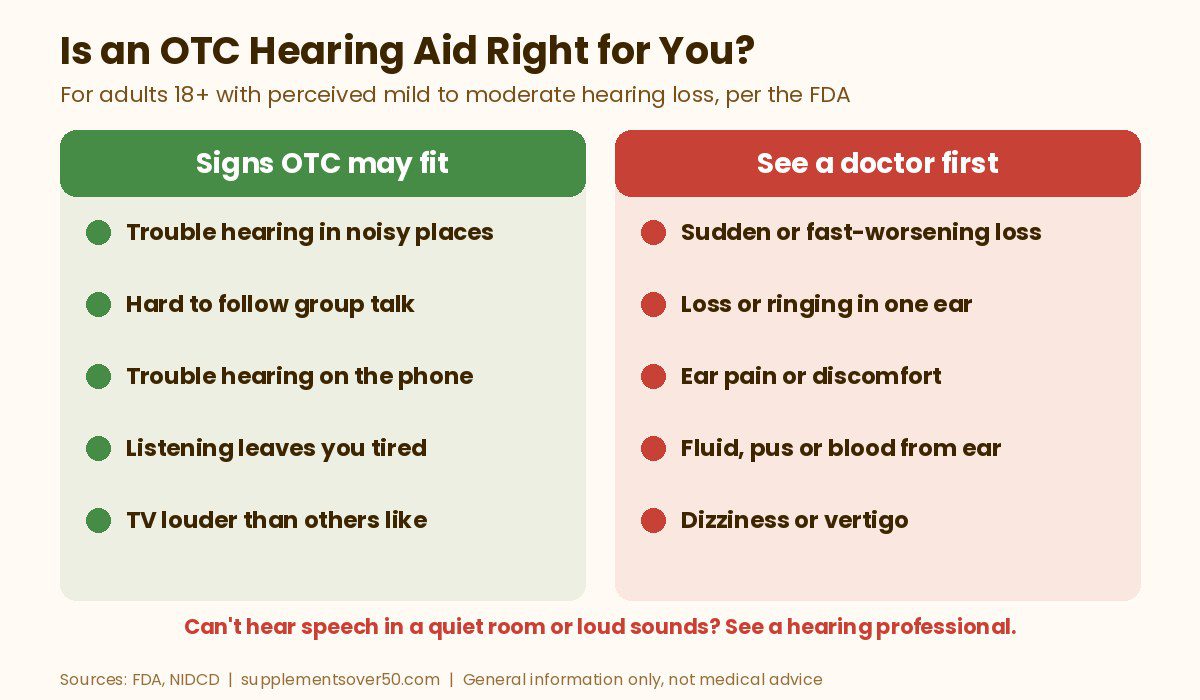
How do you know if your loss is mild to moderate? The FDA’s required box label lists typical signs: trouble hearing speech in noisy places or in groups, trouble on the phone, listening that leaves you tired, and needing the TV louder than others like. If you cannot hear speech even in a quiet room, or you do not hear loud sounds like engines or power tools well, the label says to see a hearing professional instead.
Do Over the Counter Hearing Aids Work?
For the right person, yes. NIDCD says OTC hearing aids, like prescription ones, make sounds louder so that some adults with difficulty hearing can listen, communicate and take part in daily life more fully. The FDA regulates them to make sure they are safe and effective for people with perceived mild to moderate hearing loss.
Whether they work for you depends on three things:
Your level of hearing loss. Mild to moderate loss is the target. If your loss is more severe, NIDCD warns OTC devices might not amplify sounds enough to help.
The type of device. A basic preset model only lets you change volume and maybe a tone or program. A self-fitting model tunes itself to your hearing with an in-app test, which usually means a closer match.
Your patience. The FDA notes it takes time and practice to get used to hearing aids. Your own voice and background noise can sound strange at first. Wear them regularly, practice inserting them and try different settings in different places before you judge them.
Buyer reviews show a consistent pattern: people who expect instant, perfect hearing are often disappointed, while people who give themselves a few weeks to adjust tend to be happier. If you have given a device a fair trial and still are not getting enough benefit, the FDA’s advice is to consult a hearing health professional. Many people also ask whether these devices help tinnitus. Hearing aids treat hearing loss, not tinnitus itself, so if ringing is your main problem, read our guide to tinnitus supplements and what actually helps and talk to your doctor.
OTC vs Prescription Hearing Aids
The FDA defines a prescription hearing aid simply as any hearing aid that is not OTC. Prescription devices are only available through a licensed hearing professional who programs them to your hearing loss, and they can be appropriate for all levels of loss and all ages. Here is how the two compare:
OTC hearing aids
Prescription hearing aids
Who can buy
Adults 18+ with perceived mild to moderate loss
Anyone, through a licensed professional
Hearing exam needed
No
Yes, as part of the fitting
Who sets them up
You, with controls, a test or an app
An audiologist or hearing aid specialist
Severity range
Mild to moderate only
Mild to profound
Where to buy
Stores, online, or a hearing professional
Hearing clinics and professionals
Ongoing care
Varies by brand (some offer remote support)
Usually includes follow-up visits
One useful middle path: the FDA notes that you can also buy OTC hearing aids from an audiologist or hearing aid dispenser, who can test your hearing first. You can request your hearing test records and buy your hearing aids elsewhere.
Self-Fitting vs Preset OTC Hearing Aids
The FDA describes two kinds of devices within the OTC category, and the difference matters more than most shoppers realize:
Preset (legacy) OTC hearing aids have basic features like volume control and preset programs. Some have physical dials or buttons and need no phone at all. They are usually the cheapest option and the simplest to use, but you are choosing from fixed sound profiles.
Self-fitting OTC hearing aids offer more customization through hearing tests, software and smartphone apps. You take a hearing test in the app, and the device adjusts its settings to your results. They usually cost more and need a compatible smartphone.
If you are comfortable with an app, self-fitting is usually the better bet because it shapes the sound to your hearing instead of just making everything louder. If you or a parent dislike smartphones, a preset model with simple dials is far better than a self-fitting aid that sits in a drawer. Apple’s AirPods Pro 2 and AirPods Pro 3 are another option for iPhone users: Apple says their Hearing Aid feature is for people 18 or older with perceived mild to moderate hearing loss.
How Much Do Over the Counter Hearing Aids Cost?
OTC prices vary widely, from under $100 to around $2,000 per pair. At the time of writing, here is what we saw (check current pricing, since it changes often):
Budget preset models such as the Audien Atom One were listed at about $78 per pair on Amazon.
Mid-range app-controlled models such as the ELEHEAR Beyond were around $399 per pair.
Premium self-fitting models such as the Jabra Enhance Select M2 Swift on Amazon were about $999 per pair, and the Sennheiser All-Day Clear was close to $900.
Brand-direct bundles with audiology care: Jabra Enhance’s own site listed its Select line starting around $1,195 per pair, up to about $1,995, with three years of remote audiology included.
Prescription hearing aids usually cost more because the price typically bundles the device with the professional’s testing, fitting and follow-up visits. Two money tips: several of the devices in this guide say on their listings that they are FSA and HSA eligible, and some brands offer financing. Very cheap no-name devices exist too, but the FDA warns that phrases like “FDA registered” or “FDA certified” on a hearing aid box may be misleading, so look for the words “OTC” and “hearing aid” on the package and a clear return policy.
Over the Counter Hearing Aids: Quick Comparison
Device
Type
Best for
Key details (per listing)
Jabra Enhance Select M2 Swift
Self-fitting
App users who want a personalized fit
FDA-cleared in-app self-fitting test; Bluetooth streaming and calls; 24+ hours per charge; IP68; 1-year warranty plus loss and damage protection
ELEHEAR Beyond
App-adjustable
Mid-range budget, long battery life
Up to 50 dB gain; app controls for volume and settings; up to 20 hours per charge, 100 hours with case; remote audiologist support
Audien Atom One
Preset with dials
Simple, no-app use on a tight budget
Two analog dials for volume and frequency; about 24 hours per charge; 3 dome sizes; free guided setup session; 1-year warranty
Three OTC Hearing Aids Worth a Look
This is not a ranked roundup. These three show what each price and feature level looks like, and all were in stock on Amazon at the time of writing. Features come from the Amazon listings, and ratings are what the listings showed when we checked.
1. Jabra Enhance Select M2 Swift (Best Self-Fitting Pick)
The Jabra Enhance Select M2 Swift is the most advanced of the three and is sold by Amazon. According to the listing, it is an FDA-cleared self-fitting hearing aid: you set it up with a hearing test in the Jabra app, then adjust volume, bass, treble and environment presets yourself. It also automatically adjusts speech volume to your surroundings, streams music and calls from compatible iPhone and Android phones, and supports Bluetooth LE Audio and Auracast.
The listing says each aid weighs about 2.12 grams, lasts over 24 hours per charge and is rated IP68 against rain, sweat and dust, with a portable charger, a one-year warranty and one year of loss and damage protection. It showed a 4.7 out of 5 rating, though from only a couple of dozen reviews so far, so treat that as an early signal.
🏆 Best Self-Fitting Pick
Jabra Enhance Select M2 Swift
FDA-cleared in-app self-fitting; Bluetooth calls and streaming; 24+ hour battery; IP68; 1-year warranty and loss protection.
The ELEHEAR Beyond sits in the middle on price and adds a lot of control. The listing describes up to 50 dB of maximum gain with noise and feedback reduction, aimed at mild to moderate hearing loss, plus an iOS and Android app for adjusting volume, compensation settings and phone speech settings. It uses a receiver-in-the-canal style design and comes with multiple dome sizes.
Battery life is a strong point: up to 20 hours per charge, and the charging case adds about four more charges for roughly 100 hours in total. The listing also mentions a remote audiologist care service. It showed a 4.0 out of 5 rating from 700+ reviews, which is typical of this category, where some buyers love their devices and others struggle with fit or setup.
📱 Best Mid-Range Pick
ELEHEAR Beyond
Up to 50 dB gain; app control; up to 100 hours with charging case; remote audiologist support.
The Audien Atom One is the one to consider if you want something cheap and dead simple, especially for a parent who does not want an app. The listing describes two analog dials, one for volume and one for frequency, with no app or buttons. It is a small in-ear design that fits either ear and comes with three dome sizes, a USB-C charging dock that recharges it in about three hours, and a free expert-guided setup session.
It is a big seller, with 4,000+ bought in the past month, but its rating was 3.7 out of 5 from 3,300+ reviews, the lowest of the three. That is the trade-off with budget preset aids: there is no hearing test and only basic tuning, so results vary more. It is a reasonable low-cost way to find out whether amplification helps you, as long as you keep track of the return window.
💸 Best Simple Budget Pick
Audien Atom One
No-app analog dials for volume and frequency; about 24 hours per charge; 3 dome sizes; free guided setup; 1-year warranty.
Some companies sell OTC hearing aids directly with professional support built in. On its own site, Jabra Enhance sells its Select line with three years of unlimited remote appointments and adjustments by its audiology team, a 100-day risk-free trial, a three-year warranty and free shipping and returns, according to the brand. You can personalize the aids with its in-app self-fitting test or upload an existing audiogram. That costs more than the Amazon self-fit version, but it is the closest thing to a clinic experience from home.
Best for remote audiologist support
Jabra Enhance Select (brand direct)
Hearing aids programmed to your self-test or audiogram, plus three years of remote audiology care, a 100-day trial and a three-year warranty, per the brand.
A word of caution about brand-direct buying: make sure the company will be around to support you. Eargo, once a well-known direct-to-consumer brand, posted a notice on its website saying its parent company and related companies, which also included Lexie, began winding down U.S. operations this past July, that its app was removed from app stores in late October, and that new warranty and repair requests are no longer accepted. We do not recommend buying new Eargo or Lexie devices for that reason.
Where to Buy Over the Counter Hearing Aids
The FDA says you can buy OTC hearing aids in person at a store or through an online retailer, with no medical exam, prescription or fitting needed. In practice your main options are:
Pharmacies and big-box stores. Many drugstore and big-box chains carry OTC hearing aids in store or on their websites. The advantage is seeing the box (and its required labeling) before you buy, and returning in person.
Amazon and other online retailers. The widest choice and easy price comparison. Stick to listings sold by Amazon or the brand itself, and read the newest reviews, not just the star average.
Brand direct. Buying from the manufacturer’s own site often gets you the longest trials and, with some brands, remote audiologist support.
A hearing professional. Some audiologists and hearing aid dispensers sell OTC devices and can test your hearing first, according to the FDA.
Return windows matter more than almost anything else. The FDA does not require OTC hearing aid makers to offer a warranty, but it does require the box to state the manufacturer’s return policy, and it advises leaving yourself enough time to try the device in different places and adjust. Policies vary a lot: Jabra Enhance advertises a 100-day trial on its own site, Eargo’s notice listed a standard 45-day return period for direct purchases, and the Amazon listings in this guide showed an extended holiday return window when we checked. Read the exact terms before you buy, and put the return deadline on your calendar.
What to Look for in an OTC Hearing Aid
“OTC” and “hearing aid” on the box. The FDA requires these words to appear prominently on the packaging. Be wary of devices marketed only as “amplifiers.”
A clear return policy and trial period. Aim for at least 30 days, and longer if you can get it.
The right controls for you. Self-fitting with an app for a personalized fit, or simple dials and buttons if apps are a hassle.
Rechargeable vs disposable batteries. Rechargeable models skip the tiny batteries that can be hard to handle with stiff fingers. The FDA labeling must say what batteries are used and whether they are included.
Phone requirements. The box must say whether a phone or remote is needed to control the device. Check that your phone is compatible.
Support and warranty. Look for phone or video support, a warranty of at least a year, and a company with a track record.
How to Choose the Right OTC Hearing Aid
If you are comfortable with a smartphone and want the most personalized sound, choose a self-fitting aid like the Jabra Enhance Select M2 Swift.
If you want app control and long battery life at a middle price, pick the ELEHEAR Beyond.
If you want the simplest, cheapest way to try a hearing aid, try the Audien Atom One and watch the return window.
If you want a professional to fine-tune your aids without clinic visits, consider a brand-direct plan like Jabra Enhance Select with remote audiology.
If you already own AirPods Pro 2 or 3 and an iPhone, try Apple’s built-in Hearing Aid feature before buying anything.
If you have any of the red flags below, skip the store and book a doctor or audiologist visit first.
Both the FDA and NIDCD list warning signs that mean you should see a doctor, preferably an ear, nose and throat (ENT) specialist, before using an OTC hearing aid. See a doctor promptly if you have:
Sudden hearing loss or hearing that is getting worse quickly. Sudden hearing loss should be treated as urgent.
Hearing loss or ringing in only one ear, or a noticeable difference between your ears.
Ear pain or discomfort.
Fluid, pus or blood coming from the ear within the past six months.
Vertigo or severe dizziness along with hearing loss.
Hearing that gets worse and then better again within the past six months.
A lot of earwax, or a feeling that something is in your ear canal.
An ear with a birth defect, an unusual shape or an injury.
You should also see a hearing professional, rather than buy OTC, if you have trouble hearing conversation in quiet settings or trouble hearing loud sounds like traffic, appliances or loud music. NIDCD says those are signs of more severe hearing loss that OTC hearing aids may not help. And if you tried an OTC device and it is not giving you enough benefit, an audiologist can test your hearing and tell you whether a prescription device or another option makes more sense.
Frequently Asked Questions
Do over the counter hearing aids really work?
For adults with perceived mild to moderate hearing loss, they can. NIDCD says OTC hearing aids make sounds louder so some adults hear and communicate better, and the FDA regulates them as medical devices. They are not designed for severe loss, and it takes a few weeks of regular use to adjust.
Who should not use over the counter hearing aids?
Anyone under 18, people with severe or profound hearing loss, and anyone with red flags such as sudden or one-sided hearing loss, ear pain, drainage from the ear, dizziness or vertigo, or a lot of earwax. In those cases see a doctor, ideally an ENT, first.
How much do OTC hearing aids cost?
At the time of writing, prices ranged from about $78 per pair for simple preset models to around $1,000 for premium self-fitting aids on Amazon, and up to about $1,995 for brand-direct bundles that include remote audiology care. Check current prices before buying.
Where can I buy over the counter hearing aids?
You can buy them in stores, online from retailers such as Amazon, directly from brands, or from some audiologists and hearing aid dispensers. Buy from a seller with a clear return window, and keep your receipt and packaging until you are sure they help.
Do I need a hearing test before buying OTC hearing aids?
No. The FDA allows adults with perceived mild to moderate hearing loss to buy OTC hearing aids without an exam. A test can still help: you can get one from an audiologist, request your records, and use them to choose or set up a device.
Are OTC hearing aids the same as hearing amplifiers?
No. OTC hearing aids are FDA-regulated medical devices for hearing loss. Personal sound amplification products (PSAPs) are meant for people without hearing loss, such as for bird-watching, and are not regulated as medical devices. Look for the words OTC and hearing aid on the box.
Our Take
Over the counter hearing aids are a genuine step forward for adults over 50 with mild to moderate hearing loss. They are real, FDA-regulated hearing aids you can buy today, without an appointment, for a fraction of what many people expect to pay. The catch is that you become your own fitter, so choose a device that matches your comfort with technology, buy from a seller with a generous return window and give yourself a few weeks to adjust. If you are comfortable with an app, a self-fitting aid like the Jabra Enhance Select M2 Swift is where we would start. If you notice any red flag symptoms, see a doctor first.
This article is for general information only and is not medical advice. Hearing aids treat hearing loss; they do not cure it or other ear conditions. Talk to a doctor or licensed hearing professional about your hearing, especially if you have sudden or one-sided hearing loss, ear pain, drainage or dizziness.
Home blood pressure monitor picks for adults over 50: upper arm OMRON, iHealth and Alcedo models compared on cuff size, display, memory and accuracy tips.
Our Philips Lifeline review explains the name change to Lifeline, current devices, fees, contract terms and customer reviews, plus three better alternatives.
The best medical alert systems for seniors compared: Bay Alarm Medical, Medical Guardian, LifeFone, MedicalAlert and 2 Amazon options, with fall detection and contract terms.
Medical alert systems for seniors with no monthly fee: 5 smartwatch, autodial and pager picks, what you give up without monitoring, and when to pay for 24/7 help.
Our Medical Guardian reviews roundup covers every device, fall detection, monitoring, cost per month, fees, contract and cancellation terms, and alternatives.
Fall detection for seniors living alone: compare Apple Watch SE 3, Galaxy Watch9, help buttons and medical alert services, plus fees, range and battery tips.