This guide contains affiliate links. If you buy through them, we may earn a small commission at no extra cost to you.
Choosing the best CoQ10 for older adults comes down to form, dose, and whether you take a statin. CoQ10 is one of the most well-researched supplements for adults over 60, and for good reason. It plays a central role in cellular energy production, acts as a powerful antioxidant in mitochondria and cell membranes, and directly addresses the energy decline that most seniors experience as they age. If you’re on a statin medication, CoQ10 becomes even more critical, as statins are known to deplete CoQ10 levels. Here’s a clear-eyed look at the research, the forms, and the five products worth considering.
Table of Contents
Top Picks for the Best CoQ10 for Older Adults
Quick Comparison
Product
Best for
Key fact
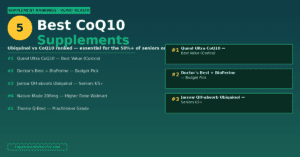
Qunol Ultra CoQ10 100mg
Best overall
Water and fat soluble CoQ10
Jarrow Formulas QH-absorb Ubiquinol 100mg
Best ubiquinol
Active ubiquinol form
Nature Made CoQ10 200mg
Best budget
USP Verified, 200mg
Life Extension Super Ubiquinol CoQ10 100mg
Best enhanced ubiquinol
Ubiquinol with shilajit
Thorne CoQ10
Best practitioner grade
NSF Certified, oil base
What CoQ10 Does and Why Levels Drop After 40
Coenzyme Q10 is produced naturally by the body and is found in virtually every cell. Its primary role is in the mitochondrial electron transport chain, where it shuttles electrons during the process of generating ATP, the cell’s primary energy currency. Without adequate CoQ10, this process becomes less efficient, and cells, particularly those with high energy demands like heart muscle cells, brain cells, and skeletal muscle fibers, underperform.
CoQ10 levels in human tissue peak in the mid-20s and decline steadily from there. By age 60, most adults have meaningfully lower CoQ10 levels than they did at 25. The heart contains some of the highest concentrations of CoQ10 in the body, which is why CoQ10 research has focused heavily on cardiovascular outcomes. Studies have shown benefits for heart failure patients, reduced blood pressure in some individuals, and improved exercise tolerance in older adults.
CoQ10 vs Ubiquinol: Which Form Is Better for Seniors?
Standard CoQ10 supplements contain ubiquinone, the oxidized form. The body must convert ubiquinone to ubiquinol (the reduced, active form) before it can be used in mitochondria. This conversion is reasonably efficient in younger adults but becomes less effective with age. By the time most people reach their 60s, the conversion process is slower and less complete.
Ubiquinol supplements bypass this conversion step by delivering the active form directly. Studies comparing absorption in older adults consistently show that ubiquinol raises blood CoQ10 levels more efficiently than equivalent doses of ubiquinone. The practical implication: a 100mg ubiquinol dose in a senior will likely have a greater effect than a 100mg ubiquinone dose from a standard CoQ10 supplement. The tradeoff is cost — ubiquinol typically runs 30–50% more than ubiquinone at the same milligram dose.
That said, some high-absorption ubiquinone formulations (like Qunol’s water-and-fat-soluble format) partially close the gap. For seniors on a tight budget, a high-absorption ubiquinone product is a reasonable compromise. For those who want to maximize the benefit, particularly those over 70 or with cardiovascular conditions, ubiquinol is the better choice.
Statins work by inhibiting an enzyme called HMG-CoA reductase, which is involved in cholesterol synthesis. The problem is that the same metabolic pathway also produces CoQ10. When statins suppress this pathway, CoQ10 production is collateral damage. Multiple studies have documented significantly lower CoQ10 blood levels in statin users compared to non-users, and the degree of depletion appears to correlate with statin dose and duration of use.
Statin-associated muscle pain (myopathy) is one of the most common reasons people discontinue statin therapy, and CoQ10 depletion is the leading proposed mechanism. Several clinical trials have tested whether CoQ10 supplementation reduces statin-induced muscle symptoms, with mixed but generally encouraging results. Most cardiologists now consider CoQ10 supplementation reasonable for statin users who experience fatigue or muscle pain, and some recommend it proactively. If you take a statin and haven’t discussed CoQ10 with your doctor, it’s worth raising.
The strongest evidence for CoQ10 is in heart failure. A large randomized controlled trial called Q-SYMBIO found that CoQ10 supplementation (300mg daily) reduced major cardiovascular events and all-cause mortality in heart failure patients over a two-year period. While heart failure is a specific medical condition, the underlying mechanisms — improved mitochondrial efficiency in cardiac muscle — are relevant to any senior concerned about cardiovascular health.
For energy and fatigue, the research is more variable. Some seniors report significant improvement in energy levels after starting CoQ10, while others notice little difference. The benefit is likely most pronounced in people who had measurably low CoQ10 levels to begin with (statin users, people with mitochondrial dysfunction, older adults with poor dietary intake). CoQ10’s antioxidant role in protecting brain cells from oxidative damage has generated interest in neurodegenerative disease research, though clinical evidence in this area is still developing.
CoQ10 is fat-soluble, which means it absorbs best when taken with a meal that contains some dietary fat. A tablespoon of olive oil, avocado, or any fat-containing food alongside your CoQ10 can significantly improve how much you actually absorb. Taking it on an empty stomach is a common mistake that dramatically reduces bioavailability.
Doses in research range widely, from 100mg to 600mg daily. For general cardiovascular and energy support, 100–200mg is a reasonable starting point. Statin users often benefit from doses on the higher end of this range. The heart failure trial used 300mg daily. CoQ10 has an excellent safety profile at all doses studied, with no significant adverse effects documented in clinical research.
Most integrative cardiologists say yes, particularly for statin users experiencing fatigue, muscle aches, or weakness. The evidence that statins deplete CoQ10 is solid; the evidence that supplementation fully reverses this depletion and reduces symptoms is moderately strong. The risk of supplementing is essentially nil, and the potential benefit is real. Discuss it with your prescribing physician.
What dose of CoQ10 should seniors take?
For general health maintenance, 100–200mg daily is the standard recommendation. For statin users or those with cardiovascular conditions, 200–300mg is often suggested. Ubiquinol can be used at the lower end of these ranges due to superior absorption. Always take with food that contains fat.
How long before you feel the effects of CoQ10?
Energy and exercise-related benefits, when they occur, are often reported within 4–8 weeks. Cardiovascular benefits are longer-term and typically assessed over months to years. If you’re taking CoQ10 for statin-related muscle pain, give it 8–12 weeks of consistent use before evaluating whether it’s helping.
Can CoQ10 interact with medications?
CoQ10 has a mild blood-thinning effect and may reduce the effectiveness of warfarin (Coumadin). If you take warfarin, discuss CoQ10 with your doctor before starting and monitor your INR more closely when making changes. CoQ10 may also modestly lower blood pressure, which is usually beneficial but worth monitoring if you already take blood pressure medications.
CoQ10 sits in a rare category: a supplement with genuine clinical evidence, a compelling biological rationale, and a very favorable safety profile. For seniors, especially those on statins or with cardiovascular concerns, it’s among the most defensible supplement investments available.
Do lymphatic drainage supplements work? An honest look at cleavers, dandelion and horse chestnut for swelling after 50, when to see a doctor, and what helps.
Which supplements to lower blood pressure have real evidence after 50? Garlic, magnesium and beetroot nitrate compared, plus DASH, drug interactions and safety.


 ✓ In stock


 ✓ In stock
 ✓ In stock
 ✓ In stock
 ✓ In stock