This guide contains affiliate links. If you buy through them, we may earn a small commission at no extra cost to you.
We have not tested these devices ourselves. This guide compiles each brand’s published specs and plan terms, FDA and NIDCD guidance, and patterns in verified buyer reviews.
⚡ Quick Answer
Both are top-tier prescription brands, and the fitting matters more than the logo. Lean Phonak (Audéo EON Sphere) if you want the widest Bluetooth compatibility, the longest stated battery life or a 100% invisible option (Lyric). Lean Oticon (Intent or the newer Reveal) if you prefer a natural, full-surround sound and built-in tinnitus relief sounds. If your loss is mild to moderate, an OTC option such as Jabra Enhance Select M3 (best overall OTC) or ELEHEAR Beyond (best value) can cost far less.
If an audiologist has mentioned two brand names to you, they were probably Oticon and Phonak. Searching Oticon vs Phonak is one of the most common ways people try to decide between them, and it is a fair question: these are two of the biggest prescription hearing aid brands in the world, and both sell premium, rechargeable, Bluetooth-capable devices through hearing care clinics.
The honest answer is that neither brand is best for everyone. They take different approaches to sound, streaming and invisible fits, and those differences matter more for some people than others. This guide compares the current lines from each maker’s own website, explains what you actually buy at the clinic, and covers lower-cost OTC options if your hearing loss is mild to moderate.
Table of Contents
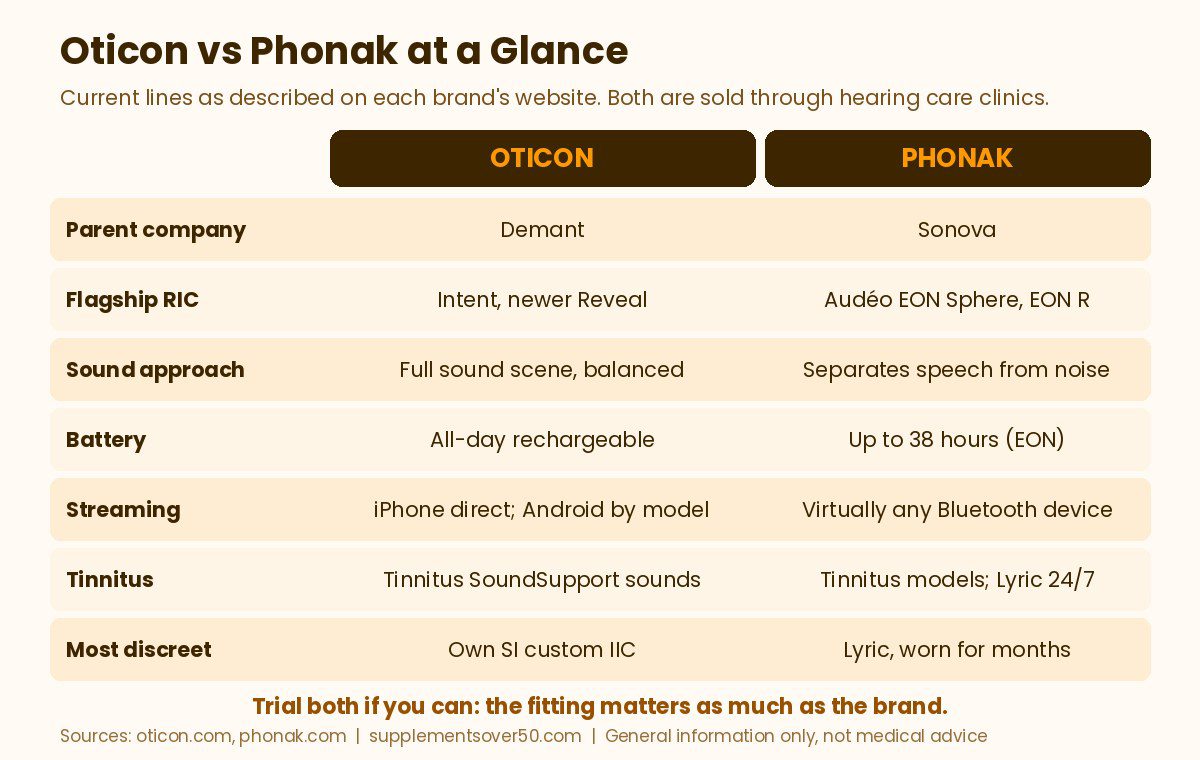
Oticon vs Phonak: Quick Comparison
Details below come from oticon.com and phonak.com at the time of writing. Neither brand publishes retail prices, because clinics set them, so check current pricing with your provider.
BrainHearing: give the brain the full sound scene, balanced
AI that separates speech from background noise (Spheric Speech Clarity 3.0 on EON Sphere)
Battery
Rechargeable models with all-day power; Verit uses disposable batteries
Audéo EON Sphere and EON R: up to 38 hours per charge
Bluetooth streaming
Direct to iPhone and iPad; Android depends on model (ASHA, LE Audio)
Virtually any Bluetooth device, including iPhone and Android; Auracast on EON
Tinnitus
Tinnitus SoundSupport relief sounds, set up by your provider
Tinnitus-compatible models; Lyric worn 24/7
Most discreet option
Own SI custom IIC and CIC; Zeal in-the-ear
Lyric, worn deep in the canal for months; Virto R Infinio custom
How you buy
Through a hearing care professional
Through a licensed hearing care provider
Why Choosing a Hearing Aid Brand Matters After 50
Hearing loss is common as we age, and the decision you make at the clinic usually locks you into one brand’s app, charger and accessories for several years. That is why the brand question feels big. It also explains why audiologists tend to work with a short list of makers they know well.
Still, the brand is only part of the result. The National Institute on Deafness and Other Communication Disorders (NIDCD) notes that hearing aids range from hundreds to several thousand dollars and warns against using price alone to pick one, since the best device is the one that fits your hearing loss, your ears and your daily life. A well-fitted mid-tier aid from either brand can outperform a poorly fitted premium one. Keep that in mind as you read the feature comparison below.
Who Makes Oticon and Phonak?
Oticon belongs to the Demant group, and Phonak is a Sonova brand, as each company’s website states. Both parents are part of what the industry calls the Big Five. According to a Capitol Forum report citing the American Economic Liberties Project, the Big Five are WS Audiology, Demant, GN, Starkey and Sonova, and together they control an estimated 90% of the global hearing aid market and 84% of the U.S. market.
Each parent sells more than one brand. Hearing aid retailer Soundly’s guide to hearing aid brands lists Sonova as the maker of Phonak, Unitron, Lyric and Sennheiser’s OTC aids, and Demant as the maker of Oticon and Philips. So if you see a Philips hearing aid at a warehouse club, it may share technology with an Oticon model, and Soundly says the two are very close in features. The same report notes that the big makers also own or run networks of retail clinics, so ask any clinic which brands it carries and whether it is independent.
Current Oticon Hearing Aids
Oticon’s hearing aid lineup is large, with many older families still listed. These are the ones most adults over 50 will be offered today.
Oticon Intent
Oticon Intent is the main premium family. Oticon calls it the first hearing aid with user-intent sensors: its 4D Sensor technology uses your head movements, the environment and the conversation around you to adjust how much help you get from moment to moment. The Intent miniRITE is rechargeable, has a telecoil for loop systems and a single push button, and supports Bluetooth streaming and hands-free calls. A miniBTE R model sits fully behind the ear.
Oticon Reveal
Oticon Reveal is the newest family, presented on Oticon’s site to hearing care professionals. Oticon says it is the first hearing aid with a Dual AI system, pairing a Speech AI with a Context AI so you hear clear speech and the sounds around it. Oticon also claims stronger feedback prevention, better wind and handling noise reduction than its first-generation system, and its most stable Bluetooth streaming yet. It comes as a rechargeable miniRITE R. Since it is new, ask your clinic whether it is available yet and how it compares on price with Intent.
Oticon Real, Zeal, Own SI and Verit
Oticon Real is the previous premium family, still widely fitted. It offers hands-free calls on recent iPhones and direct streaming from Android phones that support ASHA, according to Oticon.
Oticon Zeal is a small, rechargeable in-the-ear aid that Oticon says can be fitted the same day, with streaming from phones, Apple Watch, TV and PC.
Oticon Own SI is the custom family, including invisible-in-canal (IIC) and completely-in-canal (CIC) models. Oticon calls it its smallest hearing aid and says it uses a deep neural network trained on 12 million real-life sound scenes.
Oticon Verit is the choice for people who prefer disposable batteries. Oticon describes it as premium sound and connectivity in a non-rechargeable design, in three styles including a powerful BTE.
Current Phonak Hearing Aids
Phonak’s hearing aid range covers mild to profound hearing loss and four style types: receiver-in-canal, behind-the-ear, in-the-ear and extended wear.
Phonak Audéo EON Sphere and EON R
Audéo EON Sphere is Phonak’s newest flagship, a rechargeable receiver-in-canal (RIC) aid for mild to profound hearing loss. Phonak says it runs on a HYPERSONIC AI chip and exclusively features Spheric Speech Clarity 3.0, which separates speech from background noise in real time. Phonak also says it is 25% smaller and 20% lighter than the previous Sphere generation and gives up to 38 hours of battery life per charge, depending on use.
Audéo EON R is the step-down model. It uses AutoSense OS AI 8.0 to adapt automatically to changing sound environments, has the same up to 38-hour battery claim, and works with the CROS EON R for people with hearing in only one ear. Both connect to virtually any Bluetooth device and can receive Auracast broadcast audio in theaters, gyms and other venues that offer it.
Phonak Infinio and Virto R Infinio
The Infinio platform is the prior generation, and Phonak still lists Audéo Infinio and Infinio Ultra Sphere models. The custom Virto R Infinio is a rechargeable in-the-ear aid molded to your ear using Phonak’s RightFit approach. Phonak says it pairs with up to 8 Bluetooth devices, with 2 connected at once.
Phonak Lyric
Phonak Lyric has no Oticon equivalent. Phonak calls it the world’s only 100% invisible hearing aid: a provider places it deep in the ear canal, and you wear it around the clock for months at a time, including while sleeping and showering. It is sold through authorized Lyric providers as a subscription, which Phonak says covers one year including replacement devices. The trade-offs: Lyric does not connect to Bluetooth, is water resistant rather than waterproof, must be removed before an MRI, and is not right for everyone, so a provider has to check your ears first.
Phonak Naída Lumity
For severe to profound hearing loss, Phonak points to Naída Lumity, which it calls its most powerful hearing aid. Oticon’s equivalent for high power needs is the Xceed family, which Oticon describes as its most powerful hearing aid.
Oticon vs Phonak Sound Processing: BrainHearing vs Speech Focus
This is the biggest philosophical difference in the Oticon vs Phonak debate. Oticon builds around what it calls BrainHearing. Its Intent page says the brain needs access to all sounds, and that providing the full sound environment, balanced so it is not overwhelming, means less effort. In practice, Oticon aims to keep background sounds available while lifting voices.
Phonak leans harder into pulling speech out of noise. On Audéo EON Sphere, Phonak says Spheric Speech Clarity 3.0 separates speech from background noise in real time, from any direction, and Phonak cites its own studies showing better speech understanding in loud noise. Its AutoSense OS adapts settings automatically as you move between places.
Both brands now use AI processing, and both publish company-funded research claiming advantages over competitors. Treat those claims as marketing until you hear the aids yourself. Some listeners prefer a stronger focus on speech, others a more open, natural sound, and you cannot tell which camp you are in from a spec sheet. A trial period is the only reliable way to know which you prefer.
Bluetooth and Streaming: Phonak Universal vs Oticon Direct
If you use an Android phone or want to stream from many devices, this section may settle Oticon vs Phonak for you. Phonak’s connectivity page says its hearing aids work with most Bluetooth devices that support hands-free calling and music streaming, including iPhone and Android phones, tablets, Mac and Windows computers, and smart TVs. Soundly notes that Sonova’s aids use Bluetooth Classic, which is why they pair like an ordinary headset. The newest EON models add Auracast broadcast audio.
Oticon’s approach is more device-specific. Oticon Real offers hands-free calls on iPhone 11 or later and streams to Android only if the phone supports the ASHA hearing aid standard. Oticon Intent adds hands-free calls from iPhone, iPad and Mac and streaming from select Android devices and Windows computers. Oticon sells an Easy LE Adapter for USB-C Android phones and computers that use LE Audio. The newer Reveal connects directly to iPhone, iPad and Android devices, according to Oticon. Before you buy either brand, check your exact phone against the brand’s compatibility checker.
Styles and Rechargeable Batteries
On styles, the Oticon vs Phonak gap is small. Both brands cover every major style. Oticon offers miniRITE and miniBTE models, the same-day Zeal in-the-ear, and custom Own and Own SI shells down to IIC size. Phonak offers RIC, BTE, custom Virto models and Lyric.
Most current premium models from both are rechargeable. Phonak publishes a specific figure, up to 38 hours on Audéo EON Sphere and EON R. Oticon describes its rechargeables as all-day power and notes that runtime depends on use, hearing loss and streaming. If you prefer to swap batteries, Oticon Verit is built for that, and Lyric uses a sealed battery that is neither rechargeable nor user-replaceable.
Oticon vs Phonak for Tinnitus
Hearing aids do not cure tinnitus, but they may help some people notice it less. Oticon’s tinnitus treatment page says about 90% of people with tinnitus also have hearing loss, and that its hearing aids include Tinnitus SoundSupport, a set of relief sounds such as white noise, pink noise and ocean-like sounds. Your provider has to activate it, and you can then adjust the sounds in the Oticon Companion app. Oticon cites its own white paper reporting a 47% reduction in tinnitus impact.
Phonak’s tinnitus page explains that hearing aids can help by giving the brain more real sound to focus on, and phonak.com lets you filter models for tinnitus. Phonak also says Lyric’s 24/7 wear can provide tinnitus relief at night. If tinnitus is a major issue, ask the clinic to demonstrate each brand’s tinnitus program during your trial. For more on the topic, see our guide to tinnitus supplements and what actually helps.
How to Buy Oticon or Phonak, and What They Cost
You cannot buy either brand’s prescription aids online from the manufacturer. Phonak’s cost and coverage page says you buy through a hearing care professional, who tests your hearing, recommends a technology level and handles follow-up, cleaning and repairs. Oticon also sends you to a hearing care professional.
Neither company posts prices, and the clinic’s bundle of services is built into what you pay. As a rough guide, the Capitol Forum report cites a Hearing Tracker survey finding that the average patient pays over $2,600 for a pair of prescription hearing aids, with average prices across the Big Five’s brands ranging from just over $1,000 to more than $4,000. Ask any clinic for an itemized quote, what the trial period is, which fees are nonrefundable, and how long follow-up visits are included.
Insurance: the Capitol Forum report notes that traditional Medicare does not cover hearing aids, while most Medicare Advantage plans offer some hearing benefit. Call your plan before you shop.
Warehouse clubs: Soundly reports that Costco sells aids from the big manufacturers, including Demant’s Philips brand, plus its own Kirkland Signature line. It also reported that Costco paused sales of Sonova-made aids at one point, so ask your local Costco what is on offer now.
Tech levels: both brands sell the same family at several technology tiers. A lower tier of a new family can be better value than the top tier of an old one.
Oticon vs Phonak: Which Hearing Aid Brand Is Best for You?
Is Phonak the best hearing aid brand? For some people, yes. For others, Oticon is a better fit. Here is how to decide:
If you use an Android phone or many Bluetooth devices, lean Phonak for its broad compatibility.
If you want the longest stated battery life, Phonak Audéo EON Sphere lists up to 38 hours.
If you want a hearing aid nobody can see and you dislike handling small devices, ask about Phonak Lyric.
If busy restaurants are your biggest problem, trial Phonak EON Sphere and Oticon Intent or Reveal back to back.
If you prefer a natural, open sound and stay aware of your surroundings, lean Oticon Intent or Reveal.
If tinnitus relief sounds matter, Oticon’s Tinnitus SoundSupport is well documented on its site.
If you want a tiny custom in-canal aid, compare Oticon Own SI with Phonak Virto R Infinio.
If your loss is mild to moderate and budget matters, consider an OTC hearing aid (below).
Whichever way your Oticon vs Phonak decision goes, the audiologist and the follow-up care matter as much as the brand. Pick a clinic you trust, and use every day of the trial in the places where you struggle most.
If You Don’t Need Prescription Hearing Aids
Since the FDA created the over-the-counter category, adults with milder loss have cheaper options. The FDA’s guide to OTC hearing aids says they are for adults 18 and older with perceived mild to moderate hearing loss, and not for severe or profound loss. If you can follow conversation in quiet rooms but struggle in groups, an OTC aid may be enough. Neither Oticon nor Phonak sells OTC aids under its own name, but these two well-reviewed options come from established brands. Details come from each Amazon listing.
Jabra Enhance Select M3 Aureon comes from GN Hearing, another Big Five maker, and is the closest an OTC aid gets to the clinic experience. The listing describes a receiver-in-ear design weighing just 2.12 grams, automatic adjustment of noise reduction and speech volume, and an in-app self-fitting test, or you can send your audiogram for professional programming. It supports Bluetooth streaming, hands-free calls with a double-tap, LE Audio and Auracast, is rated IP68, and lists over 24 hours per charge.
It also includes unlimited adjustments and appointments with licensed hearing professionals, plus a 3-year warranty and 3 years of loss and damage protection, according to the listing. It costs about $1,995 a pair at the time of writing, so check current pricing. It has a 4.7 out of 5 rating, but from only 22 reviews so far.
🏆 Best Overall OTC
Jabra Enhance Select M3 Aureon
Mini receiver-in-ear OTC aids with remote professional programming, Bluetooth and Auracast, IP68, and over 24 hours per charge.
ELEHEAR Beyond costs about $399 a pair at the time of writing and is one of the better-selling OTC aids on Amazon, with 500+ bought in the past month. The listing says it is designed for mild to moderate hearing loss, with up to 50 dB of gain, AI noise reduction of 24 dB, and an iOS and Android app for volume and other settings. Battery life adds up to about 100 hours with the charging case, and the aids turn on and off automatically when you take them out or put them back.
Its title also mentions remote audiologist support. The rating is a solid 4.0 out of 5 from over 740 reviews. It will not match a clinic-fitted Oticon or Phonak in noisy places, but it is a sensible first step if you are not sure you need prescription aids.
💵 Best Value OTC
ELEHEAR Beyond
Rechargeable OTC hearing aids for mild to moderate loss with AI noise reduction, a smartphone app and up to 100 hours with the case.
3. Jabra Enhance Select, Bought Direct (Best for Ongoing Audiology Support)
You can also buy Jabra Enhance Select direct from Jabra Enhance. Its site lists pairs from as low as $1,195 at the time of writing, a 100-day risk-free trial, a 3-year warranty and 3 years of unlimited appointments and adjustments with its audiology team. Check current pricing on the site.
Best for ongoing audiology support
Jabra Enhance Select M3 (on Amazon or direct)
Self-fitting receiver-in-canal hearing aids with licensed audiology support. The Amazon listing for the Select M3 Aureon includes a 3-year warranty and 3 years of loss and damage protection. Buying direct from Jabra Enhance adds its 100-day trial.
A full hearing test is the starting point for any Oticon or Phonak fitting, and it is also wise before you try OTC aids. The FDA’s OTC labeling tells you to see a doctor, preferably an ear, nose and throat (ENT) specialist, if you:
Have worse hearing in one ear, or ringing or buzzing in only one ear.
Had a sudden change in hearing in the past 6 months, or hearing that gets worse then better again.
Get really dizzy or have a spinning or swaying feeling (vertigo).
Have ear pain or discomfort, or saw blood, pus or fluid from your ear in the past 6 months.
Have a lot of earwax, or think something could be in your ear.
The FDA also says to see a hearing professional if you cannot hear speech even in a quiet room, or you do not hear loud sounds well. Those are signs your loss may be beyond what OTC aids can handle, and where prescription aids from Oticon or Phonak earn their price.
Frequently Asked Questions
Is Oticon or Phonak better?
Neither is better for everyone. Phonak stands out for broad Bluetooth compatibility, a stated battery life of up to 38 hours on its newest RIC aids, and the invisible Lyric. Oticon stands out for its natural, full-surround sound approach and built-in tinnitus relief sounds. Trial both if your clinic offers them.
Is Phonak the best hearing aid brand?
Phonak is one of the leading brands and is owned by Sonova, one of the Big Five makers. Whether it is best for you depends on your hearing loss, phone and preferences. If your clinic fits both Phonak and Oticon, ask to compare them.
Which hearing aid brand is best for seniors?
The best brand is the one your audiologist can fit well and support locally. For seniors, look for easy rechargeable charging, simple controls and a phone you can actually pair. Both Oticon and Phonak offer rechargeable models, and Oticon Intent has a single, easy push button.
Do Oticon hearing aids work with Android phones?
Many do, but it depends on the model and phone. Oticon says Oticon Real needs an Android phone that supports ASHA streaming, Intent works with select Android devices, and the newer Reveal connects directly to Android. Check Oticon’s compatibility guide for your phone.
How much do Oticon and Phonak hearing aids cost?
Neither brand publishes prices because clinics set them. A Hearing Tracker survey cited by the Capitol Forum found the average patient pays over $2,600 for a pair of prescription hearing aids. Ask for an itemized quote and check your insurance.
Are Oticon and Phonak good for tinnitus?
Both can help some people notice tinnitus less, especially when hearing loss is present. Oticon includes Tinnitus SoundSupport relief sounds that your provider activates. Phonak lists tinnitus-compatible models, and its Lyric can be worn overnight.
Our Take
Oticon vs Phonak is a choice between two excellent prescription brands, not between a good one and a bad one. Phonak is the safer pick if you want universal Bluetooth, long battery life or the invisible Lyric. Oticon suits people who want natural, full-surround sound and well-documented tinnitus relief sounds. The bigger decision is the clinic: choose an audiologist who will trial both, fine-tune the fit and stick with you. If your hearing loss is mild to moderate, start with an OTC option like Jabra Enhance Select M3 or ELEHEAR Beyond and upgrade if you need more.
This article is for general information only and is not medical advice. OTC hearing aids are intended for adults 18 and older with perceived mild to moderate hearing loss. Product features and prices change often, so confirm details with the brand or your provider, and talk to a doctor or licensed hearing professional about sudden, one-sided or severe hearing changes.
Looking for a smart watch for seniors with fall detection? We compare Apple, Samsung, Pixel and monitored medical alert watches: who they call, cost and battery.
The best hearing aid for small ear canals is usually a receiver-in-canal or slim behind-the-ear model with small domes. See 5 fit-first picks and sizing tips.
The AARP hearing aid discount explained: the UnitedHealthcare Hearing and Soundly programs, prices, the free hearing test, the catch, and cheaper OTC options.
Jabra Enhance hearing aids reviewed: Select M1, M2 and M3 vs Pro 30 and Plus, OTC vs prescription, remote audiology, trial, warranty, pricing and where to buy.
Over the counter hearing aids explained: who they are for, OTC vs prescription, self-fitting vs preset, typical costs, where to buy and when to see a doctor.