This guide contains affiliate links. If you buy through them, we may earn a small commission at no extra cost to you.
We have not tested these devices ourselves. This guide compiles each brand’s published specs and plan terms, FDA and NIDCD guidance, and patterns in verified buyer reviews.
⚡ Quick Answer
Our top OTC pick is Audien Atom Pro 2 (best overall in-canal pick, with by far the most buyer reviews). Also worth a look: Ceretone Supermini (smallest, deep-canal IIC style), Vivtone Supermini (best-rated small CIC, small review base) and Audien Atom Air (lowest cost). For truly invisible aids or more than moderate hearing loss, ask an audiologist about Phonak Lyric, Oticon Own SI or Starkey’s custom IIC aids.
Plenty of people put off hearing help because they do not want anyone to notice a hearing aid. That is exactly why the best invisible hearing aids are so popular: they sit inside the ear canal, where most people will never spot them. Some are sold over the counter (OTC) for about $120 to $300 a pair at the time of writing. Others are custom-made prescription devices fitted by an audiologist.
Invisible comes with trade-offs, though. The smaller a hearing aid gets, the less room it has for a battery, Bluetooth, buttons and power. Tiny aids are also fiddly to handle and sit right where earwax collects. This guide explains the styles in plain terms, who can and cannot wear them, and which OTC and prescription options are worth a closer look.
Table of Contents
Best Invisible Hearing Aids: Quick Comparison
OTC prices are approximate Amazon prices per pair at the time of writing, so check current pricing. Ratings and review counts are from each Amazon listing on the day we checked. Prescription aids are priced by the clinic, so we list no prices for them.
4 listening modes on one button; UV-C cleaning case; up to 24 hours per charge; 3.7 stars (3,800+ reviews)
About $231
Ceretone Supermini
OTC, invisible-in-canal (IIC)
Smallest OTC option
About 1 gram each; volume and programs set from the case screen; IP66; 3.6 stars (140+ reviews)
About $299
Vivtone Supermini
OTC, completely-in-canal (CIC)
Best-rated small CIC
16-channel processing; 2 modes; more than 16 hours per charge; 4.2 stars (18 reviews)
About $279
Audien Atom Air
OTC, in-ear
Lowest cost
Left- and right-specific shells; volume dial, no app; up to 24 hours per charge; 3.5 stars (100+ reviews)
About $119
Phonak Lyric
Prescription, extended wear deep in canal
Fully invisible, worn for months
Placed by a Lyric provider; sold as a yearly subscription with replacement devices
Clinic pricing
Oticon Own SI
Prescription, custom IIC or CIC
Custom fit with advanced sound
Custom-made to your ear; Oticon’s smallest hearing aid; top water and dust rating
Clinic pricing
Starkey custom IIC
Prescription, custom IIC
Deepest custom fit
Rests in the second bend of the canal; available in Starkey’s Omega AI+ line
Clinic pricing
Why Invisible Hearing Aids Appeal to So Many People After 50
Hearing loss tends to creep up slowly. Many people spend years turning up the TV and asking others to repeat themselves before they try a hearing aid, and worries about looking older are a common reason for the delay. An aid that hides in the ear canal removes that barrier for a lot of people.
Since the FDA created the OTC category, adults 18 and older with perceived mild to moderate hearing loss can buy hearing aids without an exam or prescription. That has brought a wave of small in-canal OTC models to Amazon, many marketed as invisible. Some are genuinely tiny. Others are ordinary in-ear buds with a skin-tone shell. Knowing the style names helps you tell them apart.
Invisible Hearing Aid Styles Explained: IIC, CIC, ITC and Mini RIC
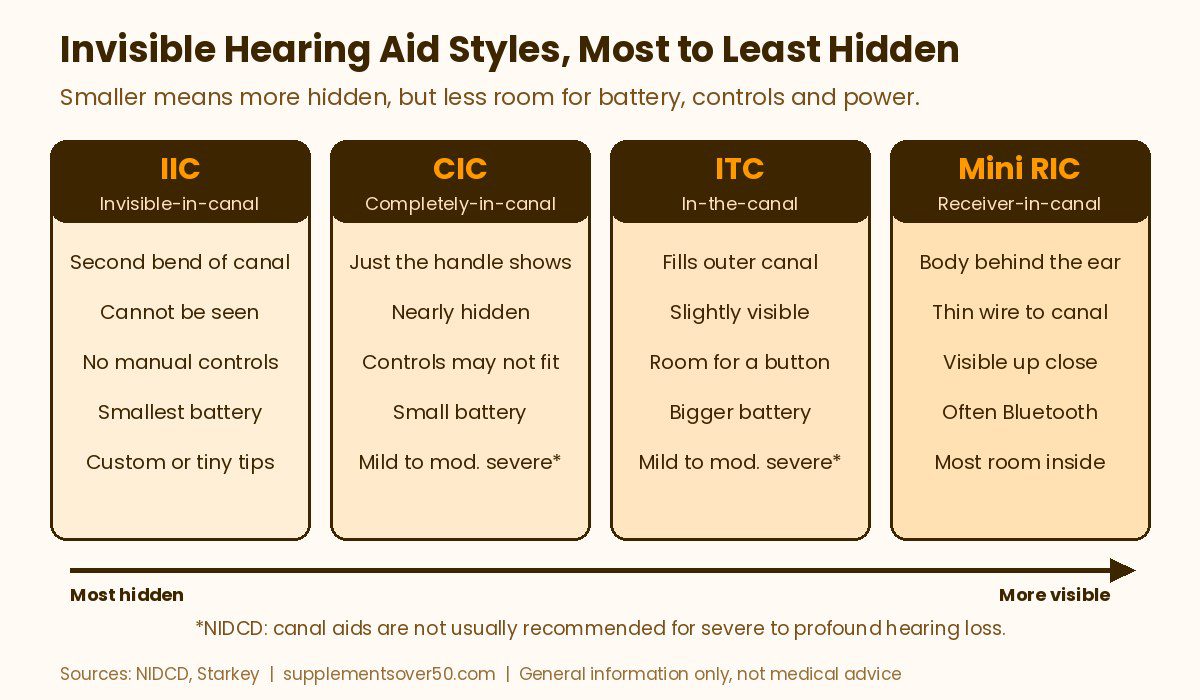
The National Institute on Deafness and Other Communication Disorders (NIDCD) describes canal aids as hearing aids that fit into the ear canal. Here is how the main discreet styles compare, from least to most visible, since the best invisible hearing aids for you start with the right style.
Invisible-in-canal (IIC)
Starkey’s guide to invisible IIC hearing aids describes this style as resting in the second bend of the ear canal, where no one can see it, and calls it the smallest, most discreet hearing aid made. Prescription IIC aids are custom-fit to a mold of your ear. A few OTC models, like the Ceretone Supermini, call themselves IIC too, but they use soft eartips instead of a custom shell.
Completely-in-canal (CIC)
A completely in canal hearing aid sits a little less deep. Starkey’s CIC page says only the tiny removal handle shows outside the ear canal, and NIDCD describes CIC hearing aids as nearly hidden in the canal. Most OTC models sold as invisible are really CIC hearing aids, or slightly larger in-canal designs.
In-the-canal (ITC)
NIDCD says an ITC aid is made to fit the size and shape of a person’s ear canal. It fills more of the outer canal, so you can see a little of it if you look, but the extra room can fit a bigger battery, a button or a volume control.
Mini receiver-in-canal (RIC)
A mini RIC is not in-canal at all. A small body sits behind the ear and a thin clear wire carries sound to a speaker inside the canal. It is visible if someone looks closely, but many people find it nearly as discreet as a CIC, and it usually has more room for Bluetooth, rechargeable batteries and power. If a truly invisible aid does not suit you, this is the usual next step.
The Trade-Offs of CIC Hearing Aids and Other In-Canal Styles
Both Starkey and NIDCD are upfront that small size has costs. Even the best invisible hearing aids share these limits, so weigh them before you buy:
Battery size. Starkey notes that small IIC and CIC aids use small batteries that need changing more often, and NIDCD says canal aids have less room for batteries. Rechargeable OTC models get around this with a charging case, but each charge may not last as long as a larger aid.
Streaming and extras. NIDCD says canal aids have less space for add-ons such as a telecoil. Most invisible OTC aids skip Bluetooth, so you usually cannot stream calls or TV audio to them.
Controls. Starkey says IIC aids are too small for manual volume or memory controls, and CIC aids may not have room for them either. Several OTC models solve this by putting controls on the charging case.
Dexterity. Both sources warn that small aids may be hard to adjust and remove. If arthritis, tremor or poor eyesight make small objects tricky, test the fit carefully during the return window.
Earwax. Anything that sits deep in the canal sits where wax builds up. Expect to clean the tips or change wax guards regularly, and see a doctor first if you have a lot of earwax.
Whistling (feedback). A loose fit lets sound leak back to the microphone and squeal. Feedback is one of the most common complaints in Amazon reviews of small in-canal aids, so trying several tip sizes matters.
Power. Smaller aids have less output, which is why in-canal styles are not meant for severe loss (see below).
Who Can and Cannot Wear In-Canal Hearing Aids
According to NIDCD, ITC and CIC hearing aids are used for mild to moderately severe hearing loss. They usually are not recommended for young children or for people with severe to profound hearing loss, because their reduced size limits their power and volume.
OTC aids have a narrower range. The FDA’s guide to OTC hearing aids says they are for adults 18 and older with perceived mild to moderate hearing loss, and not for severe or profound hearing loss. If you suspect your loss is more than moderate, the FDA says to see a licensed hearing health care professional, who can discuss prescription options, including custom invisible aids.
Ear shape matters too. A very narrow or sharply curved ear canal can make deep-fitting aids uncomfortable or impossible to seat, and a custom IIC needs enough canal space for the electronics. Starkey says the right style depends on your ear anatomy, lifestyle, budget and other factors. If OTC tips never feel right, an audiologist can look in your ears and tell you whether a custom in-canal aid or a mini RIC is the better route.
What to Look for in the Best Invisible Hearing Aids
Clear OTC hearing aid labeling. The FDA requires the words “OTC” and “hearing aid” on OTC packaging. Skip anything sold as an amplifier or sound enhancer if you have hearing loss.
Several tip sizes. A good seal reduces whistling. Look for three or four eartip sizes in the box.
Case controls. Because tiny aids have little room for buttons, a charging case with volume and program controls is a big plus for in-canal designs.
Battery life you can live with. Check hours per charge and whether the case holds extra charges for travel.
A real return window and warranty. In-canal fit is personal. A generous trial lets you see whether you can insert, remove and wear the aids all day.
Enough reviews to judge. Small in-canal OTC aids rarely score above 4 stars. A 3.7 from thousands of buyers can tell you more than a 4.5 from a dozen.
Top OTC Picks for the Best Invisible Hearing Aids
To find the best invisible hearing aids sold over the counter, we started with in-canal and IIC models on Amazon that are labeled as OTC hearing aids, sold by the brand’s own store, and in stock, then weighed sales rank, review volume and published specs. Ratings for small in-canal aids are mixed across the board, so we state each one plainly. Product details come from each Amazon listing.
1. Audien Atom Pro 2 (Best Overall OTC Pick)
Audien Atom Pro 2 is our top OTC choice mainly because it has by far the largest buyer track record of any small in-canal aid we found: over 3,800 Amazon reviews and 400+ bought in the past month at the time of writing. The listing calls it Audien’s smallest in-canal design and says it is 15% smaller than the previous generation. One button handles volume and cycles through four listening modes: Conversation, Restaurant, TV and Outdoor.
Every time you dock it, the charging case runs a 5-minute UV-C light cycle, which is a sensible extra for a device that sits in the ear canal. Audien lists up to 24 hours of use per charge, plus up to 48 more hours from the case. It costs about $231 a pair at the time of writing. The catch is a mixed 3.7 out of 5 rating, and the listing leans on “FDA registered” wording, which does not mean FDA approval. Keep the return window in mind, and know that it has no app or Bluetooth.
🏆 Best Overall OTC
Audien Atom Pro 2
Nearly invisible in-canal OTC hearing aids; 4 listening modes on one button; UV-C cleaning charging case; up to 24 hours per charge.
If you want the most hidden OTC option, Ceretone Supermini is one of the few that describes itself as invisible-in-canal (IIC). The listing says each aid weighs about 1 gram and uses an Intricon chip and a Knowles speaker. It is aimed at mild to moderate hearing loss and adds wind noise management, which can help outdoors.
Since an aid this small has no room for buttons, you adjust volume and preset programs with buttons on the charging case, which shows your settings on a small screen. The aids switch on when you lift them out, remember your last settings and are rated IP66 for dust and water. Ceretone offers a 60-day trial, a 365-day warranty and U.S.-based support, according to the listing. It costs about $299 a pair at the time of writing and holds a 3.6 out of 5 rating from over 140 reviews, so read the recent reviews and use the trial. Ceretone also sells a similar Core One Pro model, rated 3.5 from about 57 reviews, where whistling and feedback come up in several reviews.
👁️ Smallest OTC Option
Ceretone Supermini
IIC-style OTC hearing aids about 1 gram each; volume and programs set from the case screen; wind noise management; IP66; 60-day trial.
Vivtone Supermini is a completely in canal design that Vivtone says is 30% smaller than most other CIC devices. It uses 16-channel digital sound processing with noise reduction and offers two modes: one for general listening and one for noisy places. The box includes four eartip sizes from extra-small to large, which helps if your ear canals are on the narrow side.
Battery life is respectable for its size: the listing says a 2-hour charge gives more than 16 hours of use, and the case provides about a week of standby power. The aids turn on and off automatically and remember your settings, and Vivtone offers phone, email and text support. At about $279 a pair at the time of writing, it has the best rating of our OTC picks at 4.2 out of 5, but from only 18 reviews, so treat that score as early.
⭐ Best-Rated Small CIC
Vivtone Supermini
CIC OTC hearing aids with 16-channel processing; 2 listening modes; 4 eartip sizes; more than 16 hours per charge.
Audien Atom Air is the budget way to try a discreet in-ear aid, at about $119 a pair at the time of writing, with 400+ bought in the past month. Unlike many one-size buds, the shells are shaped separately for the left and right ear, which the listing says helps them sit naturally and stay put. A simple turn dial adjusts volume, and there is no app to learn.
Audien lists up to 24 hours of use per charge from the built-in battery. It is newer than the Atom Pro 2, with a 3.5 out of 5 rating from just over 100 reviews, and it sits more in the outer ear than deep in the canal, so it is discreet rather than invisible. The listing again uses “FDA registered” language. Think of it as a low-cost test of whether a small in-ear aid suits you.
💵 Lowest Cost
Audien Atom Air
Discreet in-ear OTC hearing aids with left- and right-specific shells; simple volume dial, no app; up to 24 hours per charge.
Some of the best invisible hearing aids are only available through a clinic. If you want a hearing aid that is truly hidden, or your hearing loss is more than moderate, prescription custom aids go further than any OTC model. They are fitted by a hearing care professional, and pricing is set by the clinic, so ask for an itemized quote. These are the best-known options, described from each maker’s own pages.
Phonak Lyric (Worn for Months at a Time)
Phonak Lyric is different from every other hearing aid here. Phonak says it is placed deep inside the ear canal, where it is invisible, and is designed to stay in for months at a time, with no batteries to charge or change. Phonak says you can wear it around the clock, including while exercising, sleeping and showering. It is sold through authorized Lyric providers on a subscription basis, and Phonak says a subscription covers one year, including replacement devices and servicing. Phonak also notes that Lyric is not appropriate for everyone, so a provider has to check your ears first.
Oticon Own SI (Custom IIC or CIC)
Oticon Own SI is Oticon’s custom in-ear family, available in invisible-in-canal (IIC) and completely-in-canal (CIC) models among others. Oticon describes it as its smallest hearing aid, custom-made to your ear shape, and says it uses an always-on deep neural network trained on 12 million real-life sound scenes. Oticon also says it has the highest rating available for water and dust resistance. You get it through a hearing care professional.
Starkey Custom IIC (Deepest Custom Fit)
Starkey’s invisible IIC aids are custom-fit and rest in the second bend of the ear canal, and Starkey currently offers them in its Omega AI+ line. Starkey is frank about the downsides on its own page: the small size can be hard for people with dexterity issues, the small batteries need changing more often, and there is no room for manual volume or memory controls. A Starkey provider can tell you whether your ear canal is large enough for the IIC style or whether CIC suits you better.
What Happened to Eargo?
For years Eargo was the best-known invisible OTC brand, so you may still see it recommended. We do not recommend buying it now. A notice on eargo.com says its parent company, LXE Hearing, began winding down its U.S. operations in July, and it details changes to the app, support and warranty coverage. The same company made Lexie. If you already own Eargo aids, read that notice for what still works.
How to Choose the Best Invisible Hearing Aids for You
If you want the most proven small OTC aid, pick Audien Atom Pro 2.
If being completely hidden matters most and your loss is mild to moderate, try Ceretone Supermini and use its 60-day trial.
If you have narrow ear canals, look at Vivtone Supermini, which includes an extra-small eartip.
If you are on a tight budget, start with Audien Atom Air.
If you want to stream calls or TV audio, skip invisible styles and look at a mini RIC or earbud-style OTC aid instead.
If you have stiff fingers or poor eyesight, a slightly larger ITC or behind-the-ear aid may be easier day to day.
If your loss is more than moderate, or you want an aid nobody can see, book an audiologist and ask about Phonak Lyric, Oticon Own SI or a custom Starkey IIC.
The FDA’s OTC hearing aid labeling tells you to see a doctor, preferably an ear, nose and throat (ENT) specialist, before using OTC aids if you:
Have worse hearing in one ear, or ringing or buzzing in only one ear.
Had a sudden change in hearing in the past 6 months, or hearing that gets worse and then better again.
Get really dizzy or have a spinning or swaying feeling (vertigo).
Have ear pain or discomfort, or saw blood, pus or fluid from your ear in the past 6 months.
Have a lot of earwax or think something could be in your ear.
Earwax deserves extra attention with invisible hearing aids, since they sit deep in the canal. And because in-canal aids have limited power, see a licensed hearing professional if you struggle to follow speech even in a quiet room. A proper hearing test also tells you whether your loss falls in the mild to moderate range that OTC aids are built for.
Frequently Asked Questions
What are the most invisible hearing aids?
Invisible-in-canal (IIC) aids sit deepest, in the second bend of the ear canal. Prescription options like Phonak Lyric and custom IIC aids from Oticon and Starkey are the most hidden. Among OTC models, a few, such as Ceretone Supermini, use an IIC-style design.
Are invisible hearing aids good for severe hearing loss?
Usually not. NIDCD says canal aids are generally not recommended for severe to profound hearing loss because their small size limits power and volume. OTC aids are only for perceived mild to moderate loss, so see an audiologist if your loss is worse.
What is the difference between CIC and IIC hearing aids?
A completely-in-canal (CIC) aid sits in the canal with only a tiny removal handle showing. An invisible-in-canal (IIC) aid sits even deeper, in the second bend of the canal, so it cannot be seen. IIC aids are smaller, with less room for battery and controls.
Can invisible hearing aids stream music and calls?
Most cannot. Small in-canal aids have little room for wireless parts, and none of the OTC picks in this guide list Bluetooth streaming. If streaming matters, look at a mini receiver-in-canal or earbud-style hearing aid.
Do in-canal hearing aids cause earwax problems?
They sit where wax builds up, so wax can block the speaker or make the fit feel off. Clean the tips and change wax guards as the maker directs. The FDA says to see a doctor before using OTC aids if you have a lot of earwax.
Is Eargo still a good invisible hearing aid?
We no longer recommend it. A notice on eargo.com says parent company LXE Hearing began winding down its U.S. operations, with changes to the app, support and warranty coverage. Choose a brand with active support instead.
Our Take
The best invisible hearing aids depend on how hidden you need them to be and how much hearing loss you have. For mild to moderate loss, Audien Atom Pro 2 is the safest OTC bet thanks to its long buyer track record, Ceretone Supermini is the smallest OTC option, Vivtone Supermini is a well-rated small CIC with a short history, and Audien Atom Air is the budget way to try. None of them is perfect: expect to spend time getting the fit right, cleaning out wax, and doing without Bluetooth. If you want an aid nobody can see, or your loss is more than moderate, a custom prescription aid such as Phonak Lyric, Oticon Own SI or a Starkey IIC is worth the visit to an audiologist.
This article is for general information only and is not medical advice. OTC hearing aids are intended for adults 18 and older with perceived mild to moderate hearing loss. Prices, ratings and stock change often, so confirm details on the listing before you buy, and talk to a doctor or licensed hearing professional about sudden, one-sided or severe hearing changes.
Jabra Enhance hearing aids reviewed: Select M1, M2 and M3 vs Pro 30 and Plus, OTC vs prescription, remote audiology, trial, warranty, pricing and where to buy.
Looking for a smart watch for seniors with fall detection? We compare Apple, Samsung, Pixel and monitored medical alert watches: who they call, cost and battery.
Looking for the best cheap hearing aid Amazon sells? 5 budget OTC hearing aids worth buying, how to spot amplifiers, and what “FDA registered” really means.
Home blood pressure monitor picks for adults over 50: upper arm OMRON, iHealth and Alcedo models compared on cuff size, display, memory and accuracy tips.
The AARP hearing aid discount explained: the UnitedHealthcare Hearing and Soundly programs, prices, the free hearing test, the catch, and cheaper OTC options.
AARP medical alert systems explained: the Lifeline and IRIS Ally member discounts, how to claim them, what AARP endorses, and cheaper non-AARP options.