This guide contains affiliate links. If you buy through them, we may earn a small commission at no extra cost to you.
We have not tested these devices ourselves. This guide compiles each brand’s published specs and plan terms, CDC and NCOA guidance, and patterns in verified buyer reviews.
⚡ Quick Answer
Our picks: Bay Alarm Medical (best overall, a waterproof in-home pendant or a neck-worn all-in-one with GPS), LifeFone VIP Active (best battery life and cheapest fall detection add-on), Medical Guardian MGMini (smallest pendant you can order on Amazon), Lifeline On the Go Mini (best for AARP members and Lifeline loyalists) and the Universal Medical Data engraved ID necklace (best for medical information, no monthly fee). The first four connect to a 24/7 monitoring center when pressed. The ID necklace does not call anyone; it tells first responders what they need to know.
A medical alert necklace is still the most common way older adults wear a help button, and for good reason. It sits where a hand can find it after a fall, it stays on in the shower, and it does not need a smartphone or a daily habit of checking a screen. Press it, and a trained operator answers through the pendant or a speaker in the home, then calls family, a neighbor or 911.
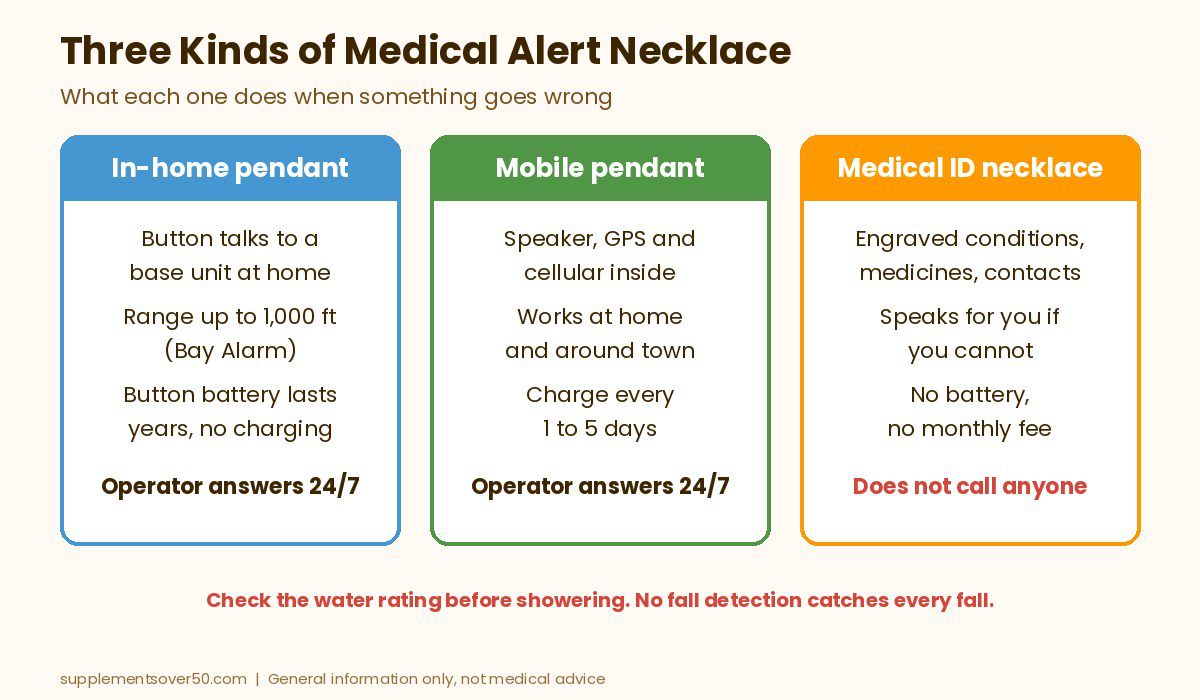
The catch is that “medical alert necklace” covers very different products: in-home pendants that talk to a base unit, mobile pendants with GPS and their own cellular service, cheap no-fee buttons that only ring family, and engraved medical ID necklaces that never call anyone. This guide sorts them out, compares five good options, and covers the details that matter for a pendant specifically: water resistance, fall detection, range, battery, cord safety and how to get one free or discounted.
Table of Contents
Medical Alert Necklace: Quick Comparison
Monthly prices are what each brand’s site or Amazon showed at the time of writing. Promotions change often, so check current pricing before you order.
In-home pendant with base unit, or mobile all-in-one pendant with GPS
Optional, about $10/mo more
Home button up to 5 years; All-In-One 2 up to 72 hours
Home cellular about $34.95/mo; All-In-One 2 about $34.95/mo plus a $149 device purchase (discounted when checked)
LifeFone VIP Active
Long battery life, budget fall detection
Mobile voice-in-pendant, AT&T 4G LTE
Optional, $5/mo more
Up to 5 days (less with fall detection)
From about $37.95/mo on an annual plan
Medical Guardian MGMini
A small pendant ordered on Amazon
Mobile pendant, Wi-Fi and GPS location
Optional, $10/mo more
3 days
About $61 for the device on Amazon, then $43.95/mo after a free first month
Lifeline On the Go Mini
AARP members, pendant or wristband
Mobile pendant with GPS
Optional, $15/mo more
Charge daily (brand advice)
From about $44.95/mo on an annual plan, plus setup fees
Universal Medical Data ID necklace
Medical information for responders
Engraved stainless steel tag, no electronics
No
None needed
About $34 one time
Why a Medical Alert Necklace Matters After 50
Falls are the main reason families start shopping. According to the CDC’s Facts About Older Adult Falls, more than one out of four adults 65 and older falls each year, but less than half tell their doctor. Falling once doubles the chance of falling again, and the CDC says one out of 10 falls causes an injury that limits activity for at least a day.
The bathroom is a hot spot. Wet floors and getting in and out of the tub are classic fall risks, which is why a pendant that can be worn in the shower matters more than any other spec.
Phones are rarely within reach. A cell phone on the kitchen counter does nothing for someone on the bathroom floor. A pendant is on the body all day.
Living alone raises the stakes. Without someone checking in, a person who cannot get up may wait hours. One button press, or automatic fall detection, shortens that wait.
Not every emergency is a fall. Chest pain, dizziness or a sudden illness at night are all reasons to press the button, and the operator can stay on the line until help arrives.
How a Medical Alert Necklace Works
Every monitored necklace in this guide works the same basic way: press the button, an operator at a 24/7 monitoring center answers, and they follow the emergency plan you set up, calling family, a neighbor or 911 in the order you choose. What differs is where the speaker sits and how far you can roam.
In-home pendant. A small, light waterproof button talks to a base unit plugged in at home, and you speak to the operator through the base unit’s speaker. Batteries in the button can last years. The limit is range: it works only within a set distance of the base.
Mobile (all-in-one) pendant. The speaker, microphone, cellular radio and location tracking are all inside the pendant, so it works at home, in the yard and around town with no base unit. The trade-off is a bigger pendant that needs regular charging.
No-fee caregiver pendant. Sold on Amazon for a one-time price, these ring a pager or a family member’s phone instead of a monitoring center. They can work when a caregiver lives in the home, but no professional answers if family misses the alert.
Medical ID necklace. An engraved tag with conditions, medications, allergies and emergency contacts. It does not call for help, but it speaks for the wearer if they cannot.
Many families pair two of these: a monitored pendant for getting help and an engraved ID for what responders need to know once they arrive.
What to Look for in a Medical Alert Necklace
Shower-safe water resistance. Look for an explicit IP67 rating or a plain statement that it can be worn in the shower. Bay Alarm rates its wearables IP67, MedicalAlert says its help buttons are waterproof to one meter for 30 minutes, and Lifeline calls the On the Go Mini pendant waterproof for bath or shower use.
Fall detection that suits the wearer. It is an add-on that usually costs $5 to $15 a month. It is worth it for anyone who lives alone, has fallen before, or might be knocked out or confused after a fall. Bay Alarm says its All-In-One 2 is optimized for fall detection when worn around the neck, and it calls the lanyard the preferred option for its SOS Micro with fall detection.
Range for in-home systems. Bay Alarm’s in-home buttons reach up to 1,000 feet from the base, and its FAQ says 800 to 1,000 feet for the standard button. That covers most homes and yards, but test the far corners during the trial.
Battery life you can live with. In-home buttons can run for years without charging. Mobile pendants range from about a day to five days per charge. Longer is better for someone who forgets to charge things.
Two-way voice in the pendant. For mobile models, check that you can talk to the operator through the pendant itself, not only a base unit.
Comfort and cord safety. A light pendant on an adjustable cord is more likely to be worn all day. Ask about cord options if the wearer uses a wheelchair, walker or bed rails (more on this below).
The real terms. Read the device fee, setup fee, minimum commitment, trial length and return rules before you order. They vary far more than the monthly price.
Is a Medical Alert Necklace Safe to Wear All Day?
For most people, yes, but cord safety deserves two minutes of thought. In 2009 the FDA cautioned users of neck-worn emergency buttons about a choking hazard after reports of serious injury or death when the cord on a Philips Lifeline help button became tangled on other objects, according to Occupational Health & Safety’s report on the alert. That pendant was designed not to break away so it would not fall off by accident. The report says risks were greater for people who use wheelchairs, walkers or beds with guard rails, and the FDA recommended talking with a health care provider about which button style, including wrist-worn ones, fits best.
Ask about the cord. Before ordering, ask the provider what lanyard comes with the pendant and whether a breakaway or adjustable option is available.
Consider the wrist or belt. Most mobile pendants here also come with a belt clip or wrist strap. For someone who uses a walker, wheelchair or bed rails, a wrist strap may be the safer choice.
Check pacemaker advice. Bay Alarm says its All-In-One 2 contains a strong magnet and should be kept in the included belt pouch away from a pacemaker, and it recommends wearing the SOS Micro on the wrist or hip for people with pacemakers. Ask any provider the same question.
Do not stack necklaces. Wear the help button on its own cord rather than threading it onto a chain with other jewelry or an ID tag.
Top Picks for the Best Medical Alert Necklace for Seniors
Monitored picks are based on each brand’s own product, pricing and terms pages at the time of writing. Amazon picks are based on the live listing; ratings are what Amazon showed when we checked.
1. Bay Alarm Medical SOS Home and All-In-One 2 (Best Overall)
Bay Alarm Medical offers the two pendant styles most people need. The SOS Home pairs a base unit with a lightweight button that can be worn as a necklace or on the wrist. Bay Alarm says the button is 100 percent waterproof, reaches up to 1,000 feet from the base, and lasts up to 5 years without charging (fall detection buttons up to 2 years). The base unit has a 32-hour backup battery, and consoles are leased free of charge but must be returned if you cancel. At the time of writing the pricing page listed SOS Home Cellular at about $34.95 a month, $44.95 a month with fall detection (which adds a separate fall detection button with a $30 device fee), and a landline version at about $27.95 a month.
For a parent who drives, walks or gardens, the SOS All-In-One 2 puts GPS, cellular service and two-way voice inside one pendant. Bay Alarm lists up to 72 hours of battery, IP67 water resistance for shower use, a caregiver tracking app, and says it is optimized for fall detection accuracy when worn around the neck. It costs about $34.95 a month, or $44.95 with fall detection, plus a required device purchase listed at $149 (discounted when we checked). Bay Alarm offers a 15-day trial, no long-term contract and states a monitoring center response time of 45 seconds or less, which is the brand’s own claim.
BEST OVERALL
Bay Alarm Medical SOS Home and All-In-One 2
Waterproof in-home pendant with up to 1,000 feet of range, or a neck-worn all-in-one pendant with GPS and optional fall detection. 24/7 US-based monitoring and a 15-day trial, per the brand.
2. LifeFone VIP Active (Best Battery Life and Budget Fall Detection)
The LifeFone VIP Active is a voice-in-pendant: the speaker and microphone are in the necklace itself, so the wearer talks to the operator wherever they are. LifeFone says it uses AT&T 4G LTE (through LifeFone’s service, not your phone plan), locates the wearer with cellular, Wi-Fi and GPS, and is water resistant for rain or the shower. Battery life is listed at up to 5 days, with text and email reminders when it runs low, which is the longest of the mobile pendants here.
Fall detection costs just $5 a month more, and LifeFone notes that battery life may be shorter with it switched on and that no system detects 100 percent of falls. Plans started at about $37.95 a month on an annual plan at the time of writing. LifeFone’s homepage lists a 30-day money-back guarantee and no activation or equipment fees. Caregivers can text a number to locate the wearer without an app, and a device finder can ring a misplaced pendant.
BEST BATTERY LIFE
LifeFone VIP Active
Voice-in-pendant with AT&T 4G LTE, GPS and Wi-Fi location, up to 5 days of battery and low-cost optional fall detection. Water resistant for the shower, per the brand.
3. Medical Guardian MGMini (Smallest Pendant on Amazon)
The Medical Guardian MGMini is the easiest monitored pendant to order without a sales call. The listing calls it a discreet medical alert necklace that comes with lanyards and a belt clip. Press the button and you speak through the device’s two-way speaker to Medical Guardian’s US-based operators, who contact EMS, family or friends. The listing quotes 3 days of battery per charge with a 4-hour recharge, plus hourly location updates and step counting in Medical Guardian’s portal and app. It was sold by Medical Guardian and fulfilled by Amazon, with a 4.0 out of 5 rating from 300+ reviews and 50+ bought in the past month when we checked.
The device was about $61 on Amazon at the time of writing, and monitoring must be activated before first use. The listing says the first month is free, then service is $43.95 a month, with optional fall detection for $10 a month more. The listing says cancel anytime, while Medical Guardian’s general terms on its website describe a three-month minimum service commitment, so confirm which applies when you activate. The listing bullets do not give a water rating, so ask before relying on it in the shower. Medical Guardian’s own site now leads with the newer Guardian Flex, which it says can be worn three ways and lasts up to 5 days per charge.
SMALLEST ON AMAZON
Medical Guardian MGMini Medical Alert Device
Discreet monitored pendant with two-way voice, 3-day battery, lanyard and belt clip. Subscription required, fall detection optional.
4. Lifeline On the Go Mini (Best for AARP Members)
The Lifeline On the Go Mini is Lifeline’s smallest and lightest mobile device, sold as either a pendant or a wristband. Lifeline says it has GPS, two-way voice with a trained care specialist through the pendant, and a waterproof design that can be worn in the bath or shower. It recommends charging daily. Optional fall detection is $15 a month extra, per Lifeline’s FAQ.
Plans started at about $44.95 a month on an annual plan at the time of writing, and the product page offered AARP members 15 percent off monthly service plus free shipping and activation. Read the subscriber terms carefully: Lifeline’s pricing page notes a setup fee made up of a $50 activation fee and a $49.95 programming fee, and its terms include a three-month minimum monitoring charge that is non-refundable, a non-refundable programming fee and a $35 restocking fee if you cancel early. It is a solid device, but it costs more up front than the picks above.
BEST FOR AARP MEMBERS
Lifeline On the Go Mini
Small GPS pendant or wristband with two-way voice, waterproof design for the shower and optional fall detection. AARP member discount on monthly service, per the brand.
5. Universal Medical Data Engraved ID Necklace (Best Medical ID, No Monthly Fee)
Plenty of people searching for a medical alert necklace actually want a medical ID: a tag that tells paramedics about diabetes, blood thinners, allergies, a pacemaker or a DNR request. The Universal Medical Data medical alert necklace is a stainless steel dog tag with custom laser engraving on both sides, up to 9 lines each for 18 lines total. The listing says it comes with a stainless steel bead chain, a printed emergency medical card with a sleeve, and a free 12-month personal health record subscription so you can update and reprint your details online.
It was sold by Universal Medical Data, held a 4.7 out of 5 rating from 700+ reviews and showed 50+ bought in the past month when we checked, at about $34 at the time of writing. It does not call anyone, so for an older adult who lives alone it is a companion to a monitored pendant, not a replacement. Wear it on its own chain, separate from the help button cord.
BEST MEDICAL ID
Universal Medical Data Medical Alert Necklace
Stainless steel ID tag with 18 lines of custom engraving, bead chain, wallet emergency card and online health record access.
MedicalAlert is another good pendant choice. Its site says systems start at $29.95 a month, help buttons can be worn around the neck or wrist, including in the shower or tub, and buttons are waterproof up to one meter of water for 30 minutes. Bay Alarm’s SOS Micro is a smaller mobile option that can hang from a lanyard, with up to 36 hours of battery and IP67 water resistance, though Bay Alarm does not recommend it for rural areas with weak cell or Wi-Fi signal.
No-fee pendants on Amazon that ring a family member’s phone or a pager can cost less over a year, but nobody answers if family misses the alert. They make the most sense when a caregiver lives in the same home.
How to Get a Free Medical Alert Necklace for Seniors
Truly free monitored necklaces are uncommon, but there are real ways to cut the cost. According to the National Council on Aging (NCOA), monthly fees for medical alert systems generally range from about $20 to $60.
Original Medicare: does not pay for medical alert systems, per NCOA.
Medicare Advantage: some plans partially or entirely cover a medical alert system. Coverage depends on your plan, so call the plan and ask about extra benefits before buying.
Medicaid: NCOA says programs vary by state and most do not cover medical alert systems, but it recommends contacting your state’s Medicaid program to ask about full or partial coverage. Home and community-based waiver programs are worth asking about specifically.
VA benefits: NCOA notes that the VA offers medical alert system benefits to qualified veterans and suggests discussing it with the veteran’s VA primary care provider.
Long-term care insurance: many policies offer full or partial coverage, according to NCOA, though some have a waiting period.
HSA and FSA funds: NCOA says many medical alert systems are HSA and FSA eligible, which lets you pay with pre-tax money.
Brand discounts: Lifeline offered AARP members 15 percent off monthly service at the time of writing, and LifeFone, Bay Alarm and Medical Guardian all advertised promotions such as a free month or discounted devices. Read what the promotion requires, since many apply only to quarterly or annual plans.
Your local Area Agency on Aging can also tell you about state or county programs that help pay for a personal emergency response system.
How to Choose the Best Medical Alert Necklace
If your parent mostly stays home, pick an in-home pendant like Bay Alarm’s SOS Home. The button lasts for years without charging.
If they drive, walk or shop alone, pick a mobile pendant: Bay Alarm’s All-In-One 2 or the LifeFone VIP Active.
If they forget to charge things, the LifeFone VIP Active’s 5-day battery or an in-home button is the safer bet.
If you want to order today on Amazon, the Medical Guardian MGMini ships like any other order, then you activate monitoring.
If you are an AARP member who prefers Lifeline, the On the Go Mini with the member discount is worth pricing out, setup fees included.
If they have a condition responders must know about, add an engraved ID necklace on its own chain.
If they use a walker, wheelchair or bed rails, ask about a wrist strap or a breakaway cord before choosing a necklace.
People who will not wear it. A pendant in the nightstand drawer cannot help. If your parent refuses a necklace, a wrist button or smartwatch may get worn more.
People with significant memory loss. Someone who forgets what the button is for, or removes it, needs more support than a pendant alone, such as in-person check-ins or caregiver tracking.
Anyone at higher risk of cord entanglement. Wheelchair, walker and bed rail users should talk to their doctor about a wrist-worn button, as the FDA advised.
Homes with weak cellular coverage. Mobile pendants and cellular base units need a signal. Test every room during the trial, or choose a landline base where available.
Anyone treating fall detection as a guarantee. LifeFone and other brands state that no system detects every fall. Press the button whenever possible.
If your parent has already fallen, tell their doctor. The CDC notes that less than half of older adults who fall do, and a doctor can look at balance, vision, strength and medicines that raise fall risk.
Frequently Asked Questions
What is the best medical alert necklace for seniors?
Bay Alarm Medical is our top pick. Its SOS Home pendant is waterproof, reaches up to 1,000 feet from the base and lasts years without charging, and its All-In-One 2 adds GPS for use away from home. LifeFone’s VIP Active is the best choice if long battery life matters most.
Can I get a free medical alert necklace for seniors?
Sometimes. Original Medicare does not pay, but some Medicare Advantage plans partially or fully cover one, and the VA offers medical alert benefits to qualified veterans. A few state Medicaid programs help, and long-term care insurance or HSA and FSA funds can lower the cost.
Can you wear a medical alert necklace in the shower?
Most monitored pendants are designed for it. Bay Alarm rates its wearables IP67, Lifeline says the On the Go Mini pendant can be worn in the bath or shower, and LifeFone calls the VIP Active water resistant for showers. Check each device’s rating before you buy.
Does a medical alert necklace have fall detection?
Many do, as a paid add-on. At the time of writing it cost about $5 a month extra with LifeFone, $10 with Bay Alarm and Medical Guardian, and $15 with Lifeline. No system catches every fall, so the wearer should still press the button when they can.
How far does a medical alert pendant work from the base?
In-home pendants work within a set range of the base unit. Bay Alarm lists up to 1,000 feet for its in-home buttons. Mobile pendants have no base and work anywhere with cellular coverage, using GPS or Wi-Fi to share location.
Is a medical ID necklace the same as a medical alert necklace?
No. A medical ID necklace is an engraved tag listing conditions, medications and contacts for first responders. It does not call for help. A monitored medical alert necklace has a button that connects to a 24/7 operator. Many seniors wear both, on separate cords.
Our Take
For most families, a monitored pendant is the right medical alert necklace, and Bay Alarm Medical gives you the best mix of choice and value: an in-home button that lasts for years, or a neck-worn all-in-one with GPS for parents who still get out. LifeFone’s VIP Active is the pick for long battery life and cheap fall detection, the MGMini is the simplest to order on Amazon, and Lifeline’s On the Go Mini suits AARP members who do not mind higher setup costs. Add an engraved ID necklace if your parent has a condition responders need to know about. Whatever you choose, check the cord, test it in the shower and the far corners of the home, and read the terms before the trial ends.
This article is for general information only and is not medical advice. Fall detection does not detect every fall. Device prices, plan fees and terms were taken from each brand’s website and Amazon at the time of writing and may change. Call 911 in an emergency.
The best OTC hearing aids for seniors by budget and hearing need: self-fitting, Bluetooth, discreet and budget picks, plus FDA guidance on who OTC aids suit.
Home blood pressure monitor picks for adults over 50: upper arm OMRON, iHealth and Alcedo models compared on cuff size, display, memory and accuracy tips.
The best medical alert systems for seniors compared: Bay Alarm Medical, Medical Guardian, LifeFone, MedicalAlert and 2 Amazon options, with fall detection and contract terms.
Sleep tracker for seniors picks: Apple Watch SE 3, Fitbit, Oura and RingConn compared on comfort, battery, subscriptions and what trackers cannot tell you.
AARP medical alert systems explained: the Lifeline and IRIS Ally member discounts, how to claim them, what AARP endorses, and cheaper non-AARP options.
Our Philips Lifeline review explains the name change to Lifeline, current devices, fees, contract terms and customer reviews, plus three better alternatives.