This guide contains affiliate links. If you buy through them, we may earn a small commission at no extra cost to you.
We have not tested these devices ourselves. This guide compiles each brand’s published specs and plan terms, FDA and NIDCD guidance, and patterns in verified buyer reviews.
⚡ Quick Answer
Our top budget pick is EarCentric EasyCharge (best overall and best rechargeable, with the strongest rating in this group). Also worth buying: Audien Atom One (lowest cost, no app), Audien Atom Pro 2 (most discreet), ELEHEAR Delight MW5 (best with an app and Bluetooth) and Cearvol Nano 2 (best personalized fit without streaming). Skip anything sold only as a "hearing amplifier" if you have hearing loss.
Finding the best cheap hearing aid amazon shoppers can trust is harder than it looks. Search Amazon for cheap hearing aids and you get pages of devices from $10 to $300, many with similar photos, big promises and brand names you have never heard of. Some are real over-the-counter (OTC) hearing aids. Many are sound amplifiers dressed up to look like them.
This guide stays at the budget end: pairs that cost roughly $80 to $300 at the time of writing. We looked for the best affordable OTC hearing aids on Amazon that are labeled as OTC hearing aids, sold by Amazon or the brand’s own store, and backed by enough buyer reviews to judge. Where a rating is weak or a review count is small, we say so. Prices appear in the text and table only, and they change often, so check current pricing before you buy.
Table of Contents
Best Cheap Hearing Aid Amazon Sells: Quick Comparison
Approximate Amazon prices per pair at the time of writing. Ratings and review counts are from each Amazon listing on the day we checked.
Behind-the-ear; about 3 days per charge, up to 12 days with the portable case; desktop dock plus travel case
About $149
4.2 (6,500+ reviews)
Audien Atom One
Lowest cost, best no-app pick
Tiny in-ear fit; separate volume and frequency dials; up to 24 hours per charge
About $78
3.7 (3,300+ reviews)
Audien Atom Pro 2
Most discreet
In-canal design; 4 listening modes on one button; UV-C cleaning case; up to 24 hours per charge
About $231
3.7 (3,800+ reviews)
ELEHEAR Delight MW5
Best with an app and Bluetooth
Earbud-style fit; iOS and Android app; streaming and calls; up to 13.5 hours per charge
About $299
3.8 (30 reviews)
Cearvol Nano 2
Best personalized fit without streaming
App hearing check builds a custom profile; daily control from the case; up to 16 hours per charge; no calls or music
About $269
4.1 (34 reviews)
Why Cheap Hearing Aids Are Worth a Look After 50
Hearing usually fades slowly, so many people get used to asking others to repeat themselves, turning up the TV and skipping noisy restaurants long before they think of hearing aids. The FDA estimates that close to 30 million adults in the U.S. have some degree of hearing loss, yet only about one-fifth of those who could benefit from a hearing aid seek help. Cost has long been a big reason. Prescription hearing aids bought through a clinic often cost thousands of dollars a pair.
The FDA’s OTC category changed that. Since the FDA created it, adults 18 and older with perceived mild to moderate hearing loss have been able to buy hearing aids in stores and online without an exam, a prescription or a fitting appointment. The FDA also notes that using hearing aids may reduce the frequency or severity of cognitive decline, depression and other health problems in adults, and can improve social participation and quality of life. That makes a well-chosen budget pair a reasonable first step for many people over 50, as long as you know what you are actually buying.
OTC Hearing Aid or Sound Amplifier? What the FDA Says
This is the single most important thing to understand before you shop for budget hearing aids on Amazon. There are two very different kinds of device in the same search results, and the listings do not always make the difference clear.
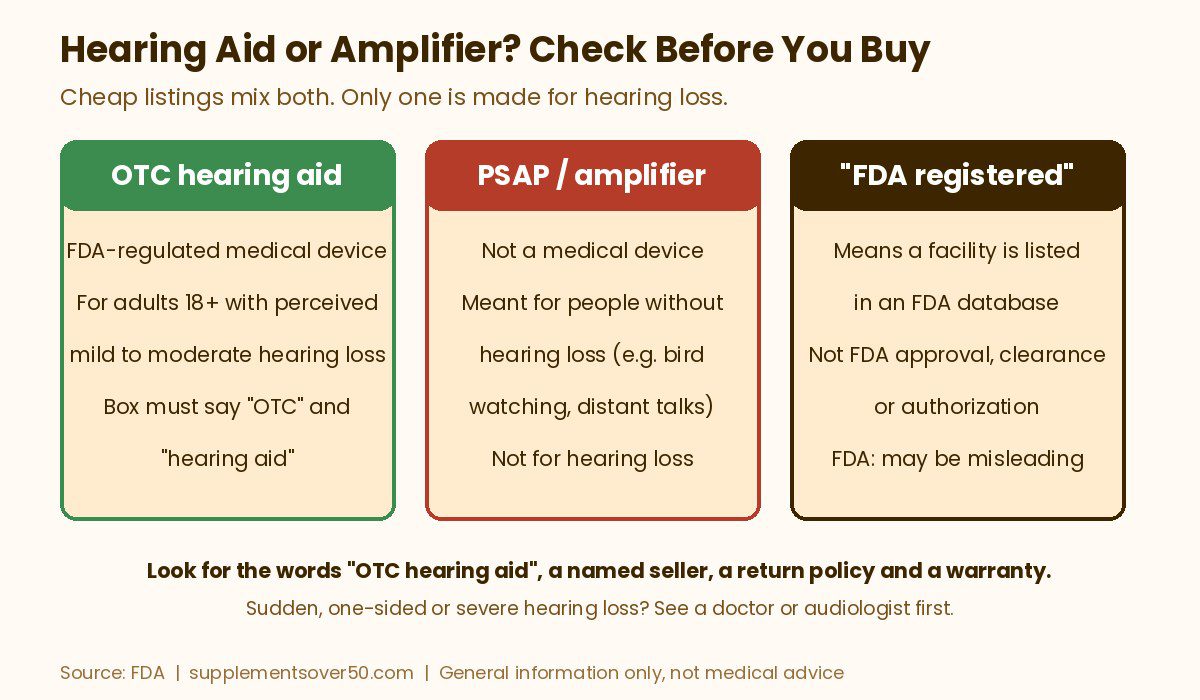
OTC hearing aids are medical devices
According to the FDA’s guide to OTC hearing aids, an OTC hearing aid is a medical device for adults 18 and older with perceived mild to moderate hearing loss. It must let you adjust and customize the settings to your hearing through tools, tests or software. The category includes simpler legacy models with volume control and preset programs, and self-fitting models that use a hearing test and an app to tune the sound. The FDA requires the words “OTC” and “hearing aid” to appear prominently on the package, along with warnings, the manufacturer’s return policy, battery details and whether you need a phone to control the device.
PSAPs and “hearing amplifiers” are not hearing aids
The FDA’s page on other hearing devices and products explains that personal sound amplification products (PSAPs) are meant to amplify sounds for people without hearing impairment, for example when bird watching, hunting or listening to a distant speaker. Unlike hearing aids, PSAPs are not intended to help with or compensate for hearing loss, and they are not medical devices. On Amazon, many of the cheapest results, some under $20, describe themselves as hearing amplifiers or sound enhancers, even when “hearing aids” appears in the listing title. If you have hearing loss, those are not what you want.
Why “FDA registered” can mislead
Many budget listings, including some of the picks below, use the phrase “FDA registered”. The FDA says this wording, along with “FDA certified” or an FDA logo on OTC hearing aid packaging, may be misleading. Its page on “FDA registered” and “FDA certified” devices explains that registration means a facility has listed itself and its devices in an FDA database, and it does not mean the FDA approved, cleared or authorized the company or its products. The FDA also does not issue registration certificates. So treat “FDA registered” as neutral at best. What you want to see is the device clearly labeled as an OTC hearing aid, sold by a brand that publishes its return policy and support details.
One more point from the FDA: its OTC hearing aid rules do not require manufacturers to offer a warranty. The FDA encourages buyers to understand the return or warranty period so they have time to try the device in different places and adjust to new sounds. With cheap hearing aids, that return window matters a lot.
What to Look for in the Best Affordable OTC Hearing Aids
The words “OTC hearing aid”. Check the title, the bullets and the box photos. If a device calls itself an amplifier, sound enhancer or PSAP, it is not an OTC hearing aid.
A real seller. Prefer listings sold by Amazon or by the brand’s own Amazon store, with a named warranty and US-based support. All five picks here are sold by the brand’s store.
Enough reviews to trust. Thousands of reviews give you a clearer picture than a few dozen. Hearing aid ratings run lower than for most electronics, so a 3.7 with thousands of reviews can be more informative than a 4.5 with 15.
Rechargeable or replaceable batteries. Most budget pairs are now rechargeable. Look at hours per charge and whether a portable case adds backup charges.
App or no app. No-app models with dials or a button are simpler for many seniors. App-based models can personalize the sound to a hearing check, which often sounds more natural.
Fit style. Behind-the-ear models are easier to handle and work well with larger fingers. In-canal models are more discreet but smaller to grip and clean.
Return window and warranty. Know how long you have to return them and what the warranty covers before you open the box.
Top Picks for the Best Cheap Hearing Aid Amazon Sells
To narrow down the best cheap hearing aid Amazon sells for most people over 50, we started with the best-selling OTC hearing aids under about $300, then dropped amplifiers, third-party resellers and listings with too little information. All five are labeled as OTC hearing aids for adults with mild to moderate hearing loss. Product details come from each Amazon listing, and ratings and review counts are from the listings on the day we checked. We have not worn or tested these devices.
1. EarCentric EasyCharge (Best Overall and Best Rechargeable)
EarCentric EasyCharge is our top pick at the budget end because it has the strongest rating of any budget pair we found with thousands of reviews: 4.2 out of 5 from over 6,500 reviews, with 800+ bought in the past month at the time of writing. It is a behind-the-ear (BTE) design with a simple volume control, several ear dome sizes, and both regular and long tubes, which the listing says helps with a comfortable fit even if you wear glasses.
The charging setup is the standout. The listing says one quick charge gives about 3 days of hearing, and the portable charging case holds 3 more charges, for up to 12 days in total. You get both a desktop dock for the nightstand and a portable case for travel, plus a USB-C cable, power adapter, domes, tubes and tools. EarCentric says its support team is US-based. At about $149 a pair at the time of writing, it is a sensible first hearing aid for someone who wants an easy-to-handle, rechargeable pair with no app to learn.
🏆 Best Overall
EarCentric EasyCharge
Behind-the-ear OTC hearing aids; about 3 days per charge and up to 12 days with the portable case; desktop dock plus travel case; US-based support.
2. Audien Atom One (Lowest Cost, Best No-App Pick)
Audien Atom One is the cheapest hearing aid we would consider, at about $78 a pair at the time of writing, and one of the best-selling, with 4K+ bought in the past month. It is aimed squarely at people who do not want an app: two small analog dials adjust volume and frequency, and you turn them until speech sounds clear. The aids switch on when you take them off the USB-C charging dock and off when you put them back, and the listing claims up to 24 hours per charge with about 3 hours to recharge.
The fit is a tiny in-ear design with small, medium and large domes, and either aid fits either ear. Each purchase includes Audien Sound Check, a free expert-guided setup session, plus a 1-year warranty, and the listing says it is FSA and HSA eligible. Be realistic about the trade-offs. The rating is a mixed 3.7 out of 5 from over 3,300 reviews, and the listing leans on “FDA-registered” wording, which, as explained above, says nothing about FDA review. With only volume and frequency dials, it cannot be tuned as precisely as an app-based model. Think of it as a low-cost way to find out whether hearing aids help you.
💵 Lowest Cost, No App
Audien Atom One
Tiny in-ear OTC hearing aids with separate volume and frequency dials; up to 24 hours per charge; free expert setup session; 1-year warranty.
If looks matter most, Audien Atom Pro 2 sits inside the ear canal and is Audien’s smallest in-canal design, according to the listing. A single button does everything: a quick press changes volume across 5 levels and a long press cycles through 4 listening modes (Conversation, Restaurant, TV and Outdoor), with each ear adjustable on its own. There is no app or phone needed.
The charging case runs a 5-minute UV-C light cycle each time you dock the aids and holds 3 extra charges, and the listing claims up to 24 hours of use per charge. Like the Atom One, it includes the Sound Check setup session, a 1-year warranty and FSA and HSA eligibility. It costs about $231 a pair at the time of writing, with 400+ bought in the past month. The rating is a mixed 3.7 out of 5 from over 3,800 reviews, and the listing again uses “FDA-registered” language, so weigh the reviews and keep the return window in mind. Very small aids are also harder to insert and clean if you have stiff fingers.
👁️ Most Discreet
Audien Atom Pro 2
In-canal OTC hearing aids; 4 listening modes and 5 volume levels on one button; UV-C cleaning case with 3 extra charges; 1-year warranty.
4. ELEHEAR Delight MW5 (Best With an App and Bluetooth)
Most budget hearing aids skip Bluetooth. ELEHEAR Delight MW5 is one of the few under $300 that includes it, at about $299 a pair at the time of writing. The listing describes an earbud-style design with a soft ear-wing fit for perceived mild to moderate hearing loss, VOCCLEAR AI processing that brings voices forward and reduces background noise, and an iOS and Android app for volume, noise control and sound focus. You can also stream music, movies and hands-free calls.
Battery life is shorter than the no-app picks: up to 13.5 hours per charge, with 2 extra charges from the case, and the aids are IP67 rated against sweat, dust and splashes. ELEHEAR also offers its ElePro remote audiologist care service. The catch is the small review base: 3.8 out of 5 from about 30 reviews, with 200+ bought in the past month when we checked. If you prefer a slightly better-rated sibling, the ELEHEAR Delight MW4 was the same price with 4.2 out of 5 from about 30 reviews. If you can stretch to about $400, the more established ELEHEAR Beyond is covered in our other hearing aid guides.
📱 Best With an App
ELEHEAR Delight MW5
Earbud-style OTC hearing aids with app control for iOS and Android; Bluetooth streaming and calls; AI noise reduction; IP67; remote audiologist service.
5. Cearvol Nano 2 (Best Personalized Fit Without Streaming)
Cearvol Nano 2 takes a middle path. You set it up once with a hearing check in the Cearvol app, which maps how you hear across frequencies and creates a custom “My Fit” profile, so the aids boost the sounds you miss instead of simply making everything louder. After that, you control volume, programs and 5 listening modes (Everywhere, Indoor, Outdoor, Restaurant and TV) from the charging case, so you do not need your phone every day.
The listing is upfront that Nano 2 does not support music streaming or phone calls. Each in-canal aid weighs about 2.4 g, battery life is up to 16 hours per charge and about 50 hours with the case, and the case adds UV cleaning. The app also offers masking sounds that the brand says may make ringing or buzzing less noticeable, while noting that this is not a treatment. It costs about $269 a pair at the time of writing and is rated 4.1 out of 5 from about 30 reviews, a small sample. One caution: the listing says it is designed for mild to moderately severe loss, but the FDA’s OTC category covers perceived mild to moderate loss only, so if your hearing is worse than that, see a professional.
🎯 Best Personalized Fit
Cearvol Nano 2
In-canal OTC hearing aids tuned by an app hearing check; daily control from the charging case; 5 listening modes; UV cleaning case; no streaming or calls.
A cheap hearing aid is not the right first step for everyone. The FDA’s OTC hearing aid labeling tells you to see a doctor, preferably an ear, nose and throat (ENT) specialist, if you:
Have worse hearing in one ear, or ringing or buzzing in only one ear.
Had a sudden change in hearing in the past 6 months, or hearing that gets worse and then better again.
Get really dizzy or have a spinning or swaying feeling (vertigo).
Have ear pain or discomfort, or saw blood, pus or fluid from your ear in the past 6 months.
Have a lot of earwax or think something could be in your ear.
Have an ear that was injured or has an unusual shape.
The FDA also says OTC hearing aids are not for severe or profound hearing loss, because their maximum output is limited. If you cannot hear speech even in a quiet room, or you do not hear loud sounds well, a licensed hearing professional can test you and discuss prescription options. And if a budget pair does not help after a fair trial, the FDA suggests seeing a hearing health care professional rather than just turning the volume up.
Frequently Asked Questions
Are cheap hearing aids on Amazon any good?
Some are. Budget pairs labeled as OTC hearing aids, sold by the brand, with a clear return policy and thousands of reviews, can help adults with mild to moderate hearing loss. Many of the cheapest listings are sound amplifiers, not hearing aids, and are not meant for hearing loss.
What is the difference between a hearing aid and a hearing amplifier?
The FDA regulates hearing aids, including OTC hearing aids, as medical devices for hearing loss. Personal sound amplification products (PSAPs) are meant to amplify sound for people without hearing loss, such as when bird watching, and are not medical devices.
Does FDA registered mean a hearing aid is FDA approved?
No. The FDA says FDA registered means a facility has listed itself and its devices in an FDA database. It does not mean the FDA approved, cleared or authorized the device, and the FDA does not issue registration certificates. Look for clear OTC hearing aid labeling instead.
What is the cheapest real hearing aid on Amazon?
Among OTC hearing aids with a large number of reviews, Audien Atom One was about $78 a pair at the time of writing. Prices change often, so check the current price, and make sure any cheaper device is labeled as an OTC hearing aid rather than an amplifier.
Are rechargeable hearing aids better for seniors?
For many seniors, yes. Rechargeable hearing aids avoid handling tiny batteries. EarCentric EasyCharge, for example, lists about 3 days per charge and up to 12 days with its portable case. Check hours per charge and how easy the case is to open.
Can I use FSA or HSA money for cheap hearing aids?
Often, yes. The Audien Atom One and Atom Pro 2 listings say they are FSA and HSA eligible. Check the listing and your plan’s rules, and keep your receipt for reimbursement.
Our Take
The best cheap hearing aid Amazon sells is not the cheapest one in the search results. You do not need to spend thousands to try hearing aids, but you do need to shop carefully. The best cheap hearing aids on Amazon are clearly labeled OTC hearing aids from a brand that stands behind them, not the $15 amplifiers that crowd the search results. EarCentric EasyCharge is our top budget pick for its strong rating and long battery life. Audien Atom One is the lowest-cost pair worth considering and the simplest to use with no app. Audien Atom Pro 2 is the discreet choice, ELEHEAR Delight MW5 adds an app and Bluetooth, and Cearvol Nano 2 gives you a personalized fit without streaming. Ignore “FDA registered” claims, read the return policy before you open the box, and see a professional if your hearing loss is sudden, one-sided or more than moderate.
This article is for general information only and is not medical advice. OTC hearing aids are intended for adults 18 and older with perceived mild to moderate hearing loss. Prices, ratings and stock change often, so confirm details on the listing before you buy, and talk to a doctor or licensed hearing professional about sudden, one-sided or severe hearing changes.
Our Medical Guardian reviews roundup covers every device, fall detection, monitoring, cost per month, fees, contract and cancellation terms, and alternatives.
Sleep tracker for seniors picks: Apple Watch SE 3, Fitbit, Oura and RingConn compared on comfort, battery, subscriptions and what trackers cannot tell you.
AARP medical alert systems explained: the Lifeline and IRIS Ally member discounts, how to claim them, what AARP endorses, and cheaper non-AARP options.
The best medical alert systems for seniors compared: Bay Alarm Medical, Medical Guardian, LifeFone, MedicalAlert and 2 Amazon options, with fall detection and contract terms.
Our ADT medical alert review covers On-The-Go and Medical Alert Plus, fall detection, real monthly costs, contract terms, customer reviews and better alternatives.