This guide contains affiliate links. If you buy through them, we may earn a small commission at no extra cost to you.
We have not tested these devices ourselves. This guide compiles each brand’s published specs and plan terms, AARP’s own benefit pages, CDC falls data, and patterns in verified buyer reviews.
⚡ Quick Answer
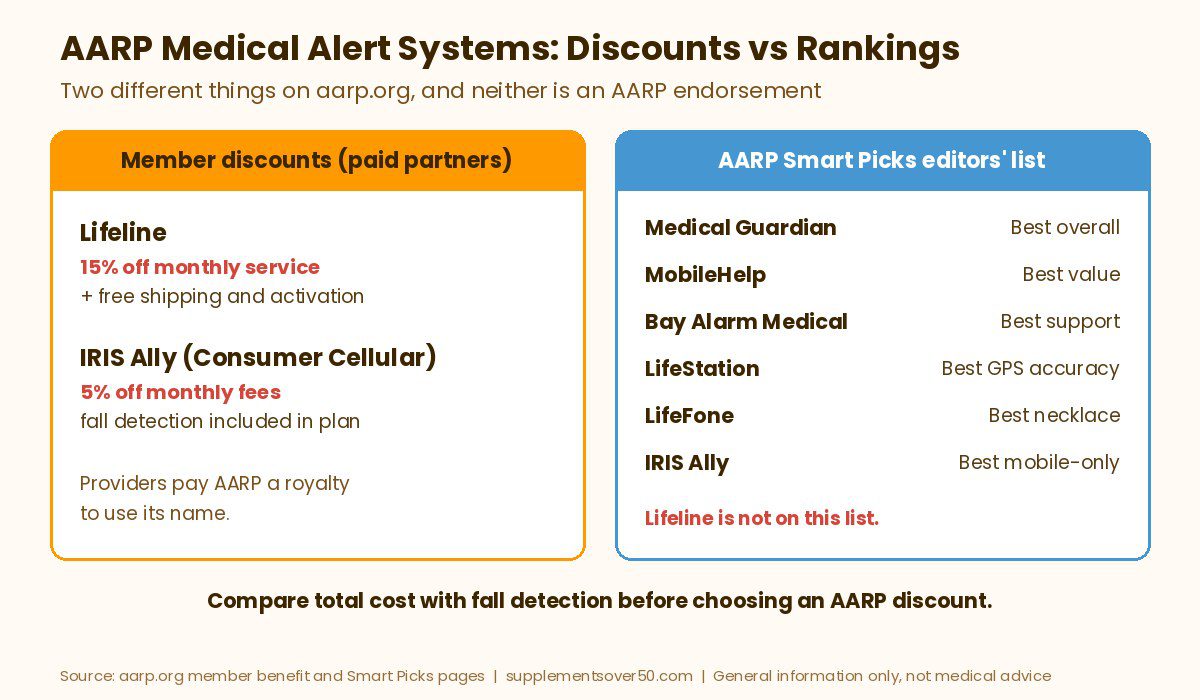
AARP does not endorse a medical alert company, but members get two discounts: Lifeline (15% off monthly service plus free shipping and activation) and IRIS Ally from Consumer Cellular (5% off monthly fees). Our picks:
Lifeline with the AARP discount: best if you want a home system from a long-established brand.
IRIS Ally: best low-cost mobile option, with fall detection included in the plan.
LifeFone: often cheaper than discounted Lifeline once fall detection is added, with a 30-day money-back guarantee.
Bay Alarm Medical: best for low starting rates and a smartwatch option.
AARP medical alert systems are not a product AARP makes or monitors. What AARP offers is a pair of member discounts with outside companies, plus a separate editorial team that reviews medical alert brands. People mix those up all the time, which is why searches like “AARP recommended medical alert systems” and “AARP approved medical alert systems” are so common.
This guide to AARP medical alert systems sorts it out. We cover which providers give AARP members a discount right now, exactly what each discount is, how to claim it, and whether AARP endorses either one. Then we run the numbers against non-AARP brands such as LifeFone, Bay Alarm Medical, MedicalAlert and ADT, because a 15% discount on a higher price is not always the best deal. Every figure comes from AARP’s benefit pages and each brand’s own site at the time of writing.
Table of Contents
AARP Medical Alert Systems: What Members Actually Get
15% off monthly medical alert service, plus free shipping and free activation
Online through Lifeline’s AARP page, or by phone with your AARP membership number
Not combined with other offers; other fees may apply; a minimum stay on service may be required
IRIS Ally from Consumer Cellular
5% off monthly subscription fees
Enter or mention your AARP membership number; also by phone or in Consumer Cellular stores
Offer may not be available at all store locations; no long-term contracts
Both AARP pages carry the same disclosure: AARP commercial member benefits are provided by third parties, and providers pay a royalty fee to AARP for the use of its intellectual property. In other words, these companies pay to use the AARP name. That does not make the offers bad, but it does mean the discount is a marketing arrangement, not a seal of approval. You can read the details on AARP’s Lifeline benefit page and IRIS Ally benefit page.
Does AARP Endorse or Recommend a Medical Alert System?
No, not in the sense most people mean, even though many sites describe AARP medical alert systems as approved or recommended. Here is what we found on the AARP pages we opened:
The member discounts are paid partnerships. Lifeline and Consumer Cellular pay AARP a royalty, as stated in the disclosures above.
AARP’s editors do rank medical alert systems. The AARP Smart Picks team publishes a best medical alert systems guide based on its own testing with older testers. Its current picks are Medical Guardian (best overall), MobileHelp (best value), Bay Alarm Medical (best customer support), LifeStation (best GPS accuracy), LifeFone (best necklace) and IRIS Ally (best mobile-only).
Those rankings are not endorsements either. The same page says brand references do not imply endorsement by AARP and that AARP may earn commissions from affiliate links. It also discloses that Consumer Cellular pays AARP a royalty, and says that relationship does not influence the review.
One detail stands out: Lifeline, the company with the bigger AARP member discount, is not on AARP’s own Smart Picks list. IRIS Ally is the only brand that appears both as a member discount and as an editorial pick. So if you see a site calling a product “AARP approved” or “AARP endorsed,” treat that as marketing language. The honest version is “AARP members get a discount” or “AARP’s review team rated it highly.”
Why a Medical Alert Matters After 50
Falls are the main reason families shop for a medical alert. The CDC’s Facts About Older Adult Falls page says more than one in four adults 65 and older falls each year, but less than half tell their doctor, and falling once doubles the chance of falling again. CDC counts about 4.5 million emergency department visits a year from falls in older adults, with 1.4 million hospitalizations, and notes that falls are the most common cause of traumatic brain injuries in this age group.
A medical alert system does not prevent a fall. It shortens the time between a fall and help arriving, which matters most for someone who lives alone. You press a button, or a fall sensor sends the alert for you, and a monitoring center agent talks to you over two-way voice and calls family or emergency services. Whether you buy through an AARP discount or not, that basic service is the same idea across brands. What changes is price, devices, fees and contract terms.
Lifeline AARP Discount: How It Works
Lifeline is the former Philips Lifeline, now owned by Connect America (Lifeline’s about page says Connect America acquired it, with Philips keeping an equity stake). Lifeline sells three main systems, and its product pages list these starting rates on an annual plan at the time of writing:
Lifeline system
Type
Listed starting rate
With 15% AARP discount (our math)
HomeSafe
In-home, no landline needed
About $34.95/mo
About $29.71/mo
On the Go
Mobile with GPS
About $39.95/mo
About $33.96/mo
On the Go Mini
Smaller mobile, pendant or wristband
About $44.95/mo
About $38.21/mo
The discounted figures are our own calculation of 15% off the listed rate, since the AARP disclosure says the discount is based on the service pricing published on lifeline.com. Lifeline also sells a smartwatch, but its pricing involves a separate device fee, so ask for an exact quote. Check current pricing before you order.
Two costs deserve a closer look. Fall detection is an extra $15 a month on Lifeline, according to its fall detection page, and the AARP page does not say whether the 15% applies to that add-on. Lifeline’s pricing page also describes its standard setup fee as a $50 activation fee plus a $49.95 programming fee. The AARP offer waives activation and shipping, and Lifeline’s AARP page says members can save over $80, but neither page we read says the programming fee is waived. Ask the sales agent to confirm the total due at checkout.
Finally, read the contract. Lifeline’s subscriber terms include a non-refundable three-month minimum, a $35 restocking fee, a non-refundable programming fee and a lost unit fee of up to $400 if equipment is not returned. The AARP disclosure also warns that a minimum stay on service may be required. None of that is unusual in this industry, but it is stricter than brands that let you cancel any time.
BEST FOR AARP MEMBERS WHO WANT A HOME SYSTEM
Lifeline (AARP member discount)
15% off monthly service plus free shipping and activation for AARP members, per AARP and Lifeline. In-home and GPS mobile systems with an optional fall detection add-on and a caregiver app.
The IRIS Ally is a mobile medical alert from Consumer Cellular, the wireless carrier that markets heavily to older adults. It is a small device you wear on a lanyard or a belt clip, and it runs on Consumer Cellular’s network rather than a home base station. Consumer Cellular’s page advertises plans “for as low as $25/month,” and the company’s blog says automatic fall detection is built into that monthly plan at no extra charge.
With the 5% AARP discount, a $25 plan works out to about $23.75 a month by our math. AARP’s Smart Picks review lists a one-time equipment fee of about $99.99 for a new device, or about $80.99 for a certified refurbished one. Consumer Cellular’s fine print says new service is activated on approved credit, that emergency response is provided by an independent company called Viiz Communications, and that the device is not designed to be submerged.
The trade-offs are clear. There is no in-home base station and no caregiver app, according to AARP’s review, and the device needs charging every few days (AARP’s testers reported about three days of battery life). If your parent rarely leaves home and hates charging things, a base station system may suit them better. If they are active and want fall detection without an extra monthly fee, IRIS Ally is one of the lowest-cost options we have seen.
BEST LOW-COST MOBILE OPTION WITH AARP DISCOUNT
IRIS Ally by Consumer Cellular
GPS mobile medical alert worn on a lanyard or belt clip, with automatic fall detection included in the monthly plan and 5% off monthly fees for AARP members.
Claiming the discount on AARP medical alert systems is simple, but small details trip people up:
Have your AARP membership active first. AARP’s site advertises membership for $15 a year with automatic renewal at the time of writing. If you or your parent is not a member, add that cost when comparing.
For Lifeline online: go to Lifeline’s AARP member page from AARP’s benefit page, enter the email address linked to your AARP membership to verify it, then continue to checkout with the discount applied.
For Lifeline by phone: AARP’s page lists 1-855-345-0130. Mention your AARP membership number when you call.
For IRIS Ally: enter or mention your AARP membership number when ordering, call 1-888-766-0824, or visit a Consumer Cellular store (AARP notes the offer may not be honored at every location).
Existing Lifeline customers: AARP’s disclosure says the 15% applies to your current monthly price going forward and is not retroactive, so call and ask for it.
Do not stack expectations. The Lifeline discount cannot be combined with other offers, so compare the AARP price with any public promotion and take whichever is lower.
AARP Medical Alert Systems vs Cheaper Non-AARP Options
A discount only matters if the final price beats the competition, and AARP medical alert systems are no exception. Here is how the AARP offers compare with four well-known brands, using each brand’s own pricing at the time of writing. Rates often depend on billing term, so check current pricing before you buy.
Brand
AARP discount?
Starting monthly rate
Fall detection
Upfront costs to ask about
Lifeline
Yes, 15% off service
About $29.71 after discount (HomeSafe, annual plan)
+$15/mo
Programming fee; activation waived for AARP
IRIS Ally
Yes, 5% off
About $23.75 after discount (mobile)
Included
Device about $99.99 (refurbished about $80.99)
LifeFone
No
From about $24.95 (at-home landline, annual plan)
+$5/mo
No activation or equipment fees, per LifeFone
Bay Alarm Medical
No
From about $27.95 (home landline)
+$10/mo (home cellular adds a $30 button fee)
Device purchase about $149 for mobile, $199 for smartwatch
MedicalAlert
No
From about $29.95
Optional add-on
Ask for the full quote
ADT Health
No
About $37.99 to $39.99 (Medical Alert Plus)
+$11/mo
Activation about $99 unless a prepaid promo waives it
The pattern is easy to see. Without fall detection, the discounted Lifeline HomeSafe lands in the same range as the cheapest non-AARP plans. Add fall detection, and Lifeline’s $15 add-on pushes it to roughly $45 a month, while LifeFone’s at-home plan with fall detection starts closer to $30. For a mobile device with fall detection, IRIS Ally is cheaper than most competitors month to month, though you pay for the device up front.
One more thing most shoppers miss: MedicalAlert is also a Connect America brand, the same parent company as Lifeline, according to Connect America’s own site. Comparing the two is less about different companies and more about different pricing and promotions under one roof.
Top Non-AARP Medical Alert Picks
1. LifeFone (Best Value With Fall Detection)
LifeFone is the brand we would price first against the Lifeline AARP offer. Its at-home landline plan starts at about $24.95 a month on an annual plan, fall detection is only $5 more per month, and its site lists no activation or equipment fees. It also advertises a 30-day money-back guarantee, a price lock for life, free protection for a spouse on basic at-home service, and cancellation at any time with payment only for the time used.
Its VIP Active mobile pendant starts at about $37.95 a month on an annual plan, with up to five days of battery life per LifeFone’s product page. AARP’s own Smart Picks team named LifeFone its best necklace pick, which is a nice independent signal even though LifeFone has no AARP discount.
BEST VALUE WITH FALL DETECTION
LifeFone
At-home and mobile medical alerts with low-cost optional fall detection, no activation or equipment fees, and a 30-day money-back guarantee, per LifeFone.
2. Bay Alarm Medical (Best for Low Starting Rates)
Bay Alarm Medical starts at about $27.95 a month for its landline home system and about $34.95 for home cellular. Mobile devices such as the SOS All-In-One 2 and SOS Micro are about $34.95 a month, and the SOS Smartwatch is about $39.95, with fall detection versions about $10 more. The catch is equipment: its pricing page lists a device purchase of about $149 for the mobile units and $199 for the smartwatch, sometimes discounted.
Bay Alarm is one of the few brands with a true smartwatch option, and AARP’s Smart Picks team rated it best for customer support. If your parent would rather wear a watch than a pendant, start here.
BEST FOR LOW STARTING RATES
Bay Alarm Medical
Landline and cellular home systems, GPS mobile devices and an SOS smartwatch, with optional fall detection on most systems, per Bay Alarm Medical.
MedicalAlert lists systems starting at about $29.95 a month, with home, mobile and smartwatch options. Its FAQ says response center operators can use a language line for real-time translation in 140 languages, which helps if your parent is more comfortable in another language. Because it shares a parent company with Lifeline, compare its public promotions directly against the Lifeline AARP price and take the lower total.
BEST FOR LANGUAGE SUPPORT
MedicalAlert
Home, mobile and smartwatch systems with 24/7 monitoring and real-time translation in 140 languages, per MedicalAlert.
ADT sells two medical alert packages online: the On-The-Go mobile device and the Medical Alert Plus home system. Plus runs about $39.99 a month on monthly billing or $37.99 prepaid, fall detection adds about $11, and activation is about $99 unless you prepay under a promotion. ADT’s terms describe a month-to-month agreement with no termination fees. It is pricier than LifeFone or Bay Alarm, but ADT’s FAQ mentions loyalty discounts for existing ADT Security customers.
BEST FOR EXISTING ADT CUSTOMERS
ADT Health Medical Alert
In-home and mobile medical alerts with optional fall detection, 24/7 monitoring and an included protection plan, per ADT.
AARP’s top-ranked brand, Medical Guardian, is also worth a look if you want a polished caregiver app, though AARP’s review notes it has some of the highest starting monthly costs on its list. Medical Guardian has no AARP member discount.
How to Choose Between AARP and Non-AARP Medical Alert Systems
If you want a home system from an established name and you are already an AARP member, get a Lifeline quote with the AARP discount, then confirm the programming fee and the three-month minimum.
If your parent is active and needs fall detection on a budget, IRIS Ally with the AARP discount is hard to beat month to month.
If fall detection at home is the priority, price LifeFone before Lifeline. Its $5 add-on usually beats Lifeline’s $15.
If your parent wants a watch, not a pendant, look at Bay Alarm Medical’s SOS Smartwatch.
If you would have to join AARP just for the discount, add the membership cost and compare again. The savings may be smaller than they look.
Whatever you choose, ask every company the same five questions: the total due on day one, the monthly rate after any promotion ends, the fall detection price, the minimum term, and how returns and refunds work if it is not a fit. For more on choosing a device, see our guide to the best fall detection devices for seniors. If your parent also juggles several prescriptions, our roundup of the best medication reminders for seniors pairs well with a medical alert, and our list of thoughtful gifts for aging parents has more safety ideas.
Does Medicare Cover AARP Medical Alert Systems?
Usually not, and AARP medical alert systems are treated like any other brand. According to the National Council on Aging, Original Medicare (Parts A and B) does not pay for medical alert systems, though some Medicare Advantage plans cover part or all of the cost. If you have a Medicare Advantage plan, call the plan and ask whether a medical alert is a covered benefit before you pay out of pocket. Some brands, including Lifeline, also work with health plans directly.
Who These Systems Are Not Right For
People who will not wear the button. A device in a drawer cannot call for help. Involve your parent in choosing the style.
Anyone who will not charge a mobile device. IRIS Ally and other mobile units need regular charging; a home base station is more forgiving.
Homes with poor cell coverage. Check the network coverage before choosing a cellular or mobile system, or pick a landline model.
People with advanced memory loss. Someone who forgets what the button is for may need in-person care or other monitoring.
Anyone expecting fall prevention. A medical alert summons help. Strength and balance work, a medication review and removing tripping hazards still matter most.
If your parent has fallen and hit their head, CDC advises seeing a doctor right away, especially for people taking blood thinners.
Frequently Asked Questions
Which medical alert systems does AARP offer discounts on?
At the time of writing, AARP’s member benefits list two: Lifeline Medical Alert Service (15% off monthly service plus free shipping and activation) and the IRIS Ally from Consumer Cellular (5% off monthly subscription fees). Offers can change, so check AARP’s benefits page.
Does AARP recommend or endorse a medical alert system?
No. AARP’s member benefits are provided by third parties that pay AARP a royalty, and AARP’s Smart Picks review page says brand references do not imply endorsement by AARP. AARP’s editors do rank brands, with Medical Guardian named best overall in their current guide.
How do I get the AARP discount on Lifeline?
Go to Lifeline’s AARP member page and enter the email linked to your AARP membership to verify it, then check out. You can also call the number on AARP’s benefit page and give your membership number. Existing customers can ask for the discount, but it is not retroactive.
Is the AARP Lifeline discount worth it?
It can be, especially for a home system without fall detection, where the discounted rate is close to the cheapest brands. With fall detection added at $15 a month, brands like LifeFone are often cheaper. Also confirm the programming fee and Lifeline’s three-month minimum.
Are AARP medical alert systems covered by Medicare?
Original Medicare does not cover medical alert systems, according to the National Council on Aging. Some Medicare Advantage plans cover part or all of the cost, so ask your plan directly.
What is the cheapest medical alert with fall detection?
Among the brands we compared, IRIS Ally includes fall detection in a plan advertised from $25 a month (about $23.75 with the AARP discount), plus a one-time device fee. For a home system, LifeFone’s $5 fall detection add-on keeps its total low. Check current pricing.
Our Take
AARP medical alert systems are really two member discounts and an editorial review page, not an AARP product. The Lifeline discount is worthwhile for members who want a home system and do not need fall detection, as long as you confirm the setup fees and accept the three-month minimum. IRIS Ally is the standout value for active people who want fall detection included. But the AARP label alone should not decide it: LifeFone and Bay Alarm Medical often cost the same or less without any membership, and AARP’s own editors rank several non-discount brands above Lifeline. Get two or three quotes, compare the total first-year cost, and choose the device your parent will actually wear.
This article is for general information only and is not medical advice. Medical alert systems do not prevent falls, and fall detection does not detect every fall. Prices, discounts and plan terms were taken from AARP’s and each brand’s websites at the time of writing and may change. Talk to a doctor about fall risk and call 911 in an emergency.
Our ADT medical alert review covers On-The-Go and Medical Alert Plus, fall detection, real monthly costs, contract terms, customer reviews and better alternatives.
Fall detection for seniors living alone: compare Apple Watch SE 3, Galaxy Watch9, help buttons and medical alert services, plus fees, range and battery tips.
Looking for a smart watch for seniors with fall detection? We compare Apple, Samsung, Pixel and monitored medical alert watches: who they call, cost and battery.