This guide contains affiliate links. If you buy through them, we may earn a small commission at no extra cost to you.
We have not tested these devices ourselves. This guide compiles each brand’s published specs and plan terms, FDA and NIDCD guidance, and patterns in verified buyer reviews.
⚡ Quick Answer
For most people with small or narrow ear canals, a receiver-in-canal (RIC) hearing aid with a small dome fits better than a tiny in-canal model. Our top pick is Jabra Enhance Select M2 Swift (best overall fit kit). Also worth a look: Sennheiser All-Day Clear (slim RIC with small, medium and large tips), ELEHEAR Beyond (best value RIC), EarCentric EasyCharge (best budget behind-the-ear) and Jabra Enhance Select direct (best if you want an audiology team to help with fit).
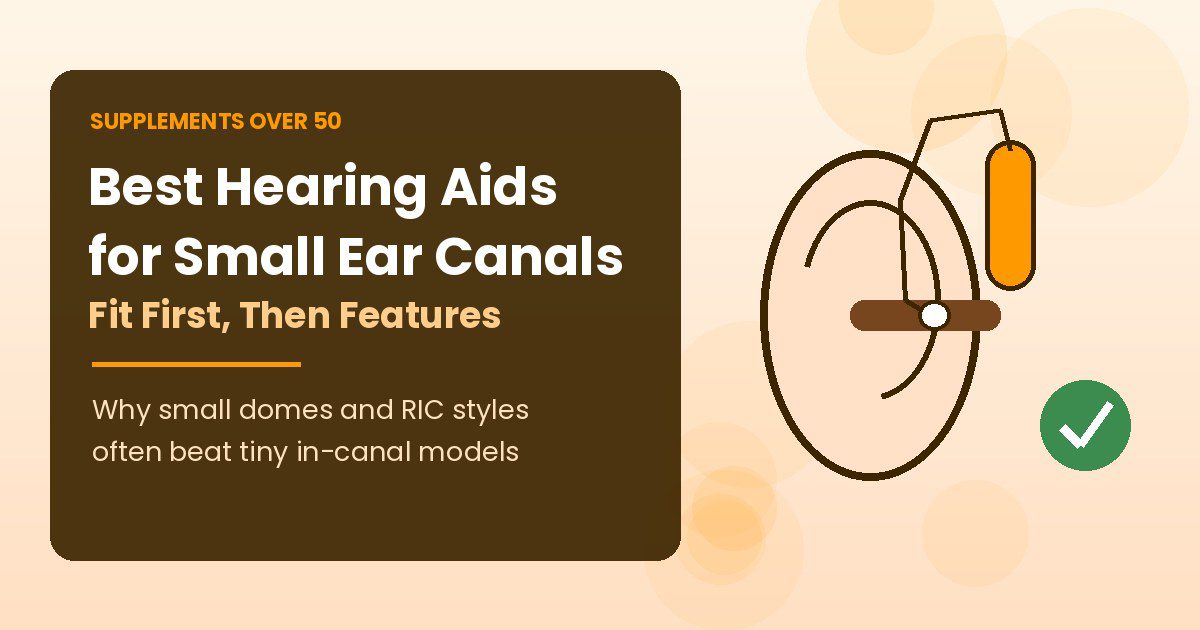
If you have tried hearing aids before and they hurt, popped out or whistled, the problem may not be your hearing. It may be your ear canal. Finding the best hearing aid for small ear canals is mostly a fit question, and the answer surprises a lot of people: the smallest hearing aid is often the wrong choice for a small canal.
Tiny in-canal hearing aids have to squeeze the whole device, battery and speaker included, into the canal itself. A narrow or sharply curved canal leaves little room for that. Hearing aids that sit behind the ear and send sound down a thin wire or tube only need to fit a soft dome into your canal, and domes come in sizes. This guide explains why that matters, what to look for in the kit before you buy, and five options for small ear canal hearing aids, from about $149 to about $1,995 a pair at the time of writing. Prices appear in the text and table only, so check current pricing before you buy.
Table of Contents
Best Hearing Aid for Small Ear Canals: Quick Comparison
Approximate prices per pair at the time of writing. Ratings and review counts are from each Amazon listing on the day we checked.
Mini RIC, about 2.12 g per aid; kit includes ear measurement tools and domes
About $999
4.7 (23 reviews)
Sennheiser All-Day Clear
Slim RIC with sized tips
RIC; 8 ear tips in small, medium and large in the box
About $899.95
3.7 (138 reviews)
ELEHEAR Beyond
Best value RIC
RIC; multiple dome sizes included
About $399
4.0 (700+ reviews)
EarCentric EasyCharge
Best budget behind-the-ear
BTE with thin tube; multiple domes plus regular and long tubes
About $149
4.2 (6,600 reviews)
Jabra Enhance Select (direct)
Best with audiology help
RIC; 3 years of audiology appointments and adjustments included
About $1,195 to $1,995
Not sold on Amazon this way
Why Small Ear Canals Change the Hearing Aid Choice After 50
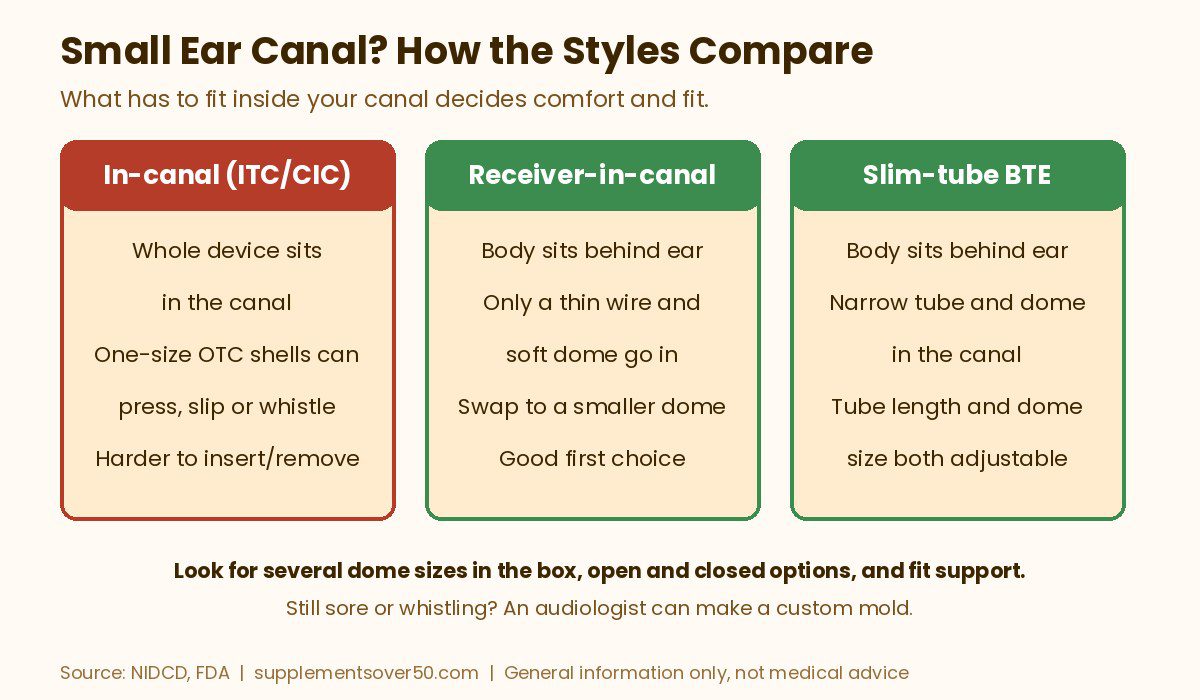
The National Institute on Deafness and Other Communication Disorders (NIDCD) describes three basic hearing aid styles in its guide to hearing aid styles. Behind-the-ear (BTE) aids keep the electronics in a case behind the ear and send sound into the ear. A newer open-fit version fits behind the ear with only a narrow tube in the ear canal, leaving the canal open. In-the-ear (ITE) aids fill the outer ear. Canal aids, called in-the-canal (ITC) and completely-in-canal (CIC), sit inside the canal itself.
NIDCD notes that because canal aids are small, they may be difficult to adjust and remove, and they have less space for batteries and extras. That is the core problem for small and narrow canals. A CIC or ITC device has to fit its whole body into the canal, so if your canal is tight or bends sharply, an off-the-shelf in-canal model may press on the canal wall, sit at an angle, or never seat deep enough to stay put. Prescription in-canal aids are made to the shape of your canal from an impression, which is why they can work. Most OTC in-canal models come in one shell size with a few rubber tips.
Receiver-in-canal (RIC) and slim-tube BTE hearing aids avoid most of this. The case and battery ride behind the ear, and only a thin wire or tube with a soft dome goes into the canal. Swapping to a smaller dome is the main adjustment, and it costs nothing if the right size is in the box. That is why, for most people asking about hearing aids for narrow ear canals, we point to RIC or slim BTE styles first.
Fit also matters more as we age. Hearing loss is common after 50, and many people start with an over-the-counter (OTC) pair. Hands may be less nimble, and earwax can build up more easily. NIDCD says open-fit aids may be a good choice for people who get earwax buildup, since they are less likely to be damaged by it. A behind-the-ear body is also easier to grip than a tiny in-canal shell.
What OTC Hearing Aids Are and Who They Are For
Every hearing aid in this guide is sold as an OTC hearing aid. According to the FDA’s guide to OTC hearing aids, this category is for adults 18 and older with perceived mild to moderate hearing loss, and you can buy them without an exam, prescription or fitting appointment. The FDA estimates close to 30 million U.S. adults have some degree of hearing loss, yet only about one-fifth of those who could benefit from a hearing aid seek help.
The same FDA page lists reasons to see a doctor, preferably an ear, nose and throat (ENT) specialist, before using OTC hearing aids. Two are directly relevant here: if your ear has a birth defect or an unusual shape, or if your ear was injured or deformed in an accident. A canal that is simply on the small side is common and usually not a medical issue, but if your canal is unusually narrow, very curved, or you have had ear surgery, get it checked first.
Signs a Hearing Aid Does Not Fit Your Ear Canal
Whistling or feedback. NIDCD says a whistling sound can come from a hearing aid that does not fit or work well, or one clogged by earwax or fluid. A dome that is too small can leak sound back to the microphone, while one that is too big may never seat properly.
Soreness or pressure. Some mild discomfort is normal at first, according to NIDCD. Pain, red spots or soreness that does not settle means the dome or shell is too large or sitting at the wrong angle.
The aid keeps working its way out. Talking and chewing move the canal. An in-canal shell that is too big for a narrow canal often backs out during meals.
Your own voice sounds plugged up. NIDCD calls this the occlusion effect and says it is very common in new users. A more open dome often helps, as long as your hearing loss allows it.
It is hard to insert or remove. NIDCD flags this as a known drawback of small canal aids, especially if you have stiff fingers.
Buyer reviews of OTC hearing aids show the same pattern. On the EarCentric listing, for example, one reviewer described being sent different domes by the brand and finding that a small solid dome worked much better than the ones they tried first. Expect some trial and error with dome sizes, and choose a kit that gives you options.
What to Look for in Hearing Aids for Narrow Ear Canals
RIC or slim-tube BTE style. Only a dome goes into the canal, so size changes are easy and cheap.
Several dome sizes in the box. Read the “what’s included” list. Look for small or extra-small domes, not just one size. If a listing only says “multiple domes”, ask the brand which sizes are included.
Open and closed dome options. Open domes feel less plugged up. Closed or power domes seal better and boost more low sounds. Having both lets you balance comfort and sound.
A way to measure your ear. Some kits include ear measurement tools or a sizing guide, which takes the guesswork out of picking a wire length or dome size.
Support that helps with fit. A brand that will mail you different domes, or an audiology team you can talk to, is worth more than an extra feature you will never use.
A real return window. The FDA does not require OTC hearing aid makers to offer a warranty, so read the return policy. You need time to try a few dome sizes.
The words “OTC hearing aid”. Skip devices sold as amplifiers or sound enhancers if you have hearing loss.
Top Picks for the Best Hearing Aid for Small Ear Canals
We started with best-selling OTC hearing aids on Amazon and on brand sites, kept RIC and slim BTE models whose listings or brand pages state more than one dome or tip size, and dropped tiny one-size in-canal models and amplifiers. Ratings and review counts are from each listing on the day we checked. We have not worn or tested these devices. We also left out Eargo: Eargo’s own site posts a notice that its parent company is winding down, and support and its app have ended.
1. Jabra Enhance Select M2 Swift (Best Overall Fit Kit)
Jabra Enhance Select M2 Swift is our top pick for small ear canals because it combines a very small RIC body with a kit built around getting the fit right. The listing describes a “mini” design weighing about 2.12 grams per aid, and Amazon’s product details say the kit includes ear measurement tools, microphone and wax filters, and domes for a personalized fit. One verified buyer counted six different sizes and shapes of domes in the box. That range is exactly what you want when a standard medium dome feels too big.
It is sold by Amazon, rated 4.7 out of 5 from 23 reviews (a small sample), with 100+ bought in the past month when we checked. You set it up yourself with Jabra’s FDA-cleared self-fitting hearing test in the app. The listing also mentions hands-free calls, Bluetooth streaming, Bluetooth LE Audio and Auracast support, over 24 hours per charge with a portable charger, and an IP68 rating. It cost about $999 a pair at the time of writing.
🏆 Best Overall Fit Kit
Jabra Enhance Select M2 Swift
Mini receiver-in-canal OTC hearing aids; kit includes ear measurement tools and domes for a personalized fit; app-based self-fitting; Bluetooth calls and streaming.
2. Sennheiser All-Day Clear (Slim RIC With Sized Tips)
Sennheiser All-Day Clear uses what the listing calls a modern take on the classic receiver-in-the-canal design, with an emphasis on all-day comfort and a discreet fit. For small canals, the important detail is in the box contents: 8 ear tips in small, medium and large, along with wax guards and a cleaning brush. Starting with the small tips is easy, and you are not stuck with one size.
Setup is done in the app with personalization options and no appointment required. The listing mentions Bluetooth calls and streaming for iOS and Android, up to 24 hours of use per charge depending on usage, and a 30-day risk-free trial. It is sold by Sennheiser’s own store and cost about $899.95 a pair at the time of writing. Be aware of the mixed rating: 3.7 out of 5 from 138 reviews, with 50+ bought in the past month. Use the 30-day trial to test the fit properly.
👂 Slim RIC With Sized Tips
Sennheiser All-Day Clear
Receiver-in-canal OTC hearing aids with 8 ear tips in small, medium and large; app setup without an appointment; Bluetooth calls and streaming; 30-day trial.
ELEHEAR Beyond is the most affordable RIC hearing aid here with a sizable review base: 4.0 out of 5 from over 700 reviews, with 500+ bought in the past month when we checked. The listing describes a lightweight receiver-in-the-canal design and says multiple dome sizes are included to fit ears of all sizes. The aids turn on and off automatically when you take them out of or put them back in the case.
The listing describes maximum gain of up to 50 dB with up to 24 dB of noise attenuation, an iOS and Android app, Bluetooth, up to 20 hours per charge and a total of about 100 hours with the case. ELEHEAR also offers its ElePro remote audiologist care service, which is useful if you want help deciding between dome sizes. It is sold by ELEHEAR and cost about $399 a pair at the time of writing.
💰 Best Value RIC
ELEHEAR Beyond
Receiver-in-canal OTC hearing aids with multiple dome sizes; app control and Bluetooth; up to 20 hours per charge; remote audiologist care service.
EarCentric EasyCharge is a behind-the-ear hearing aid with a thin tube into the canal, and it has the strongest rating of any pick here: 4.2 out of 5 from about 6,600 reviews, with 800+ bought in the past month. The listing says multiple ear domes and both regular and long tubes help you find a comfortable fit, even if you wear glasses. Tube length matters more than people expect. A tube that is too short pulls the dome out of the canal, and one that is too long lets it sit crooked.
There is no app, just a simple volume control, which suits people who want something easy. EarCentric lists about 3 days per charge, up to 12 days with the portable case, and a desktop dock for the nightstand. The brand says its support team is US-based, and as noted above, at least one reviewer reported that the brand sent different domes to try. It cost about $149 a pair at the time of writing.
💵 Best Budget BTE
EarCentric EasyCharge
Behind-the-ear OTC hearing aids with a thin tube; multiple domes plus regular and long tubes; about 3 days per charge; no app needed.
5. Jabra Enhance Select, Bought Direct (Best With Audiology Help)
If you have struggled with fit before, buying Jabra Enhance Select direct from Jabra Enhance adds the one thing an Amazon box cannot: people to help. Jabra Enhance says its direct packages include 3 years of unlimited appointments and adjustments with its audiology team, a 100-day risk-free trial with a full refund if you are not satisfied, a 3-year warranty, and free shipping and returns. Its homepage says customers rate Enhance Select 4.5 out of 5 across about 5,400 reviews.
On the Jabra Enhance product page, the Select M3, which Jabra calls its smallest, was listed at about $1,995 a pair at the time of writing, the M2 at about $1,695, and the M1 package from about $1,195, with financing available. That is more than the Amazon Swift version, so it makes sense mainly if you want ongoing professional help with dome choice and settings. If your canals are very small and nothing has worked, a clinic visit for a custom mold may still be the better route (see below).
Best if you want audiology help with fit
Jabra Enhance Select M3 (on Amazon or direct)
Self-fitting receiver-in-canal hearing aids with licensed audiology support. The Amazon listing for the Select M3 Aureon includes a 3-year warranty and 3 years of loss and damage protection. Buying direct from Jabra Enhance adds its 100-day trial.
Domes are a good starting point, but they are not the only option. A hearing care professional can take an impression of your ear canal and make a custom earmold or custom tip that matches its exact size and shape. This is often the fix when the canal is very narrow, very curved, or when standard domes keep slipping or causing feedback. NIDCD notes that prescription in-the-canal aids are made to fit the size and shape of a person’s ear canal, which is why a professional fitting can succeed where off-the-shelf in-canal models do not.
See an audiologist or doctor first if:
Your ear has an unusual shape, a birth defect, or was injured in an accident, as the FDA’s OTC labeling advises.
Your ear is painful or uncomfortable, or you saw blood, pus or fluid from it in the past 6 months.
You have a lot of earwax or think something could be in your ear.
You get really dizzy or have a spinning or swaying feeling.
Whistling, soreness or a loose fit continues after you have tried the smaller domes in the box.
Your hearing loss feels more than moderate, or has changed suddenly.
NIDCD also suggests asking about the trial period, which fees are nonrefundable, and what the warranty covers before you buy. Most of those questions apply just as much to OTC hearing aids as to prescription ones.
Frequently Asked Questions
What type of hearing aid is best for small ear canals?
For most people, a receiver-in-canal (RIC) or slim-tube behind-the-ear hearing aid with a small dome. Only the dome goes into the canal, so you can change sizes easily. Off-the-shelf in-canal models must fit their whole body into the canal, which can be uncomfortable in a narrow one.
Are invisible in-canal hearing aids bad for narrow ear canals?
Not always, but they are harder to fit. NIDCD notes that canal aids can be difficult to adjust and remove. Prescription in-canal aids made from an ear impression can work, but one-size OTC in-canal shells often press, slip or whistle in a narrow canal.
What size hearing aid dome do I need for a small ear canal?
Start with the smallest dome in the kit that seals comfortably without pain. If you hear whistling, the dome may be leaking sound. If it hurts or will not seat, it is too big. Brands such as Sennheiser include small, medium and large tips, and some brands will send other sizes on request.
Why does my hearing aid whistle?
NIDCD says whistling, or feedback, can come from a hearing aid that does not fit or work well, or one clogged by earwax or fluid. In a small canal, a poorly sized dome is a common cause. Try a different dome size, clean the aid, and see an audiologist if it continues.
Can small ear canals affect hearing?
A small canal on its own is common and does not usually cause hearing loss, but it can make earwax buildup and hearing aid fit harder. If your ear has an unusual shape or you notice pain, fluid or a sudden change in hearing, the FDA advises seeing a doctor before using OTC hearing aids.
Can I get custom earmolds for OTC hearing aids?
Some hearing care professionals can make custom tips or molds, but compatibility depends on the hearing aid. Ask the brand and the clinic before ordering. If standard domes do not work, a prescription fitting may be the simpler route.
Our Take
The best hearing aid for small ear canals is usually not the smallest one. If your canals are narrow, look for a receiver-in-canal or slim behind-the-ear hearing aid with several dome sizes in the box and a brand that helps you get the fit right. Jabra Enhance Select M2 Swift is our top pick for its mini RIC body and fit kit. Sennheiser All-Day Clear clearly includes small tips, ELEHEAR Beyond is the value RIC, and EarCentric EasyCharge is the low-cost, no-app option with the most reviews. If you want an audiology team in your corner, buy Jabra Enhance Select direct. And if nothing feels right after trying the small domes, a custom mold from an audiologist is the next step.
This article is for general information only and is not medical advice. OTC hearing aids are intended for adults 18 and older with perceived mild to moderate hearing loss. Prices, ratings and stock change often, so confirm details before you buy, and talk to a doctor or licensed hearing professional about ear pain, unusual ear shape, or sudden or severe hearing changes.
Our Silent Beacon review covers how the Bluetooth panic button works with your phone, free vs paid plans, battery, buyer complaints and safer alternatives for seniors.
The best medical alert systems for seniors compared: Bay Alarm Medical, Medical Guardian, LifeFone, MedicalAlert and 2 Amazon options, with fall detection and contract terms.
AARP medical alert systems explained: the Lifeline and IRIS Ally member discounts, how to claim them, what AARP endorses, and cheaper non-AARP options.
Fall detection for seniors living alone: compare Apple Watch SE 3, Galaxy Watch9, help buttons and medical alert services, plus fees, range and battery tips.
The best OTC hearing aids for seniors by budget and hearing need: self-fitting, Bluetooth, discreet and budget picks, plus FDA guidance on who OTC aids suit.