Best Vitamins for Winter Immunity Over 50: What Helps, What Doesn’t
This guide contains affiliate links. If you buy through them, we may earn a small commission at no extra cost to you.
Every winter, the pharmacy fills up with “immune support” bottles promising to keep you healthy through cold and flu season. For adults over 50, the truth is more modest and more useful. Your immune system does change with age, a process researchers call immunosenescence, and certain nutrients that support it become harder to get from food and sunlight. Filling those gaps is reasonable. Megadosing everything on the shelf is not.
This guide looks at the best vitamins for winter immunity for people over 50, one nutrient at a time. For each, we explain why it matters, how much is safe, what the research shows and one well-reviewed product. Health facts link to the NIH Office of Dietary Supplements and other sources, and product details come from the Amazon listings.
Table of Contents
Winter Immunity Vitamins Over 50: Quick Comparison
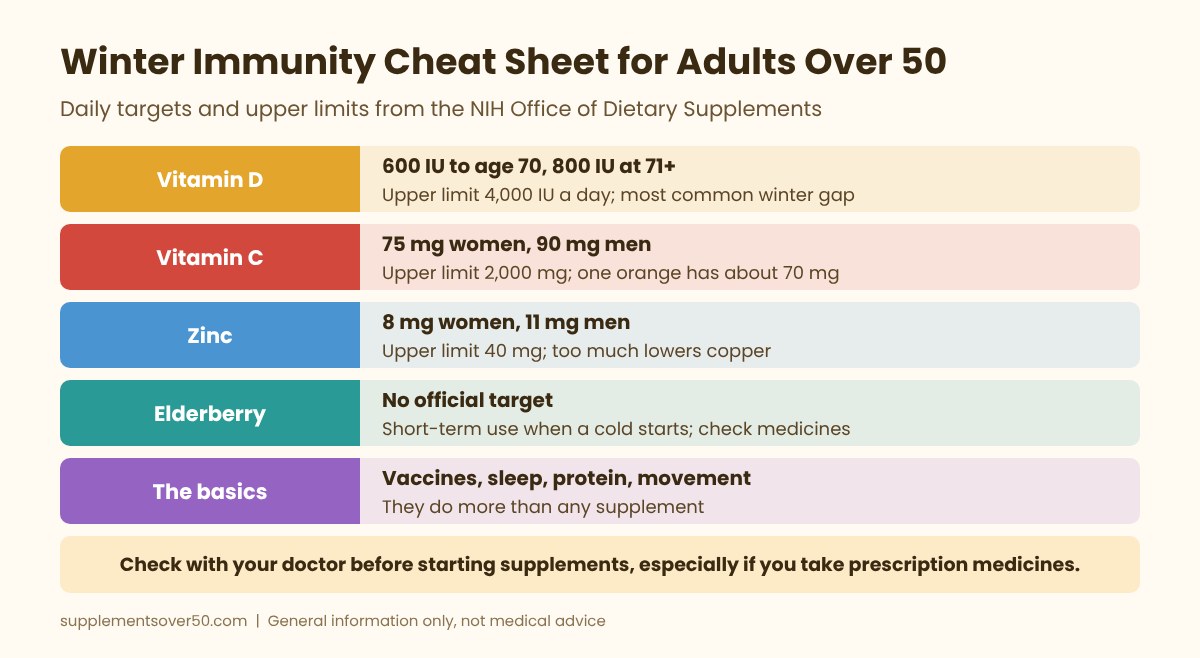
| Nutrient | Daily target over 50 | Upper limit | Our pick |
|---|---|---|---|
| Vitamin D | 600 IU (ages 51 to 70), 800 IU (71+) | 4,000 IU | NatureWise Vitamin D3 2000 IU |
| Vitamin C | 75 mg (women), 90 mg (men) | 2,000 mg | NOW Foods Vitamin C-1000 with Rose Hips |
| Zinc | 8 mg (women), 11 mg (men) | 40 mg | Jarrow Formulas Zinc Balance |
| Elderberry | No official target | Not established | Sambucol Black Elderberry Syrup |
Why Immunity Changes After 50
As we age, the immune system responds more slowly to new threats and produces a weaker response to some vaccines. At the same time, a few common nutrient gaps grow. The skin makes less vitamin D from sunlight, appetite can shrink, and medicines like acid reducers can lower absorption of some nutrients. Winter makes the vitamin D problem worse, because for much of the northern United States and Canada the sun is too low from roughly November to March for the skin to make much vitamin D at all.
None of this means supplements are a shield. The basics still do most of the work: getting your flu and other recommended vaccines, sleeping well, eating enough protein, staying active and washing your hands. Supplements are best thought of as a way to fill specific gaps, not as protection on their own.
Popular Supplement Guides:

Vitamin D: The Most Common Winter Gap
Vitamin D is the nutrient most likely to run low in older adults during winter. According to the NIH Office of Dietary Supplements, older adults are at higher risk of deficiency because their skin makes less vitamin D from sunlight, and the immune system needs vitamin D to fight off bacteria and viruses.
How much: the recommended amount is 600 IU (15 mcg) a day through age 70 and 800 IU (20 mcg) from age 71. The upper limit for adults is 4,000 IU (100 mcg) a day from all sources, unless a doctor prescribes more for a deficiency.
What the research shows: studies on vitamin D and respiratory infections are mixed. Some pooled analyses suggest a small benefit, mostly in people who were deficient to begin with and who took vitamin D daily. Large trials in people with adequate levels have generally not found a clear benefit. That is why the most sensible approach is to check your level with a simple blood test and correct a shortfall, rather than taking very high doses.
Who should be careful: people with kidney disease, sarcoidosis or high calcium levels, and anyone taking thiazide diuretics or certain heart medicines, should check with their doctor first.
NatureWise Vitamin D3 2000 IU is an inexpensive, well-reviewed choice. Each mini softgel provides 2,000 IU of D3 in olive oil, comfortably under the upper limit, and the listing notes NSF contents certification. Take it with a meal that contains some fat for better absorption.
For more detail, see our guides to the best vitamin D supplement for seniors and the signs of vitamin D deficiency in seniors.
Vitamin C: Helpful If Your Diet Falls Short
Vitamin C supports several parts of the immune system, and the body cannot store much of it, so you need some every day. Most people who eat fruits and vegetables daily get enough from food. Older adults who eat less, live alone or have trouble chewing fresh produce are more likely to fall short.
How much: 75 mg a day for women and 90 mg for men, plus 35 mg more for smokers, per the NIH. The upper limit is 2,000 mg a day. A single orange has about 70 mg.
What the research shows: taking vitamin C regularly does not prevent colds for most people, but reviews suggest it may slightly shorten how long they last. Starting vitamin C after a cold begins does not appear to help much. High doses can cause stomach upset and may raise the risk of kidney stones in people prone to them.
NOW Foods Vitamin C-1000 is a popular, budget-friendly option with rose hips and bioflavonoids. At 1,000 mg it is well above the daily target, so many people take it every other day or split a tablet. If ascorbic acid upsets your stomach, a buffered form is gentler.
Our guide to the best vitamin C supplement for seniors compares buffered and whole-food options.
Zinc: Important, but More Is Not Better
Zinc helps immune cells develop and work properly, and mild zinc shortfalls are more common in older adults, especially those who eat little meat or seafood or take certain medicines.
How much: 8 mg a day for women and 11 mg for men. The upper limit is 40 mg a day, according to the NIH. Taking more than that for months can lower copper levels, which can cause anemia and nerve problems. Zinc can also reduce the absorption of some antibiotics and other medicines, so space them apart.
What the research shows: zinc lozenges started within a day of cold symptoms may shorten a cold, though they often cause a bad taste or nausea. Daily zinc tablets are best for filling a dietary gap rather than preventing colds. Avoid zinc nasal sprays, which have been linked to a lasting loss of smell.
Jarrow Formulas Zinc Balance pairs 15 mg of zinc with 1 mg of copper, which makes it a sensible choice for anyone taking zinc every day through the winter.
See our full guide to the best zinc supplement for seniors for more options and forms.
Elderberry: Short-Term Help When a Cold Starts
Elderberry is not a vitamin, but it is one of the most popular winter supplements. The NIH National Center for Complementary and Integrative Health says only a small number of studies have looked at elderberry for colds and flu, and some preliminary research suggests it may relieve symptoms. It is not proven to prevent illness, and it is not a substitute for a flu shot or antiviral medicine your doctor prescribes.
Commercial elderberry products are made from cooked or processed berries. Raw or unripe elderberries, leaves and stems contain substances that can cause nausea and vomiting, so do not make your own from wild plants. If you take medicines, especially drugs that suppress the immune system, check with your doctor before using elderberry.
Sambucol Black Elderberry Syrup is one of the best-known brands and the one many people reach for when a cold starts. Note that the syrup contains sugar, which matters if you manage blood sugar.
Our in-depth guide to the best elderberry supplement for seniors compares syrups, gummies and sugar-free capsules.
What About Other Immune Supplements?
Probiotics: some studies suggest certain strains may modestly reduce respiratory infections, but results vary by strain and the evidence is not strong. Our best probiotic for seniors guide covers what to look for.
Multivitamins: a basic multivitamin can cover small gaps in vitamin D, zinc and vitamin C at once, which is a simple option for older adults with small appetites. See the best multivitamin for seniors.
Quercetin, lactoferrin and echinacea: these are popular, but the evidence for preventing colds in older adults is limited. If you are curious, see our guides to quercetin and lactoferrin.
Using the Best Vitamins for Winter Immunity: A Simple Plan
- Ask your doctor about a vitamin D blood test, and get your recommended vaccines.
- If your level is low or you get little winter sun, take a moderate vitamin D3 dose, such as 1,000 to 2,000 IU, unless your doctor advises otherwise.
- Eat fruits and vegetables daily for vitamin C, or add a supplement if your diet is limited.
- Consider daily zinc only if your diet is low in meat, seafood, beans and nuts, and keep the total under 40 mg.
- Keep elderberry or zinc lozenges on hand for short-term use when a cold starts, if your doctor agrees.
- Prioritize sleep, protein and regular movement. They matter more than any bottle.
What is the best vitamin for immunity in winter for seniors?
Vitamin D is usually the most important, because older adults make less of it from sunlight and winter sun is weak in northern areas. The recommended amount is 600 IU a day through age 70 and 800 IU from age 71, with an upper limit of 4,000 IU unless a doctor prescribes more.
Can vitamins prevent colds and flu?
No supplement reliably prevents colds or flu. Vitamin D may help people who are deficient, regular vitamin C may slightly shorten colds and zinc lozenges started early may shorten symptoms. Vaccines, sleep and handwashing do more for prevention.
How much zinc should a senior take in winter?
The daily target is 8 mg for women and 11 mg for men, with an upper limit of 40 mg from all sources. Long-term intake above 40 mg can cause copper deficiency, so many people choose a product that includes a small amount of copper.
Is it safe to take vitamin D, vitamin C and zinc together?
For most healthy adults, yes, as long as each stays under its upper limit: 4,000 IU for vitamin D, 2,000 mg for vitamin C and 40 mg for zinc. Check with your doctor or pharmacist if you take prescription medicines.
Does elderberry work for colds?
According to the NIH, only a few small studies exist, and some suggest elderberry may relieve cold and flu symptoms. It is not proven to prevent illness. Use commercial products, not raw berries, and check with your doctor if you take medicines.
Should I take a multivitamin instead of separate supplements?
A senior multivitamin is a simple way to cover small gaps in vitamin D, vitamin C and zinc together. If a blood test shows a specific deficiency, such as low vitamin D, a separate supplement may be needed to reach the right dose.
Our Take
Of the best vitamins for winter immunity, vitamin D matters most for adults over 50, because it is the gap most likely to grow when the days get short. A moderate dose like NatureWise D3 2000 IU is a reasonable start for many people, ideally after a blood test. Add vitamin C or zinc only if your diet falls short, keep elderberry for short-term use and let vaccines, sleep and good food do the heavy lifting.
This article is for general information only and is not medical advice. Supplements can interact with medicines and health conditions. Talk to your doctor or pharmacist before starting a new supplement, especially if you take prescription medicines, have kidney disease or are being treated for a chronic condition.