⚕️ Medically reviewed by Dr. Neha T. Reviewed for general accuracy only. This is not personal medical advice, and Supplements Over 50 does not accept responsibility for individual health decisions. Always consult your own doctor or pharmacist about your medications and needs.
This guide contains affiliate links. If you buy through them, we may earn a small commission at no extra cost to you.
We have not tested these products ourselves. This guide compiles manufacturer label information, guidance from the National Institute of Mental Health (NIMH) and NCCIH, published clinical trials, and patterns in verified buyer reviews.
⚡ Quick Answer
No supplement is a proven treatment for winter depression. Light therapy and talk therapy have the strongest evidence. Vitamin D is worth taking if your level is low, but trials on mood are mixed. Omega-3s rich in EPA show a modest benefit in depression trials. Melatonin depends on timing, and St. John’s wort interacts with many common medicines. If you want to cover the basics, our picks are: 1. Nature Made Vitamin D3 2000 IU: best everyday vitamin D 2. Nordic Naturals Ultimate Omega: best higher-dose omega-3 3. NOW Omega-3 180 EPA / 120 DHA: best budget EPA-rich omega-3
If your mood sinks every November and lifts again in spring, you have probably wondered whether a pill could help. Searches for vitamin d for seasonal depression climb every fall, and the shelves are full of vitamins and herbs promising a brighter winter. The honest answer is more nuanced. Some options have solid research behind them, some have mixed or weak evidence, and one popular herb can be risky for anyone taking regular medication.
This guide walks through what the evidence actually says about vitamin D, omega-3s, melatonin and St. John’s wort, how they compare with light therapy, and how to put together a sensible winter plan after 50. Depression is a medical condition, not a character flaw, so we also cover when to bring your doctor in.
If you are in crisis or thinking about harming yourself, call or text 988 (US).
Table of Contents
Vitamin D for Seasonal Depression and Other Options: Quick Comparison
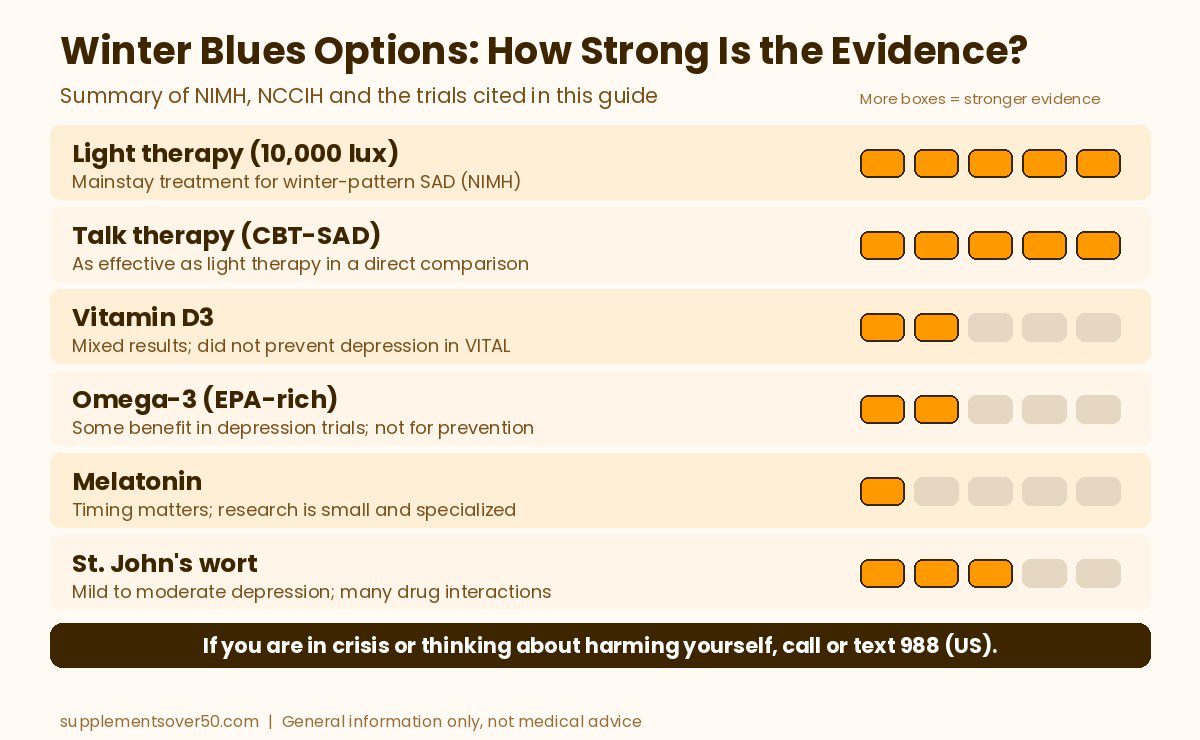
Here is how the main options stack up, based on the NIMH seasonal affective disorder page, NCCIH and the trials linked below.
Option
What the evidence says
Best use
Main caution
Light therapy (10,000 lux light box)
Mainstay treatment for winter-pattern SAD since the 1980s
Daily, usually first thing in the morning, fall to spring
Eye disease or light-sensitizing medicines: ask a doctor first
Talk therapy (CBT-SAD)
As effective as light therapy in a direct comparison; benefits seemed to last longer
Weekly sessions over about 6 weeks
Needs a trained therapist
Vitamin D3
Mixed: some studies positive, others no effect; did not prevent depression in a large trial of adults 50+
Correcting a low vitamin D level
Stay under the upper limit; can interact with some medicines
Omega-3 (EPA-rich)
Modest benefit for depression symptoms in a meta-analysis; did not prevent depression in adults 50+
Add-on, not a replacement for treatment
Blood thinners: check with your doctor
Melatonin
Small, specialized research on timing in winter depression
Sleep timing, under guidance
Can cause daytime drowsiness in older adults
St. John’s wort
May help mild to moderate depression
Only with your doctor’s okay
Dangerous interactions with many medicines
Why Winter Blues Hit Differently After 50
According to the National Institute of Mental Health, many people feel down or have the winter blues when days get shorter, and feel better when longer daylight returns in spring. When those changes are more serious and affect how you think, feel and behave, it may be seasonal affective disorder (SAD). NIMH notes that SAD is much more common in women than in men and more common in people living farther north, where winter days are shorter.
Several things can make winter harder in your 50s, 60s and beyond. Retirement, living alone, losing a spouse or friends, and less time outdoors when sidewalks are icy can all shrink your daily dose of light and social contact. Vitamin D needs also rise with age: MedlinePlus lists a recommended 600 IU a day for adults up to 70 and 800 IU after 70, and notes that people who do not live in sunny places may not make enough vitamin D from limited time in the sun.
NIMH explains that researchers think shorter days may lower serotonin activity, and that low vitamin D may add to the problem, because vitamin D is believed to promote serotonin activity. People with winter-pattern SAD also appear to produce too much melatonin, which can lead to oversleeping. That biology is why vitamin D, omega-3s and melatonin get so much attention. The question is whether taking them actually helps.
Winter Blues or Seasonal Affective Disorder?
The difference matters, because it changes what you should try first. NIMH describes SAD as a type of depression with a recurrent seasonal pattern, with symptoms lasting about four to five months of the year. Winter-pattern symptoms can include:
A sad, anxious or empty mood most of the day, nearly every day, for at least two weeks.
Loss of interest in hobbies and activities you usually enjoy.
Low energy, fatigue or feeling slowed down.
Oversleeping, overeating (especially craving carbohydrates) and weight gain.
Social withdrawal, the feeling of wanting to hibernate.
Trouble concentrating, feelings of hopelessness or guilt, and thoughts of death or suicide.
NIMH also separates SAD from the holiday blues, which are stress-related feelings tied to the calendar rather than to daylight. A diagnosis of SAD needs a seasonal pattern for at least two consecutive years, so if this is new for you, or if symptoms are severe, start with your doctor rather than the supplement aisle.
Does Vitamin D for Seasonal Depression Work?
This is the most common question, and the research is genuinely mixed. NIMH says that because many people with winter-pattern SAD have vitamin D deficiency, supplements may help improve symptoms, but studies of vitamin D as a SAD treatment have produced mixed results: some suggest it works as well as light therapy, and others find no effect.
The trials that found no benefit
A small Danish randomized trial in healthcare workers with seasonal symptoms gave 34 completers a daily vitamin D dose or placebo for three months over winter. Both groups improved as spring arrived, with no difference between them. The authors noted the study was small and underpowered.
The most relevant study for readers over 50 is the VITAL-DEP trial published in JAMA. It followed 18,353 adults aged 50 and older (average age 67.5) for a median of 5.3 years. Taking 2,000 IU of vitamin D3 a day did not lower the risk of depression or improve mood scores compared with placebo. The researchers concluded the findings do not support vitamin D3 to prevent depression. Keep in mind these were mostly people without depression at the start, so the trial tells us about prevention, not treatment.
The analysis that found some benefit
A meta-analysis of 41 randomized trials with more than 53,000 adults found that vitamin D supplements reduced depressive symptoms overall, with doses of 2,000 IU a day or more appearing to help. But the authors rated the certainty of the evidence as very low, because the studies varied widely and many had a risk of bias.
Vitamin D for Seasonal Depression: Our Read
Vitamin D for seasonal depression makes the most sense if your blood level is low, which is common in winter. It is cheap and generally safe at sensible doses, and it supports bone health whatever it does for mood. It is not a substitute for proven treatment. Ask your doctor about a 25(OH)D blood test, and stay under the 4,000 IU a day upper limit listed by MedlinePlus unless your doctor advises otherwise. Our guide to the signs of vitamin D deficiency after 60 covers the symptoms to watch for.
Omega-3s for Winter Mood: Some Evidence
Omega-3 fish oil has a more encouraging record for depression symptoms than for prevention. A meta-analysis of 26 double-blind trials with 2,160 participants found an overall benefit of omega-3s on depression symptoms. The benefit showed up with formulas that were mostly EPA (60% EPA or more) at doses of 1 gram a day or less, while DHA-dominant formulas did not show the same benefit.
Prevention is another story. In the same VITAL-DEP study of adults 50 and older, 1 gram a day of fish oil did not prevent depression or improve mood scores over about five years. The fish oil group actually had a small increase in depression risk, which the authors called a mixed result. So if you are considering omega-3s for winter blues, think of them as a possible add-on for low mood, ideally EPA-rich, not as insurance against depression. Most of these trials were not specific to SAD.
If you take a blood thinner or have a bleeding disorder, check with your doctor before adding fish oil. For more on choosing a formula, see our guide to the best omega-3 for women over 60.
Light Therapy: The Strongest Non-Drug Option
If you only try one thing for winter-pattern SAD, NIMH’s guidance points to light therapy. NIMH calls it a mainstay of treatment since the 1980s. The typical routine is sitting in front of a very bright light box (10,000 lux) for about 30 to 45 minutes a day, usually first thing in the morning, from fall to spring. NIMH says the box is about 20 times brighter than ordinary indoor light and filters out UV light, making it safe for most people.
There are important exceptions. NIMH says people with certain eye diseases, or who take medicines that increase sensitivity to sunlight, may need other treatments or should use light therapy under medical supervision. If you have glaucoma, macular degeneration, diabetic eye disease or bipolar disorder, talk to your doctor before buying a lamp.
NIMH also describes a version of cognitive behavioral therapy adapted for SAD (CBT-SAD), usually group sessions twice a week for six weeks. When researchers compared it directly with light therapy, both worked equally well, and a two-winter follow-up suggested the benefits of CBT lasted longer. Antidepressants, including an extended-release form of bupropion approved by the FDA to help prevent seasonal episodes, are another option your doctor may discuss.
Melatonin: Timing Matters More Than Dose
Melatonin is a hormone your brain makes in response to darkness, and NIMH notes that people with winter-pattern SAD appear to produce too much of it, which can drive oversleeping. That makes melatonin a tricky choice for winter blues: taken at the wrong time, it could make the sluggish, sleepy side of SAD worse.
Research on melatonin for SAD is small and specialized. A study in PNAS used low doses of melatonin, timed carefully in the afternoon or evening for most patients, to shift the body clock, and found that better circadian alignment tracked with lower depression scores. That is very different from taking a large dose at bedtime, and it was done under expert supervision.
For older adults, NCCIH adds two cautions: melatonin may stay active longer in older people and cause daytime drowsiness, and sleep medicine guidelines recommend against melatonin for people with dementia. If sleep is part of your winter struggle, our guide to melatonin for older adults explains why lower doses tend to work better after 60.
St. John’s Wort: Read This Before You Try It
St. John’s wort is the herb most often sold for low mood. According to NCCIH, it appears more effective than placebo and about as effective as standard antidepressants for mild to moderate depression, though it is unclear whether that holds for severe depression or beyond 12 weeks.
The bigger issue after 50 is safety. NCCIH says it has been clearly shown that St. John’s wort can interact in dangerous, sometimes life-threatening ways with many medicines. It can weaken the effects of:
Warfarin and other blood thinners.
Heart medicines such as digoxin and ivabradine.
Certain statins, including simvastatin.
Some antidepressants, including amitriptyline and bupropion.
Some seizure, HIV, cancer and transplant medicines.
Taken with antidepressants or other drugs that affect serotonin, it may also cause serious serotonin-related side effects, and large doses can cause skin reactions after sun exposure. If you take any prescription medicine, do not start St. John’s wort without talking to your doctor or pharmacist. We do not recommend a St. John’s wort product in this guide for that reason.
What to Look for in Seasonal Affective Disorder Supplements
Vitamin D3 at a sensible dose. 1,000 to 2,000 IU a day is a common everyday amount; 2,000 IU is the dose used in the VITAL trial. Avoid stacking several products that all contain vitamin D.
Third-party verification. Look for a USP Verified mark or similar testing, since supplements are not approved by the FDA before sale.
EPA-rich omega-3. If mood is your goal, check the label for EPA and DHA amounts per softgel. The meta-analysis above favored formulas with at least 60% EPA.
Clear serving size. Many fish oils need two softgels to reach the amount on the front label.
No mood blends with St. John’s wort unless your doctor has approved it, especially if you take other medicines.
Skip big promises. No supplement can cure depression or seasonal affective disorder. Be wary of labels or ads that suggest otherwise.
Our Picks: Vitamin D3 and Omega-3 for Winter
We kept this short on purpose. These are the two supplements with a reasonable case for a winter routine after 50, chosen for strong sales, large buyer review counts, and availability from Amazon or the brand. Details come from each Amazon listing, and ratings were read on the live listing at the time of writing.
1. Nature Made Vitamin D3 2000 IU (Best Everyday Vitamin D)
Nature Made Vitamin D3 2000 IU is a simple, widely available choice. Each softgel contains 2,000 IU (50 mcg) of vitamin D3, the same daily amount used in the VITAL trial, and the 250-count bottle is a 250-day supply. The listing says it is USP Verified, gluten free, and made with no added color or artificial flavors. It holds 4.8 out of 5 from more than 40,000 ratings, with 30K+ bought in the past month.
Nature Made suggests taking one softgel daily with water and a meal, ideally one with some fat, which helps absorption. It cost about $15 at the time of writing, so check current pricing. If your doctor finds a low vitamin D level, they may suggest a different dose for a while.
☀️ Best Everyday Vitamin D
Nature Made Vitamin D3 2000 IU, 250 Softgels
2,000 IU (50 mcg) vitamin D3 per softgel, USP Verified, gluten free, one a day with a meal.
Nordic Naturals Ultimate Omega is one of the best-known fish oils, with 4.7 out of 5 from more than 60,000 ratings and 20K+ bought in the past month. The listing describes 1,280 mg of omega-3s per serving in the triglyceride form found naturally in fish, a lemon flavor meant to avoid fishy burps, and fish oil from wild-caught fish that is non-GMO and gluten and dairy free.
Nordic Naturals says omega-3s may also help support a healthy mood, which is a brand claim, not a promise of results. It is a higher-dose option, so it suits people who also want omega-3s for heart health. The 60-count bottle was about $22 at the time of writing; check current pricing and the serving size on the label.
🐟 Best Higher-Dose Omega-3
Nordic Naturals Ultimate Omega, Lemon
1,280 mg omega-3s per serving in triglyceride form, lemon flavored, from wild-caught fish.
3. NOW Omega-3 180 EPA / 120 DHA (Best Budget EPA-Rich Omega-3)
NOW Omega-3 180 EPA / 120 DHA is the budget pick. Each 1,000 mg softgel provides 180 mg EPA and 120 mg DHA, so 60% of its EPA plus DHA is EPA, which lines up with the EPA-rich formulas that showed a benefit in the meta-analysis above. It shows 4.7 out of 5 from more than 30,000 ratings and 10K+ bought in the past month.
The listing suggests two softgels a day, and notes it is non-GMO and made under NPA A-rated GMP certification. The softgels contain gelatin. The 200-count bottle was about $9 at the time of writing, so check current pricing.
💵 Best Budget EPA-Rich Omega-3
NOW Omega-3 180 EPA / 120 DHA, 200 Softgels
180 mg EPA and 120 mg DHA per 1,000 mg softgel, non-GMO, GMP quality assured.
If your mood dips every winter and it is affecting daily life, see your doctor first and ask about light therapy, CBT-SAD or medication.
If you rarely get outside in winter or your vitamin D has been low, ask for a blood test and consider a daily vitamin D3 such as Nature Made 2000 IU.
If you want an omega-3 for mood and heart health, choose an EPA-rich formula like NOW Omega-3, or Nordic Naturals Ultimate Omega for a higher dose.
If you sleep too much in winter, skip bedtime melatonin unless a doctor suggests a specific timing.
If you take any prescription medicine, avoid St. John’s wort unless your doctor or pharmacist clears it.
Simple habits help too: get outside in daylight in the morning when you can, keep a regular wake time, stay active, and plan social contact into your week. For more on choosing a vitamin D product, see our ranking of the best vitamin D supplements for seniors.
When to Talk to Your Doctor
Depression is a medical condition, and winter depression is real depression. Talk to your doctor or a mental health professional if:
Low mood, hopelessness or loss of interest lasts more than two weeks.
You are sleeping or eating much more or less than usual, or struggling to get through the day.
You have had depression or bipolar disorder before. NIMH notes SAD is more common in people with these conditions, and light therapy or supplements may need supervision.
You take blood thinners, heart medicines, antidepressants or several other prescriptions and want to add any supplement.
You have an eye condition and are thinking about light therapy.
If you are in crisis or thinking about harming yourself, call or text 988 (US). You can also chat at 988lifeline.org. In a life-threatening emergency, call 911.
Frequently Asked Questions
Does vitamin D help seasonal depression?
The evidence is mixed. NIMH says some studies found vitamin D worked as well as light therapy while others found no effect. A large trial in adults 50 and older found 2,000 IU a day did not prevent depression. Vitamin D makes most sense if your level is low.
How much vitamin D should I take for winter blues?
MedlinePlus lists 600 IU a day for adults up to 70 and 800 IU after 70, with an upper limit of 4,000 IU a day. Many people take 1,000 to 2,000 IU in winter. Ask your doctor about a blood test before taking higher doses.
What supplements help seasonal affective disorder?
No supplement is a proven SAD treatment. Vitamin D has mixed results, EPA-rich omega-3s show a modest benefit for depression symptoms in general, and St. John’s wort may help mild to moderate depression but interacts with many medicines. Light therapy and talk therapy have stronger evidence.
Is light therapy better than vitamin D for SAD?
Light therapy has the stronger track record. NIMH calls it a mainstay of treatment for winter-pattern SAD, usually 30 to 45 minutes in front of a 10,000 lux light box each morning. Check with a doctor first if you have an eye condition or take light-sensitizing medicines.
Should I take melatonin for winter depression?
Be careful. People with winter-pattern SAD may already make too much melatonin, and bedtime doses can add to oversleeping. NCCIH notes melatonin may cause daytime drowsiness in older adults. Use it only with guidance on timing.
Is St. John’s wort safe after 50?
It can be risky. NCCIH says it can interact in dangerous ways with many medicines, including blood thinners, some heart drugs, certain statins and antidepressants. Talk to your doctor or pharmacist before trying it.
Our Take
For winter blues after 50, the strongest steps are not in a bottle: bright morning light, a light box if your doctor agrees, talk therapy, and medication when needed. Vitamin D for seasonal depression is worth considering if your level is low, and an EPA-rich omega-3 is a reasonable add-on, but neither is a cure. Treat melatonin with care, and skip St. John’s wort if you take other medicines. If your mood drops every winter, tell your doctor. It is common, and it is treatable.
This article is for general information only and is not medical advice. Supplements are not a treatment for depression or seasonal affective disorder. Talk to your doctor before starting any supplement, especially if you take prescription medicines. If you are in crisis or thinking about harming yourself, call or text 988 (US).
Learn how to read a supplement label after 50: serving size, mcg vs IU, %DV, the best nutrient forms, upper limits, proprietary blends and what USP and NSF seals mean.
Berberine vs Ozempic: semaglutide is a prescription GLP-1 drug with large trial results, while berberine has modest effects on blood sugar and weight. Here is what the evidence shows.
Practical stocking stuffers for seniors and adults over 50: hand warmers, lip care, grip socks, a jar opener, a lighted magnifier, motion night lights and large print puzzles, most under $25.