This guide contains affiliate links. If you buy through them, we may earn a small commission at no extra cost to you.
We have not tested these lamps ourselves. This guide compiles manufacturer specs, guidance from the National Institute of Mental Health, Mayo Clinic and Yale’s winter depression program, and patterns in verified buyer reviews.
⚡ Quick Answer
Our picks for a SAD lamp that is easy to use after 50: 1. Carex Day-Light Classic Plus: best overall, 10,000 lux at a comfortable 12 inches 2. Verilux HappyLight Luxe: best with a built-in timer 3. Circadian Optics Lumos: best small desk or table lamp 4. Verilux HappyLight Lucent: best simple one-button budget pick 5. Northern Light Technologies Boxelite: best large-panel splurge
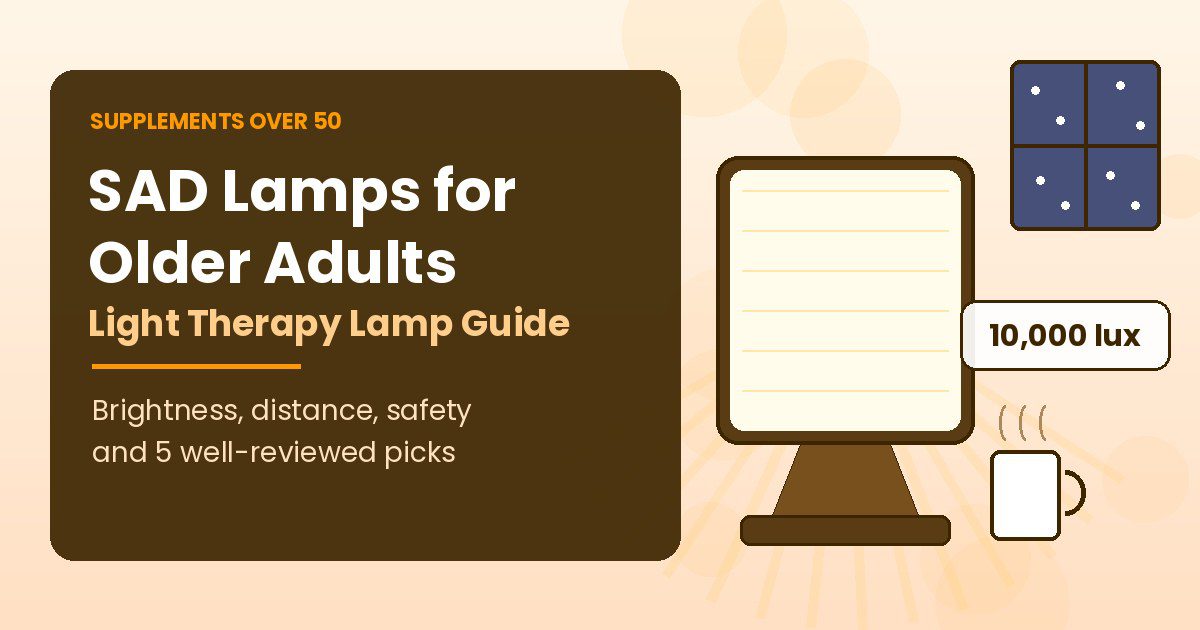
A sad lamp (also called a light therapy lamp or light box) is one of the simplest things you can try when short, dark days drag your mood and energy down. You sit near a very bright, UV-filtered light for part of the morning, and for many people with winter-pattern seasonal affective disorder (SAD) that daily dose of light helps. But the lamp has to be bright enough at the distance you actually sit, and a few eye and mood conditions that are more common after 50 mean some people should check with a doctor first.
Below we explain what the research and medical guidance say, what 10,000 lux really means, how to use a lamp each morning, who should get advice before starting, and five well-reviewed lamps chosen with older eyes, hands and routines in mind.
Table of Contents
SAD Lamp Picks: Quick Comparison
Details come from each Amazon listing, and ratings were read on the live listing at the time of writing. Prices change often, so check current pricing.
The National Institute of Mental Health (NIMH) describes SAD as a type of depression with a recurring seasonal pattern, with symptoms lasting about four to five months a year. In most cases symptoms start in late fall or early winter and ease in spring and summer. Winter-pattern SAD can add oversleeping, carbohydrate cravings with weight gain, and social withdrawal (feeling like “hibernating”) on top of the usual signs of depression.
NIMH notes that SAD is much more common in women than men and in people who live farther north, where winter days are shorter. Researchers think less daylight affects serotonin, a brain chemical that helps regulate mood, and melatonin, the hormone behind the sleep-wake cycle. People with winter-pattern SAD may make too much melatonin, which can drive sleepiness and oversleeping.
Most people with SAD first notice it as young adults, but winter can still be hard decades later. Retirement, living alone, mobility limits and icy sidewalks can all mean fewer hours outdoors in daylight. That is where a lamp at the breakfast table can help fill the gap. It is also why the eye and medication questions further down matter: they come up far more often in your 60s and 70s than in your 20s.
NIMH also separates SAD from the “holiday blues.” SAD tracks changes in daylight, not the calendar or holiday stress. If you feel down only around a stressful event, a lamp is less likely to be the answer.
Does a SAD Lamp Actually Work?
Light therapy has the strongest track record of any non-drug option for winter-pattern SAD. NIMH says it has been a mainstay of treatment since the 1980s, and lists it alongside talk therapy, antidepressants and vitamin D as the main treatment options. The idea is simple: bright light makes up for the natural sunlight you miss in darker months.
NIMH also reports that when researchers compared light therapy directly with a form of cognitive behavioral therapy adapted for SAD (CBT-SAD), both worked about equally well. Some symptoms improved slightly faster with light, while a study that followed people for two winters found the benefits of CBT seemed to last longer. Mayo Clinic adds that for some people light works better combined with another treatment, such as an antidepressant or talk therapy.
Two honest caveats. First, Mayo Clinic points out that light boxes are not regulated by the FDA for SAD treatment, so marketing claims vary and you have to check the specs yourself. Second, NIMH says vitamin D studies for SAD have produced mixed results, so a lamp is not interchangeable with a supplement. If you want to read more on that side, see our guide to the best vitamin D supplements for older adults.
What to Look for in a SAD Lamp
10,000 lux at a distance you can actually sit
Both NIMH and Mayo Clinic name 10,000 lux as the usual target. NIMH describes it as about 20 times brighter than ordinary indoor light. The catch is that brightness drops quickly as you move away from the lamp, so “10,000 lux” means little unless the maker says at what distance. A lamp that hits 10,000 lux at 12 to 14 inches lets you sit back and eat breakfast or read. A small tablet that reaches “up to 10,000 lux” may need to be much closer to your face to deliver that dose.
Yale’s winter depression program notes that free phone apps can measure light in lux, so you can check where you need to sit to get close to 10,000 lux.
UV-free, white light
Mayo Clinic says a SAD lamp should produce as little UV light as possible and warns that some light therapy lamps are made for skin conditions, mainly give off UV light and could damage your eyes if used the wrong way. Buy a lamp sold specifically for SAD. Yale’s program recommends broad-spectrum white light as the best balance of risk and benefit, noting that blue light may act more strongly on the body clock but is also more toxic to the retina. That matters more as eyes age.
A bigger screen, angled down
Larger panels spread light over a wider area, so small changes in posture do not drop you out of the bright zone. Some lamps are designed to shine down from slightly above eye level, which many people find easier on the eyes than a light pointed straight at them.
A timer and simple controls
A countdown timer takes the guesswork out of a 20 or 30 minute session and switches the lamp off if you get distracted. Large, simple buttons beat tiny touch strips if you have arthritis in your hands or wear reading glasses at breakfast.
Size, weight and where it will live
Mayo Clinic suggests thinking about where you will place the lamp and what you will do during sessions, like reading, crafts or watching TV. A big floor-standing light box is great on a table you use every morning. A small, light lamp is better if you move between rooms or travel to see family for the holidays.
How to Use a SAD Lamp Safely
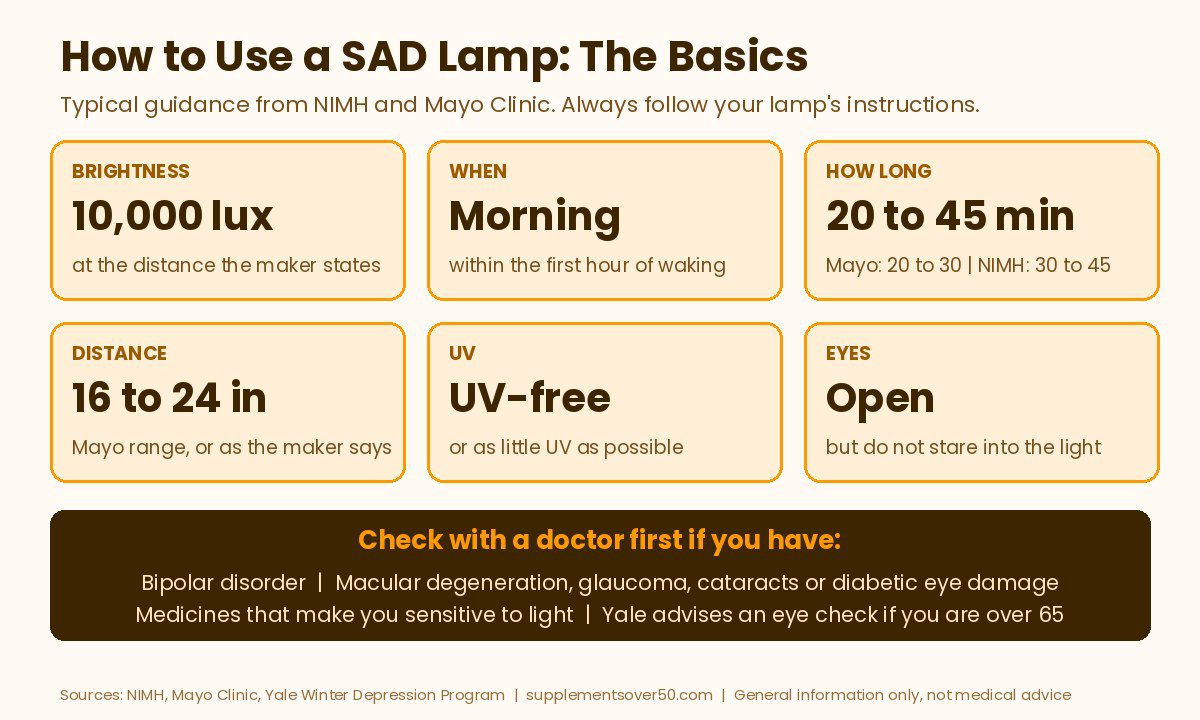
Typical guidance from Mayo Clinic is to use the lamp:
Within the first hour of waking up in the morning.
For about 20 to 30 minutes. NIMH describes about 30 to 45 minutes a day, usually first thing in the morning, from fall to spring.
About 16 to 24 inches from your face, but follow the manufacturer’s instructions about distance.
With your eyes open, but without looking directly at the light.
Use it every day. Mayo Clinic says a lamp’s effectiveness depends on daily use, so buy one that fits easily into your routine. Many people put it beside their coffee, newspaper or tablet so the session happens without extra effort.
Start gently. Yale’s program says some people get eyestrain or headaches and may benefit from moving the lamp a bit farther away for a while, and that people who feel overstimulated may cut sessions to 15 minutes a day for a week or two. Avoid evening sessions unless your doctor suggests them, since bright light late in the day can make it harder to fall asleep.
Plan ahead next year. NIMH notes that because SAD is so predictable, people with a history of it might benefit from starting treatment before fall, though few studies have tested prevention. Talk with your provider about timing.
Top Picks for the Best SAD Lamp After 50
Product details come from each Amazon listing. Ratings, review counts and recent sales were read on the live listing at the time of writing.
1. Carex Day-Light Classic Plus (Best Overall)
Carex Day-Light Classic Plus is our top pick because it solves the biggest problem with cheaper lamps: distance. The listing says it delivers 10,000 lux at 12 inches, from a large glare-free screen that projects light downward. It also says the lamp blocks 99.3% of UV rays, has two light settings and an adjustable stand, and comes with a 5-year warranty. It is shipped and sold by Amazon and shows 4.3 out of 5 from more than 3,500 ratings, with 1K+ bought in the past month.
The trade-offs are size and price. The listing gives dimensions of about 12 x 16 x 29 inches and a weight of about 9 pounds, so it needs a permanent spot on a table. It runs about $126 at the time of writing, so check current pricing. For a lamp you will use daily for months, the comfortable working distance is worth it for most people.
🏆 Best Overall
Carex Day-Light Classic Plus
Large downward-angled screen rated for 10,000 lux at 12 inches, two light settings, adjustable stand and 5-year warranty.
Verilux HappyLight Luxe is a thin, tablet-style lamp with the most useful extra for a morning routine: a countdown timer you can set up to one hour in 5-minute steps. The listing describes up to 10,000 lux of UV-free, flicker-free LED light, four brightness levels, three color temperature options, and a detachable stand plus wall mount. It carries a 3-year warranty with U.S.-based support. It shows 4.5 out of 5 from more than 4,900 ratings, with 3K+ bought in the past month.
The Amazon listing does not state the distance at which it reaches 10,000 lux, and as a smaller panel it will need to sit closer than the Carex. Check the manual and keep it at the distance Verilux specifies. It costs about $56 at the time of writing.
⏲️ Best With a Timer
Verilux HappyLight Luxe
Slim UV-free LED lamp with up to 10,000 lux, 4 brightness levels, 3 color temperatures, countdown timer and wall mount.
3. Circadian Optics Lumos (Best Small Desk or Table Lamp)
Circadian Optics Lumos is a compact lamp with a 270-degree rotating panel on a weighted base, so you can angle the light where you need it without taking over the table. The listing says it provides 10,000 lux of UV-free, full-spectrum light at 5500K, with a one-touch button that cycles through three brightness levels. It folds down for storage and stands about 21 inches tall in use. It has the highest rating in our list, 4.6 out of 5 from more than 6,200 ratings, with 2K+ bought in the past month.
The listing’s usage note suggests placing it 9 to 12 inches away in the morning for 30 to 60 minutes. It comes with a 4-year replacement warranty and costs about $70 at the time of writing. It is a good fit for a desk, side table or travel bag.
💡 Best Small Lamp
Circadian Optics Lumos
Compact UV-free 10,000 lux lamp with a 270-degree rotating panel, weighted base, one-touch brightness control and 4-year replacement warranty.
Verilux HappyLight Lucent is the easiest lamp here to operate: one on/off button and nothing else to set. The listing describes up to 10,000 lux of UV-free, flicker-free LED light, a slim tablet design and a two-way stand that lets you use it upright or sideways. It also has Verilux’s 3-year warranty. It is one of the best-selling lamps in the category, with 10K+ bought in the past month and 4.5 out of 5 from more than 9,100 ratings.
There is no timer and no brightness control, and like the Luxe, the listing does not say at what distance it hits 10,000 lux. As a small lamp it needs to sit fairly close, so follow the manual. It costs about $38 at the time of writing, which makes it a low-risk way to see whether light therapy fits your routine.
💵 Best Budget Pick
Verilux HappyLight Lucent
One-button UV-free LED lamp with up to 10,000 lux, slim design, two-way stand and 3-year warranty.
Northern Light Technologies Boxelite is a classic, full-size light box. The listing says it delivers 10,000 lux at 14 inches, the longest distance in our list, from a large 12 x 15 inch panel with UV-filtered, glare-free fluorescent bulbs. It is made in North America with metal construction and carries a 7-year warranty. It shows 4.2 out of 5 from more than 600 ratings, with 300+ bought in the past month, and is sold by the brand.
It is the priciest pick at about $192 at the time of writing, and fluorescent tubes make it bulkier than LED lamps. If you want to sit back from the light while eating or reading and plan to use it every winter, the extra distance and long warranty may justify the cost.
☀️ Best Large-Panel Splurge
Northern Light Technologies Boxelite
Full-size UV-filtered light box rated for 10,000 lux at 14 inches, 12 x 15 inch panel, made in North America, 7-year warranty.
Also consider for a reading chair: the Verilux HappyLight Duo floor lamp doubles as a task light, with up to 10,000 lux, five brightness levels, a flexible gooseneck and a telescopic pole, per the listing. Its rating is lower (4.0 out of 5 from more than 640 ratings) and it costs about $90 at the time of writing, but it suits people who want light therapy while reading or doing crafts in one favorite chair.
How to Choose the Right SAD Lamp
If you want the most forgiving setup at the breakfast table, pick the Carex Day-Light Classic Plus.
If you tend to lose track of time, pick the Verilux HappyLight Luxe for its countdown timer.
If table space is tight or you travel in winter, pick the Circadian Optics Lumos.
If you want one button and a low price, pick the Verilux HappyLight Lucent.
If you want to sit farthest back and keep the lamp for years, pick the Northern Light Technologies Boxelite.
When to Talk to Your Doctor Before Using a SAD Lamp
Mayo Clinic says it is best to talk with your health care provider about choosing and using a light box, and NIMH notes that people with certain eye diseases or who take medicines that increase sensitivity to sunlight may need other treatments or medical supervision. Check with a doctor first if any of these apply:
Bipolar disorder. Mayo Clinic says increasing exposure too fast or using the lamp too long may trigger manic symptoms in people with bipolar disorder, and Yale’s program says light treatment must be monitored with particular caution in this group.
Eye conditions. Mayo Clinic advises seeing your eye specialist first if you have past or current eye problems such as glaucoma, cataracts or eye damage from diabetes. Yale’s program does not recommend bright light treatment for people with retinal diseases such as macular degeneration, or diabetes that may affect the retina, without first consulting an eye doctor.
Age over 65. Yale’s program recommends that people over 65 check with their eye doctor before starting light treatment.
Medicines that make you sensitive to light. Yale’s program suggests avoiding bright light treatment while using a photosensitizing medicine. Examples it lists include some antibiotics (such as fluoroquinolones, tetracyclines like doxycycline, and sulfonamides), antimalarials such as hydroxychloroquine, NSAIDs such as naproxen, and certain antihistamine, diabetes, antidepressant and antipsychotic medicines. Ask your pharmacist if you are unsure.
Moderate or severe depression. A lamp is not a substitute for care. Yale’s program notes that, as with other antidepressant treatments, a small number of reports describe increased agitation or suicidal thoughts when energy rises before mood improves, so it advises using light treatment under the supervision of a qualified clinician.
If you or someone you know is struggling or having thoughts of suicide, call or text the 988 Suicide and Crisis Lifeline at 988 (US). In a life-threatening emergency, call 911.
Also see your doctor if low mood lasts most of the day, nearly every day, for two weeks or more, if you lose interest in things you used to enjoy, or if symptoms do not improve after a few weeks of consistent light use. NIMH notes SAD is diagnosed when seasonal episodes recur for at least two consecutive years, and a provider can rule out other causes such as thyroid problems or medication side effects.
Frequently Asked Questions
Do SAD lamps really work?
For winter-pattern seasonal affective disorder, light therapy has been a mainstay treatment since the 1980s, according to NIMH, and in studies it worked about as well as a form of talk therapy adapted for SAD. Results vary, and some people do best combining a lamp with therapy or medication.
How long should I sit in front of a SAD lamp?
Mayo Clinic gives about 20 to 30 minutes within the first hour of waking as a typical recommendation, and NIMH describes about 30 to 45 minutes each morning. Follow your lamp’s instructions and your doctor’s advice, and start shorter if you get headaches or eyestrain.
How far away should a SAD lamp be?
Mayo Clinic’s typical range is about 16 to 24 inches from your face, but distance depends on the lamp. Use the distance the maker gives for 10,000 lux. Larger lamps like the Carex and Boxelite list 12 and 14 inches, while small lamps usually need to be closer.
Is a light therapy lamp for seniors safe with macular degeneration or glaucoma?
Ask your eye doctor first. Mayo Clinic advises talking to an eye specialist if you have glaucoma, cataracts or diabetic eye damage, and Yale’s winter depression program does not recommend bright light for people with retinal disease such as macular degeneration unless an eye doctor agrees. Yale also suggests an eye check for anyone over 65.
Can I use a SAD lamp if I take medication?
Usually, but check first. Some medicines, including certain antibiotics, antimalarials, NSAIDs, and some antidepressants, antihistamines and diabetes drugs, can make you more sensitive to light. Yale’s program suggests avoiding bright light treatment while taking a photosensitizing medicine, so ask your doctor or pharmacist.
Does a SAD lamp give you vitamin D?
No. SAD lamps are designed to filter out UV light, and your skin needs UVB to make vitamin D. A lamp works through light entering the eyes, not the skin. If you are concerned about vitamin D in winter, ask your doctor about a blood test.
Our Take
A sad lamp is one of the most practical, evidence-backed steps you can take against winter-pattern SAD, as long as it is bright enough at the distance you really sit and you use it every morning. For most older adults, the Carex Day-Light Classic Plus offers the easiest setup, the Verilux HappyLight Luxe adds a handy timer, the Circadian Optics Lumos suits small spaces, the HappyLight Lucent is the simple budget choice, and the Boxelite is the long-term splurge. If you have bipolar disorder, an eye condition, take light-sensitizing medicines or are over 65, talk to your doctor or eye doctor before you start.
This article is for general information only and is not medical advice. A light therapy lamp is not a substitute for diagnosis or treatment of depression. Talk to your doctor before starting light therapy, especially if you have bipolar disorder, an eye condition, or take prescription medicines.
Magnesium is one of the most widespread deficiencies in older adults, and it is also one of the most underappreciated. The mineral is involved in over…
Life alert cost explained: reported monthly prices, the one-time fee, the three-year contract, no fall detection, and cheaper alternatives that cost far less.
Oticon vs Phonak compared: sound processing, Bluetooth, battery life, tinnitus features, styles and cost, plus lower-cost OTC options if your loss is mild.
Best Buy hearing aids explained: which OTC models it carries, its 60-day hearing aid return policy, what in-store help to expect, and the picks worth buying.