Modern Hearing Aids Reviews and Complaints: An Honest Take
This guide contains affiliate links. If you buy through them, we may earn a small commission at no extra cost to you. We have no relationship with Modern Hearing.
We have not tested these devices ourselves. This guide compiles each brand’s published specs and plan terms, FDA and NIDCD guidance, and patterns in verified buyer reviews.
If you have seen an ad for hearing aids that look like tiny earbuds, promise a 45-day home trial and cost a fraction of clinic prices, you may have landed on Modern Hearing. People searching for modern hearing aids reviews usually want two answers: are these real hearing aids, and what happens if they do not work out? This review answers both, using the brand’s own product, FAQ, refund and terms pages, the FDA’s rules for over-the-counter (OTC) hearing aids, and the public reviews we opened on Trustpilot and the Better Business Bureau (BBB).
Quick note on names before we start. The brand covered here sells online at trymodernhearing.com. It is not connected to the local audiology clinics called Modern Hearing Solutions in Ohio or Modern Hearing in Wisconsin, which show up in the same searches and carry their own, separate BBB profiles.
Table of Contents
Who Is Modern Hearing? The Company Behind the Ads
Modern Hearing sells direct to consumers through its own online store at trymodernhearing.com. Here is what its pages say about the business:
Popular Supplement Guides:

- Legal entity: the Terms and Conditions name Modern Hearing LLC, with a legal address in Sheridan, Wyoming that the terms state is not a return address. The terms are governed by Wyoming law and include an individual arbitration clause with a class action waiver.
- Shipping: orders ship from a US fulfillment center in New Jersey, according to the FAQ, with free standard shipping inside the US only.
- Support: email ([email protected]) and a phone line with a New Jersey area code. The FAQ lists support hours as Monday to Friday, 9 a.m. to 6 p.m. Eastern, while the product page says the team picks up day or night, 7 days a week. Ask which applies before you buy.
- Who makes the devices: the site does not name the factory. A certificate image shown on the product page lists Modern Hearing as both applicant and manufacturer at the Wyoming address, and it was issued by a testing lab in Shenzhen, China.
- Founder story: the About page describes a family business started because of the founder’s grandmother. We could not independently verify the story or the founder’s identity.
- Not on Amazon: we did not find Modern Hearing listed when we searched Amazon, so purchases go through the brand’s store and its own return rules.
The brand has also used other web addresses. Two related domains we checked, trymodern-hearing.com and themodernhearing.com, now show only a hearing aid care guide with no products for sale, while the Trustpilot profile for the brand is still filed under the hyphenated domain.
Modern Hearing Models and Prices
At the time of writing, the store listed three hearing aids. Prices are shown next to a crossed-out “compare at” figure that is roughly double; treat that as marketing rather than a real former price, and check current pricing before you order.
| Model | Style | Key details (per the brand) | About |
|---|---|---|---|
| Modern Hearing Comfort | In the canal, no app | 16-channel processing, three listening modes, one-touch controls, 30+ hours from a 2-hour charge, magnetic charging case | $249.99 a pair |
| Modern Hearing Compact Pro | In the canal, compact case | Same claims as Comfort with a smaller case | $299.99 a pair |
| Modern Hearing Connect | Behind the ear, Bluetooth | App control and AI sound adjustment | $499 a pair |
The Comfort is the model most buyers mention. It sits inside the ear canal with interchangeable silicone tips, and it has no Bluetooth: one buyer on the brand’s own review widget said they had hoped to stream phone calls and found the aids were not Bluetooth compatible. The box includes the aids, a charging case, cleaning tools, several ear tip sizes and a manual. The FAQ says the aids are not waterproof and that water exposure voids both the warranty and return eligibility.
Add-ons are pushed hard: a cleaning kit, a UV drying case, a six-month replacement kit, an ear camera and a two-year care plan. Under the refund policy, the extended warranty plan, cleaning kits, replacement ear tip sets and drying devices are final sale, so think twice before adding them to a first order.
Are Modern Hearing Aids Real OTC Hearing Aids? What the FDA Says
OTC hearing aids are a real FDA category. Per the FDA page on OTC hearing aids, they are air-conduction hearing aids for adults 18 and older with perceived mild to moderate hearing loss, sold without a prescription or an audiologist visit. They are not meant for severe or profound loss, because their maximum output is limited. Modern Hearing’s FAQ describes its products in exactly those terms, as FDA-regulated OTC hearing aids for adults 18 and older with perceived mild to moderate hearing loss.
Where it gets messy is the wording. Modern Hearing’s product page uses “FDA registered”, “FDA-certification” and “FDA certified” in some spots and “FDA-cleared” in others. Under a line that reads “Please see our FDA registration below”, the image shown is a Supplier’s Declaration of Conformity for FCC Part 15, which is a radio emissions test for electronics, not an FDA document. The FDA’s own OTC page warns that statements like “FDA Registered” and “FDA Certified” on hearing aid packaging may be misleading, and its page on FDA registered and certified devices explains that registering and listing a device does not mean the FDA approved or cleared it, and that the FDA does not issue registration certificates at all.
We also searched the FDA’s public establishment registration and device listing database for “Modern Hearing” as a company name and as a device name, and got no results. That does not prove the aids are unregistered, since devices are often listed under the overseas maker’s name, which Modern Hearing does not disclose. And many standard OTC hearing aids are exempt from FDA premarket review anyway. The practical takeaway: a phrase like “FDA registered” on a hearing aid ad tells you very little about quality, for Modern Hearing or any other brand.
Why Choosing the Right Hearing Aid Matters After 50
Hearing loss climbs steeply with age. According to NIDCD statistics, about 10% of adults 55 to 64 have disabling hearing loss, rising to 22% of those 65 to 74 and 55% of those 75 and older. Yet among adults 70 and older who could benefit from hearing aids, fewer than one in three has ever used them. Low-cost OTC aids like Modern Hearing exist to close that gap, which is a good thing.
The flip side is that an OTC buyer is their own fitter. With no audiologist checking the fit, the ear tip size, the volume level and whether the loss is really mild to moderate all fall on you. That is why fit and returns come up so often in modern hearing aids reviews and complaints, and why the return policy matters as much as the sound.
Modern Hearing Aids Reviews and Complaints: What Buyers Report
On Trustpilot, the Modern Hearing profile (shown under the name modernaudiologycare) had 118 reviews when we checked, but Trustpilot displayed a warning that the company’s rating is unavailable due to a breach of its guidelines. Trustpilot does not say what the breach was. Most of the recent reviews we read were five stars; a smaller group were one to three stars. The brand’s own site shows a 4.5 out of 5 rating from about 3,900 reviews collected on its store, which we could not verify independently.
Positive patterns:
- Value: several reviewers compared them favorably with clinic aids costing thousands, and one long-time hearing aid wearer called them the best they had used.
- Clear voices and easy setup: many praised speech clarity, fast shipping and a simple start, with some saying it took practice and different tips to get comfortable.
- Helpful staff: a few mentioned a consultant helping them switch to the behind-the-ear model when the in-ear fit did not work.
Complaint patterns:
- In-canal fit: the most common issue. Reviewers described feedback, hearing their own breathing, aids that would not stay seated, or sound that was too loud even on the lowest program for a mild loss.
- Partial refunds: more than one buyer said they expected a full refund under the guarantee and got back less. One said $81 was kept; another said the refund was a small share of the price.
- The 45-day cutoff: one buyer wrote that both aids stopped working at around 55 days, just past the return window, leaving warranty service as the only route.
- Support follow-through: one reviewer said an AI chat assistant promised callbacks that never came while they tried to swap models. The company replied publicly asking them to email support.
- “It was my ear’s fault”: one buyer said the guarantee was refused because the company blamed the shape of their ear canal.
The BBB profile for Modern Hearing in Cranbury, New Jersey (filed as a hearing aid parts business and listed as an LLC) appears to be the same brand, since it matches the name and the New Jersey shipping base. It was not accredited and showed no letter grade; the BBB said it is not rated because the business is in the process of responding to previously closed complaints. The profile listed 45 complaints in the last 12 months and a 3.48 out of 5 average from 29 customer reviews. The individual complaint texts were not displayed when we checked, so we cannot summarize them. BBB notes that the nature of complaints and a company’s responses matter more than the count.
The 45-Day Trial and Refund Fine Print
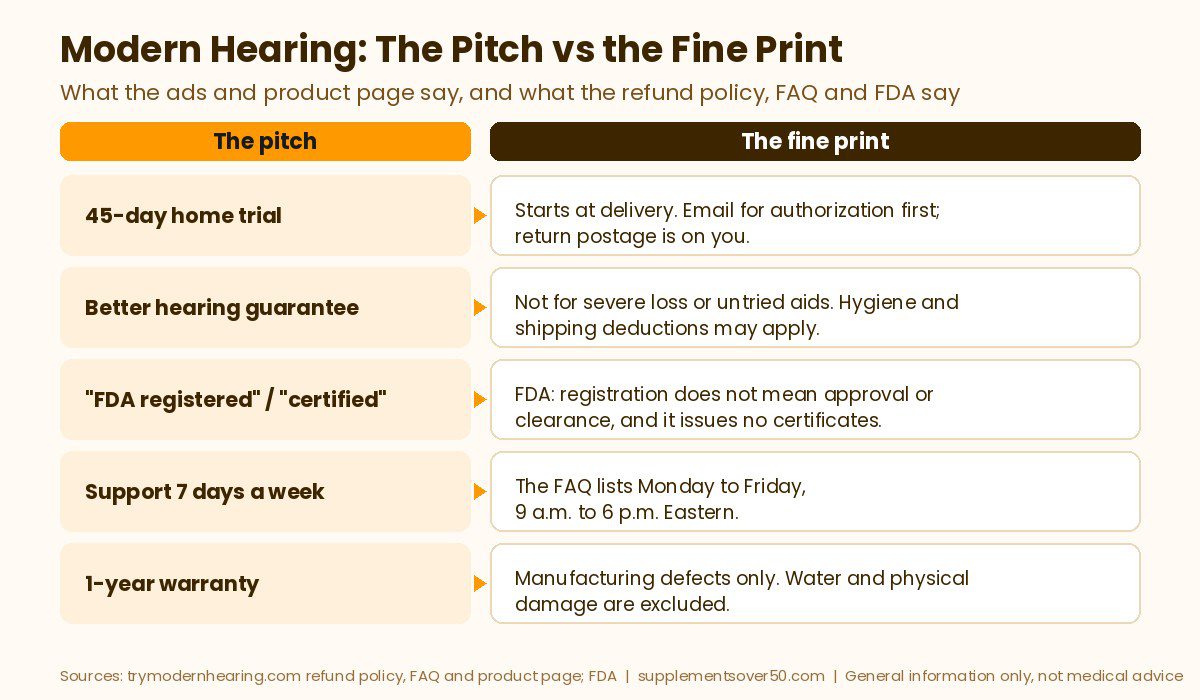
Most complaints in modern hearing aids reviews trace back to the return rules, so read them before ordering. The Modern Hearing refund policy and FAQ at the time of writing said:
- 45 days from delivery, not from purchase. The guarantee is “if you don’t notice better hearing”, for mild to moderate loss, and it does not apply to severe hearing loss or to aids returned without being tried.
- Authorization first. You must email support and wait for a return address. Returns sent without authorization or to the wrong address do not qualify and may be refused with extra fees.
- You pay return postage, with tracking recommended, and must send back the original packaging and every accessory in working order.
- Possible deductions. A cleaning and hygiene fee may apply if the aids were used. If you cancel after dispatch, the policy lists up to about $55 in deductions (non-refundable $20 tracked shipping, $20 carrier return charges, $15 reprocessing), or about $35 plus your own return postage if you return an unopened box after delivery. That sits awkwardly next to the FAQ’s “free shipping” and “no hidden fees” lines, and its statement that a restocking fee generally does not apply.
- Late returns are not usually refunded; the aids are sent back to you, and a handling fee may apply.
- Warranty: one year from arrival for manufacturing defects, extendable to two years at checkout. Physical damage, water exposure and poor maintenance are excluded.
To its credit, the policy states that fees are not automatic and will be explained before you send anything back. Our advice: start wearing the aids the day they arrive, contact support well before day 45 if they are not working, get the deductions confirmed in writing, and keep your tracking receipt.
What About Modern Hearing Aids Reviews From Consumer Reports?
There is no Consumer Reports rating for Modern Hearing that we could find. The Consumer Reports guide to the best OTC hearing aids, last updated in August, describes lab and panel testing of 14 OTC models and lists recently tested models from brands such as Yeasound, Soundbright, ELEHEAR, Concha Labs, MDHearing and Audien. Modern Hearing was not mentioned. CR’s full scores sit behind its membership paywall, so be wary of any ad or website that implies a CR endorsement without linking to it.
CR’s most useful free advice applies here too: use the whole trial period, start wearing the aids right away, and test the company’s customer support while you can still return them.
Modern Hearing Pros and Cons
Pros
- Low price for a rechargeable pair of in-canal OTC hearing aids.
- Many buyers report clear speech and a quick, simple start.
- 45-day home trial and a one-year warranty, with an optional extension.
- Ships from New Jersey with free standard US shipping.
- A behind-the-ear Bluetooth model for people who cannot get an in-canal fit.
Cons
- “FDA registered” and “FDA certified” claims, plus an FCC certificate presented as an FDA registration.
- The factory behind the devices is not named.
- Strict return steps, return postage on you, and possible deductions that buyers say surprised them.
- The Comfort model has no app or Bluetooth streaming.
- Not waterproof; water exposure voids warranty and returns.
- Trustpilot rating suspended for a guidelines breach, and a BBB profile with no rating and dozens of recent complaints.
Modern Hearing vs Better OTC Options: Quick Comparison
Here is how Modern Hearing’s best-known model stacks up against the alternatives below. Prices are from each seller’s page at the time of writing; check current pricing.
| Option | Style | App | Trial and support | About |
|---|---|---|---|---|
| Modern Hearing Comfort | In the canal | No | 45 days, authorized returns, 1-year warranty | $249.99 |
| Audien Atom Pro 2 | In the canal | No | Sold on Amazon, expert setup session, 1-year warranty | $231 |
| ELEHEAR Beyond | Receiver in the canal | Yes | Sold on Amazon, remote audiologist care | $399 |
| Sennheiser All-Day Clear | Receiver in the canal, self-fitting | Yes | 30-day trial per listing | $900 |
| Jabra Enhance Select | Receiver in the canal, self-fitting | Yes | 100-day trial, 3 years of audiology, 3-year warranty | From $1,195 |
Best Alternatives to Modern Hearing Aids
1. Audien Atom Pro 2 (Best Like-for-Like Budget Swap)
If the Modern Hearing Comfort appealed to you because it is tiny, rechargeable and cheap, the Audien Atom Pro 2 is the closest match with a larger track record. The listing describes an in-canal design 15% smaller than the previous generation, four listening modes (conversation, restaurant, TV and outdoor), up to 24 hours per charge plus about 48 more from the case, and a charging case that runs a UV-C cleaning cycle. Each purchase includes a free expert-guided setup session, three dome sizes, a wax guard kit and a one-year warranty, and the listing says it is FSA and HSA eligible.
On Amazon it had 3.7 out of 5 stars from about 3,800 ratings, with 400+ bought in the past month. Consumer Reports lists it among its recently tested OTC models. The same fit caveat applies to any in-canal aid, and note that Audien’s listing also leans on the “FDA-registered” phrase, so judge it on reviews and return terms rather than that label. Buying through Amazon at least gives you Amazon’s familiar order and return process.
2. ELEHEAR Beyond (Best Value With App Control)
If in-canal tips gave you feedback or felt too loud, a receiver-in-the-canal design with app adjustments is often easier to live with. The ELEHEAR Beyond pairs with the ELEHEAR app on iPhone and Android for volume, noise and speech settings, and the listing quotes up to 50 dB of gain, 24 dB of noise attenuation, up to 20 hours per charge and about 100 hours in total with the case. The aids switch on and off automatically when taken out of or placed in the case, and ELEHEAR offers remote audiologist care through its ElePro service.
It had 4.0 out of 5 stars from about 740 Amazon ratings and 500+ bought in the past month, making it one of the steadier sellers in the category. It costs more than Modern Hearing, but the app gives you far more control over how loud and how sharp it sounds.
3. Sennheiser All-Day Clear (Best Self-Fitting Pick on Amazon)
For a well-known audio brand with a self-fitting setup, the Sennheiser All-Day Clear uses a receiver-in-the-canal design and an app that personalizes the sound in a few minutes. The listing says it adjusts automatically to your surroundings, streams calls and audio over Bluetooth from iOS and Android phones, runs up to 24 hours per charge, and comes with a 30-day risk-free trial.
It had 3.7 out of 5 stars from about 130 Amazon ratings, a much smaller base than the picks above. Consumer Reports notes that Sennheiser stopped selling its All Day Clear Slim, which CR had recommended, while this All-Day Clear model remains on sale but has not yet been tested by CR.
4. Jabra Enhance Select (Best With Audiologist Support)
The biggest gap with Modern Hearing is support. Jabra Enhance sells its Select hearing aids direct with licensed, US-based audiology care: you can personalize them with an FDA-cleared in-app hearing test or upload an audiogram, and the audiology team can fine-tune them remotely. Plans include three years of audiology services, a three-year warranty with three years of loss and damage protection, and a 100-day risk-free trial with a full refund if you are not satisfied, per the brand.
It is a much bigger spend. The Enhance Select lineup was listed at about $1,195, $1,695 and $1,995 a pair at the time of writing, depending on the model; check current pricing. If you have tried cheap aids and struggled with fit or settings, paying for real follow-up is often what makes hearing aids stick.
One brand we do not recommend right now: Eargo. Its site posts a notice that parent company LXE Hearing is winding down, with warranty requests and app support already ended. See the eargo.com notice before buying a used or discounted pair.
How to Choose: Is Modern Hearing Right for You?
- If you want the cheapest possible in-ear test run and are comfortable with strict return steps, Modern Hearing can work. Order, start wearing them on day one and decide well before day 45.
- If you want a similar tiny in-ear aid with an easier purchase path, pick the Audien Atom Pro 2.
- If in-canal tips have given you feedback or discomfort before, choose a receiver-in-the-canal aid with an app, like the ELEHEAR Beyond.
- If you want a self-fitting brand-name aid, look at the Sennheiser All-Day Clear.
- If you want real audiologist follow-up and a long trial, choose Jabra Enhance Select.
- If you are not sure your loss is mild to moderate, get a hearing test first; no OTC aid is designed for severe loss.
Buying hearing aids for a parent? Our list of the best gifts for aging parents and our guide to gifts for parents and grandparents have more ideas. If ringing in the ears is part of the problem, our look at tinnitus supplements explains what the evidence does and does not show, and our guide to fall detection for seniors covers another device worth discussing as parents age.
When to See an Audiologist or Doctor
The FDA’s required OTC hearing aid labeling lists “red flag” signs that call for a doctor, preferably an ear, nose and throat (ENT) specialist, before using any OTC aid, including Modern Hearing:
- Hearing that changed suddenly in the past six months, or that gets worse and then better again.
- Worse hearing in one ear, or ringing or buzzing in only one ear.
- Ear pain or discomfort, or blood, pus or fluid from the ear in the past six months.
- A lot of earwax, or a feeling that something is in the ear.
- Dizziness or a spinning or swaying feeling (vertigo).
- An ear that has a birth defect, an unusual shape, or was injured in an accident.
See a hearing professional too if you cannot follow speech even in a quiet room, if you do not hear loud sounds well, or if an OTC aid is not helping enough after a fair trial. Modern Hearing’s site says it may help some people notice tinnitus less, but no hearing aid cures tinnitus, and new or one-sided ringing should be checked.
Frequently Asked Questions
Are Modern Hearing aids legit?
Modern Hearing is a real online seller of low-cost OTC hearing aids, and many buyers report good results. But its site uses “FDA registered” and “FDA certified” wording that the FDA warns can mislead, it does not name its manufacturer, and complaints focus on fit and partial refunds. Read the return policy before you buy.
What do Modern Hearing aids reviews and complaints say?
Positive reviews praise clear voices, easy setup and the low price. Complaints center on in-canal fit (feedback, too loud, falling out), refunds smaller than expected under the 45-day guarantee, aids failing just after the return window, and slow callbacks. Trustpilot has suspended the brand’s rating for a guidelines breach.
Did Consumer Reports review Modern Hearing aids?
Not that we could find. Consumer Reports’ OTC hearing aid guide lists models from brands such as Yeasound, Soundbright, ELEHEAR, Concha Labs, MDHearing and Audien, and Modern Hearing was not mentioned. CR’s full ratings require a membership.
How much do Modern Hearing aids cost?
At the time of writing, the Comfort model was about $249.99 a pair, the Compact Pro about $299.99 and the Bluetooth Connect about $499, each shown next to a higher crossed-out price. Add-ons such as care plans and cleaning kits are final sale. Check current pricing on the brand’s site.
What is the Modern Hearing return policy?
There is a 45-day trial from the delivery date. You must email support for authorization, ship the aids back with all accessories at your own cost, and fees may be deducted, for example hygiene fees on used aids or shipping and reprocessing charges. Unauthorized or late returns do not qualify.
Who makes Modern Hearing aids?
The site does not name the factory. Its Terms list Modern Hearing LLC with a legal address in Sheridan, Wyoming, orders ship from New Jersey, and a certificate image on its product page was issued by a testing lab in Shenzhen, China.
Our Take
Modern Hearing is not a scam in the sense of taking money and shipping nothing: buyers receive OTC hearing aids, and plenty say they hear voices better for a few hundred dollars. But reading Modern Hearing aids reviews alongside the company’s own fine print, a few things give us pause. The FDA wording on its product page is the kind the FDA specifically warns about, the manufacturer is not named, the in-canal fit fails for a noticeable share of buyers, and the 45-day guarantee comes with authorization rules, return postage and possible deductions that have surprised people. If you still want to try Modern Hearing, go in with the trial calendar in hand. If you would rather skip the uncertainty, the Audien Atom Pro 2 or ELEHEAR Beyond cost about the same to a bit more, and Jabra Enhance Select is the pick when you want an audiologist in your corner.
This article is for general information only and is not medical advice. OTC hearing aids are intended for adults 18 and older with perceived mild to moderate hearing loss. Prices, policies and ratings were taken from each seller’s website, Amazon, Trustpilot and the BBB at the time of writing and may change. See a doctor about sudden hearing changes, ear pain, drainage or dizziness.