This guide contains affiliate links. If you buy through them, we may earn a small commission at no extra cost to you.
We have not tested these devices ourselves. This guide compiles each brand’s published specs and plan terms, FDA and NIDCD guidance, and patterns in verified buyer reviews.
⚡ Quick Answer
Our picks for the best rated OTC hearing aids, based on where independent testers and verified buyers line up: 1. Jabra Enhance Select M3 Aureon: best overall, with the most tester agreement 2. Yeasound RIC800: best lab-rated mid-price pick 3. ELEHEAR Beyond: best value with a large review base 4. Sennheiser All-Day Clear: best for all-day comfort 5. Apple AirPods Pro 3: best for occasional hearing help
If you have typed “consumer reports hearing aids” into a search bar, you are not alone. It is one of the most common ways people try to cut through a confusing market. Consumer Reports does test hearing aids, but its full ratings sit behind a membership paywall, and we will not reproduce them here. What we can do is show you the best rated OTC hearing aids by a standard you can check yourself: where independent testers, verified Amazon buyers, FDA rules and each brand’s own return terms all point the same way.
That approach turns up a short list. Some models win praise from lab reviewers and buyers alike. Others look great on one scorecard and shaky on another, and we flag those too. Every rating below was read on the live listing or the reviewer’s page at the time of writing, so check current numbers before you buy.
Table of Contents
Best Rated OTC Hearing Aids: Quick Comparison
Amazon ratings and prices were read on each live listing at the time of writing. Prices change often, so check current pricing. Recognitions are attributed to the reviewer that published them.
HearingTracker: best for remote care. Wirecutter’s top OTC pick is the Jabra Enhance Select 300
$1,995 pair
100-day trial when bought direct; 3 years of virtual audiology
Yeasound RIC800
Lab-rated mid-price
4.2 (97)
HearingTracker: best overall OTC
$549 pair
100-day trial and 1-year warranty on yeasound.com
ELEHEAR Beyond
Value with lots of reviews
4.0 (749)
HearingTracker: best value OTC
$399 pair
ElePro remote audiologist care
Sennheiser All-Day Clear
All-day comfort
3.7 (138)
HearingTracker: best for everyday comfort
$899.95 pair
30-day risk-free trial per listing
Apple AirPods Pro 3
Occasional hearing help
4.4 (17,949)
Wirecutter: worth considering for occasional use
$179.99
Needs a recent iPhone or iPad
Why Picking a Well-Rated Hearing Aid Matters After 50
Hearing loss climbs steeply with age. According to the National Institute on Deafness and Other Communication Disorders (NIDCD), 22% of people ages 65 to 74 and 55% of those 75 and older have disabling hearing loss. Yet among adults 70 and older who could benefit from hearing aids, fewer than 1 in 3 has ever used them.
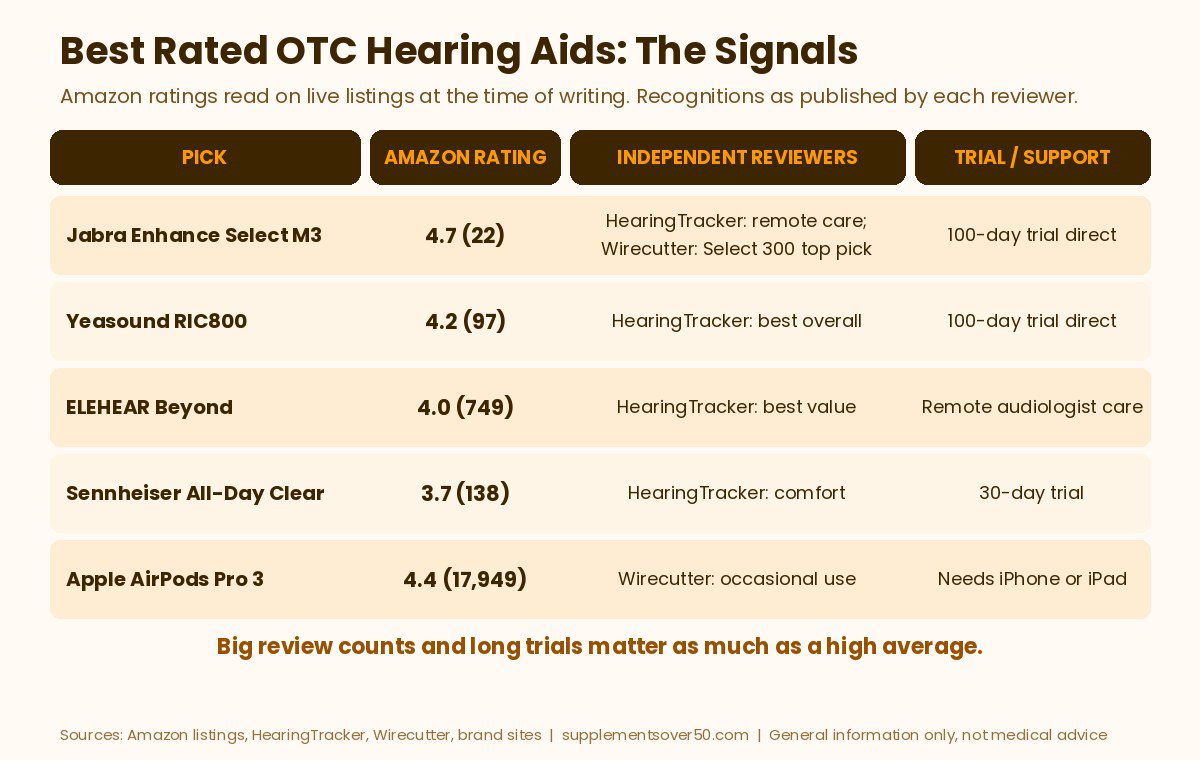
Cost and hassle are part of the reason, and that is the gap OTC hearing aids were created to fill. The trouble is that the OTC aisle is crowded with look-alike products, some with bold claims and thin support. Choosing a model that holds up with independent reviewers and with thousands of everyday buyers lowers the odds that your hearing aids end up in a drawer. The chart below shows how our five picks stack up on the signals we used.
Consumer Reports Hearing Aids Ratings: What CR Covers and Why We Don’t Repeat Them
Consumer Reports is a nonprofit that buys and tests products, and it does test OTC hearing aids. Its OTC hearing aid guide says the lab now evaluates these devices for audio performance and usability, and that full ratings cover 14 over-the-counter models. Here is what CR says it measures, in brief:
Ease of use: a usability expert scores setup, daily operation and the smartphone app.
Performance: panelists rate comfort, and a separate panel with mild to moderate hearing loss takes listening tests.
Sound quality: an audiology test device measures noise filtering, maximum output, the frequencies amplified and distortion.
CR names a few top-rated models publicly, but the complete scores are for members. Those ratings are CR’s work and its trademarked brand, so we do not quote or estimate them, and nothing on this page should be read as a Consumer Reports endorsement. If you want CR’s verdict on a specific model, the most reliable route is to read its guide directly.
Two points from CR’s public guide are worth knowing even without the scores. First, CR’s testing lead urges buyers to start using new hearing aids right away and to test customer support during the trial period. Second, CR describes the OTC market as volatile: it notes that Eargo and Lexie went out of business, Sony ended its OTC line, and Sennheiser stopped selling the All Day Clear Slim. CR also says it has not yet tested the standard Sennheiser All-Day Clear, which appears on our list below. So if you searched for consumer reports otc hearing aids hoping for a simple ranking, keep in mind that even CR’s list changes as models disappear.
How We Define Best Rated
Since we did not run our own tests, we built this list from signals anyone can verify. A model needed to do well on several of these, not just one:
Buyer ratings with real volume. A 4.0 average from hundreds or thousands of verified Amazon buyers tells you more than a 4.9 from a dozen. We note small review counts plainly.
Independent tester recognition. We read HearingTracker’s lab-reviewed OTC picks, which says it has reviewed over 100 OTC hearing aids in an acoustic lab, and Wirecutter’s OTC hearing aid guide, which used a panel of testers with hearing loss. We only cite recognitions we read on those pages.
Real OTC status. The device should be sold as an OTC hearing aid for perceived mild to moderate loss, not as a cheap sound amplifier.
Trial and return terms. A generous trial matters because your brain needs time to adjust.
Support after the sale. Access to audiologists, app updates and a warranty, from a company likely to still be around.
What Testers and Buyers Agree On, and Where They Don’t
Reading the reviewer guides side by side with Amazon listings shows a few clear patterns. The biggest area of agreement is the trial period. Wirecutter surveyed nearly 500 members of the Hearing Loss Association of America, and 84% of respondents stressed the importance of a trial long enough to adjust. CR gives the same advice. Testers also agree that remote support from a hearing professional makes a real difference, which is one reason Jabra Enhance keeps showing up near the top.
The disagreements are just as useful:
ELEHEAR Beyond: HearingTracker names it the best value OTC hearing aid, and it has one of the larger review bases on Amazon. Wirecutter’s panel, though, found it hard to handle for people with dexterity challenges and noted that a firmware update wiped one tester’s custom settings.
Sennheiser All-Day Clear: HearingTracker gives it the highest rating in its comparison table, 4.6 out of 5, as its best pick for everyday comfort. On Amazon it averages 3.7 out of 5, a more mixed buyer verdict.
Tweak Enhance: Wirecutter recommends it for people who need help only occasionally or in one ear. Its single-ear Tweak Enhance listing on Amazon shows just 2.4 out of 5 from 27 ratings, so we left it off our main list.
When testers and buyers split like this, look at why. Lab and panel reviews capture sound quality and setup. Buyer reviews capture what happens months later: charging problems, lost domes and how support responds.
What OTC Hearing Aids Are and Who They’re For
The FDA’s guide to OTC hearing aids says the category is for adults 18 and older with perceived mild to moderate hearing loss, and that these devices are not intended for severe or profound loss because their maximum output is limited. You can buy them in stores or online without seeing an ear, nose and throat (ENT) doctor or an audiologist.
The FDA lists signs that suggest mild to moderate loss: trouble hearing speech in noisy places, difficulty following group conversations, trouble on the phone, feeling tired from listening, and turning the TV up until others complain. If that sounds like you, OTC aids may be a reasonable first step.
Two FDA notes matter when you compare ratings. The agency warns that labels such as “FDA Registered” or “FDA Certified” on a hearing aid package may be misleading. It also says OTC rules do not require manufacturers to offer a warranty, so read the return and warranty terms before you buy. The outside of an OTC hearing aid box must state the manufacturer’s return policy.
What to Look for in Best Rated OTC Hearing Aids
A trial of 30 days or more. Longer is better. Jabra Enhance and Yeasound both advertise 100 days when you buy direct.
Self-fitting or audiogram programming. An in-app hearing test is good; the option to upload an audiogram from a professional is better.
Sound modes for noisy places. Testers consistently rate restaurant and outdoor modes as helpful.
Bluetooth only if you will use it. Streaming calls and TV is handy, but it can drain the battery faster.
Battery life that covers a full day. Look for 20 hours or more per charge plus a portable charging case.
A comfortable fit. Receiver-in-canal designs with several dome sizes suit most ears. Small controls can be hard for stiff fingers.
A brand with staying power. CR and Wirecutter both point to recent shutdowns, so favor established companies with clear support channels.
Top Picks for the Best Rated OTC Hearing Aids
Product details come from each Amazon listing and the brand’s own site. Ratings were read on the live listing at the time of writing.
1. Jabra Enhance Select M3 Aureon (Best Overall)
Jabra Enhance Select M3 Aureon is the pick with the broadest support. HearingTracker names the Jabra Enhance Select M3 its best OTC hearing aid for remote care, and Wirecutter’s top OTC pick for first-time users is the Jabra Enhance Select 300 from the same family, praised for its service team and adjustable sound. On Amazon the M3 has a 4.7 out of 5 rating, though from only 22 reviews so far, and it is sold by Amazon.
The listing describes a mini receiver-in-ear design weighing 2.12 grams, automatic adjustment of noise reduction and speech volume, and an FDA-cleared in-app self-fitting test, or you can send your audiogram for professional programming. It supports Bluetooth streaming, double-tap call answering, LE Audio and Auracast, is rated IP68, and lists over 24 hours per charge. It costs about $1,995 a pair on Amazon at the time of writing, so check current pricing.
🏆 Best Overall
Jabra Enhance Select M3 Aureon
Mini receiver-in-ear OTC aids with self-fitting or audiogram programming, licensed audiology support, Bluetooth and IP68 protection.
Yeasound RIC800 is the newest name on this list and the one HearingTracker currently calls its best overall OTC hearing aid, citing strong lab-tested sound and a comfortable fit. Wirecutter says it plans to include the RIC800 in its next round of panel testing. Buyers agree so far: it holds 4.2 out of 5 from 97 Amazon ratings, with 200+ bought in the past month.
The listing describes AI noise reduction and feedback control, five sound modes (Adaptive, General, Noisy, Music and Outdoors), Bluetooth calls and music for iOS and Android, and up to 23 hours in hearing mode with three more full charges in the case. Yeasound’s own site lists a 100-day trial, a 1-year warranty and FDA clearance; check the return window on the Amazon listing, since it may differ. It runs about $549 a pair at the time of writing.
⭐ Best Lab-Rated Mid-Price
Yeasound RIC800
Small RIC hearing aids with AI noise reduction, five sound modes, Bluetooth calls and music, IPX8 water resistance and a charging case.
ELEHEAR Beyond has the biggest buyer base of the dedicated hearing aids here, with 4.0 out of 5 from 749 ratings and 500+ bought in the past month. HearingTracker names it the best value OTC hearing aid. As noted above, Wirecutter’s panel was less impressed, mainly over dexterity and an app update that reset settings, so weigh that if small parts are hard for you.
The listing says it is designed for mild to moderate hearing loss, with up to 50 dB of gain and 24 dB of noise attenuation, an iOS and Android app, up to 20 hours per charge and about 100 hours in total with the case. The aids turn on and off automatically in the case, multiple dome sizes are included, and ElePro remote audiologist care is offered. It costs about $399 a pair at the time of writing.
💵 Best Value
ELEHEAR Beyond
Rechargeable RIC hearing aids for mild to moderate loss with AI noise reduction, a smartphone app and remote audiologist care.
4. Sennheiser All-Day Clear (Best for All-Day Comfort)
Sennheiser All-Day Clear gets the highest rating in HearingTracker’s comparison table, which names it the best OTC choice for everyday comfort. Buyers are more divided at 3.7 out of 5 from 138 Amazon ratings, and CR notes it has not yet tested this model. That split is why it sits fourth, not first.
The listing describes a receiver-in-the-canal design built for long wear, automatic adjustment to your surroundings, app setup in a few minutes with no appointment needed, Bluetooth calls and streaming on iOS and Android, and up to 24 hours per charge. It includes a 30-day risk-free trial, shorter than the Jabra and Yeasound direct trials. It costs about $899.95 a pair at the time of writing.
😌 Best for Comfort
Sennheiser All-Day Clear
Classic receiver-in-the-canal OTC hearing aids with quick app setup, Bluetooth calls and up to 24 hours per charge.
5. Apple AirPods Pro 3 (Best for Occasional Hearing Help)
Apple AirPods Pro 3 are earbuds first, but they are by far the most-reviewed product here, with 4.4 out of 5 from 17,949 ratings and 10K+ bought in the past month. Apple’s support page says the Hearing Aid feature is a clinical-grade option for perceived mild to moderate hearing loss in people 18 and older, set up with Apple’s hearing test or an audiogram, and it needs an iPhone or iPad on current software.
Wirecutter lists the AirPods Pro 3 as worth considering for people who need occasional hearing help, but its testers felt they are not suited to all-day hearing aid use. The listing gives up to 10 hours in Transparency mode using the Hearing Aid feature. At about $179.99 on Amazon at the time of writing, they are a low-risk way to find out whether amplification helps you.
🎧 Best for Occasional Use
Apple AirPods Pro 3
Earbuds with Apple’s Hearing Aid feature for perceived mild to moderate loss, plus noise cancellation and calls. Requires iPhone or iPad.
Also Consider: Jabra Enhance Select, Bought Direct
If you like the Jabra pick but want the longest trial and a lower starting price, buy Jabra Enhance Select direct from Jabra Enhance. Its site lists three models at about $1,195, $1,695 and $1,995 a pair at the time of writing, a 100-day risk-free trial with a full refund if you are not satisfied, a 3-year warranty and 3 years of virtual audiology appointments and adjustments. Check current pricing on the site.
Best for ongoing audiology support
Jabra Enhance Select M3 (on Amazon or direct)
Self-fitting receiver-in-canal hearing aids with licensed audiology support. The Amazon listing for the Select M3 Aureon includes a 3-year warranty and 3 years of loss and damage protection. Buying direct from Jabra Enhance adds its 100-day trial.
Some older lists of top rated OTC hearing aids still include Eargo or Lexie. Skip them. Eargo’s website posts a notice that its parent company, LXE Hearing (Eargo, Lexie and Go), is winding down: warranty requests stopped on September 15 and app support ended on October 22. Wirecutter and CR both removed or flagged these brands for the same reason. A hearing aid without app updates or warranty service is a poor buy at any price.
How to Choose the Best Rated OTC Hearing Aids for You
If you want the most hand-holding, pick Jabra Enhance Select, ideally bought direct for the 100-day trial.
If you want strong lab results without a four-figure price, pick Yeasound RIC800.
If budget comes first, pick ELEHEAR Beyond, and plan to use the remote audiologist support.
If comfort over long days is your priority, pick Sennheiser All-Day Clear and use the full 30-day trial.
If you only struggle now and then and own an iPhone, try AirPods Pro 3 first.
If you have stiff fingers or poor eyesight, favor larger controls and a brand that offers live support, and ask a family member to help with setup.
OTC hearing aids are not right for everyone. The FDA’s required OTC labeling tells you to see a doctor, preferably an ENT, if you:
Have worse hearing in one ear, or ringing or buzzing in only one ear.
Had a sudden change in hearing in the past 6 months, or hearing that gets worse then better again.
Get really dizzy or have a spinning or swaying feeling (vertigo).
Have ear pain or discomfort, or saw blood, pus or fluid from your ear in the past 6 months.
Have a lot of earwax, think something is in your ear, or have an ear that is unusually shaped or was injured.
The FDA also says to see a hearing professional if you cannot hear speech even in a quiet room or do not hear loud sounds well. Those are signs your loss may be beyond what OTC aids can handle, and a prescription fitting is the better path.
Frequently Asked Questions
What are the best rated OTC hearing aids?
Based on independent reviews and verified buyer ratings at the time of writing, our top picks are Jabra Enhance Select M3 Aureon, Yeasound RIC800, ELEHEAR Beyond, Sennheiser All-Day Clear and Apple AirPods Pro 3 for occasional use. Check current ratings before you buy.
Does Consumer Reports rate OTC hearing aids?
Yes. Consumer Reports says it tests OTC hearing aids for ease of use, performance and sound quality, and its full ratings of 14 models are available to members. We do not reproduce CR’s scores, so read its guide directly for its verdict.
Are OTC hearing aids as good as prescription hearing aids?
For perceived mild to moderate hearing loss, a well-chosen OTC aid can help a lot. The FDA says OTC aids are not intended for severe or profound loss because their output is limited. If your loss is greater, a professionally fitted prescription aid is the better option.
How long should an OTC hearing aid trial be?
As long as you can get. CR and Wirecutter both stress using the full trial, and Wirecutter’s survey found 84% of respondents saw a generous trial as important. Jabra Enhance and Yeasound list 100 days when you buy direct, and Sennheiser’s listing offers 30.
Should I trust a hearing aid labeled FDA registered?
Be careful. The FDA says labels like FDA Registered or FDA Certified on an OTC hearing aid package may be misleading. Look for a device sold as an OTC hearing aid with the required outside-of-box labeling, including the return policy.
Can AirPods Pro 3 replace hearing aids?
For some people with perceived mild to moderate loss, partly. Apple says the Hearing Aid feature is clinical-grade for that group. Wirecutter’s testers found AirPods Pro 3 good for occasional help but not suited to all-day hearing aid use.
Our Take
There is no single best rated OTC hearing aid, but there is real overlap in what testers and buyers like. Jabra Enhance Select earns the widest agreement thanks to its audiology support and long direct trial. Yeasound RIC800 is the lab favorite at a mid-range price, ELEHEAR Beyond is the value play with a big review base, and Sennheiser All-Day Clear suits people who prize comfort. If you only need help now and then, AirPods Pro 3 are an easy first test. Whatever you choose, use the trial period hard, and if you want Consumer Reports’ ratings, go to CR directly rather than trusting anyone who claims to quote them.
This article is for general information only and is not medical advice. OTC hearing aids are intended for adults 18 and older with perceived mild to moderate hearing loss. Ratings, features and prices change often, so confirm details with the seller, and talk to a doctor or licensed hearing professional about sudden, one-sided or severe hearing changes.
Looking for a smart watch for seniors with fall detection? We compare Apple, Samsung, Pixel and monitored medical alert watches: who they call, cost and battery.
The best free life alert systems for seniors: who qualifies through Medicare Advantage, Medicaid, PACE or the VA, what free offers really cost, and no-fee picks.
Our Silent Beacon review covers how the Bluetooth panic button works with your phone, free vs paid plans, battery, buyer complaints and safer alternatives for seniors.
Fall detection for seniors living alone: compare Apple Watch SE 3, Galaxy Watch9, help buttons and medical alert services, plus fees, range and battery tips.
The best medical alert necklace for seniors: waterproof monitored pendants with fall detection, an engraved ID option, real costs and how to get one free.
Best Buy hearing aids explained: which OTC models it carries, its 60-day hearing aid return policy, what in-store help to expect, and the picks worth buying.