This guide contains affiliate links. If you buy through them, we may earn a small commission at no extra cost to you.
We have not tested these devices ourselves. This guide compiles each brand’s published specs and plan terms, FDA and NIDCD guidance, and patterns in verified buyer reviews.
⚡ Quick Answer
There is no single best brand, so match the hearing aid to your need. Phonak Audéo EON Sphere for following speech in noisy places, Oticon Intent for hearing support that adapts as you move, Signia Pure Charge&Go MaX for group conversations, Starkey Omega AI+ for health tracking in the app, ReSound Vivia for a very small AI hearing aid with Auracast, and Widex Allure for natural sound if you are new to hearing aids. For severe to profound loss, ask about super power models such as Phonak Naída Lumity, Oticon Xceed or ReSound Enzo IA. Mild to moderate loss? Jabra Enhance Select M3 is a strong over-the-counter (OTC) option.
Over-the-counter hearing aids get most of the headlines, but they are not built for everyone. If your hearing loss is severe, if you struggle even in a quiet room, or if you have a medical red flag like sudden or one-sided hearing loss, the best prescription hearing aids are the ones a licensed hearing professional tests you for, programs and adjusts over time. That professional care is what you pay for, and for many people over 50 it is worth it.
This guide explains who should skip OTC and go the prescription route, what the six biggest hearing aid makers currently offer, which super power models exist for severe and profound loss, where to buy, and what prescription hearing aids cost, including what Medicare, Medicare Advantage and the VA cover. We do not rank brands by invented test scores. Each pick is matched to the use case its maker describes.
Table of Contents
Best Prescription Hearing Aids: Quick Comparison
Every brand below sells several technology levels and styles, and your hearing care professional chooses the model and settings from your hearing test. Prices are set by each clinic, so we do not list them per model. Details come from each manufacturer’s own website.
Why Prescription Hearing Aids Matter More After 50
Hearing loss usually creeps in slowly with age, and it rarely stays mild forever. The FDA notes that close to 30 million U.S. adults have some degree of hearing loss, yet only about one in five people who could benefit from a hearing aid seeks help. The FDA also says that using hearing aids may reduce the frequency or severity of cognitive decline, depression and other health problems in adults.
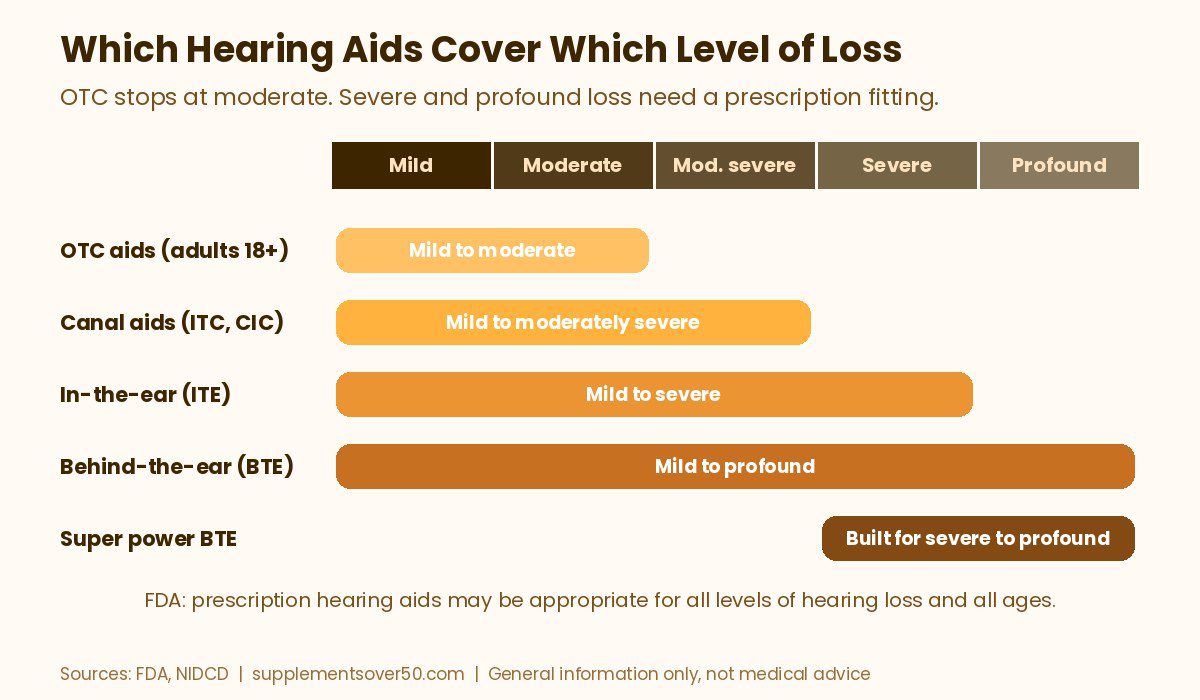
OTC hearing aids opened the door for people with milder loss, but they have a ceiling. The FDA’s guide to OTC hearing aids says they are limited in maximum output, so they may not give enough benefit for more severe hearing loss. A prescription hearing aid, by the FDA’s definition, is any hearing aid that is not OTC. It is only available through a licensed hearing health care professional who programs it to your hearing loss, and the FDA says these devices may be appropriate for all levels of hearing loss and all ages, depending on the indications for use.
Prescription vs OTC: Who Should Skip OTC Hearing Aids
The FDA sets clear boundaries for OTC hearing aids. They are for adults 18 and older with perceived mild to moderate hearing loss, and NOT for severe or profound loss. Prescription is the better route if any of these apply to you:
Your loss may be severe or profound. FDA-required OTC labeling says to see a hearing professional if you cannot hear speech even in a quiet room, or if you do not hear loud sounds well, such as loud music, power tools or engines.
You are under 18. The FDA says anyone younger than 18 must get hearing aids by prescription and should see a doctor, preferably an ENT, for specialized care. That matters if you are shopping for a grandchild.
You have a red flag condition. OTC labels must tell you to see a doctor first if you had a sudden hearing change in the past 6 months, have worse hearing or ringing in only one ear, get dizzy or have vertigo, have ear pain, drainage or a lot of earwax, or have an ear that is misshapen from birth or injury.
OTC aids did not help enough. The FDA labeling itself says that if an OTC hearing aid does not help you enough, ask a hearing healthcare professional for help.
You want ongoing in-person care. Prescription fittings usually include follow-up visits for adjustments, cleaning and repairs, which helps if you have poor eyesight, stiff fingers or little interest in apps.
Style matters for power too. The National Institute on Deafness and Other Communication Disorders (NIDCD) says behind-the-ear (BTE) hearing aids are used for mild to profound hearing loss, in-the-ear aids for mild to severe loss, and canal aids for mild to moderately severe loss. NIDCD adds that canal aids are usually not recommended for severe to profound loss because their small size limits power and volume. NIDCD also explains that hearing aids have practical limits: if the inner ear is too damaged, even a powerful aid may not help, which is when doctors discuss implants.
What to Look for in Prescription Hearing Aids
The right power level for your audiogram. Most families come in standard, power and super power versions. Ask which receiver or model fits your test results now and leaves headroom if your hearing gets worse.
Style you can handle. Receiver-in-canal (RIC) aids suit most people with mild to severe loss. BTE aids with custom earmolds suit severe to profound loss and are often easier to grip.
Rechargeable batteries. Tiny disposable batteries are hard to change with arthritis or poor eyesight. Most current premium families come in rechargeable versions, so ask for one.
Speech in noise. Restaurants and family gatherings are the toughest test. Each maker now uses AI or motion sensors to separate speech from noise, so ask for a trial in the places you struggle.
Streaming and Auracast. Bluetooth streaming for calls and TV is standard on premium models, and several now support Auracast broadcast audio for theaters, gyms and airports.
Telecoil. NIDCD explains that a telecoil connects to induction loop systems in many churches, theaters and airports. Ask if your model has one.
Service terms in writing. NIDCD suggests asking about the total cost, the trial period, warranty length, what servicing and repairs are included, and whether loaner aids are provided during repairs.
Top Picks for the Best Prescription Hearing Aids by Brand
These are each maker’s current flagships as shown on their U.S. websites when we checked. We list them by the use case each brand emphasizes, not by an invented score, because the best prescription hearing aids for you are the ones your audiologist can fit well to your hearing test. Ask about each brand’s lower technology levels too, since they often share the same hardware at a lower price.
1. Phonak Audéo EON Sphere (Best for Speech in Noisy Places)
Phonak’s newest premium line is Audéo EON. The top model, Audéo EON Sphere, is a receiver-in-canal hearing aid that Phonak lists for mild to profound hearing loss. It runs on Phonak’s HYPERSONIC AI chip with a feature Phonak calls Spheric Speech Clarity 3.0, which the brand says separates speech from background noise in real time. That makes it the one to ask about first if noisy restaurants are your biggest frustration.
Phonak describes EON Sphere as smaller and lighter, and says it runs up to 38 hours per charge, streams from virtually any Bluetooth device and supports Auracast broadcast audio. EasyGuard domes are designed to keep earwax out of the receiver. A sister model, Audéo EON R, has the same connectivity and battery claim without Spheric Speech Clarity, and pairs with a CROS device for people with hearing in only one ear.
2. Oticon Intent (Best for Support That Adapts as You Move)
Oticon Intent is built around what Oticon calls the world’s first user-intent sensors. Its 4D Sensor technology uses your movements, the environment and the conversation around you to change how much help you get, for example giving more access to one voice when you turn toward a single person in a busy café. Oticon says Intent supports hands-free calls from iPhone, iPad and Mac and streams from select Android devices and Windows computers.
Oticon’s hearing aid lineup now also lists Oticon Reveal, which Oticon describes as the first hearing aid with a Dual AI system, plus Zeal, a tiny in-ear aid, and Own SI custom aids. If your clinic carries Oticon, ask whether Intent or the newer Reveal is the better fit and what the price difference is.
3. Signia Pure Charge&Go MaX (Best for Group Conversations)
Signia’s newest platform is Multi-adaptive Xperience (MaX). Pure Charge&Go MaX uses what Signia calls RealTime Conversation Enhancement AI to track several speakers in the same conversation, which is useful for dinner tables and family get-togethers. Own Voice Processing is meant to keep your own voice sounding natural, a common complaint with new hearing aids.
Signia also lists AI-based Ambient Scene Adaptation and Dynamic Noise Control, which analyze the sound around you and soften noise without hiding the voices you want. Signia’s wider lineup includes tiny custom and instant-fit CIC models and its Motion Charge&Go IX BTE family for more severe loss (see the power section below).
4. Starkey Omega AI+ (Best for Health Tracking and App Features)
Starkey Omega AI+ stands out for what it does beyond hearing. Paired with the My Starkey app, Starkey says it can monitor exercise, social activity, sleep and respiratory rate, though feature availability varies by location. The app also lets you change programs, adjust volume, turn on Edge Mode for tough listening situations and connect to Auracast public broadcasts.
A newer feature reminds you if you leave your hearing aids behind, which is handy for anyone prone to misplacing them. Omega AI+ comes in several styles, including Starkey’s custom invisible-in-canal aids. Starkey sells only through hearing professionals and says on its own site that it does not endorse online sellers.
5. ReSound Vivia (Best for Very Small Size and Auracast Streaming)
ReSound Vivia is the one to ask about if you want a very discreet design with modern streaming. ReSound calls its rechargeable version the world’s smallest AI hearing aid. A deep neural network chip, trained on real-life sounds, is designed to tone down thousands of everyday noises like fans, traffic, cutlery and wind while bringing speech forward.
Vivia supports Bluetooth LE Audio and Auracast, and ReSound says its Smart 3D app has the first Auracast Assistant for hearing aids, letting you join a public broadcast with a tap. Tap-to-answer works for hands-free calls on iPhone, iPad and compatible Android phones. A non-rechargeable small style is also available.
6. Widex Allure (Best for Natural Sound for New Wearers)
Widex Allure is Widex’s latest platform, built on its W1 chip. Widex says its Allure PureSound program, using ZeroDelay technology, is tailored to new wearers and people with mild hearing loss, which makes Allure worth a look if you are wearing hearing aids for the first time and worry they will sound tinny or artificial.
Allure comes in RIC, BTE and in-the-ear styles. The app includes AI sound assistants, adjustable text size and a dark mode for easier reading, and you can control the hearing aids from an Apple Watch. Widex’s Charge n Clean charger dries and sanitizes the aids while charging, and Widex says a 30-minute fast charge gives about 4 hours of use.
Most Powerful Hearing Aids for Severe and Profound Hearing Loss
If you are looking for the most powerful hearing aid for profound hearing loss, you are looking at super power and ultra power models, almost always in a behind-the-ear style with a custom earmold. These are prescription-only by design, since OTC aids are capped at mild to moderate loss. Each of the big makers has one:
Phonak Naída Lumity. Phonak calls Naída Lumity its most powerful hearing device. It is a BTE family with models for different levels, including one for severe to profound hearing loss, and it adds Phonak’s SmartSpeech technology and Bluetooth streaming.
Oticon Xceed. Oticon describes Xceed as its most powerful hearing aid and as a new approach to super and ultra power hearing aids. Oticon says it is built to prevent feedback (whistling) and streams from iPhone, iPad and Mac, and from Android phones through its ConnectClip.
ReSound Enzo IA. ReSound says Enzo IA is the world’s smallest rechargeable super power hearing aid, made for severe to profound loss, with up to 28 hours per charge and support for Bluetooth LE Audio and Auracast.
Signia Motion Charge&Go SP IX. Signia’s Motion Charge&Go IX BTE family comes in M, P and SP models covering mild to profound loss. Signia says the SP model has the longest battery runtime of any rechargeable super power hearing aid, and the family includes a telecoil.
Widex Allure BTE. Widex says its Allure BTE brings the Allure platform to people with mild to profound hearing loss, with a larger battery and telecoil support for hearing loops.
If even a super power hearing aid no longer helps you follow speech, ask about cochlear implants. NIDCD explains that when the inner ear is badly damaged, hearing aids may not be enough, and the VA notes that it offers cochlear implants to veterans with severe to profound hearing loss. ReSound and Starkey both describe bimodal setups that pair a hearing aid in one ear with a cochlear implant in the other.
How to Choose the Best Prescription Hearing Aids for Seniors
If noisy restaurants are your main problem, ask about Phonak Audéo EON Sphere, Signia Pure Charge&Go MaX or Oticon Intent, and test them where you actually struggle.
If you have severe hearing loss, ask for a power or super power BTE with a custom earmold, such as Phonak Naída Lumity, Oticon Xceed, ReSound Enzo IA or Signia Motion SP IX.
If your hearing loss is profound, ask both about super power aids and whether a cochlear implant evaluation makes sense.
If you have arthritis or poor eyesight, choose a rechargeable model with a simple charger, and consider a slightly larger BTE or RIC over tiny in-canal styles.
If you want health and safety features, Starkey Omega AI+ adds activity tracking and a left-behind reminder in its app.
If you are a first-time wearer, Widex Allure’s PureSound program is aimed at you, and any brand should give you a trial period to adjust.
If you have hearing in only one ear, ask about CROS devices, which Phonak, Oticon and Jabra all list.
If your loss is mild to moderate and you are comfortable with apps, an OTC hearing aid may save you money (see below).
Independent audiologists and hearing aid clinics carry one or more of the major brands, do your hearing test, fit the aids and handle follow-up adjustments. Starkey’s cost page notes that professional services such as selection, fitting, adjustments and maintenance are often included in the price of the hearing aid. Ask for an itemized quote so you can compare clinics fairly.
Costco Hearing Aid Center
Costco is one of the best-known lower-cost routes. Its Hearing Aid Center page lists a free hearing test for members 18 and older, free service appointments for hearing aids bought there, and says its hearing aids are FSA and HSA eligible. At the time of writing, it showed four premium rechargeable models: Philips HearLink 9060, Jabra Enhance Pro 30, Rexton Reach and Sonite Rise, each listed as a pair with a charger, starting around $1,599.99 to $1,699.99 depending on the model. Costco says prices vary by state and custom earmolds are extra, so check current pricing at your warehouse. You also need a Costco membership.
Two notes on brands. First, Costco’s Kirkland Signature hearing aids were not among the models shown on that page when we checked, so ask your local center what it carries. Second, the Jabra name appears in two very different places. Jabra’s Enhance Pro 30 page says the Pro 30 is exclusively available at Costco, where it is fitted by hearing professionals, with up to 30 hours of battery life (up to 25 hours when streaming) and a CROS transmitter option for hearing in only one ear. That Pro line is prescription. The Jabra Enhance Select line, covered below, is OTC and sold online.
The VA, for eligible veterans
According to VA audiology services, hearing aids recommended by a VA audiologist are provided at no cost to eligible veterans, including repairs and batteries, as long as VA eligibility is maintained. The VA says it offers premium models through national contracts with the top five hearing aid makers, and audiology is one of the few VA services you can book without a referral once you are enrolled.
How Much Do Prescription Hearing Aids Cost?
NIDCD says hearing aids range from hundreds to several thousand dollars, with style and features driving the cost, and warns against using price alone to choose. Costco’s starting prices of around $1,600 to $1,700 a pair at the time of writing are a useful floor for premium prescription aids. Independent clinics often charge more, partly because they bundle years of follow-up care. Ask whether a quote is for one aid or a pair, and what visits, warranty and loss coverage it includes.
Payer
What it covers
Source
Original Medicare
Does not cover hearing aids or exams for fitting them. Diagnostic hearing evaluations may be covered when a physician orders them.
Medicare.gov, NIDCD
Medicare Advantage (Part C)
Some plans offer hearing benefits that Original Medicare does not. Contact the plan for details.
Medicare.gov
VA health care
Hearing aids, repairs and batteries at no cost for eligible veterans when recommended by a VA audiologist.
VA audiology
Medicaid
Coverage for adults varies by state. Medicaid covers hearing aids for eligible children and young adults 21 and under.
NIDCD, Starkey
Private insurance
Some plans cover tests and part or all of a hearing aid; many do not. Call member services.
Starkey, NIDCD
FSA and HSA
Pre-tax health accounts can generally be used for hearing aids.
Starkey, Costco
The Medicare.gov hearing aids page is blunt: Medicare does not cover hearing aids or exams for fitting hearing aids, and you pay all costs for non-covered services. If you are choosing a Medicare Advantage plan, compare the hearing benefit closely, since allowances, networks and brand choices differ. Starkey’s cost and financing page also points to state vocational rehabilitation programs (if you need hearing aids for work), service clubs such as the Lions Club, and manufacturer foundations for people with limited income.
If Your Loss Is Mild to Moderate: OTC Options
If a hearing test shows mild to moderate loss and none of the red flags above apply, an FDA-cleared OTC hearing aid can be a sensible, cheaper first step. Two well-supported options on Amazon, plus a direct option with audiologist help:
Jabra Enhance Select M3 (Best OTC Pick)
Jabra Enhance Select M3 Aureon is the most advanced model in Jabra Enhance’s OTC line and is sold by Amazon. The listing says it is Jabra’s smallest receiver-in-ear hearing aid yet, weighing 2.12 grams, with automatic noise and speech adjustment, an in-app FDA-cleared self-fitting test, and the option to send in your audiogram for more precise programming by a licensed professional. It supports Bluetooth streaming, LE Audio and Auracast, hands-free calls with a double tap, and the listing claims over 24 hours of listening per charge.
It costs about $1,995 a pair on Amazon at the time of writing, so check current pricing. It is rated 4.7 out of 5, but from only 22 reviews so far. Remember that this is the OTC Select line, not the prescription Enhance Pro sold at Costco.
🏆 Best OTC Pick
Jabra Enhance Select M3 Aureon
Smallest Jabra receiver-in-ear OTC hearing aid; self-fitting test or audiogram programming; LE Audio and Auracast; over 24 hours per charge.
Sennheiser All-Day Clear (Classic RIC With Bluetooth)
Sennheiser All-Day Clear is a self-fitting receiver-in-canal OTC hearing aid sold by Sennheiser’s own Amazon store. The listing says you set it up in a few minutes in the app, it adjusts automatically to your surroundings, connects to iOS and Android phones over Bluetooth for hands-free calls, and lasts up to 24 hours per charge depending on use. It comes with a 30-day risk-free trial.
It sells for about $900 a pair at the time of writing (check current pricing) and holds a 3.7 out of 5 rating from about 138 reviews, so read recent reviews and use the trial window.
🎧 Classic RIC With Bluetooth
Sennheiser All-Day Clear
Self-fitting RIC OTC hearing aids; app setup in minutes; Bluetooth hands-free calls; up to 24 hours per charge; 30-day trial.
Jabra Enhance Select Direct (Best if You Want Audiologist Help)
Buying Jabra Enhance Select direct from Jabra Enhance bridges the gap between OTC and a clinic. Jabra Enhance says its direct packages include 3 years of professional adjustments from its licensed audiology team through the app, a 100-day risk-free trial with a full refund, free shipping and returns, and 3 years of warranty plus loss and damage protection. Financing is offered. It is still an OTC product for mild to moderate loss.
Best if you want remote audiology care
Jabra Enhance Select M3 (on Amazon or direct)
Self-fitting receiver-in-canal hearing aids with licensed audiology support. The Amazon listing for the Select M3 Aureon includes a 3-year warranty and 3 years of loss and damage protection. Buying direct from Jabra Enhance adds its 100-day trial.
One brand to avoid for now: a notice on eargo.com says its parent company, LXE Hearing, which also made Lexie, is winding down its U.S. operations, with changes to app support and warranty coverage.
When to See an Audiologist or Doctor
See a doctor, preferably an ear, nose and throat (ENT) specialist, before buying any hearing aid if you have any of the FDA’s red flag symptoms:
Sudden hearing change in the past 6 months, or hearing that gets worse and then better again.
Worse hearing in one ear, or ringing or buzzing in only one ear.
Dizziness, spinning or swaying (vertigo).
Ear pain or discomfort, or blood, pus or fluid from the ear in the past 6 months.
A lot of earwax, or a feeling that something is in your ear.
An ear that is misshapen from birth or injury.
A sudden change in hearing is a reason to see a doctor promptly, not to wait for a hearing aid appointment. And even without red flags, a full hearing test from an audiologist tells you whether your loss is mild, moderate, severe or profound, which decides whether OTC is even an option. You can request your test records and shop elsewhere, as the FDA notes.
Frequently Asked Questions
What is the best prescription hearing aid brand?
No brand is best for everyone. Phonak, Oticon, Signia, Starkey, ReSound and Widex all make premium prescription aids. Choose by need, such as speech in noise, power for severe loss or app features, and by which brands your audiologist fits and services well.
What is the most powerful hearing aid for profound hearing loss?
Each maker has a super power behind-the-ear model: Phonak Naida Lumity, Oticon Xceed, ReSound Enzo IA, Signia Motion Charge&Go SP IX and Widex Allure BTE. If even these do not help you follow speech, ask about a cochlear implant evaluation.
How much do prescription hearing aids cost?
NIDCD says hearing aids range from hundreds to several thousand dollars. At the time of writing, Costco listed premium prescription pairs starting around $1,600 to $1,700, while independent clinics often charge more and bundle follow-up care. Always ask for an itemized quote.
Does Medicare pay for prescription hearing aids?
Original Medicare does not cover hearing aids or fitting exams, according to Medicare.gov. Some Medicare Advantage plans offer hearing benefits, so check your plan. Eligible veterans can get hearing aids at no cost through the VA.
Can I use OTC hearing aids instead of prescription ones?
Only if you are 18 or older with perceived mild to moderate hearing loss and no red flags such as sudden or one-sided loss, dizziness or ear drainage. The FDA says OTC aids are not for severe or profound loss.
Is the Jabra Enhance Pro 30 at Costco a prescription hearing aid?
Yes. Jabra says the Enhance Pro 30 is sold only at Costco, where hearing professionals fit it. The Jabra Enhance Select M1, M2 and M3 are a separate OTC line sold online and on Amazon.
Our Take
The best prescription hearing aids are the ones fitted properly to your hearing test, so start with the audiologist and use the brand list as a shortlist. For speech in noise, ask about Phonak Audéo EON Sphere, Signia Pure Charge&Go MaX or Oticon Intent. Starkey Omega AI+ suits people who want health tracking, ReSound Vivia suits people who want something small with modern streaming, and Widex Allure is a gentle start for new wearers. For severe or profound loss, go straight to a super power model like Phonak Naída Lumity, Oticon Xceed or ReSound Enzo IA. Costco and the VA are the two biggest ways to bring the cost down. If your loss turns out to be mild to moderate, an OTC aid such as Jabra Enhance Select M3 is a reasonable, cheaper place to start.
This article is for general information only and is not medical advice. Hearing aid models, prices and coverage change often, so confirm details with your hearing care professional, insurer or the seller before you buy, and see a doctor promptly about sudden, one-sided or painful hearing changes.
Looking for a smart watch for seniors with fall detection? We compare Apple, Samsung, Pixel and monitored medical alert watches: who they call, cost and battery.
The best free life alert systems for seniors: who qualifies through Medicare Advantage, Medicaid, PACE or the VA, what free offers really cost, and no-fee picks.
The AARP hearing aid discount explained: the UnitedHealthcare Hearing and Soundly programs, prices, the free hearing test, the catch, and cheaper OTC options.
The best medical alert necklace for seniors: waterproof monitored pendants with fall detection, an engraved ID option, real costs and how to get one free.