Best Turmeric Supplement for Seniors
This guide contains affiliate links. If you buy through them, we may earn a small commission at no extra cost to you.
The best turmeric supplement for seniors is one your body can actually absorb, at a dose that fits your medications. Turmeric is one of the most popular supplements among seniors, and for good reason — the research on curcumin’s anti-inflammatory effects is substantial. But here is what most articles fail to mention up front: the standard curcumin in most cheap turmeric supplements barely makes it into your bloodstream. The bioavailability problem is the defining issue with turmeric, and understanding it is the difference between spending money on something that works and buying an expensive placebo. This guide covers enhanced delivery forms, what the evidence actually shows for joint health, safe dosing for seniors, and five products that solve the absorption problem.
Top Picks for the Best Turmeric Supplement for Seniors
Quick Comparison
| Product | Best for | Key fact |
|---|---|---|
| Thorne Meriva SF Curcumin Phytosome | Best overall | Meriva phytosome, NSF Certified |
| Sports Research Turmeric Curcumin C3 with BioPerine | Best value | 500mg C3 complex + 5mg BioPerine, third-party tested |
| Qunol Ultra Turmeric 1000mg | Best water-soluble | Water and fat soluble, no black pepper needed |
| Life Extension Super Bio-Curcumin 400mg | Best long-studied formula | BCM-95 curcumin with turmeric essential oils |
| NOW Foods Curcumin Phytosome 500mg | Best budget | Meriva phytosome 500mg, GMP certified |
The Bioavailability Problem With Standard Turmeric
Popular Supplement Guides:


Curcumin is poorly absorbed through the intestinal wall. It is also rapidly metabolized and eliminated, which means that even what does get absorbed does not stay around long. Studies on standard curcumin extract find very low plasma concentrations after typical doses — often too low to produce a therapeutic effect. Eating turmeric as a spice provides even less, since cooking spice is only 2-5% curcumin to begin with.
This is why the form of curcumin matters enormously. Several technologies have been developed to improve absorption: Meriva phytosome (binds curcumin to phospholipids for dramatically better uptake), BioPerine (piperine from black pepper that slows metabolism of curcumin), BCM-95 (curcumin combined with turmeric essential oils that improve absorption), and water-soluble formulations that make curcumin dispersible rather than relying on fat for absorption. A good curcumin supplement specifies which of these technologies it uses. If it does not, it is probably standard extract with minimal effect.
1. Thorne Meriva SF Curcumin Phytosome: Best Overall
Meriva is the gold standard of curcumin absorption technology. The phytosome complex bonds curcumin to phosphatidylcholine (a natural phospholipid) which dramatically improves both intestinal uptake and lymphatic transport. Published research shows Meriva delivers 29 times more curcumin to the bloodstream than standard curcumin extract. That is not a marketing number — it comes from peer-reviewed pharmacokinetic studies.
Thorne’s version is NSF Certified and soy-free (“SF” in the name), which matters for seniors avoiding soy. With 6,000 reviews at 4.7 stars, the user feedback aligns with the clinical data. This is the product with the most direct evidence base behind it, and the one most likely to produce the joint and inflammation results you are looking for. The price is higher, but you are getting a meaningfully different product than a standard curcumin capsule.
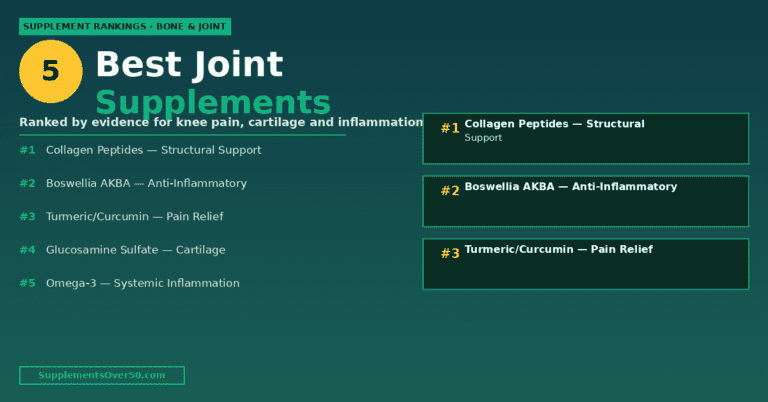
For a summary of the research and safety notes, see the NCCIH page on Turmeric. If knee pain is your main reason for considering turmeric, read Turmeric vs Boswellia for Knee Pain After 50 and 5 Best Joint Supplements for Seniors.
What Turmeric Actually Does for Seniors
The primary mechanism is NF-kB pathway inhibition — curcumin blocks a key signaling molecule involved in turning on inflammatory genes. Chronic low-grade inflammation drives a lot of the conditions that worsen with age, including osteoarthritis, metabolic dysfunction, and even cardiovascular disease. By reducing inflammatory signaling, curcumin can lower markers like CRP and IL-6 and improve symptoms in conditions driven by that chronic inflammation.
For joint health specifically, multiple trials comparing curcumin to NSAIDs like ibuprofen for osteoarthritis symptoms show curcumin performing comparably in self-reported pain and function scores, with fewer gastrointestinal side effects. That tradeoff matters for seniors who often cannot tolerate long-term NSAID use due to stomach lining concerns or cardiovascular risk. Curcumin is not a replacement for acute pain management, but as a daily anti-inflammatory supplement it has real evidence behind it.
2. Sports Research Turmeric Curcumin C3 with BioPerine: Best Value
Sports Research uses Curcumin C3 Complex, a branded extract standardized to contain 95% curcuminoids, combined with 5mg of BioPerine (standardized black pepper extract). BioPerine inhibits the intestinal enzymes that break down curcumin before it can be absorbed, increasing bioavailability up to 20-fold compared to curcumin alone. This is a well-established combination with substantial research behind it.
With 38,000 reviews at 4.7 stars, this is one of the most validated turmeric supplements in the market. Sports Research third-party tests each batch for purity and potency. For seniors who are not on medications that piperine could interact with (particularly anticoagulants or certain immunosuppressants), this is an outstanding value — the per-dose cost is significantly lower than phytosome options while still delivering meaningfully better absorption than standard extracts.
3. Qunol Ultra Turmeric 1000mg: Best Water-Soluble
Qunol takes a different approach: they use micronization and surfactant technology to make curcumin both water and fat soluble. Most curcumin formulas require fat to absorb, which means you need to take them with a meal. Qunol’s format absorbs whether you have eaten or not, and their internal testing shows substantially better absorption than standard curcumin. The 1,000mg dose per serving is higher than many competitors.
Over 22,000 reviews at 4.6 stars reflects broad consumer trust. Qunol is probably best known for their CoQ10 products where they pioneered a similar water-soluble delivery technology, so this approach is not new for them. For seniors who take supplements inconsistently (sometimes with food, sometimes not), the flexibility of not needing a fatty meal to absorb the curcumin has practical value.
Dosage Guidance for Seniors Using Turmeric
Clinical trials typically use 500mg to 1,000mg of curcumin extract per day, divided across two doses. With enhanced bioavailability forms like Meriva, effective doses can be lower — studies often use 500mg of the phytosome complex and get better results than 1,000mg of standard extract. Follow the specific product’s dosing guidance since the relevant dose depends on the delivery technology used.
Take turmeric supplements with a meal that contains some fat, unless you are using a water-soluble form. This is because curcumin is inherently fat-soluble and benefits from dietary fat even when the formula includes absorption enhancers. Start at the lower end of the dosing range and give it four to six weeks before evaluating results — turmeric works on chronic inflammation, and the effects build gradually rather than occurring acutely.
4. Life Extension Super Bio-Curcumin 400mg: Best Long-Studied Formula
Life Extension uses BCM-95 in their Super Bio-Curcumin, a patented form that combines curcumin with turmeric essential oils. The essential oils contain ar-turmerone, which research suggests enhances curcumin absorption by improving its interaction with the intestinal mucosa. BCM-95 studies demonstrate 7x better bioavailability than standard curcumin, and it achieves this without needing black pepper extract, which can interact with medications.
Life Extension has been publishing research and formulating supplements based on it since 1980, and their Super Bio-Curcumin has one of the longer track records among enhanced curcumin products. With 7,000 reviews at 4.7 stars and a lower price point than Thorne’s Meriva option, it is a strong alternative for seniors who want an enhanced bioavailability form without the premium price tag and who prefer to avoid piperine.
5. NOW Foods Curcumin Phytosome 500mg: Best Budget
NOW Foods licenses the Meriva phytosome technology from Indena, the same company that developed it, and delivers it at a significantly lower price than branded products using the same ingredient. You get the same 29x absorption advantage at a fraction of the cost. NOW Foods is GMP certified and does extensive in-house testing, which makes them a credible source for ingredients they do not manufacture themselves.
For seniors on a fixed budget who still want the best available curcumin delivery technology, NOW Foods Curcumin Phytosome is the most straightforward recommendation. The 8,000+ reviews at 4.6 stars back up the product quality. The 500mg per capsule matches the dosing used in the clinical Meriva studies, so you are working with research-calibrated amounts.
How to Choose the Best Turmeric Supplement for Seniors
If you want the highest clinical evidence and can afford the premium, Thorne Meriva SF is the top pick. For the best value among high-absorption options, NOW Foods Curcumin Phytosome delivers the same Meriva technology at a lower price. If piperine interaction with your medications is not a concern, Sports Research with BioPerine is excellent and extremely well-reviewed. If you need a medication-interaction-free enhanced form at a mid-range price, Life Extension’s BCM-95 formula is the right choice. Qunol suits anyone who wants flexibility on whether to take it with food.
Frequently Asked Questions
Does turmeric actually reduce joint pain in seniors?
The research is genuinely promising. Multiple randomized controlled trials show curcumin reduces markers of inflammation and improves self-reported joint pain scores in people with osteoarthritis. The key is using a bioavailable form — standard curcumin powder absorbs poorly, but enhanced forms like Meriva, BCM-95, and curcumin with BioPerine show meaningful effects in clinical settings.
How much turmeric should seniors take per day?
Standard curcumin extract doses in studies range from 500mg to 1,000mg per day, often split across two servings. With enhanced bioavailability forms, effective doses can be lower — Meriva studies often use 500mg of the phytosome complex rather than 1,000mg of standard extract. Follow the dosing on the specific product you are using.
Can seniors take turmeric with blood thinners?
This is a real concern. Curcumin has mild anticoagulant properties and may potentiate the effect of blood thinners like warfarin. Anyone taking anticoagulant medications should speak with their doctor before starting a curcumin supplement. The interaction risk is generally considered low at typical supplement doses, but it is worth flagging to whoever manages your medications.
What is the difference between turmeric and curcumin?
Turmeric is the spice — a root that contains various compounds including curcuminoids. Curcumin is the primary active curcuminoid. A supplement labeled turmeric extract standardized to 95% curcuminoids is very different from one labeled simply turmeric root powder, which may be close to the 2-5% concentration in the whole spice.
Is black pepper necessary with turmeric supplements?
It depends on the form. Piperine increases curcumin absorption dramatically by inhibiting its metabolism, but it also affects the metabolism of several medications. Enhanced delivery forms like Meriva phytosome and BCM-95 achieve excellent absorption without piperine, making them preferable for seniors on multiple medications.
Turmeric is worth taking, but only in a form that actually absorbs. The five products on this list each solve the bioavailability problem through different mechanisms — choose based on your budget, medication situation, and whether you prefer a certified practitioner brand or a more affordable option with the same core technology.
Related Articles
- Best Magnesium Supplement for Women Over 60
- Best Vitamin D3 + K2 for Women Over 60: Bone Health, Heart Protection & Top USA Picks
- Best Collagen for Women Over 60: Types, Evidence & Top Picks (2026)
- Signs of Magnesium Deficiency After 60 — 10 Symptoms Most Adults Overlook
- How Much Magnesium Should Seniors Take Daily? — Dosing by Form, Goal and Health Condition